
Plan Sunglasses Colorways That Sell
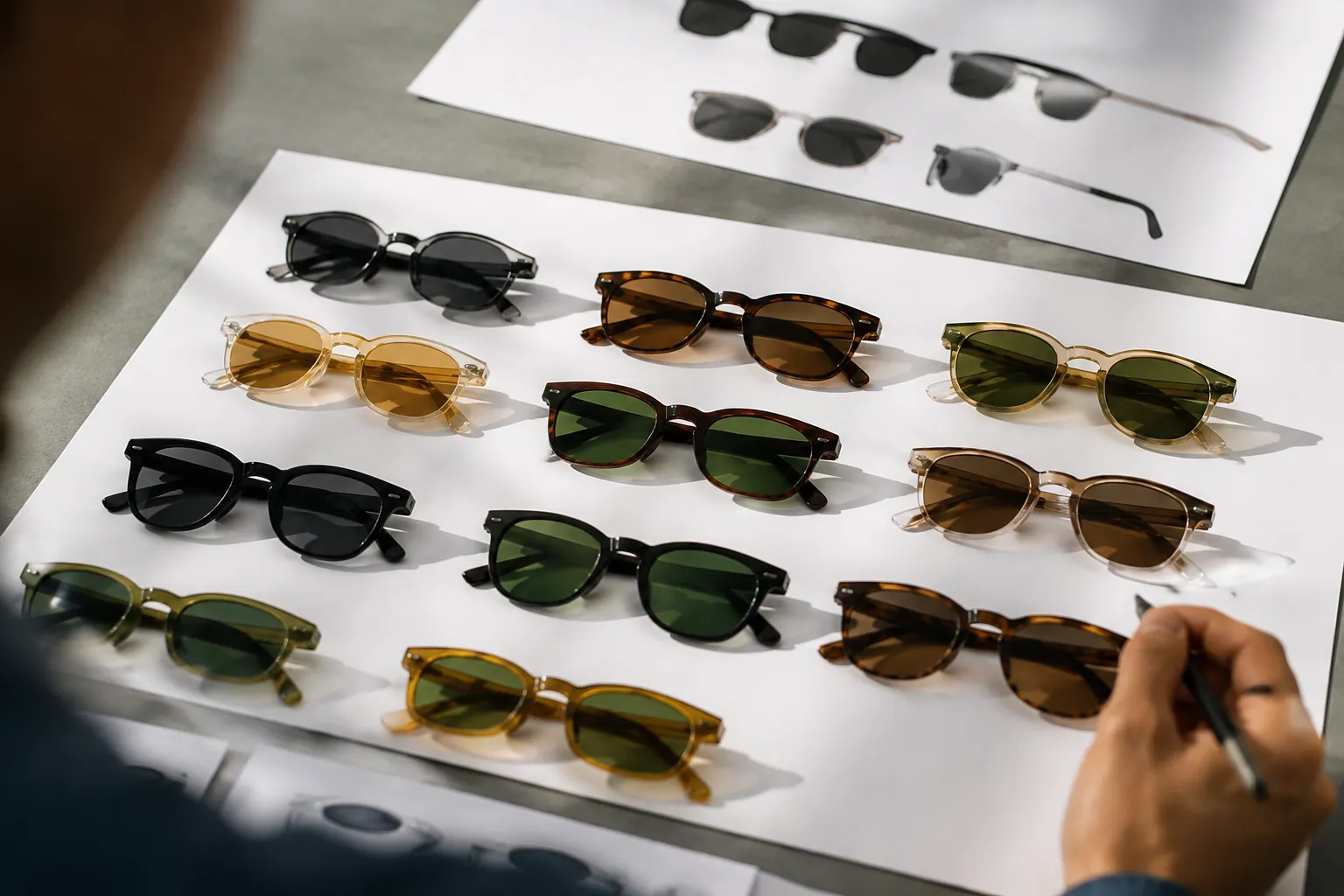
For brand owners, importers, distributors, and retailers, colorway planning is not a design exercise. It is an inventory and margin decision. Too many shades can split stock into slow movers. Too few can miss local demand, channel expectations, or price-tier needs. The right assortment comes from sales data, MOQ economics, material behavior, and factory capability—not a mood board. This guide shows how to build a sunglasses colorway program that fits channel, region, and margin while still being practical to reorder.
Start With the Sales Channel
Different channels reward different color behavior, so start with how the product will be sold. A fashion boutique can usually support more novelty because the buyer expects rotation and visual impact. A supermarket, pharmacy chain, or marketplace listing usually needs conservative, repeatable colors that are easy to reorder and easy to explain. If you start with aesthetics, you can approve samples that look strong in a photo and move slowly in bulk.
Use the channel as the first filter. Not the mood board.
A workable B2B starting mix is to assign colors by channel rather than treating the range as one pool. In practice:
- Mass retail: black, tortoise, smoke, brown, and one controlled seasonal accent.
- E-commerce: proven bestsellers first, then a few variants that support ads and hero imagery.
- Specialty optical or sport: functional lens tints, high-clarity finishes, and familiar frame colors with obvious use cases.
- Promotional programs: one or two low-risk colors that decorate cleanly, pack simply, and reorder without special handling.
Channel strategy also sets your risk level. A retail chain may tolerate a small pastel run if the planogram supports it, while a corporate gifting program will usually reject anything that feels too fashion-led. For multi-channel buyers, keep a base assortment that is shared across channels, then layer a channel-specific set on top. That keeps one weak color from dragging down the whole order book.
One blunt rule: if a color needs a long sales explanation, a special photo story, or a seasonal discount to justify itself, it should not be a core SKU. Core colors should sell and repeat.
Build the Core Before Seasonal Colors
The easiest way to control SKU creep is to separate evergreen colorways from seasonal or experimental ones. Evergreen colors should carry most of the volume and most of the reorder logic. Seasonal colors should create freshness, collect market feedback, and be easy to cut if they do not repeat. A common mistake is to reverse that order: buyers overcommit to newness and underbuy the dependable shades that actually keep the line moving.
For a new sunglasses program, a sensible starting ratio is often 60% evergreen, 30% channel-specific, and 10% seasonal tests. That ratio is not fixed, but it creates discipline. If the launch is uncertain, lean harder toward core shades. A first season should prove repeatability before it proves creativity. You want reorder data more than applause.
Evergreen frame colors usually include black, transparent crystal, tortoise, dark brown, and matte gunmetal. For lenses, smoke gray, brown, green, and gradient smoke are common workhorse tints because they are readable in-market and easier to repeat batch to batch. Seasonal colors work best as accents—temple tips, inner lamination, a limited mirror tint, or a special acetate treatment—rather than as the entire program.
Set a volume threshold and stick to it. If a color cannot reasonably hit the factory's MOQ without wrecking pricing, it should not be a major SKU. Splitting demand into too many small colors weakens economics because each color adds setup time, material handling, and QC attention. Fewer colorways at healthier quantities are usually better than many colors at weak volumes.
Rule of thumb: if a colorway cannot survive a reorder without a clear commercial reason, it should not be a major SKU.
Use Region to Filter Color Risk
Color preference is regional, but not in a neat, universal way. Use your own sell-through data, distributor feedback, and local market requests rather than assuming one palette works everywhere. The goal is not to stereotype a region. It is to reduce avoidable risk before tooling, artwork, and packaging are committed.
Regional differences usually track climate, fashion tempo, channel mix, and functional expectation. Some markets want darker coverage and less ornament. Others tolerate more visual novelty but still reject weak finish quality. In every case, the safer move is to narrow the palette before sample approval.
| Region / channel pattern | Usually safer choices | Riskier choices | Buying note |
|---|---|---|---|
| North America mass retail | Black, tortoise, smoke, brown | Very pale pastels, unusual lens mirrors | Keep most volume in low-return colors and reserve novelty for small tests |
| Europe fashion and optical | Crystal, matte neutrals, olive, gradient lenses | Overly shiny novelty finishes | Style matters, but finish quality and material credibility matter more |
| Middle East premium retail | Dark frames, stronger coverage, gold or gunmetal details | Weak tint density, toy-like colors | Favor a heavier, more substantial look with confident lens darkness |
| Australia and outdoor-led channels | Functional tints, smoke, brown, wrap styles | Fashion-only tints without use value | Performance, lens protection, and compliance should be checked early |
Use the table as a screen, not a rulebook. A pastel capsule may work in a fashion-heavy district, and an outdoor market may still accept a bright accent if the frame shape is practical. The point is to remove obvious misfits before you spend time and money on samples that were unlikely to succeed.
When you work through distributors, ask for evidence rather than adjectives. Request actual sales ranks, repeat-order history, and return reasons by color if available. "Blue sells" is not useful. "Opaque blue sold in coastal stores but underperformed in inland pharmacy doors" is.
Match Colorway to Price Tier
Price tier determines how much complexity your color program can carry. A low-entry promotion line cannot absorb the same decorative burden as a premium acetate range. Every extra process step—special mixing, additional coatings, multi-pass printing, or tighter cosmetic inspection—adds cost through labor, yield loss, and lead time. The lower the target price, the tighter the color list needs to be.
At the factory level, color cost is not just raw pigment or acetate sheet. It includes setup time, changeover waste, QC hold time, and the risk that a small batch misses tolerance and has to be remade. If your order is only a small run per color, the factory may spend almost as much time preparing the run as producing it. That is why color strategy should be tied directly to MOQ and price breakpoints.
| Tier | Color strategy | Factory impact | Buyer risk |
|---|---|---|---|
| Entry / promo | 2-3 core colors only | Lower setup time, simpler QC, fewer material swaps | Low differentiation, but better cost control and cleaner replenishment |
| Mid-market | Core colors plus 1-2 seasonal accents | More changeovers, manageable complexity, moderate packing variation | Moderate SKU fragmentation and forecast drift |
| Premium | Transparent acetate, multilayer effects, metal details, refined lens tints | Higher process control, stricter cosmetic inspection, more finish rejects if specs drift | Higher reject cost and greater risk if approvals are vague |
For a price ladder with clear breakpoints, fewer colorways at larger runs often work better than many colors at weak volumes. That protects unit economics and usually improves consistency because the factory can stabilize production. In practice, three strong colorways can beat eight weak ones if the eight never reach an economical batch size.
Premium programs can justify more finish work, but only if the margin supports it. Transparent crystal, two-tone lamination, soft-touch coatings, or metal-accented temples can all work. They also raise the cost of a bad approval. Keep that in mind.
Pick Materials That Hold Color
Colorway is not only a visual decision; it is a material decision. The same reference can look different depending on whether the frame is injection-molded, acetate-cut, or metal-finished. Material choice affects depth, gloss, edge definition, color repeatability, and how obvious small defects become after assembly.
Injection-molded frames are usually the safest option for solid, repeatable colors. Once the resin formula is locked, they can deliver better batch-to-batch uniformity and tighter control on opaque tones. Acetate gives richer visual depth and is better for translucent, layered, or marbled effects, but it also reveals variation more clearly because the material itself has natural movement. Metal frames support slimmer, more premium-looking palettes, yet they demand tighter finish control on plating, coating adhesion, and scratch resistance.
Check color against actual production capability, not just a render. A translucent crystal acetate may look perfect in a mood image, but if the sheet batch varies in clarity, the final shade can drift more than the buyer expects. A solid black injection frame is usually the safer choice for broad-volume replenishment.
Material behavior also affects tolerance. For opaque black injection frames, buyers often want a tight visual match because small shifts are easy to see. For tortoise or marbled acetate, the acceptable variation window is usually wider because the pattern is naturally less uniform. Define the standard before bulk, not after a mismatch shows up in the warehouse.
Lens tinting needs its own logic. Smoke gray and brown remain workhorse tints because they read cleanly in the market and are easier to repeat. Gradient lenses can help fashion sell-through, but they add a subjective layer in QC because the fade point, density, and symmetry all matter. Mirror coatings should be selected carefully because consistency depends on both the base tint and the coating spec; if either is loose, the final finish can shift from premium to cheap quickly.
Use Decoration as an Accent
Decoration should support the colorway, not rescue it. Laser engraving, pad printing, hot stamping, and metal logo plates are all useful tools, but if a frame only sells when it is heavily branded, the base color is probably doing too little work. Strong assortments start with a color that already makes sense on shelf or online, then add decoration that reinforces the product story.
The right decoration method depends on both channel and durability. A retail or optical line can justify a cleaner metal badge or subtle laser mark. A promotional program may need pad print because it is economical and fast, even if it is less premium-looking. Laser engraving works well on selected plastics and metal parts, but it requires proper placement, depth, and surface consistency so the mark remains visible after handling, packing, and repeated cleaning.
Approve decoration against the actual base color, not a white sample card. Contrast changes everything. A black logo can disappear on dark tortoise but pop on crystal acetate. A silver plate may look elegant on matte gunmetal but look over-bright on a glossy frame. Decoration cannot be decided in isolation.
Keep the process sequence tight:
- Choose the frame base color first.
- Confirm whether the logo should contrast or blend in.
- Check whether the method survives handling, packing, and repeated cleaning.
- Approve a pre-production sample before scaling to bulk.
Do not stack too many decoration methods on one SKU. Every extra process point increases the chance of mismatch, especially when multiple vendors touch the product. On a tight-margin order, that can turn a good design into a late shipment or a rejected lot.
Plan the SKU Matrix Before Samples
Sample orders are where many buyers waste time. They ask for too many colors, then discover that half the palette cannot justify production volume. A better method is to build a matrix before sampling, so the team knows which combinations are worth testing and which are speculative.
The matrix should define the commercial purpose of each SKU before the sample exists. That prevents "nice to have" colors from consuming sample budget, artwork cycles, and sales attention. It also helps the factory estimate whether the program can be made efficiently at the target quantity.
- Column 1: channel, such as retail, promo, optical, or outdoor.
- Column 2: frame color, limited to core shades and one test color.
- Column 3: lens tint or mirror option.
- Column 4: target MOQ and reorder expectation.
- Column 5: decoration method and packaging level.
Use sample time to test commercial logic, not just visual approval. Typical custom programs often move from sample approval to bulk on a schedule that depends on complexity, factory queue, and packaging requirements, so buyers should plan backward from the selling date rather than forward from the first sketch. If you cannot clearly defend a color's role in the assortment, it is probably extra.
A useful sample review checklist includes frame color consistency, lens tint repeatability, logo position, finish quality, hinge fit, packaging accuracy, and whether the product still looks intentional under store lighting. Review samples in the same environment where they will be sold if possible. A color that looks rich under studio lights may read flat in a retail box or too reflective under daylight.
Tie Colorway to Compliance and QC
Color choices never override compliance. They sit inside it. A sunglasses line still has to pass the relevant market requirements, and the colorway should be reviewed against those requirements from day one. If the product is destined for Europe, the US, Australia, or multiple export markets, evaluate the assortment with the destination standard in mind rather than treating it as a purely aesthetic program.
Relevant compliance references for sunglasses programs may include CE EN ISO 12312-1, ANSI Z80.3, AS/NZS 1067, REACH, and, where applicable, FDA registration. Quality systems may also involve ISO 9001 and BSCI. The exact set depends on the destination market and the product configuration, so confirm what applies before production, not after the order is placed.
QC should also look beyond color match. The inspection plan should verify tint consistency, coating uniformity, logo placement, surface defects, hinge alignment, and carton-level packing accuracy. A frame can be the right shade and still fail if the lens density drifts across the lot or if the finish shows streaking, bubbles, or dust inclusion. Ask for a written color tolerance standard before bulk production starts. For opaque frame colors, that means agreeing on the master reference, the allowed visual deviation, and the lighting condition used for the check.
Lead time should be planned backward from the selling date. If samples and bulk production both need approval cycles, seasonal programs should include buffer for rework, packing correction, and freight variability. That matters most when the colorway includes special finishes or multiple decoration steps, because those are the first places where small delays become large ones.
Colorway mistakes are usually cheaper to catch at sample stage and more expensive to fix after packing. The safest buying habit is simple: approve fewer variables, set tighter references, and leave more time for correction than you think you need.
Have a custom sunglasses project in mind?
Send us your styles, target market and quantities and we will return a detailed quote with MOQ, lead time and a sample plan.
Get a QuoteWhy source this from Wenzhou with LumiShades
Wenzhou in Zhejiang Province is widely regarded as China’s eyewear manufacturing capital, producing a large share of the world’s sunglasses. That concentration matters to buyers: a deep local supply chain for acetate sheet, hinges, lens blanks, plating and packaging means shorter component lead times, easier color and material matching, and a workforce with decades of eyewear-specific skill. LumiShades has manufactured in this ecosystem since 2009, and our vertical integration — in-house injection molding, acetate cutting, CNC milling, lens tinting, decoration and quality control — means no part of your order is quietly subcontracted to a workshop you cannot audit.
For international buyers, that vertical control translates into accountability. When a single factory owns every step, defects are traced and fixed at source rather than bounced between vendors, and your specifications survive intact from first sample to bulk. For procurement review, buyers can request process records, approved samples, quality checkpoints and project-specific compliance files before placing a bulk order. Required testing and documentation are confirmed against the destination market and product specification rather than assumed from a generic certificate list. Explore our manufacturing capabilities and quality control process to see how this works in practice.
Frequently asked questions
How many colorways should I launch in one sunglasses model? For most B2B programs, start with 3-5 colorways. A practical mix is 2-3 evergreen colors, plus 1-2 test or seasonal options. If your MOQ is low or your price breaks only improve at higher quantities, fewer colorways usually give better economics and make replenishment easier to manage. Use the first season to prove which colors deserve repeat orders.
What colors are safest for a first-time order? Black, tortoise, smoke gray, brown, and clear crystal are the safest starting points. They are usually easier to sell across channels, easier to reorder, and less likely to trap stock if demand is uneven. If you want to test novelty, keep it to one small seasonal color rather than making it a core part of the launch.
Should I use seasonal colors in every market? No. Seasonal colors should be chosen by channel and region, not used everywhere by default. Use them where the buyer expects novelty and where the order size can absorb a test run. If a market is price-sensitive or reorder-driven, keep seasonal colors small until you have actual sell-through and repeat-order data.
How does MOQ affect colorway planning? MOQ should drive the palette. If the MOQ is small, too many colors can make the program inefficient because each color adds setup, handling, and QC effort. If the price improves at larger quantities, concentrate volume into fewer colorways whenever possible so the factory can work at a more efficient batch size and you can reorder the winners.
What should I check in a pre-production sample? Check frame color consistency, lens tint, logo placement, finish quality, hinge fit, and packaging accuracy. Confirm the sample against the approved master reference under the same lighting condition you will use for final approval. If the color, tint, or finish drifts from the approved standard, stop before bulk and request a corrected sample.
Which certifications matter for export sunglasses? Use the requirements that apply to the destination market and product type. Common references include CE EN ISO 12312-1 for Europe, ANSI Z80.3 for the US, AS/NZS 1067 for Australia, and REACH where applicable. FDA registration, ISO 9001, and BSCI may also be relevant depending on the program, but none of these should be assumed to cover every market automatically. Confirm the compliance set before production starts.
Ready to start?
Explore our round sunglasses or request a quote — our sales team replies within 12 hours.
Request a Quote