
Wholesale Sunglasses Assortment Plan for New Markets
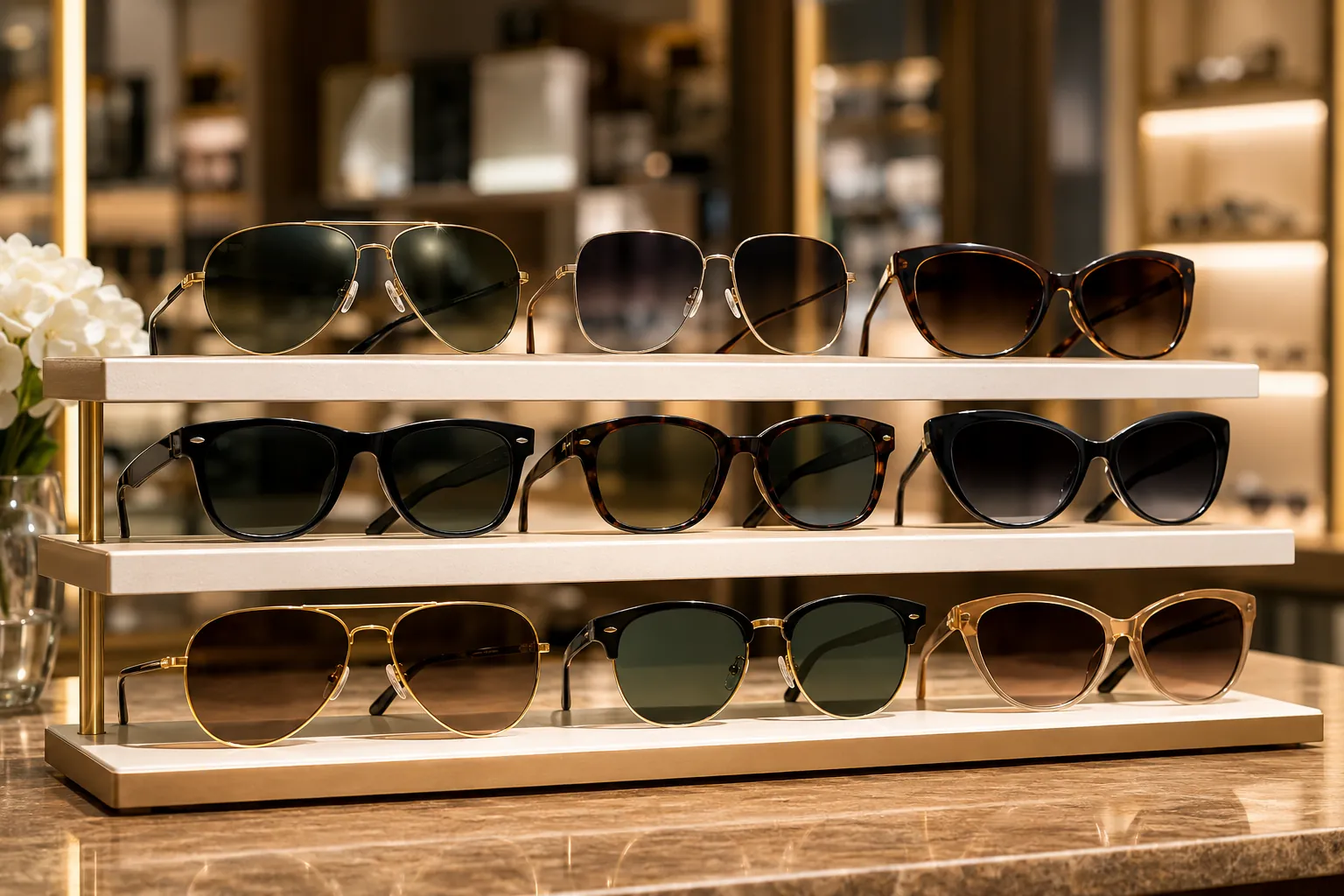
This guide is for importers, regional distributors, retail groups, and private-label eyewear buyers launching sunglasses in a market without proven demand. The aim is not to build the biggest catalog. It is to launch a controlled, reorderable range with enough silhouettes, lens options, price tiers, and compliance coverage to test demand without trapping cash in weak colors or poor constructions. A strong first assortment gives sales teams a clear story, purchasing teams clear MOQ logic, warehouses countable SKUs, and the factory repeatable specifications for the next order.
Start With A Controlled Launch
A new market does not need 80 styles on day one. It needs enough choice to test demand without creating duplicate shapes, fragile color experiments, and carton leftovers. For many regional launches, a disciplined first buy can sit between 12 and 24 SKUs. That often means 4 to 6 frame families, with 2 to 4 lens or frame-color variants per family.
Separate assortment breadth from assortment noise. Breadth covers real wearing occasions: city fashion, driving, beach retail, outdoor casual, tourist retail, value chains, and premium gifting. Noise is five similar black square frames with small temple changes that only the product team can spot.
A practical launch structure is 6 to 8 core SKUs, 4 to 6 channel-specific SKUs, and 4 to 10 controlled test SKUs. Core SKUs should receive the deepest quantities because they support replenishment. Test SKUs should stay shallow until sell-through data proves demand. If the market has no sales history, do not give every item equal depth.
LumiShades offers production from 50 pairs per design. Better cost efficiency usually starts at higher quantities such as 300, 1000, and 5000+ pairs, depending on material, lens, decoration, and packaging. Use 50 pairs for samples, sales kits, buyer meetings, and cautious color tests. Use 300 pairs when a SKU has a defined retail channel. Use 1000 pairs or more only when the shape, color, lens type, and channel demand are backed by evidence.
A blunt rule: if your sales team cannot explain why two SKUs both deserve shelf space, remove one before issuing the purchase order.
Build Around Proven Silhouettes
Silhouette choice drives sell-through more than logo detail. In an unfamiliar market, start with shapes buyers already understand. Then localize through lens color, finish, packaging, and price tier. Extreme shapes, oversized fashion profiles, and aggressive sport designs can wait until sales reports show where the market accepts risk.
| Silhouette | Best launch role | Material fit | Commercial note |
|---|---|---|---|
| Classic square | Core unisex volume SKU | PC, TR90, acetate | Safe in black, tortoise, smoke grey, and brown lenses |
| Wayfarer-style | Fashion retail, tourist shops, lifestyle chains | PC, acetate | Check hinge tension and front weight; heavier fronts need stable temples |
| Aviator | Men's, driving, gifting, duty-free | Metal, stainless steel, mixed material | Nose pad quality, plating consistency, and screw locking matter |
| Round or panto | Boutique, youth fashion, seasonal displays | Acetate, metal | Good test item, but not always a first-volume SKU |
| Sport wrap | Outdoor, fishing, cycling-adjacent, beach retail | TR90, PC | Lens base curve and optical distortion must be checked carefully |
For the first commercial order, let two silhouettes carry most of the volume. One or two silhouettes can test regional taste. The final slot can be a margin item with acetate, metal trim, polarized lenses, or upgraded packaging. This keeps tooling, lens matching, spare parts, QC, and replenishment easier to control.
Fit needs numbers, not opinions. For many adult unisex frames, common commercial dimensions fall around front widths of 140 to 148 mm, lens widths of 50 to 56 mm, bridge widths of 18 to 22 mm, and temple lengths of 140 to 150 mm. These are not universal standards. Buyers should approve fit using physical samples and target-user feedback. Very narrow fits may fail in broader-face markets. Oversized fronts can feel unstable if temple spring and hinge quality are weak.
LumiShades supports common custom sunglasses processes such as injection molding, acetate cutting, CNC finishing, lens tinting, laser engraving, pad printing, and metal logo plate decoration. The commercial point is simple: one proven frame platform can often be adapted across several price tiers without rebuilding the full product line.
Use Materials By Channel And Price Tier
Distributors often choose one target FOB price for an entire country. That rarely works. A pharmacy chain, beach kiosk, duty-free shop, online bundle, and boutique account do not need the same material, hinge, lens, or packaging story. Plan price tiers by channel first. Then assign materials.
- Entry tier: PC injection frames, standard smoke or brown lenses, simple temple printing, standard pouch or polybag packaging, suitable for impulse retail and promotional programs.
- Middle tier: TR90 or better-finished PC, stronger hinge feel, polarized options, cleaner lens tinting, printed or laser logo, suitable for repeat distributor stock.
- Premium accessible tier: acetate, stainless steel, or metal-acetate construction, CNC finishing, metal logo plates, richer lens colors, upgraded case and cloth, suitable for boutiques and gifting.
Material behavior affects returns. PC is economical and works well for high-volume retail, but it can look cheap if mold polish, gate trimming, and color consistency are poor. TR90 is lighter and more flexible, making it useful for comfort-led products, sport casual frames, and markets where durability sells. Acetate gives stronger perceived value and richer color depth, but it requires more cutting, tumbling, polishing, and alignment control. Metal frames need careful plating, soldering, screw fitting, and nose pad inspection.
Review pricing by SKU, not only by total order value. Cost can shift with order quantity, material, lens type, lens coating, decoration method, packaging, inspection requirements, and compliance documentation. Do not chase the lowest unit price across every SKU. Put the deepest volume into core black, tortoise, smoke, and brown combinations. Keep champagne, crystal, mirror, pink, blue, and gradient options at lower quantities until reorder data proves them.
A sensible first-shipment split may be 50 percent entry tier, 35 percent middle tier, and 15 percent premium accessible. In higher-income channels, move more weight to middle and premium accessible tiers. Still, do not let the most expensive designs consume working capital before sell-through reports arrive.
Treat Lens Planning As Inventory Control
Lens color is not just decoration. It affects compliance testing, perceived quality, visual comfort, returns, and reorder accuracy. For a new territory, keep the base lens plan conservative. Use fashion colors only where the channel can sell them quickly.
Smoke grey is a safe general-purpose lens because it keeps color perception relatively neutral. Brown and amber are often used for driving and outdoor retail because they can increase contrast. Green can feel premium in aviator and metal frames. Blue, pink, yellow, and mirror lenses can work for fashion, beach, and tourist channels, but they fragment inventory and can create slow stock.
- Assign smoke grey to the highest-volume black, matte black, and gunmetal SKUs.
- Use brown or gradient brown for tortoise, champagne, havana, and warm acetate colors.
- Limit mirror lenses to 1 or 2 styles unless the buyer has clear channel demand.
- Keep polarized lenses separate in SKU codes and cartons; do not mix them casually with standard tinted lenses.
- Confirm lens category, UV claim, markings, and user information before bulk production.
Write lens specifications on the product sheet. Define lens material, lens color, UV claim, filter category, polarization status, coating, base curve, and acceptable color tolerance. Inspect lens appearance against approved samples under consistent light, not random office lighting. For curved sport lenses, optical distortion matters even more. Poor lens forming can cause discomfort and returns.
For regulated markets, lens performance must be documented. Relevant requirements may include CE EN ISO 12312-1 for the EU, ANSI Z80.3 for the United States, AS/NZS 1067 for Australia and New Zealand, REACH for restricted substances, and FDA registration where applicable for the US supply chain. The exact file set depends on the destination, product type, and sales channel. Request compliance files before deposit. Confirm that the test report, product description, lens category, markings, and user information match the SKU being ordered.
Make Reorderable SKUs First
A good wholesale assortment can be reordered without detective work. Every SKU should define frame model, material, frame color, lens color, lens type, hinge, decoration, packaging, carton ratio, barcode, and compliance requirement. If those details live only in email threads, the second order will drift.
Use SKU codes that warehouse and purchasing teams can read. For example, SQ01-PC-BLK-SMK-NP can mean square model 01, PC frame, black color, smoke lens, non-polarized. Add a separate suffix for decoration or customer brand if the same frame platform is sold into multiple private-label programs.
Lock master samples for every reorderable SKU. A complete master sample should record front width, lens width, bridge width, temple length, frame weight, lens base curve, frame color chip, lens color sample, logo position, lens category, hinge type, screw type, packaging, and carton mark. Agree commercial tolerances in writing before production. Logo placement may need to stay within plus or minus 0.5 to 1.0 mm if the design requires precise alignment. Frame color should be judged against the approved sample under agreed lighting conditions.
For injected frames, watch shrinkage, color streaks, gate marks, and warpage. For acetate, check lamination gaps, polishing quality, temple alignment, and nose bridge comfort. For metal frames, inspect plating consistency, solder joints, screw tightness, pad arm symmetry, and nose pad softness. Small physical defects become large commercial problems when they repeat across thousands of pairs.
Inspection should cover incoming materials, in-process checks, and final pre-shipment review. Buyers can request an AQL-style final inspection plan and define critical, major, and minor defects before production starts. Common failures to control include loose hinges, tilted temples, lens popping, color mismatch, pad printing rub-off, sharp edges, unstable nose pads, and optical distortion.
Match MOQ, Lead Time, And Cash Risk
MOQ planning is not only about what the factory will accept. It is about cash risk, shelf space, landed cost, and reorder speed. Samples are often planned around 7 to 10 days. Bulk production is commonly planned around 25 to 35 days after sample approval, deposit, artwork confirmation, and final specification lock. Confirm the exact timeline for the selected materials. Then add time for compliance review, carton marks, barcode confirmation, freight booking, customs clearance, and local distribution.
| Order level | Useful quantity | Best purpose | Main risk control |
|---|---|---|---|
| 50 pairs per design | Sales samples or small tests | Buyer meetings, color trials, showroom sets | Higher unit cost; avoid creating too many test SKUs |
| 300 pairs per SKU | First commercial read | Small chain launch or distributor pilot | Good balance between market test and production efficiency |
| 1000 pairs per SKU | Core replenishment level | Known channels with repeat demand | Better cost, but requires reliable sell-through confidence |
| 5000+ pairs | Volume program | National retail, promotion, large distributor stock | Best price logic; wrong SKU becomes expensive quickly |
For a new market, place depth only behind the safest SKUs. A sensible first PO may include 6 core SKUs at 300 to 1000 pairs each, plus 8 to 12 test SKUs at 50 to 300 pairs each. That gives sales enough choice without creating 40 weak stock lines.
Do not approve bulk production from a photo. Approve physical samples for fit, lens darkness, lens clarity, logo placement, hinge tension, temple balance, case fit, hangtag placement, and carton logic. One extra week of approval can prevent a shipment that looks acceptable in pictures but feels cheap in hand.
Plan reorder timing before launch. If production takes 25 to 35 days and sea freight adds several weeks, the distributor needs reorder triggers. Core SKUs may need reorder review when available stock drops to 8 to 10 weeks of forecast sales. Test SKUs should not be reordered until actual sell-through proves the shape and lens combination.
Localize Without Losing Control
Local market adaptation is useful. Random customization is not. The safest route is to change visible details while keeping the technical platform stable. Use the same frame mold with different lens colors, temple logo methods, packaging inserts, and hangtags. This keeps production faster, reduces tooling risk, and limits QC variation.
Decoration choices should match material, channel, and expected handling. Pad printing is cost-effective on PC and TR90 temples, but rub resistance must be checked. Laser engraving is clean on metal, coated surfaces, and some premium trims, but the contrast must be approved on the actual finish. Metal logo plates look stronger on acetate and premium plastic frames, but they add process steps, adhesive or pinning decisions, and alignment risk. Hot stamping can work for packaging and pouches, but artwork thickness and foil adhesion should be tested before mass production.
- For value retail: use one-color temple printing, standard lenses, simple pouches, and clear barcode placement.
- For fashion stores: use richer frame colors, gradient lenses, controlled logo scale, and better presentation cases.
- For multi-retailer distributors: keep frame branding neutral and use hangtags, stickers, or packaging inserts for channel-specific information.
- For regulated destinations: make compliance markings, warnings, language requirements, and user information part of the artwork checklist.
The factory still needs clean buyer decisions. Final artwork, Pantone references, lens category, carton labels, barcode rules, and packaging materials should be frozen before bulk production. Late changes can require new samples, revised packaging, or retesting, depending on the change. Rework creates delay. It can also create inconsistent product if the change is not controlled through a revised specification sheet.
Review The Range Before Deposit
Before deposit, hold a short assortment review with sales, purchasing, finance, operations, and compliance. The goal is not to admire the range. The goal is to kill weak SKUs before they become inventory.
Ask five hard questions. Does each SKU have a target channel? Is the expected retail price believable after duty, freight, VAT or local tax, platform fees, and distributor margin? Can the SKU be reordered from a written specification sheet? Is the lens compliant for the destination? Does the order quantity match the level of market confidence?
Check carton logic too. Single-SKU cartons are cleaner for distributors with ERP systems, barcode receiving, and automatic replenishment. Mixed cartons may help small retailers, but they complicate warehouse counts and reorder decisions. If mixed cartons are used, define the inner ratio clearly and print it on the carton mark. For example, a 12-piece inner box should specify the exact color and lens split, not just the model name.
Document supplier qualification before production. Buyers can request evidence relevant to their program, such as ISO 9001 quality management certification, BSCI audit status, product test reports, material declarations, REACH documentation, FDA registration where applicable, and current compliance files for the destination market. A strong launch assortment is not the largest range. It is the range that sales can explain, finance can fund, the factory can repeat, compliance can approve, and the warehouse can count.
Have a custom sunglasses project in mind?
Send us your styles, target market and quantities and we will return a detailed quote with MOQ, lead time and a sample plan.
Get a QuoteWhy source this from Wenzhou with LumiShades
Wenzhou in Zhejiang Province is widely regarded as China’s eyewear manufacturing capital, producing a large share of the world’s sunglasses. That concentration matters to buyers: a deep local supply chain for acetate sheet, hinges, lens blanks, plating and packaging means shorter component lead times, easier color and material matching, and a workforce with decades of eyewear-specific skill. LumiShades has manufactured in this ecosystem since 2009, and our vertical integration — in-house injection molding, acetate cutting, CNC milling, lens tinting, decoration and quality control — means no part of your order is quietly subcontracted to a workshop you cannot audit.
For international buyers, that vertical control translates into accountability. When a single factory owns every step, defects are traced and fixed at source rather than bounced between vendors, and your specifications survive intact from first sample to bulk. For procurement review, buyers can request process records, approved samples, quality checkpoints and project-specific compliance files before placing a bulk order. Required testing and documentation are confirmed against the destination market and product specification rather than assumed from a generic certificate list. Explore our manufacturing capabilities and quality control process to see how this works in practice.
Frequently asked questions
How many SKUs should a distributor launch in a new sunglasses market? Start with 12 to 24 SKUs unless you already have reliable local sell-through data. Build the range from 4 to 6 frame families, put most volume behind 6 to 8 core SKUs, and keep color, lens, or channel tests at shallow quantities until sales data confirms demand.
Should we order 50 pairs per design or go straight to 300 pairs? Use 50 pairs for sales samples, buyer meetings, showroom sets, uncertain colors, or fit validation. Move to 300 pairs or more only when the SKU has a defined channel, approved sample, confirmed compliance path, and a buyer or sales forecast strong enough to justify commercial stock.
Which materials are safest for a first wholesale sunglasses assortment? Use PC for entry-volume programs where price is critical, TR90 for lightweight and flexible frames, and acetate or metal for premium accessible channels. Confirm the material choice against the target retail price, hinge requirement, decoration method, packaging level, and expected return risk before approving the SKU.
Which lens colors are safest for a first wholesale assortment? Smoke grey and brown are the safest base colors for most first assortments. Use green, gradient, mirror, blue, or pink lenses only for selected channels such as fashion, beach, outdoor, or tourist retail. Keep each color in a separate SKU code so sell-through and reorders can be measured accurately.
What compliance documents should we request before production? Request documents that match the destination market and exact SKU: CE EN ISO 12312-1 for the EU, ANSI Z80.3 for the United States, AS/NZS 1067 for Australia and New Zealand, REACH documentation for restricted substances, and FDA registration where applicable for the US supply chain. Also confirm lens category, UV claim, markings, warnings, user information, and whether the report description matches the ordered product.
How do we keep reorders consistent with the first shipment? Create a written specification sheet and locked master sample for every reorderable SKU. Record frame model, material, color, dimensions, lens color, lens category, polarization status, hinge type, logo method, packaging, carton marks, barcode, compliance notes, and approved tolerances before placing the first bulk order.
What lead time should we plan for private-label sunglasses? Plan sample timing around 7 to 10 days and bulk production around 25 to 35 days after all approvals, but confirm the exact schedule for the selected materials and decoration. Add time for artwork approval, compliance review, barcode confirmation, packaging approval, freight booking, customs clearance, and local distribution before setting the retail launch date.
Ready to start?
Explore our sport wrap sunglasses or request a quote — our sales team replies within 12 hours.
Request a Quote