
Smoke, Brown, Green, and G15 Lens Selection Guide
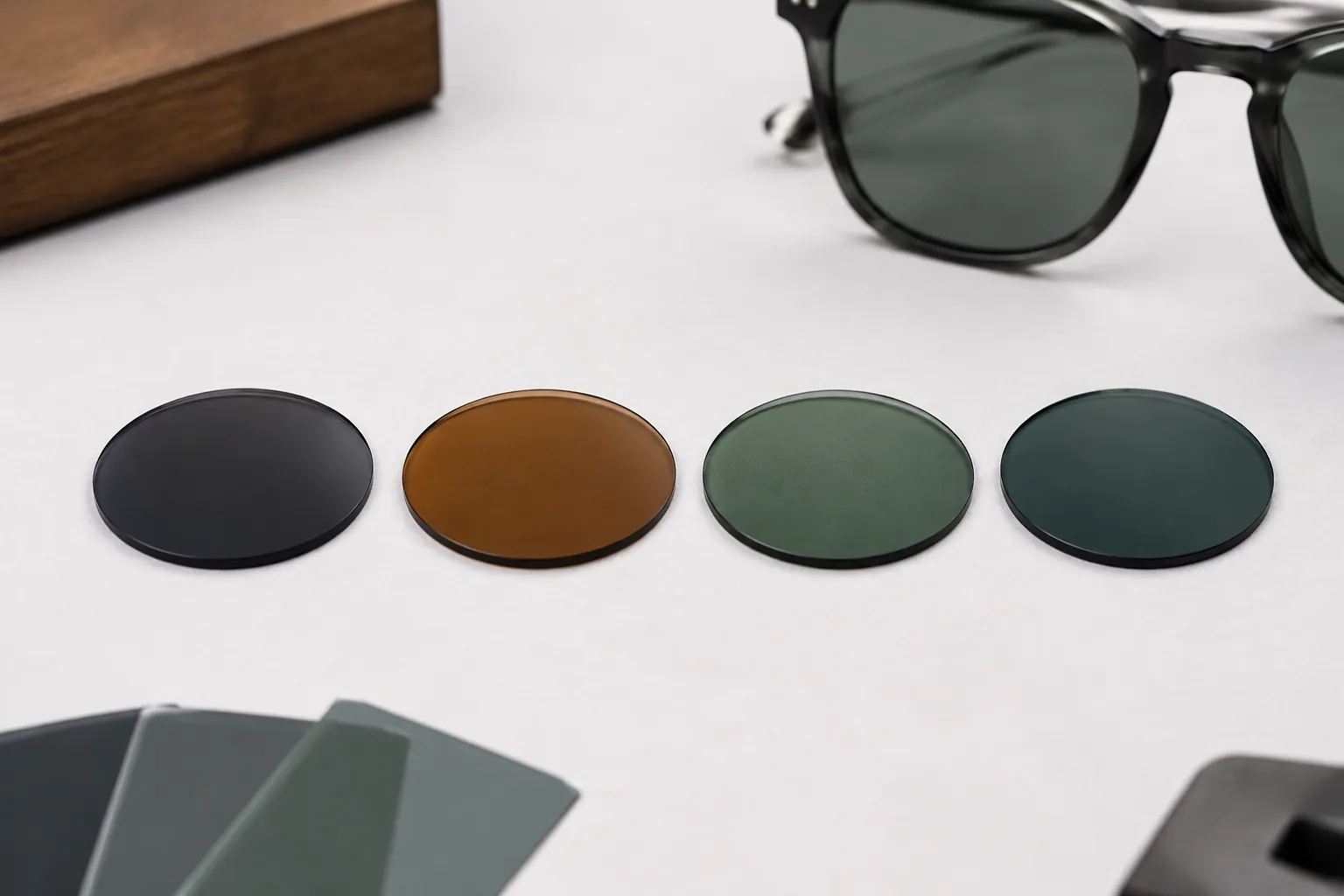
This guide is for brand owners, importers, distributors, and retail buyers building sunglass ranges at production volume. It covers four core lens families—smoke, brown, green, and G15—and shows how they affect wearer perception, line planning, sample approval, and compliance. The goal is simple: better buying decisions. That means looking past color names and checking VLT, substrate behavior, tint consistency, coating effects, and the documents needed before bulk production begins.
Start With Channel, Not Color
Many buyers start by asking which lens color sells best. Wrong first question. Start with channel: where the product will sell, what price level the account expects, and how the customer will use the sunglasses.
Smoke, brown, green, and G15 all cut visible light. They do not create the same visual impression or the same wearing experience. In fashion-led retail, the sale often happens on first try-on, so neutral tints like smoke are usually easier to place across many frame colors and shapes. In driving, travel, and outdoor-lifestyle programs, buyers often prefer brown because many wearers see stronger contrast through it. In optical chains, department stores, and heritage-led collections, G15 can matter because buyers read it as a specific lens direction, not just generic green.
Channel fit also limits how many lens directions a line can support. A first-season program usually works better with a tight structure: one neutral core, one warm option, and one classic or technical-looking direction. That keeps sales training simpler, reduces slow SKUs, and makes reorders easier.
- Fashion retail: smoke first, brown second, selective use of green or G15.
- Resort and travel: brown and smoke as the main commercial pair, with G15 where the assortment supports a more classic position.
- Optical and premium department: smoke plus G15 is a common core pairing.
- Promotional or entry-price programs: smoke is often the easiest tint family to standardize across multiple frame shapes.
Simple rule: if the account cannot explain the role of a fourth lens family, it probably does not need one.
How Each Lens Family Affects Wearer Perception
Lens color is not just a style choice. It changes perceived brightness, contrast, color balance, and the wearer's opinion after real outdoor use. That matters because many sample approvals happen indoors, where tint differences are harder to judge.
Smoke is the most neutral family. It reduces brightness with minimal color cast, so it works across unisex assortments and mixed channels. Commercially, it is often the safest default. Its weakness is obvious: density mismatch and uneven gradients show fast because the tint does not hide process variation.
Brown usually gives a warmer view and can increase perceived contrast. Many buyers and wearers prefer it for driving and casual outdoor use over flat dark grey. It can also make a product feel less generic at shelf. The trade-off is stronger color shift than smoke, so it is not the best option where neutral color perception matters most.
Green often sits between smoke and brown. Many wearers see it as more balanced than brown and softer than some dark grey tints. Commercially, green can give a line a classic tone. The risk is hue control. If the shade drifts toward yellow or muddy olive, the product can look inconsistent from batch to batch.
G15 is part of the green family, but buyers often treat it separately because it points to a recognized lens direction: green-based appearance with a nominal VLT around 15 percent. In practice, factories and brands may work within small tolerance bands around that target. Do not assume every G15 sample is the same. Confirm the exact VLT specification. If the range will be compared with established sunglass brands, a stable G15 option can make the collection look more credible.
For general-purpose sunwear, many dark lenses are developed within the VLT range commonly linked to Category 3 sunglasses under applicable standards. But appearance alone is not enough. The target must match the intended market, end use, and compliance requirement.
A Practical Comparison for Line Planning
| Lens family | Typical VLT target | Common channel use | Perceived quality signal | Main process risk |
|---|---|---|---|---|
| Smoke | Often specified within Category 3 programs; exact target should be confirmed by market and use | Fashion chains, promotional programs, broad unisex assortments | Clean, modern, neutral | Uneven density or a flat low-grade appearance is easy to spot |
| Brown | Often specified within Category 3 programs; exact target should be confirmed by market and use | Resort, driving, outdoor lifestyle, warm frame palettes | Warmer, richer, less generic | Color shift between sample rounds can be more visible |
| Green | Often specified within Category 3 programs; exact target should be confirmed by market and use | Classic programs, mixed retail, outdoor casual | Traditional, balanced, understated | Hue drift toward yellow or muddy olive |
| G15 | Nominally around 15% VLT; exact tolerance should be written into the specification | Premium optical, department store, heritage collections | Recognizable, technical, more credible | Inconsistent hue or transmission is easy to detect against buyer expectations |
Use this table as a planning tool, not a formula. Frame build, lens substrate, surface coating, and edge thickness all affect the final result. A clean smoke lens will beat a poorly controlled G15 every time if the finished product looks more consistent.
Also separate shade family from spec control. Two suppliers may both offer green lenses. One may hold transmission and visual matching far better than the other. For repeat programs, that usually matters more than the color label.
Material and Process Details Buyers Miss
Lens color does not behave the same way across materials. Polycarbonate, CR-39, and nylon-based performance materials can all present tints differently. That affects both sample approval and bulk repeatability.
Polycarbonate (PC) is common in volume sunglasses because it supports high-output production and is widely used in molded programs. Tint appearance can shift with lens thickness, curvature, and the base tone of the material. Check wrapped shapes and thicker edges carefully if the target is a precise dark green or G15-style result.
CR-39 is common in dress and optical-style sunwear and is often chosen when buyers want a cleaner tint appearance. Brown and green can look especially clear on well-made CR-39 lenses. The trade-off is straightforward: it may not suit every sport-driven or highly wrapped construction.
Nylon or similar performance materials are often used in sport and wrap frames where flexibility and stability matter. They can deliver strong optical performance, but sampling may move slower because appearance depends on the grade, molding process, and finishing method.
Coatings and decoration change tint perception too. A smoke lens with flash mirror can look cooler and more technical from the front. A brown lens with a light gold flash can read warmer and more premium. Common decoration methods include:
- Solid tinting: the base lens is tinted to a uniform density.
- Gradient tinting: darker at the top and lighter at the bottom; this needs tighter visual control on fade smoothness and alignment.
- Flash mirror coating: a light reflective finish that changes front appearance without fully hiding the eye.
- Full mirror coating: a stronger reflective finish often used in fashion or sport-led programs.
- Hard coating and backside anti-reflective options: these do not change the tint family, but they do affect durability, appearance, and perceived quality.
During sample review, do not check the front view only. Check side view, back view, edge color, and left-right matching. On rimless, nylor, or light-colored frames, edge tone can make a lens look redder, dirtier, or greener than expected.
Where Buyers Usually Get It Wrong
First mistake: matching the lens only to the frame color. Brown may look natural with tortoise, honey, or champagne acetate. That does not mean it is the best commercial choice if the account depends on fast, low-friction sell-through. Smoke is often easier for the end customer to understand fast.
Second mistake: assuming one tint name behaves the same across all constructions and price points. It does not. Smoke exposes density variation. Brown makes contamination and inconsistency easier to spot. Green and G15 depend on tighter hue control. If a line runs from entry price to premium, the same nominal lens family may not create the same quality impression across every build.
Third mistake: approving samples under office lighting only. A lens that looks fine indoors may feel too dark, too warm, or visually off outdoors. Review samples in daylight. If relevant, review them in use cases such as driving, subject to local legal and safety requirements.
Fourth mistake: treating compliance as paperwork at the end. It belongs in development. If the target market requires conformance to CE EN ISO 12312-1, ANSI Z80.3, or AS/NZS 1067, agree the intended lens category and transmittance target before bulk approval. If chemical compliance is part of the requirement, ask for REACH documentation early. A good-looking lens is useless if it is mislabeled, miscategorized, or unsupported by the required records.
What to Check on Samples Before Bulk Approval
Sample approval should combine visual review with written specs. No shortcuts. On lower-volume programs especially, one weak approval can create avoidable cost and delay.
- Confirm the lens substrate. Ask whether the sample uses PC, CR-39, or nylon-based material, and confirm that bulk production will use the same substrate and grade.
- Write the VLT target into the spec. Do not approve based on a verbal description such as "dark green" or "G15 look." Record the intended visible light transmission and any tolerance the supplier is expected to hold.
- Check left-right consistency. View both lenses side by side in daylight. Visible mismatch is a rejection point.
- Review the sample outdoors. Compare on white paper, open sky, and real wear conditions rather than relying on fluorescent indoor light.
- Inspect edge color and thickness effect. Wrapped or thick-edged lenses can read darker or shift hue at the perimeter.
- Check coating interaction. Flash mirror, full mirror, backside anti-reflective coating, and hard coat all affect the finished appearance.
- Keep a physical approval standard. Retain one signed approval sample or one measured control standard tied to the purchase order and color specification.
For repeat programs, good suppliers compare new production against the last approved control sample, not against vague comments. Phrases like "slightly greener" or "less red" are too subjective to control repeatability.
Buyers should also align technical and compliance documents with the approved construction. If the product is going into regulated markets, ask for the relevant test reports or conformity documents for the final sunglass specification, not a generic certificate from an unrelated model. Depending on the supplier relationship and market, broader quality and social compliance records such as ISO 9001 or BSCI may also matter for vendor qualification, but they do not replace product-level sunglass compliance testing.
MOQ, Lead Time, and Cost Planning
Lens family is rarely the only cost driver in a sunglass program. Frame construction, hardware, coating package, packaging, testing, and order volume often matter more. Still, smoke, brown, green, and G15 do not carry the same process risk, so they can affect sampling effort and schedule confidence.
At low MOQs, expect lower efficiency. Setup, quality control, and approval work are spread across fewer units. More exact shade targets—especially in green-family lenses—can also increase the number of sample rounds if the spec is not clear from the start.
Lead time follows the same pattern. Standard repeat programs with settled materials and straightforward lens decoration usually move faster than developments involving new tooling, custom metal trims, mirror-coating trials, or repeated shade correction. Destination-market testing or documentation review can also extend the timeline if it starts too late.
When planning cost and delivery, ask for quotes that break out the real variables:
- lens substrate and coating package
- frame material and construction method
- order quantity by SKU and colorway
- packaging specification
- required testing or compliance documents
- sample rounds included before bulk approval
Factories that control molding, frame finishing, lens tinting, decoration, assembly, and quality control in-house may have a scheduling advantage because color correction and assembly review happen inside one system. Do not take that claim at face value. Verify it through sampling speed, documentation discipline, and production follow-through.
A Sensible First-Buy Formula
New sunglass lines are often overbuilt. Too many shapes and too many tint directions lead to slower inventory turns and weaker sell-through data. A tighter structure gives better learning.
For many launches, four frame shapes with two lens directions each is easier to manage than a wide assortment with several experimental colors. A practical opening assortment looks like this:
- 2 SKUs with smoke lenses: one core black or crystal injection frame and one clean acetate style.
- 1 SKU with brown lenses: preferably on tortoise, olive, tea, or other warm translucent frame colors.
- 1 SKU with G15 or classic green: on an aviator, square metal, keyhole bridge, or heritage acetate shape.
This creates three clear roles in the line. Smoke is usually the easiest replenishment lens. Brown gives the range a warm, comfort-led option. G15 or green adds a more classic or technical direction for accounts that want stronger product language.
Then follow the reorder data, not internal opinion. If retailers keep asking for the safest replenishment option, expand smoke. If travel and driving accounts respond better to warmth and contrast, deepen brown. If premium doors want more heritage or technical credibility, add G15 selectively. Keep the lens strategy measurable and tied to the channel that actually sells the product.
Useful rule: if a lens color is in the range only because it looked good in a meeting, it has not earned its SKU.
Have a custom sunglasses project in mind?
Send us your styles, target market and quantities and we will return a detailed quote with MOQ, lead time and a sample plan.
Get a QuoteWhy source this from Wenzhou with LumiShades
Wenzhou in Zhejiang Province is widely regarded as China’s eyewear manufacturing capital, producing a large share of the world’s sunglasses. That concentration matters to buyers: a deep local supply chain for acetate sheet, hinges, lens blanks, plating and packaging means shorter component lead times, easier color and material matching, and a workforce with decades of eyewear-specific skill. LumiShades has manufactured in this ecosystem since 2009, and our vertical integration — in-house injection molding, acetate cutting, CNC milling, lens tinting, decoration and quality control — means no part of your order is quietly subcontracted to a workshop you cannot audit.
For international buyers, that vertical control translates into accountability. When a single factory owns every step, defects are traced and fixed at source rather than bounced between vendors, and your specifications survive intact from first sample to bulk. We back this with 15+ years of experience, shipments to 60+ countries, more than 5 million pairs produced per year and a 98.5% on-time delivery rate. Our certifications — CE EN ISO 12312-1, FDA registration, ANSI Z80.3, AS/NZS 1067, REACH, ISO 9001 and BSCI audit — mean the compliance documentation your market requires already exists. Explore our manufacturing capabilities and quality control process to see how this works in practice.
Frequently asked questions
Is G15 always better than standard green lenses? No. G15 is not automatically better; it is more specific. In eyewear buying, G15 usually refers to a green-based sunglass lens with a nominal visible light transmission around 15 percent, but the exact tolerance should be confirmed in the supplier specification. A standard green lens may be fully adequate for entry-price fashion or promotional programs. Choose G15 when the collection needs a recognizable classic lens direction and when you can verify the actual VLT, visual appearance, and consistency against an approved control sample.
Which lens color is safest for a first private-label order? Smoke is usually the safest starting point because it is neutral, widely accepted, and easy to pair with many frame colors and shapes. It also works across mixed channels. Buy it with discipline: confirm the substrate, write the target VLT into the specification, review the sample outdoors, and keep one approved control sample linked to the purchase order. Smoke is flexible, but it also reveals density inconsistency quickly.
Do brown lenses cost more than smoke lenses? Not in any fixed or universal way. In a basic program, the larger cost drivers are usually frame material, hardware, coatings, packaging, testing, and order quantity. Brown, green, and G15 may need tighter visual control or extra sample rounds if the buyer expects a precise look, and that can add development time or cost. When requesting quotes, ask the factory to separate lens material, coating package, compliance testing, and packaging so you can see what is actually changing the price.
How many lens colors should a small launch collection carry? Usually two to three lens directions are enough. A practical structure is smoke as the core, brown as the warm contrast option, and one green or G15 style for a classic or premium signal. Before adding more, make sure each lens family has a clear channel role, a reorder case, and enough projected volume to justify its own sample approval and inventory position.
What compliance documents should a buyer ask for on sunglass lenses? Ask for documents that match the destination market and the exact finished product specification. Depending on market, that can include compliance or test documentation for CE EN ISO 12312-1, ANSI Z80.3, or AS/NZS 1067. If chemical compliance is required, request relevant REACH documentation. If the supplier claims FDA registration, verify what that registration actually covers, because it does not replace sunglass performance compliance. For supplier qualification, buyers may also ask for ISO 9001 or BSCI records, but those do not substitute for product-level testing. Always confirm that the documentation applies to the actual sunglass construction being produced, including lens category and visible light transmission range.
Ready to start?
Explore our aviator sunglasses or request a quote — our sales team replies within 12 hours.
Request a Quote