
Mirror Lens Coatings: Cost, Yield, Repeat Orders
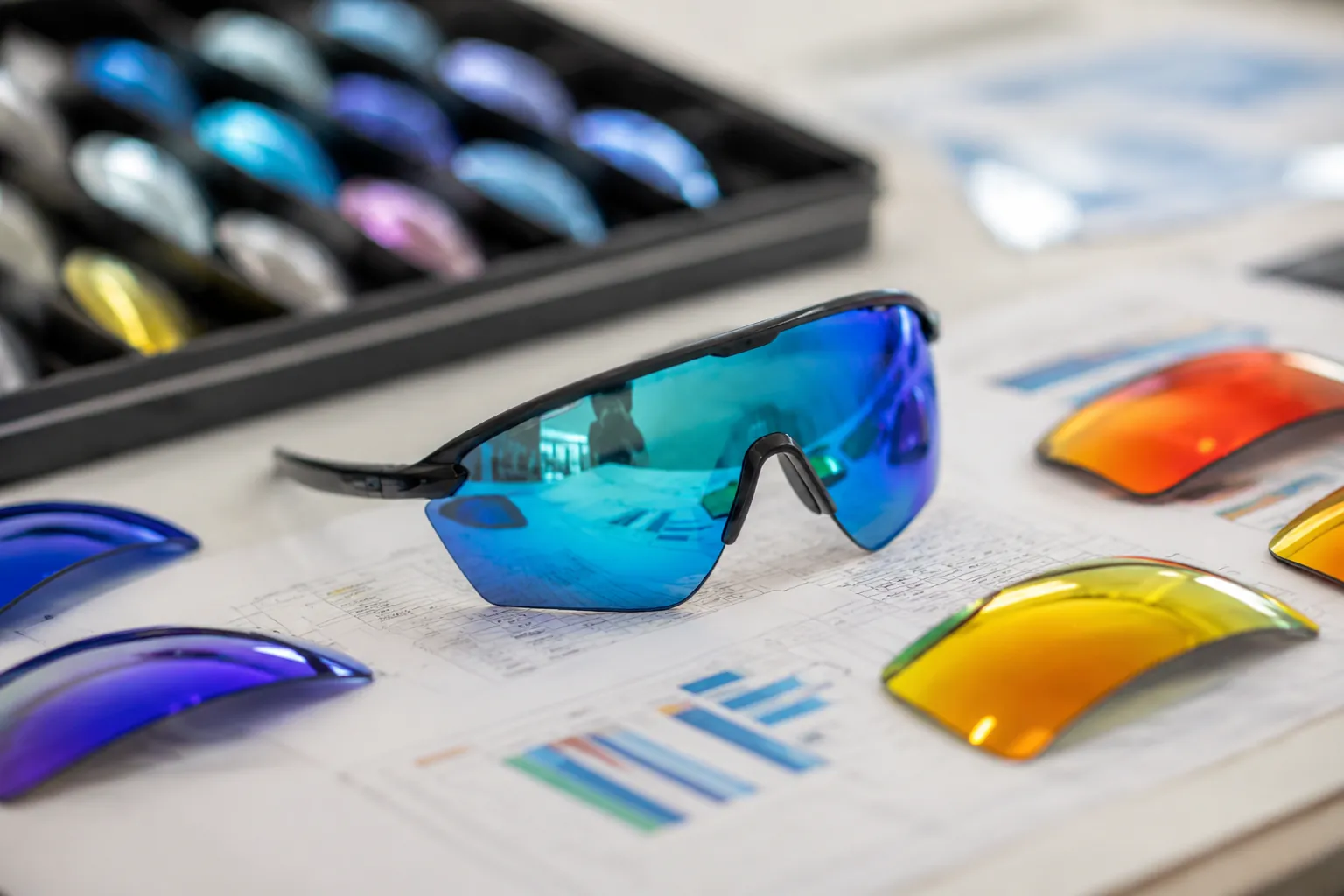
This article is for brand owners, importers, and retail buyers sourcing custom sunglasses at volume. Mirror lenses may look simple in renders and sample photos. Production is not. A mirror finish is more than a color choice. It adds a separate lens-finishing step with its own handling rules, cosmetic risks, approval criteria, and repeat-order issues. The real sourcing question is not whether the first sample looks good. It is whether the supplier can define the lens construction clearly, control defects in bulk, and reproduce the approved look on future purchase orders.
Why mirror lenses change the commercial math
Mirror coating is not just a tint upgrade. In most sunglass programs, the base lens is first molded or machined, then tinted or produced in the target base color, and then mirror coated in a separate step. A hard coat may also be part of the system. Every added step means more handling, more inspection, and more chances for a lens to fail before assembly.
Mirror surfaces also expose defects faster than standard tinted lenses. Dust nibs, pinholes, wipe marks, streaks, edge voids, and light scratches show up more clearly because the surface reflects light. A lens that passes in a dark solid tint may fail once the mirror layer goes on.
That affects four buyer decisions right away: cost, approval method, lead-time planning, and reorder control. The coating fee is only part of the issue. The bigger issue is process control. Mirrored lenses usually need tighter controls and a clearer cosmetic standard than non-mirrored lenses. If the standard is vague, disputes often show up late, after coating or even after assembly.
So ask better questions. Not just, "Can you make blue mirror?" Ask: what is the base lens color, what mirror process is used, how is appearance approved, and what reference controls repeat orders? Those questions are specific. They also show whether the supplier actually controls the finish.
Where the added cost really comes from
Buyers are often told that mirror lenses cost more. True, but that answer is too loose to be useful. In practice, the extra cost usually comes from several operating factors, not one simple surcharge.
- Extra processing: lenses need additional cleaning, surface preparation, coating, and inspection before assembly.
- Higher cosmetic sensitivity: mirror finishes make small surface defects easier to see, so more lenses may be held or rejected during QC.
- Stricter handling requirements: coated faces usually need cleaner trays, better separation, and more careful glove handling to reduce scuffing and rub marks.
- Approval complexity: buyers often react to small appearance differences that were never defined in writing, which slows approvals and rework decisions.
- Geometry dependence: coverage and appearance can change with lens curve, edge exposure, and trimming method, so some shapes are harder to run consistently than others.
Separate three things when you review a quotation: the stated lens upcharge, the likely yield impact, and the risk of extra lead time if the first coated lot misses the approval standard. A low coating surcharge means little if the finish is hard to repeat or easy to damage during assembly.
Material and lens shape matter too. Mirror coatings are usually easier to control on common sunglass geometries than on high-wrap shields, semi-rimless constructions, or exposed-edge fashion shapes. If more of the lens edge stays visible, edge coverage and trim quality become part of the saleable appearance. Not a minor detail.
A practical cost and yield comparison
The exact commercial effect depends on lens material, curve, frame structure, coating process, and order size. Still, buyers can compare finishes in a practical way. Use the table below as a relative guide to complexity and risk, not as a fixed pricing standard.
| Lens finish | Typical lens upcharge vs. standard tint | Expected cosmetic fallout | Lead-time impact | Reorder stability | Best fit |
|---|---|---|---|---|---|
| Standard solid tint | Lowest | Lowest relative risk | None to minimal | High | Core repeaters, price-driven volume |
| Basic silver or blue mirror | Moderate | Moderate relative risk | Usually requires added coating time and approval attention | Medium | Sports, mainstream fashion, stable repeat demand |
| Bright mirror such as red, green, or ice blue | Higher | Higher relative risk | Often adds approval and recovery time if appearance drifts | Medium to low | Seasonal drops, trend-led capsules |
| Multicolor flash mirror | Highest | Highest relative risk | Most vulnerable to delays from appearance variation | Low | Visual-impact styles where margin is secondary |
The point is simple. Compare mirror finishes by process risk as well as unit price. Two suppliers can quote similar frame programs and very different mirror add-ons because they are assuming different levels of coating difficulty, acceptable variation, and internal loss.
Also assess mirror finish at the total-pair level, not only as a lens line item. If the product already carries cost pressure from packaging, decoration, or freight, a mirror finish can take more margin than expected even if the quoted surcharge looks modest.
The defect points buyers miss most often
Mirror lenses usually fail where handling, geometry, and approval standards intersect. Buyers often miss this in development because they review one sample at a time. Bulk production shows the spread.
1. Surface contamination during coating. Fine dust, lint, residue, or incomplete cleaning can create pinpoints, craters, haze, or uneven reflectivity. These defects are easier to spot on mirrored faces than on standard tinted lenses, especially under direct white light.
2. Edge coverage and trimming. Appearance near the perimeter is sensitive to lens curve, trim method, groove depth, and how much of the edge the frame hides. Semi-rimless styles, shields, and exposed-edge fashion shapes need tighter approval because the perimeter stays visible at retail.
3. Color drift from the full lens stack. The final look comes from the base lens color plus the mirror layer, not the mirror layer alone. A silver mirror over one gray base can look different from a silver mirror over another gray base if undertone or transmission shifts. This causes many reorder disputes when only the mirror color name is recorded and the full lens construction is not.
Put the inspection method in writing: viewing distance, lighting condition, main viewing zone, and left-right matching criteria. Without that, one side may call a lens acceptable and the other may reject it while both are looking at the same pair.
How to spec mirror lenses for repeat orders
Most repeat-order problems start with incomplete approvals. A development sample helps, but it is not enough on its own. The supplier must be able to tie that sample to a defined lens construction and a retained production reference.
- Approve the full lens stack: record the lens material, base lens color, target visible light transmission if relevant to your program, mirror color, and any hard-coat requirement.
- Retain a production-approved reference: keep one sample from the first accepted bulk run, not only from the development stage.
- Define cosmetic zones: identify the primary viewing area and state what is acceptable near the perimeter, especially on large, wrapped, or semi-rimless lenses.
- Lock the geometry: do not assume the same mirror finish will look the same on different base curves or lens shapes.
- Use controlled approval records: support physical approval with photos taken under a fixed light setup so both parties have a visual record tied to the same standard.
For repeat programs, describe the mirror by commercial intent, not only by a broad color name. "Bright ice blue fashion mirror" and "moderate blue sports mirror" may both be called blue mirror in casual email. They are not the same standard.
The supplier should be able to state exactly what controls the repeat order. If the answer is only "same as last time," control is weak. Expect a retained sample, a defined lens construction, and a clear approval record.
Compliance and cosmetic control are separate issues
Mirror finish does not remove the need for compliance. But compliance does not define mirror appearance. Buyers still need the right optical, safety, and chemical documentation for the destination market, whether the lens is mirrored or not. Common references in commercial eyewear programs include CE EN ISO 12312-1, ANSI Z80.3, AS/NZS 1067, REACH, FDA registration where relevant to the importer or listing process, ISO 9001, and BSCI.
Those references matter. They do not tell you whether the mirror finish is commercially acceptable. A lens can meet optical and market-access requirements and still fail the program because the mirror is too green, the left and right lenses do not match closely enough, or the defect rate is too high for the intended retail position.
So run two controls in parallel: compliance documentation for market requirements, and a separate cosmetic approval standard for mirror appearance. Ask for both. One does not replace the other.
Lead time risk and when mirror coatings make sense
Mirror finishes add planning risk because coated lenses are less forgiving than standard tinted lenses once appearance problems appear. A printed logo can sometimes be reworked. A mirror surface with visible scratches, haze, or off-standard appearance often cannot. It usually needs replacement.
The main schedule risks sit in three places: coating queue time, approval delay, and recovery after cosmetic fallout. If the first coated lot misses the approved appearance, the delay is not limited to recoating time. It can disrupt assembly sequencing, final inspection, and shipment release.
For first orders tied to a fixed launch date, build in time for one real approval loop. For repeat orders, ask the supplier to compare pre-production coated lenses against the retained bulk reference before full assembly starts. Catch drift early. After assembly, the fix is slower and more expensive.
There is also a clear commercial filter for using mirror lenses:
- Use mirror confidently when shelf impact is central to the product story and the program can support tighter approvals.
- Use basic mirror carefully on repeating core styles, but lock the base lens, mirror specification, and retained production standard from the first accepted bulk run.
- Avoid complex mirror on highly price-sensitive programs unless the supplier has already proven the exact finish on the same geometry.
- Be cautious on exposed-edge or high-wrap designs unless you have approved production-quality samples made on the final lens shape and curve.
Mirror sells appearance. It does not sell simplicity. Cost it at the finished-pair level, specify it as a full lens construction, and treat it as a production-critical component rather than a loose color idea. The best mirror suppliers are the ones that can explain their control method clearly, not just show a good first sample.
Have a custom sunglasses project in mind?
Send us your styles, target market and quantities and we will return a detailed quote with MOQ, lead time and a sample plan.
Get a QuoteWhy source this from Wenzhou with LumiShades
Wenzhou in Zhejiang Province is widely regarded as China’s eyewear manufacturing capital, producing a large share of the world’s sunglasses. That concentration matters to buyers: a deep local supply chain for acetate sheet, hinges, lens blanks, plating and packaging means shorter component lead times, easier color and material matching, and a workforce with decades of eyewear-specific skill. LumiShades has manufactured in this ecosystem since 2009, and our vertical integration — in-house injection molding, acetate cutting, CNC milling, lens tinting, decoration and quality control — means no part of your order is quietly subcontracted to a workshop you cannot audit.
For international buyers, that vertical control translates into accountability. When a single factory owns every step, defects are traced and fixed at source rather than bounced between vendors, and your specifications survive intact from first sample to bulk. We back this with 15+ years of experience, shipments to 60+ countries, more than 5 million pairs produced per year and a 98.5% on-time delivery rate. Our certifications — CE EN ISO 12312-1, FDA registration, ANSI Z80.3, AS/NZS 1067, REACH, ISO 9001 and BSCI audit — mean the compliance documentation your market requires already exists. Explore our manufacturing capabilities and quality control process to see how this works in practice.
Frequently asked questions
Do mirror lenses always add a lot to unit cost? Not necessarily, but they almost always add some cost and some process risk compared with a standard solid tint. Ask the supplier to split the quote into three parts: lens upcharge, any expected lead-time effect, and any approval conditions that could affect yield or rework. That gives you a usable commercial picture instead of one surcharge line.
What mirror color is easiest to repeat on reorders? Basic silver and common blue are usually the easiest starting point because they are widely used and suppliers often have more experience controlling them. Even so, repeatability depends on the full lens stack, not the mirror name alone. To improve consistency, lock the base lens color, confirm the lens material and geometry, and retain one approved bulk-production sample as the standard for future POs.
Can I approve mirror color from a photo? Use photos for screening and recordkeeping, not as the only approval method. Mirror appearance changes with angle, background, light source, and the underlying lens color. The practical approach is to review controlled photos taken under a fixed lighting setup, then issue final approval from a physical sample that represents the actual production lens construction.
Does compliance testing cover mirror coating quality? No. Standards and registrations such as CE EN ISO 12312-1, ANSI Z80.3, AS/NZS 1067, REACH, and FDA registration address market, safety, or chemical requirements, but they do not define your cosmetic standard for mirror appearance. If mirror finish matters commercially, issue a separate written standard covering viewing conditions, defect tolerance, left-right matching, and the retained reference sample for repeats.
How should I handle first orders versus repeat orders for mirror styles? For a first order, approve the full lens stack in writing: material, base lens color, mirror finish, geometry, and cosmetic standard. Keep one sealed sample from the first accepted bulk run. For each repeat order, require a pre-production lens check against that retained sample before bulk assembly starts. If the supplier cannot compare the new lot to a defined physical standard, repeat-order control is weak.
Ready to start?
Explore our wayfarer sunglasses or request a quote — our sales team replies within 12 hours.
Request a Quote