
Sunglass Lens Base Color Guide for Bulk Buyers
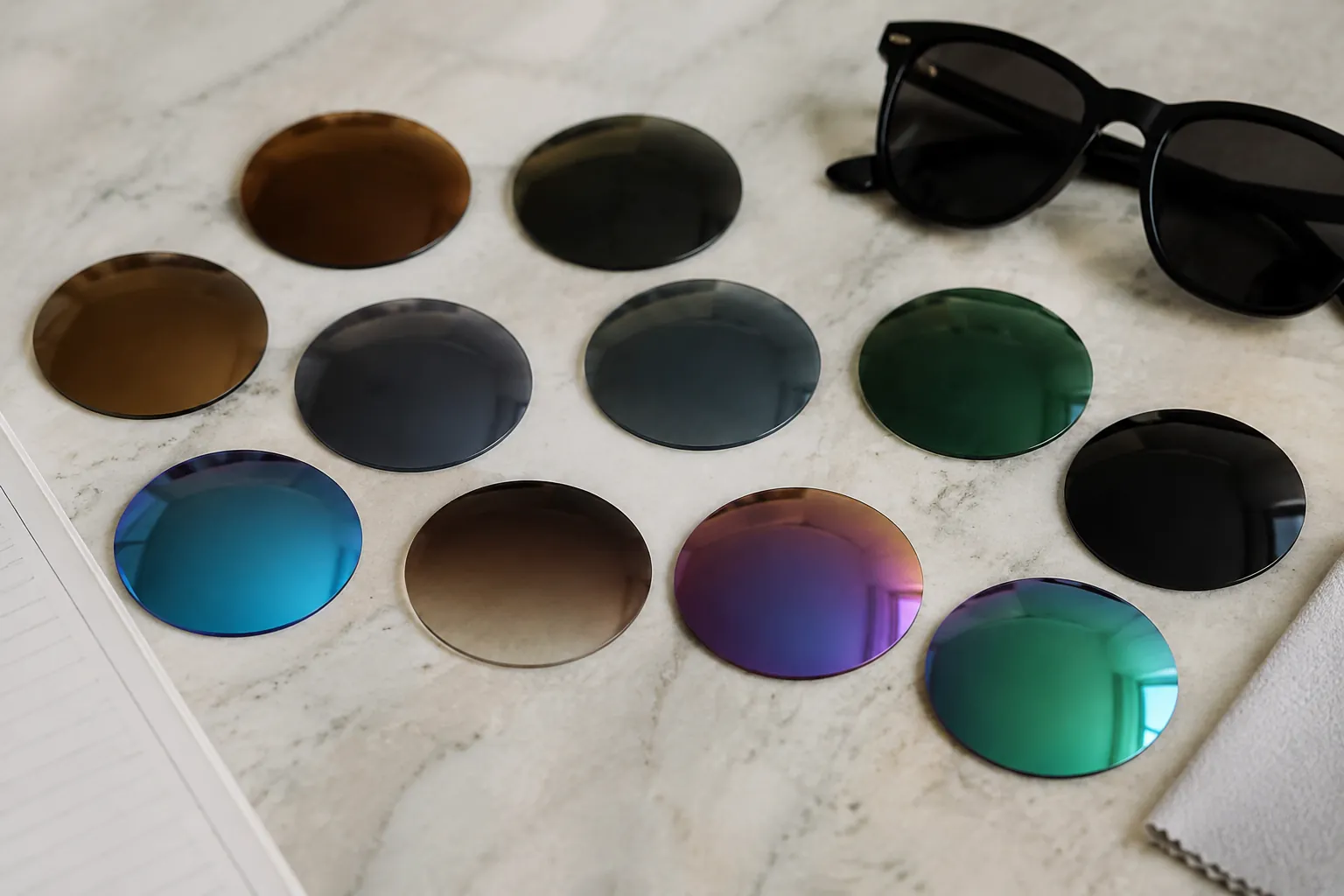
This guide is for brands, importers, distributors, and retailers buying custom sunglasses in volume. Lens base color is often treated as a style choice. That is a mistake. It also affects wearer perception, sample approval, compliance planning, and production control. If you are comparing smoke, brown, green, and G15, the right choice depends on end use, target visible light transmission (VLT), lens material, and how the factory controls tint consistency from sample to bulk. Use this article as a buying framework and as a checklist for your tech pack or RFQ.
Start With Use Case, Not Frame Styling
Many buyers choose the frame first and leave the lens for later. That often leads to avoidable revisions. Lens base color changes how the wearer perceives brightness, contrast, terrain definition, and long-wear comfort. Two sunglasses can share the same frame, similar VLT, and the same mirror coating, yet still feel different in use because the base tint is different.
Use a simpler sequence. First define the main wearing scenario. Then define the visual target. After that, confirm the destination-market compliance route and lens construction. Only then should you lock cosmetic details such as mirror, gradient, flash, edge color, logo, or packaging.
- Driving and general outdoor wear: usually calls for neutral color rendering and steady brightness reduction over long periods.
- Beach, resort, and bright-sun fashion: often benefits from stronger comfort in harsh light and, in some ranges, a warmer visual impression.
- Golf, trail, fishing, and mixed-light use: may benefit from higher perceived contrast and clearer separation of surfaces and edges.
- Classic aviator and heritage styling: may call for G15 when the market expects that specific gray-green look and inside view.
If your brief says only "dark green lens" or "category 3 black lens," expect delays. A usable factory brief should state base color, lens material, target VLT or category, polarization requirement, finish, and whether the visual priority is neutrality, warmth, contrast, or heritage styling. That level of detail reduces disagreement during sample review and lowers the risk of approving a look that the factory cannot repeat consistently in bulk.
What The Wearer Sees Through Each Base Color
Smoke, brown, green, and G15 are not interchangeable labels. They produce different viewing experiences. Buyers need to treat them that way.
Smoke or gray base is the most common broad-market option because it cuts brightness while keeping color perception relatively neutral. It works well for general fashion, driving, and core retail programs where you want to avoid complaints that the view looks too warm or too green.
Brown base shifts the view warmer and often increases perceived contrast, especially in mixed light. Surfaces, terrain edges, and some depth cues may look more defined. That makes brown useful in driving, golf, resort, and outdoor-lifestyle collections. The tradeoff is straightforward: some buyers and end users find it too warm for purely fashion-led urban programs.
Green base sits between smoke and brown. It controls brightness well, gives less warmth than brown, and is often chosen for long-wear comfort in bright outdoor conditions. It is a practical option when the buyer wants something less standard than smoke without moving into an obviously warm view.
G15 is not simply any green lens. In the eyewear market, it usually refers to a darker gray-green appearance linked to classic aviator styling. The exact tone can vary by material and supplier, so do not assume that all "green" or all "G15" samples will match. If you want that result, write G15 explicitly on the tech pack and on the sample approval record.
Mirror coating changes what the consumer sees from the outside. Base tint controls what the consumer sees from the inside. Review those two decisions separately.
Side-By-Side Lens Color Trade-Offs
| Base color | Typical visual effect | Best-fit use cases | Typical VLT direction | Common buyer risk |
|---|---|---|---|---|
| Smoke / Gray | Neutral color rendering, clear brightness reduction | Driving, everyday retail, broad-market fashion, carryover SKUs | Often developed in medium-to-dark sunglass VLT ranges depending on market requirement | Can feel visually standard if the collection depends on a stronger color story |
| Brown | Warmer view, often stronger perceived contrast and depth | Driving, beach, golf, outdoor leisure, sunny-region lifestyle collections | Often developed in medium-to-dark sunglass VLT ranges depending on use case | Can look too cosmetic if too light, or too warm for some fashion positioning |
| Green | Balanced brightness control with moderate color shift | General outdoor, comfort-focused wear, premium classics | Commonly developed in similar sunglass VLT ranges to smoke | "Green" is often underspecified, causing mismatch on darkness and undertone |
| G15 | Dark gray-green view with classic aviator identity | Aviators, heritage lines, premium classic assortments | Usually targeted toward a darker sunglass appearance, subject to compliance limits | Buyers approve generic dark green and expect a true G15 look in bulk |
For a new program, request at least two development options within the intended compliance category if the exact darkness is still open. This matters most for brown and G15. Small VLT differences can change how the lens feels in use even when the product still sits in the same broad category.
Also ask the factory to record sample approval against substrate, measured VLT, and coating stack. Do not assume a color approved on one lens material will match perfectly on another. It often will not.
Material Behavior, Tinting Method, And Why Approved Color Drifts
Base color control depends heavily on lens material and process. Buyers often assume the same color can move freely from one lens construction to another. In production, that is rarely exact.
Polycarbonate (PC) lenses are widely used in sunglasses because they are lightweight and impact resistant. CR-39 lenses are also common in optical and sunglass applications and are often chosen for optical clarity. Nylon lenses are used in some sport applications because of impact performance and flexibility. TAC polarized lenses add another variable because final appearance is shaped by the laminated structure, not only the outer tint.
Process control matters. On a serious program, the factory should control:
- Substrate match: approved color must be tied to the exact lens material and thickness.
- Tint process consistency: concentration, temperature, and immersion time all affect final shade.
- Cycle-time control: small process shifts can make a lens visibly lighter or darker.
- Coating sequence: hard coating, anti-reflective coating, flash, or mirror can change final perceived color.
- QC reference: retained approval sample plus measured VLT should be used together.
Factories usually work to an approved appearance window, not to zero visible deviation. Ask what production tolerance is being controlled, whether VLT is measured instrumentally, and how left-right lens matching is checked. If the product uses a gradient tint, add a control point for transition consistency. A lens can meet overall darkness expectations and still show an uneven fade.
Regional Demand Patterns Buyers Can Actually Use
There is no universal winner. Still, some demand patterns are consistent enough to help with assortment planning.
North America: smoke is widely used in driving, polarized basics, and general men's and unisex programs. G15 is common in aviators and other heritage metal styles. Brown often performs well when linked to outdoor, golf, or driving use.
Europe: smoke remains a dependable volume option in fashion retail. Green and G15 can work in premium classics and metal frames, but they usually need a clearer style rationale. Brown tends to perform better when linked to summer, travel, or use-case positioning rather than offered as an unexplained shade alternative.
Australia and New Zealand: buyers often pay closer attention to practical lens performance, category suitability, and compliance documentation. Smoke, brown, and green can all work, but the brief usually needs to be tighter and the approval process more structured.
Middle East, Southeast Asia, and resort-driven channels: darker smoke, brown, and green families are often favored where bright-light comfort is a stronger sales driver. Cosmetic appeal still matters. Comfort under strong sun often matters more.
The useful commercial question is not just which color is popular. Ask distributors and retailers what customers object to now: view too warm, lens too dark indoors, not enough comfort in strong sun, or aviator lens not looking classic enough. Those are specification signals. Feed them into development.
Compliance Limits The Build, Not The Color Choice
Base color sits inside a compliance framework. The color itself is not the standard. The finished lens construction, transmittance, labeling, and test results must match the destination-market requirement.
For export buyers, commonly referenced requirements include CE EN ISO 12312-1, ANSI Z80.3, AS/NZS 1067, and REACH. In some US import documentation flows, buyers may also ask about FDA registration. At the factory-management level, buyers may review whether the supplier operates under ISO 9001 quality management systems or has a current BSCI audit for social compliance. These systems and audits do not replace product testing, but they do matter in supplier assessment.
- CE EN ISO 12312-1: principal reference for sunglasses intended for the EU market, including transmittance, labeling, and performance requirements.
- ANSI Z80.3: a common US reference standard for non-prescription sunglasses and fashion eyewear.
- AS/NZS 1067: an important reference for Australia and New Zealand, especially where UV performance and product classification are reviewed closely.
- REACH: applies to chemical and material compliance for components, finishes, and treatment inputs supplied into the EU market.
- FDA registration: may appear in supplier documentation discussions for the US market, but it is not a substitute for product performance testing.
A visually attractive sample is not enough. Confirm which tests apply to the exact build, when testing is done, and whether production is controlled against the approved sample and measured VLT. That is a better risk question than asking only whether a factory is "certified."
Order Planning And Why Extra Colors Add Cost And Delay
Lens base color affects order economics, usually through complexity rather than through major raw-material cost differences between smoke, brown, and green. Every extra color split can add setup, approval handling, batch tracking, and QC checkpoints.
A buyer ordering one lens color across a larger volume will usually get smoother production than a buyer splitting the same order into several colors in small quantities. The exact impact depends on the supplier's MOQ policy, lens sourcing route, and how many parallel variants are being developed. Polarized builds, gradients, mirrors, and multiple logo applications can all add coordination steps.
Lead time follows the same pattern. More lens variants usually mean more sample rounds, more approval records, and more production controls. Actual timing varies by supplier and season, so ask for separate timelines for sampling, test confirmation, and mass production rather than relying on one generic lead-time claim.
A practical launch strategy is:
- Start with one core base color, usually smoke, for the highest-volume SKU.
- Add brown when it supports a distinct use case such as driving, golf, or resort wear.
- Add G15 when the frame styling clearly depends on a classic aviator or heritage position.
This keeps forecasting cleaner, reduces sample waste, and lowers the chance that one slow-moving lens color ties up inventory while the core style sells through.
How To Write A Lens Color Brief The Factory Can Use
Weak briefs produce vague samples and expensive revisions. "Dark lens" or "green like competitor brand" is not a production instruction. A factory needs a target that can be reviewed visually and checked against measurable criteria.
A workable lens-color brief should include:
- Base color: smoke, brown, green, or G15
- Lens material: PC, TAC polarized lens, nylon, CR-39, or another defined substrate
- Target use case: driving, fashion, outdoor, fishing, beach, resort, or general retail
- VLT target or category: with the approval tolerance window agreed during sampling
- Finish: solid, gradient, flash, mirror, polarized, or non-polarized
- Visual priority: neutral view, warmer tone, stronger contrast, long-wear comfort, or classic heritage look
- Compliance market: EU, US, Australia/NZ, or another named destination market
- Approval control: retained sample reference, test report reference if applicable, and bulk confirmation note
If the supplier manages lens tinting, coating, assembly, and final QC under one system, handoff risk is usually lower. That matters even more when the product also includes pad printing, laser marking, hot stamping, foil logos, or metal logo plates, because the lens tone and overall cosmetic presentation need to stay aligned across the full build. Require the approved sample to be retained and referenced on the production order.
The rule is simple. Choose smoke for the broadest retail acceptance, brown for a warmer and often higher-contrast view, green for a more balanced alternative, and G15 when the frame depends on a classic gray-green aviator identity. Do not judge the lens by shelf appearance alone. Judge it by how it performs for the wearer.
Have a custom sunglasses project in mind?
Send us your styles, target market and quantities and we will return a detailed quote with MOQ, lead time and a sample plan.
Get a QuoteWhy source this from Wenzhou with LumiShades
Wenzhou in Zhejiang Province is widely regarded as China’s eyewear manufacturing capital, producing a large share of the world’s sunglasses. That concentration matters to buyers: a deep local supply chain for acetate sheet, hinges, lens blanks, plating and packaging means shorter component lead times, easier color and material matching, and a workforce with decades of eyewear-specific skill. LumiShades has manufactured in this ecosystem since 2009, and our vertical integration — in-house injection molding, acetate cutting, CNC milling, lens tinting, decoration and quality control — means no part of your order is quietly subcontracted to a workshop you cannot audit.
For international buyers, that vertical control translates into accountability. When a single factory owns every step, defects are traced and fixed at source rather than bounced between vendors, and your specifications survive intact from first sample to bulk. We back this with 15+ years of experience, shipments to 60+ countries, more than 5 million pairs produced per year and a 98.5% on-time delivery rate. Our certifications — CE EN ISO 12312-1, FDA registration, ANSI Z80.3, AS/NZS 1067, REACH, ISO 9001 and BSCI audit — mean the compliance documentation your market requires already exists. Explore our manufacturing capabilities and quality control process to see how this works in practice.
Frequently asked questions
Is G15 just another name for green lens? No. Green is a broad lens-color family, while G15 usually refers to a specific darker gray-green appearance associated with classic aviator styling. In sourcing terms, do not write only "green" if you want a G15 look. Ask the supplier for a labeled G15 development sample, require the exact lens material to be stated on the approval sheet, and record the measured VLT and any coating details so the approved look can be repeated in bulk.
Which base color is safest for a first order? Smoke is usually the safest first-order choice for broad retail because it offers the most neutral viewing experience and suits a wide range of fashion and everyday outdoor use. For a first program, ask for smoke on the exact production lens material, confirm the target market standard, and approve the sample against both appearance and measured VLT. That gives you a reliable baseline before adding brown, green, or G15 variants.
Does polarized construction change which base color I should choose? Yes. Polarization reduces reflected glare, but it does not replace the visual effect of the base tint. A polarized smoke lens still reads relatively neutral, while a polarized brown lens still looks warmer and often higher in perceived contrast. Because TAC polarized lenses are laminated constructions, the final color can differ from a non-polarized solid lens even when the nominal shade name is the same. Approve color only on the exact final polarized construction you plan to buy.
Will using two lens base colors increase lead time? Usually yes, because each color variant may require separate sampling, approval records, batch control, and QC checks. The exact impact depends on the supplier's process and whether the lenses are stock colors or custom developed. Before placing the order, ask the factory for a timeline split into sampling, test confirmation if required, and mass production for each lens color. Also confirm whether each color has its own MOQ or can be combined under one program.
What should I ask the factory to confirm before approving bulk? Ask for the exact base color name, lens material, measured VLT, polarized or non-polarized construction, finish type, applicable market standard, and the retained approval-sample reference. Also confirm whether the approved sample uses the same substrate, thickness, and coating stack as production. If compliance testing applies, ask which standard is being used, whether the report matches the final build, and whether production QC checks include both instrument measurement and visual left-right lens matching.
Ready to start?
Explore our square sunglasses or request a quote — our sales team replies within 12 hours.
Request a Quote