
Specify Sunglass VLT by Market and Use
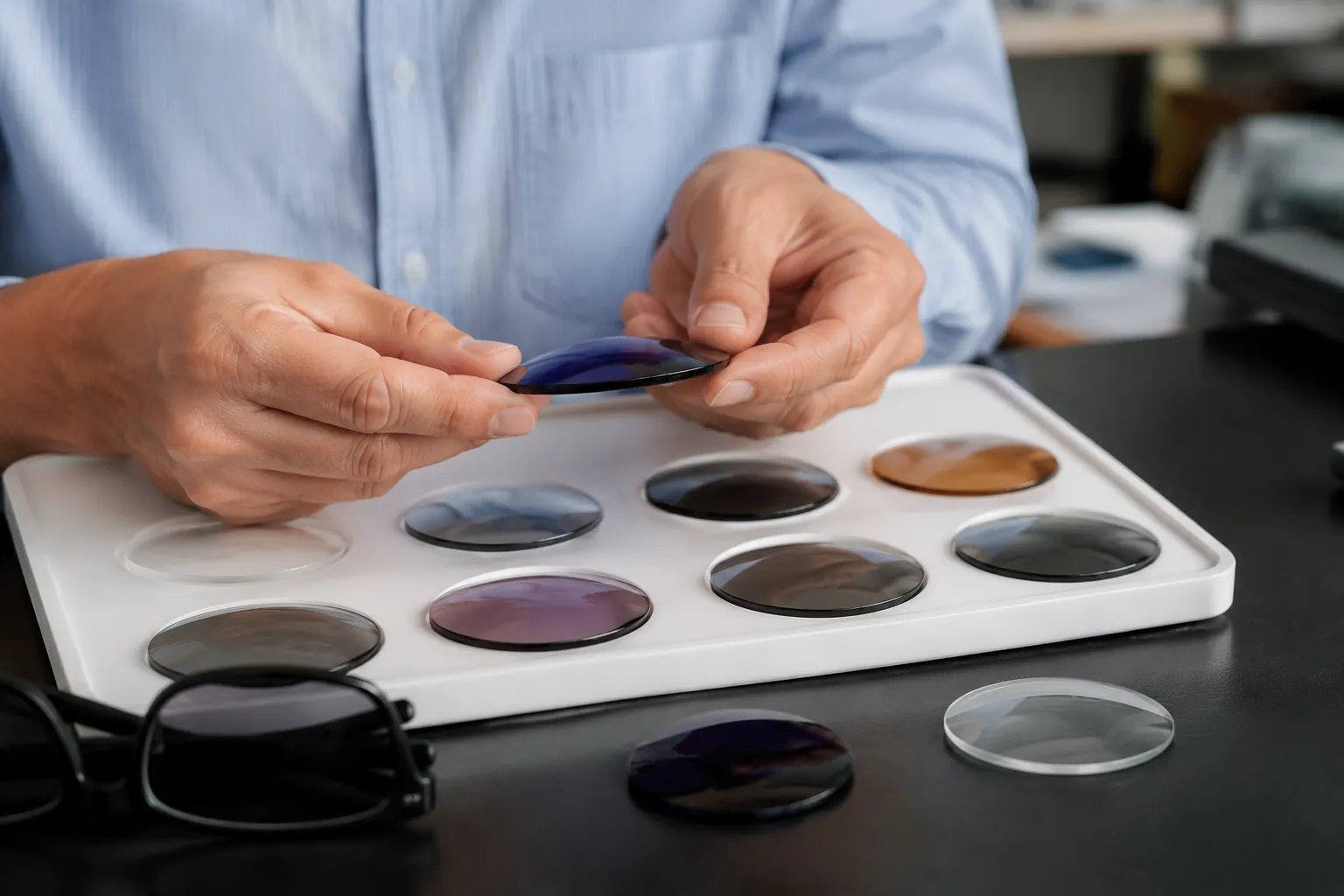
This guide is for brand owners, importers, distributors, and retail buyers ordering custom sunglasses in volume. The aim is simple: choose a visible light transmission (VLT) range that fits the target market, season, and end use, while cutting avoidable sample disputes and customer complaints. VLT is not just a style choice. It affects comfort, daytime usability, product category under applicable standards, sample approval, and how consistently a factory can reproduce the lens in bulk. A clear VLT spec at PO stage gives the supplier and your QC team a measurable target instead of a vague description like dark smoke.
Start with a buyer decision tree, not a lens swatch
Many VLT mistakes start with appearance alone. A lens that looks good under office lighting may be too dark for mixed-weather city retail, too light for high-glare resort use, or hard to reproduce if the brief says only smoke or dark brown. Start with function. Then set the look.
Use this order when building the specification:
- Define the sales channel: fashion chain, optical, sporting goods, resort, auto accessory, mass market, or DTC online.
- Define the main use: casual wear, daytime driving, beach, running, cycling, fishing, or mixed use.
- Define the climate and season: peak summer, year-round city wear, tropical glare, shoulder season, or cloudy northern market.
- Set a VLT range: usually a band rather than a single number.
- Lock the lens construction: solid tint, gradient, polarized, mirrored, and base material.
- Confirm compliance and labeling: CE EN ISO 12312-1, ANSI Z80.3, AS/NZS 1067, or other destination-market requirements as applicable.
For bulk orders, write a tolerance band, not a single-point VLT. Production is never that neat. Lens thickness, substrate, tint recipe, polarization film, and mirror coating can all shift final transmission. If the PO says 15% only, approval becomes subjective. If it says finished lens VLT 13% to 16%, QC has a real control point.
Define the approval sample clearly too. Approve a retained reference sample and record whether the VLT requirement applies to the finished lens after all coatings and assembly steps. That detail matters, especially for polarized and mirrored builds.
Commercial VLT ranges by use case
Buyers usually choose better from ranges than from exact numbers. The table below is a practical starting point for many custom sunglass programs. It is not the final word. Check the concept, the destination-market rules, and what end users actually expect.
| End use | Practical VLT target | Typical build | Main buyer caution |
|---|---|---|---|
| Fashion / everyday | 15% to 25% | PC or CR-39 smoke, brown, or green; optional flash mirror | Very dark lenses can reduce wearability in mixed-light markets. |
| Driving | 18% to 30% | Grey or brown, often polarized, low to medium mirror | Check local standard limits and avoid specifying a lens that is too dark for the intended driving use. |
| Beach / resort | 8% to 15% | Dark smoke or brown, often polarized, optional mirror | Good for high-glare environments, but less versatile for year-round urban wear. |
| Running / cycling | 20% to 35% | Brown, amber, or rose; shield or wrapped styles | Too-dark lenses can perform poorly when users move quickly between sun and shade. |
| Fishing / open water | 10% to 18% | Polarized TAC or PC, grey/brown/green, optional blue mirror | Mirror changes appearance, but polarization and finished VLT remain the key functional controls. |
| Cloudy markets / shoulder season | 25% to 40% | Lighter smoke, brown, or gradient | Marketing should match the lighter lens appearance and intended use. |
For a new sunwear line, 15% to 25% is often a solid default for broad everyday positioning. It reads as sunglasses. It also stays more wearable across varied conditions than a very dark beach-first lens.
- Below 10% VLT: better for high-glare, narrow-use concepts than broad daily wear.
- 15% to 25% VLT: a common commercial range for general sunglass programs.
- 25% to 35% VLT: often more suitable for sport, mixed light, and lower-glare markets.
- Above 35% VLT: may be too light for mainstream sunglass positioning unless the concept is fashion-led or low-light specific.
Regional and seasonal demand changes the target
The same frame does not need the same lens everywhere. High-glare markets and resort-heavy channels usually accept darker sunglass lenses more readily than cloudy urban markets, where buyers often want a lens that feels easier to wear through changing weather and lower light.
Season shifts the target too. For spring and autumn assortments, a 20% to 30% VLT is often more versatile than a very dark beach lens because customers can wear it in more conditions. For summer resort capsules, a darker polarized option may fit better. For travel-focused collections, many buyers choose a middle-range polarized lens that balances glare control with everyday usability.
One practical sourcing strategy is to split the same frame into two SKUs:
- Core urban SKU: smoke or brown lens at 18% to 25% VLT for fashion stores, online, and mixed-weather sell-through.
- High-sun SKU: darker polarized smoke, green, or brown at 10% to 15% VLT for resort, beach, and bright-region sales.
This is often easier than forcing one lens spec into every market. It lets the buyer keep one frame shape and tooling plan while adjusting lens performance by channel.
Lens material and construction change the result
Buyers often treat VLT as a color decision. It is not. Material and construction matter just as much. A 15% target in one build will not always behave the same way in another, either visually or in testing.
| Lens build | Typical sourcing use | Production behavior | What to control |
|---|---|---|---|
| PC solid tint | Mass market, sport, fashion | Widely used; thickness and curve can affect perceived darkness and measured transmission | Control base curve, center thickness, and finished VLT after edging |
| TAC polarized | Driving, fishing, beach | Multi-layer assembly; polarization film and adhesive stack affect total transmission | Confirm finished lens VLT for the complete assembly, not the substrate alone |
| CR-39 dyed lens | Optical-style or premium sunwear | Good optical clarity; final transmission depends on the tint process and process control | Approve both the visual color and the measured VLT band |
| Gradient lens | Fashion and women's collections | Upper and lower zones differ; indoor appearance can be misleading | Confirm how transmission is measured and verify category suitability under the target standard |
Tint color, polarization, and mirror coating are separate choices. Grey or smoke is common because it is visually neutral. Brown or tea is widely used for general wear and driving-led concepts. Green remains a classic balanced option. Amber or rose appears more often in sport programs where contrast in changing light matters.
If you specify mirror, ask for both the base lens VLT and the finished lens VLT after coating. If you specify polarized lenses, confirm that the quoted transmission refers to the full finished lens assembly. Miss this point and sample-to-bulk mismatch becomes much more likely.
How factories control VLT in production
VLT is controlled by process, not by guesswork. The main variables are substrate material, lens thickness, tint recipe, bath conditions where applicable, coating density, curing stability, and final inspection method. Repeatability usually improves when the supplier fixes these variables and measures finished lenses against an approved target.
A typical tinted sunglass lens workflow looks like this:
- Lens substrate is molded or prepared to the required curve and thickness.
- Surface is cleaned, inspected, and prepared for tinting, lamination, or coating.
- Lens is tinted or assembled to the approved construction.
- If required, polarized film, mirror coating, hard coating, or other treatment is applied according to the build.
- Lenses are cured, edged, and assembled into the frame.
- Finished eyewear is checked for transmission, cosmetics, and assembly quality.
In practice, a wrapped sports lens with a larger area and thicker edge may not look identical to a smaller flat fashion lens made to a similar recipe. Good suppliers account for that. They tune the process to the style and measure transmission with proper equipment rather than approving by color alone.
For buyers, the takeaway is simple: ask how the factory measures VLT, confirm whether the reading is taken on the finished lens, and keep the approved sample and test record with the production file.
Write the spec so QC can enforce it
A weak lens brief sounds like this: dark grey polarized lens with silver mirror. That is not enough. A usable brief gives the supplier and your QC team measurable control points.
Include these items on the specification sheet or PO:
- Lens material: PC, TAC polarized assembly, CR-39, nylon, or other approved material.
- Lens color: smoke, brown, green, amber, rose, gradient smoke, and so on.
- Target VLT range: for example 12% to 15%, 18% to 25%, or 22% to 30%.
- How VLT is defined: base lens only or finished lens after mirror and full assembly. For production control, finished lens is usually safer wording.
- Construction notes: polarized yes or no, mirror yes or no, gradient yes or no, hard coat or other required treatments.
- Reference sample: signed physical sample or retained approval sample matched to the production file.
- Compliance target: CE EN ISO 12312-1, ANSI Z80.3, AS/NZS 1067, or other destination-market standard as applicable.
- Chemical and packaging requirements: REACH where applicable, warning statements, barcode, carton marks, and market-specific labels.
For decoration-heavy programs, freeze the non-lens details before bulk too: pad printing color and position, laser engraving location, and metal logo plates or inserts if used. These details do not change VLT directly, but late cosmetic changes can delay final approval and create confusion over which sample is the real production reference.
For regulated sale, do not confuse management-system documents with lens performance. FDA registration may matter to a US import file, and ISO 9001 or BSCI may matter to supplier qualification, but they do not replace product performance testing. Keep supplier-qualification documents separate from product compliance evidence for the exact lens construction being purchased.
Common failure modes and a practical buying plan
Most VLT complaints are predictable. Common causes include specifying a lens that is too dark for the target market, approving by appearance only, using one global lens spec for very different climates, and failing to define a measurable tolerance band in the PO. Gradient programs add extra risk because the lens can look dark enough on a table while still wearing lighter than the buyer expected.
A practical way to cut risk on a new style is to launch one frame with more than one lens program and compare sell-through by channel. For example:
| SKU type | Lens spec | Best channel | Commercial logic |
|---|---|---|---|
| Core everyday | Smoke or brown, 18% to 25% VLT | General fashion retail, online, urban stores | Broad wearability with lower risk of darkness complaints |
| High-sun polarized | Smoke or brown polarized, 10% to 15% VLT | Beach, resort, bright-region driving | Clear performance step-up without changing frame design |
| Sport / active | Brown, amber, or rose, 22% to 32% VLT | Cycling, running, mixed-light use | More functional in changing light than a very dark lens |
Do not chase an exact number for its own sake. Pick a range that fits the market, write it clearly, and tie it to a retained sample and the applicable compliance standard. Control those basics and VLT becomes much easier to manage in both approval and production.
Have a custom sunglasses project in mind?
Send us your styles, target market and quantities and we will return a detailed quote with MOQ, lead time and a sample plan.
Get a QuoteWhy source this from Wenzhou with LumiShades
Wenzhou in Zhejiang Province is widely regarded as China’s eyewear manufacturing capital, producing a large share of the world’s sunglasses. That concentration matters to buyers: a deep local supply chain for acetate sheet, hinges, lens blanks, plating and packaging means shorter component lead times, easier color and material matching, and a workforce with decades of eyewear-specific skill. LumiShades has manufactured in this ecosystem since 2009, and our vertical integration — in-house injection molding, acetate cutting, CNC milling, lens tinting, decoration and quality control — means no part of your order is quietly subcontracted to a workshop you cannot audit.
For international buyers, that vertical control translates into accountability. When a single factory owns every step, defects are traced and fixed at source rather than bounced between vendors, and your specifications survive intact from first sample to bulk. We back this with 15+ years of experience, shipments to 60+ countries, more than 5 million pairs produced per year and a 98.5% on-time delivery rate. Our certifications — CE EN ISO 12312-1, FDA registration, ANSI Z80.3, AS/NZS 1067, REACH, ISO 9001 and BSCI audit — mean the compliance documentation your market requires already exists. Explore our manufacturing capabilities and quality control process to see how this works in practice.
Frequently asked questions
What VLT is the safest default for a new fashion sunglass line? For broad everyday positioning, 15% to 25% VLT is often a practical starting range. It is usually dark enough to read clearly as sunglasses while staying more wearable across mixed weather and urban conditions than a very dark resort lens. On the PO, specify the range, the lens color, the material, and whether the value refers to the finished lens after any mirror coating or polarization assembly.
Should driving sunglasses be polarized and very dark? Polarization is often useful for daytime driving because it can reduce reflected glare from roads and other flat surfaces. Very dark is not automatically better. For many daytime driving concepts, buyers start around 18% to 30% VLT, then verify the final specification against the destination-market standard and intended use. If the product is marketed for driving, confirm compliance first and do not approve a lens only because it looks premium indoors.
How should I write VLT on a purchase order? Use a measurable range and define the construction. A workable format is: smoke polarized lens, TAC construction, finished lens VLT 12% to 15%, silver mirror, compliance to CE EN ISO 12312-1 and ANSI Z80.3 if required by destination market. Also attach or reference the approved sample so QC can compare bulk goods against the same standard used at approval stage.
Does mirror coating determine how dark the lens is? No. Mirror affects appearance and can change transmission, but final VLT depends on the full lens build: substrate, tint depth, thickness, coatings, and polarization stack where applicable. Ask the supplier for both base-lens VLT and finished-lens VLT after coating, and use the finished-lens value for production control whenever possible.
What should I ask the supplier to provide when VLT is critical? Ask for the target VLT range, the test method or measurement equipment used, confirmation that the reading applies to the finished lens, and a retained approval sample. If the product is sold in a regulated market, also ask for the relevant compliance documents for the exact lens construction, such as CE EN ISO 12312-1, ANSI Z80.3, or AS/NZS 1067 as applicable. Keep REACH, FDA registration, ISO 9001, and BSCI in the file where relevant, but treat them as separate from lens-performance evidence.
Ready to start?
Explore our wayfarer sunglasses or request a quote — our sales team replies within 12 hours.
Request a Quote