
Polarized Lens Film Checks Before OEM Scale-Up
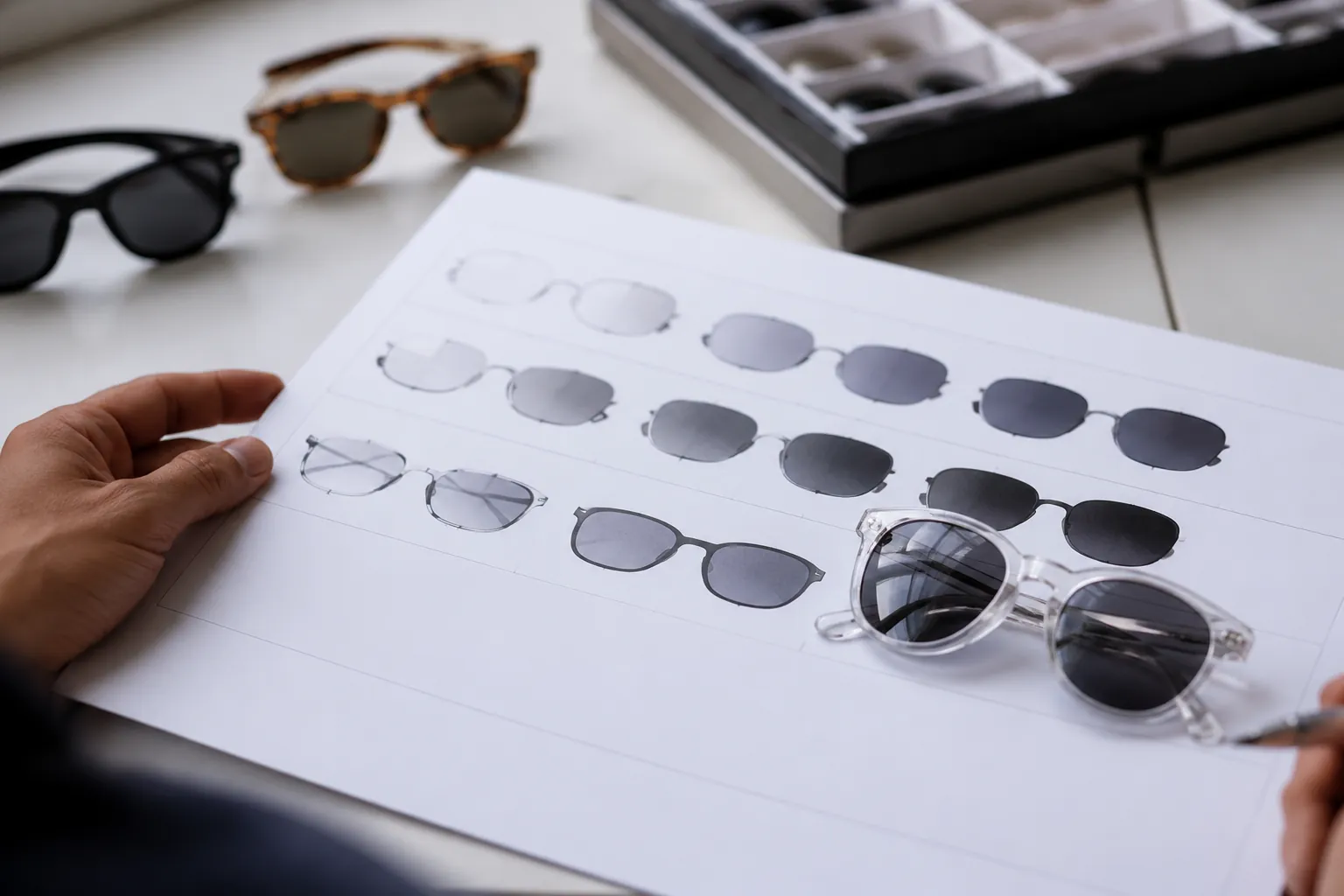
This guide is for brand owners, importers, distributors, and retail buyers sourcing polarized sunglasses at OEM scale. Risk usually shows up after sample approval, when production moves to volume. A lens that looked fine in sampling can show haze after lamination, distortion after mounting, left-right mismatch, or poor repeatability on reorders. Polarized film quality is not just about glare reduction. It affects optical clarity, assembly yield, compliance review, warranty exposure, and whether a supplier can reproduce the same SKU on the next purchase order. Define the lens stack clearly. Review the right checkpoints before release. That is how you cut avoidable quality risk as volume rises.
Start With Failure Modes, Not Sample Beauty
Many buying mistakes start here: the sample is judged like a retail display piece instead of a production reference. It may look good under showroom lighting and still fail after lens edging, frame insertion, heat exposure, or repeat production. Ask a better question. Not, "Does this sample look nice?" Ask, "Which failure modes can hurt sell-through, trigger returns, or break reorder consistency, and which can I screen before bulk?"
In polarized programs, the costliest failures are often not obvious at first glance. Delamination may appear only after heat exposure or long storage. Distortion may show up only after the lens is mounted. Haze can increase when film quality, contamination, or unstable lamination conditions affect the finished lens. Rank these issues by business impact, not by how easy they are to spot on a sample table.
- Delamination: separation within the lens structure after heat, humidity, or weak bonding; often becomes a post-delivery claim.
- Haze: a milky appearance that reduces clarity and shows up more clearly against a dark background.
- Optical distortion: visible warpage caused by lens forming, base-curve error, or mounting stress.
- Axis error: inconsistent polarization orientation between left and right lenses, which can affect visual comfort.
- Reorder drift: the same SKU being produced later with different film, substrate, tint behavior, or coating appearance.
These risks do not carry the same weight. A small color shift may be manageable in some fashion programs if the pair still matches and remains within the intended lens category. Distortion is more serious because the wearer sees it fast. Delamination is often the most expensive because it can appear after shipment and lead to replacements, freight loss, and retailer complaints. That is why lens approval should include QC and production staff, not just the sales contact.
Lock The Lens Spec Before Approval
Do not approve a polarized SKU based on a frame photo, a lens color name, and a verbal promise that "bulk will be the same." If the lens stack is not written down, the supplier still has room to change film source, substrate, thickness, coating route, or tint process while claiming the order met the request. That gap is where reorder problems start.
A usable purchase specification should define construction, appearance targets, and compliance market. At minimum, it should state substrate material, nominal thickness, base curve, tint target, polarization axis requirement, coatings, cosmetic standard, and required market documents. This matters in every price tier. It matters even more in private-label programs where substitution risk is higher.
- Substrate: TAC, PC, nylon, or another specified material, with the nominal thickness required for the program.
- Lens construction: laminated polarized lens, co-extruded structure, or another defined build, plus whether hard coat, AR, mirror, or hydrophobic topcoat is included.
- Base curve and shape: for example a lower-wrap fashion lens versus a higher-wrap sport lens, because curve affects forming and distortion risk.
- Tint and lens category target: color reference plus the intended transmission target or approved range used for product review.
- Axis requirement: a stated left-right alignment requirement with an agreed inspection method.
- Cosmetic acceptance: haze, bubbles, scratches, edge whitening, flow marks, and coating defects defined before the PO is released.
- Compliance market: CE EN ISO 12312-1, ANSI Z80.3, AS/NZS 1067, REACH, FDA registration where applicable, and any other required market-access documents.
If these points are not defined in writing, it becomes hard to challenge substitutions later. Use a lens specification sheet. Attach it to sample approval and reference it on the purchase order. The approved sample should sit on top of a controlled technical record, not appearance alone.
How To Screen Film Quality Without A Full Lab
You do not need a full optical lab to catch many common polarized lens problems. You do need a disciplined review method. Ask for three sample forms: loose lenses before assembly, assembled frame samples, and one retained approval reference. Each serves a different purpose. Loose lenses help you review lamination quality, edge finish, and tint uniformity. Assembled samples show mounting stress, fit tolerance, and real-use appearance.
Review samples under more than one condition: daylight or daylight-equivalent lighting, indoor white light, and a dark background. Lighting changes what defects you can see. A lens that looks clean in a display box may show stress marks, edge whitening, or haze under stronger contrast. For production programs, review multiple pairs from a pilot run instead of relying on one hand-finished sample.
- Straight-line check: look through the lens at window frames, tile joints, or a printed grid from a consistent distance to screen for visible warpage.
- LCD rotation check: rotate each lens in front of a phone, tablet, or monitor screen; darkening should be even, and left-right response should be consistent.
- Edge inspection: examine the rim area for film exposure, chips, whitening, adhesive irregularity, or signs of separation after edging.
- Haze review: place the lens against a black card under strong light to make milkiness easier to see.
- Lens pair match: compare left and right lenses for tint depth, mirror appearance, and polarization response.
One issue gets missed again and again: assembly stress. A lens may pass every check as a loose part and then distort once inserted into a tight groove or a frame with uneven curvature. So link lens approval to frame assembly approval. Review them separately and you can end up with false confidence.
Material And Process Trade-Offs Buyers Feel In Bulk
Not all polarized lenses behave the same in production. Material choice affects reject rate, product positioning, and claims risk as much as quoted lens cost. The right option depends on target price, frame construction, wrap level, and the performance expected by the end market. Cheap on paper can get expensive fast.
| Lens Type | Typical Thickness | Best Use | Main Advantage | Main Production Risk |
|---|---|---|---|---|
| TAC polarized | About 0.74-1.1 mm | Fashion sunglasses, private label, medium volume | Good optical appearance and competitive cost | Lamination strength and edge durability depend heavily on film and process control |
| PC polarized | About 1.0-1.8 mm | Sport, kids, lightweight injected frames | Low weight and good impact resistance | Stress sensitivity can increase visible distortion during forming or mounting |
| Nylon polarized | About 1.0-1.5 mm | Premium performance and wrap styles | Good optical performance and suitability for demanding curves | Higher cost and a narrower forming process window |
| Mixed-source low-cost polarized | Varies widely | Promotional and price-led programs | Lower entry cost | Higher batch variation and weaker reorder matching if inputs are not tightly controlled |
Process detail matters just as much as material. A TAC lens can perform well if lamination, edging, coating handling, and QC are stable. A PC lens can still fail if a tight wrap or aggressive insertion creates stress. Mirror coating, flash coating, laser marking, pad printing, hot stamping, and metal logo insertion can all affect perceived lens quality because they change handling, heat exposure, or how defects show up in the finished product. In bulk production, buyers feel these choices through yield and complaint rate. Not through theory. A factory with clear control over molding, lens processing, decoration, and final QC usually gives the buyer better traceability than a supply chain split across several subcontractors.
Reorder Stability Is A Control-System Issue
The first order is often easier than the third. Many polarized SKUs drift on repeat orders because the approved sample was never tied to a controlled material record. The style code stays the same, but the film source changes, the substrate lot behaves differently, or the coating supplier changes the visual finish. Buyers may notice only after mixed inventory hits the warehouse.
If a polarized SKU matters commercially, ask exactly how the supplier protects repeatability. A strong answer should include retained samples, lot traceability, process records, and change approval rules. Generic statements like "same as before" prove very little.
- Retained references: one sealed master sample kept by the factory and one kept by the buyer for each live SKU.
- Lot logging: film lot, substrate lot, coating lot, tint batch, and assembly date tied to the PO or production order.
- Color standard: a visual master plus the transmission target or another agreed internal control reference.
- Process record: key production settings and assembly notes recorded for repeat orders.
- Change control: no film or substrate substitution without written buyer approval.
These controls matter because reorder stability depends less on promises than on whether the factory has a system to reproduce the same lens structure on purpose. Buyers should ask to see how sample retention, lot records, and change approval work before the first large-volume release, not after a mismatch appears.
Manage Compliance And Production Timing Together
Polarization does not replace compliance. A lens can reduce glare and still fail the standard required for its target market. Confirm not only which standard applies, but whether the exact product configuration being sold was the one reviewed. Frame style, lens category, tint, and coating can all affect the final compliance position.
Common market references include CE EN ISO 12312-1, ANSI Z80.3, and AS/NZS 1067. Chemical and market-access review may also involve REACH and, where applicable, FDA registration. System certifications such as ISO 9001 and BSCI can indicate process discipline at the factory level, but they do not replace product-level review for the specific sunglass being sold.
Timing matters too. If you are still changing tint density, mirror finish, lens source, or artwork placement after sample approval, bulk release becomes less predictable. The safer sequence is simple: lock the lens construction, review pilot samples, confirm that compliance documents match the actual SKU and target market, then release bulk production.
Decoration planning should be part of that sequence. Pad printing, screen printing, laser engraving, heat-transfer logo application, and metal logo attachment may not change the lens structure directly, but they can affect handling, production pace, and the visual balance of the finished product. Some delays that look like lens problems are really artwork changes or assembly conflicts found too late. Plan for those interactions before the order is released.
A Practical Pre-PO Checklist For Buyers
Before scaling a polarized SKU, run a short gate review. This catches many preventable problems without turning sourcing into a lab exercise. The goal is not theoretical perfection. The goal is to remove avoidable uncertainty before you commit to volume.
- Approve the exact lens stack: substrate, polarized construction, nominal thickness, coating route, base curve, and tint target.
- Review loose lenses and assembled samples: never approve on frame appearance alone.
- Check visual distortion: use straight-line targets and compare multiple pairs, not one hand-finished sample.
- Inspect haze and edge quality: use a dark card, strong light, and close rim inspection for whitening, chips, or film exposure.
- Confirm left-right consistency: tint depth, mirror appearance, and polarization response should match within your acceptance standard.
- Match documents to the real SKU: compliance records should reflect the actual material, tint family, and target market requirement.
- Require retained production references: keep one approved sample with the buyer and one with the factory for reorder control.
- Use pilot production strategically: if the lens structure or frame fit is new, validate the process with a small controlled run before moving to full volume.
That last point matters. A pilot run helps expose assembly stress, tint inconsistency, or edge defects before they spread across a shipment. Once the supplier shows that the polarized lens can survive normal production conditions and still match the approved reference, the decision to scale is based on evidence, not hope.
Have a custom sunglasses project in mind?
Send us your styles, target market and quantities and we will return a detailed quote with MOQ, lead time and a sample plan.
Get a QuoteWhy source this from Wenzhou with LumiShades
Wenzhou in Zhejiang Province is widely regarded as China’s eyewear manufacturing capital, producing a large share of the world’s sunglasses. That concentration matters to buyers: a deep local supply chain for acetate sheet, hinges, lens blanks, plating and packaging means shorter component lead times, easier color and material matching, and a workforce with decades of eyewear-specific skill. LumiShades has manufactured in this ecosystem since 2009, and our vertical integration — in-house injection molding, acetate cutting, CNC milling, lens tinting, decoration and quality control — means no part of your order is quietly subcontracted to a workshop you cannot audit.
For international buyers, that vertical control translates into accountability. When a single factory owns every step, defects are traced and fixed at source rather than bounced between vendors, and your specifications survive intact from first sample to bulk. We back this with 15+ years of experience, shipments to 60+ countries, more than 5 million pairs produced per year and a 98.5% on-time delivery rate. Our certifications — CE EN ISO 12312-1, FDA registration, ANSI Z80.3, AS/NZS 1067, REACH, ISO 9001 and BSCI audit — mean the compliance documentation your market requires already exists. Explore our manufacturing capabilities and quality control process to see how this works in practice.
Frequently asked questions
How can I tell if polarized film quality is stable enough for repeat orders? Ask the supplier for three things in writing: lot traceability for film and substrate, a retained approval sample, and a no-substitution rule without buyer approval. Then, before releasing the next PO, compare a new production sample against the retained reference for haze, left-right tint match, lens category target, and polarization response. If the supplier cannot connect the sample back to specific material lots and production records, repeatability is not well controlled.
Is TAC polarized always the best value for a commercial sunglass program? No. TAC is widely used because it can offer a good balance of appearance and cost, but value depends on the frame design and how the lens is processed. For a lower-wrap fashion frame, TAC may be a practical choice if lamination quality and edge finish are stable. For kids, sport, or higher-wrap styles, PC or nylon may reduce mounting stress or performance complaints. Judge the option by total risk in the finished SKU, not lens cost alone.
What is the biggest mistake buyers make with polarized samples? They approve a cosmetic sample without checking the lens after assembly. A loose lens can look clean and still show visible warpage, edge whitening, or left-right mismatch once mounted in the actual frame. Always review both loose lenses and assembled samples, and ask to see parts from a pilot run if the frame fit or lens construction is new.
Should I request compliance reports before or after sample approval? Request them before bulk release and early enough to adjust the product if something does not match. The key point is not just to collect documents, but to confirm that they apply to the actual SKU being sold, including the lens category, material, tint family, and target market. If the report is based on a different lens construction or a different product configuration, it should not be treated as final support for the bulk order.
How do MOQ and volume affect polarized lens quality control? Higher volume does not automatically improve quality, but it does make control systems more important. In small runs, suppliers may use available stock and more manual handling, which can hide repeatability issues. As volume increases, buyers should require stronger lot control, retained samples, and documented process records because any mismatch in film, tint, or mounting condition affects more units. A practical approach is to use a pilot run to prove the lens stack and assembly method before scaling to full production.
Ready to start?
Explore our cat-eye sunglasses or request a quote — our sales team replies within 12 hours.
Request a Quote