
PC vs TAC vs Nylon Polarized Lenses: Buyer Guide
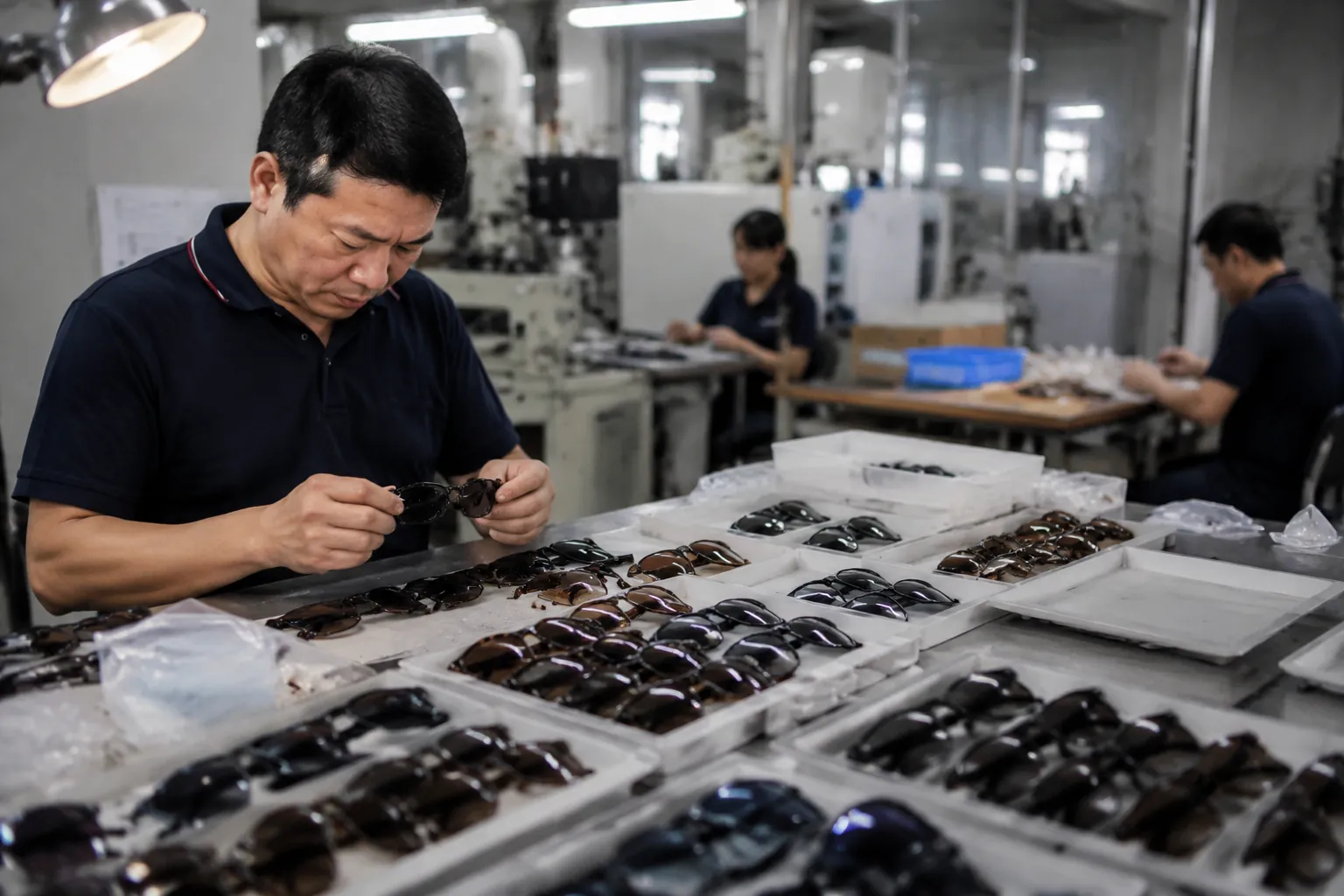
This guide is for brand owners, importers, distributors, and retail buyers selecting a polarized lens construction for custom sunglasses. PC, TAC, and nylon can all work. They do not behave the same in production, transport, retail use, or claims handling. The real decision is not lens cost per pair. It is total landed cost after production yield, coating scrap, assembly risk, compliance testing, return exposure, and channel fit. If you are sourcing at volume, lock the lens construction before you finalize frame geometry, decoration, packaging, and target-market compliance requirements.
Start with channel economics, not the lens pitch
Buyers often compare polarized lenses through vague claims like "better clarity" or "more premium feel." That is not enough. Start with the channel, target retail price, use case, and how much after-sales risk the margin can absorb.
In practice, PC, TAC, and nylon usually support different product positions. PC polarized is common in price-sensitive programs, youth styles, promotions, and active frames where impact resistance matters. TAC polarized is widely used in mid-market fashion and lifestyle sunglasses because it delivers a familiar polarized story at a workable cost. Nylon polarized is more common in sport, driving, outdoor, and better specialty retail, where low weight and stable visual performance on wrapped frames can support a higher selling price.
This choice affects more than raw lens cost. It changes edging yield, insertion difficulty, coating handling, QC checkpoints, and the risk that an approved sample performs differently after shipping, storage, or retail display. A low-cost TAC lens may look attractive on the quote sheet. If lamination is inconsistent, losses can rise during edging or assembly. A nylon lens costs more upfront, but it may make more sense in a premium sport program where distortion complaints or laminate failures would be expensive to absorb.
Set the lens construction early. Then lock frame curvature, logo treatment, and packaging. Reverse that order and you invite rework, fit issues, and late compliance checks.
What changes in production with PC, TAC, and nylon
These are not just different materials. They bring different process controls and different failure risks. Those differences show up in production first, then in the field.
- PC polarized: Usually based on polycarbonate with polarization created through a specific construction selected by the supplier. PC is widely used because it offers strong impact resistance and broad commercial availability. Its weak points are usually lower surface hardness unless hard-coat performance is well controlled, and tighter optical control needs on stronger curves or fashion shapes.
- TAC polarized: A laminated lens construction built from multiple layers, typically including TAC films, adhesive layers, and a polarized core. TAC is common because it balances appearance and cost. The main risk is laminate stability. If adhesive control, storage, edging, or handling is poor, the lens may develop edge lift, bubbles, haze, or warpage.
- Nylon polarized: More common in premium and performance sunglasses because it is light, tough, and generally well suited to wrapped frames. It usually costs more than PC or TAC, so it is less common in budget-led programs. Still, it can be the right fit where optical stability and wearing comfort matter more than entry cost.
Production usually runs through lens sourcing or forming, tinting where needed, hard coating, mirror or flash treatment if required, polarization verification, edging to frame shape, cleaning, assembly, and final inspection. Every step can create loss if the lens specification and frame geometry are misaligned. Wrapped frames with tight grooves demand disciplined tolerance control after edging. Too large, and insertion stress rises. Too small, and retention weakens or the lens rattles. Simple as that.
Decoration choices also matter. Hot foil, laser logo, pad print, temple metal insert, and heat-transfer branding all affect handling order. A mirrored or flash-coated lens needs more careful handling and packing than a basic tinted lens. That raises labor sensitivity during assembly and final QC.
Head-to-head comparison: optics, durability, MOQ, and landed cost
| Lens type | Main strengths | Main risks | Typical channel fit | MOQ and cost logic |
|---|---|---|---|---|
| PC polarized | High impact resistance, broad availability, commercially efficient for many entry programs | Scratch performance depends heavily on hard-coat quality; optical distortion must be controlled carefully on stronger curves | Entry retail, promotions, kids, active and sport-inspired styles | Often selected for low to mid budgets; usually easier to justify on small runs than premium materials |
| TAC polarized | Balanced cost-to-appearance ratio, familiar polarized value story, widely available | Lamination-related failure if heat, humidity, edging, or storage control is weak | Mid-market fashion, lifestyle chains, private label programs | Common commercial middle ground for many custom programs |
| Nylon polarized | Low weight, good suitability for wrapped sport frames, strong fit for premium performance positioning | Higher raw material cost and less suited to promotion-led price targets | Performance sport, outdoor, driving, premium specialty retail | Usually easier to justify when the retail price and channel can support the higher lens cost |
| Relative lead-time sensitivity | Low to moderate | Moderate | Moderate to higher on special wraps and colors | Late specification changes are usually more disruptive on nylon and laminated constructions |
There is no universal winner. TAC is often the middle lane because consumers recognize the polarized value story and the entry cost stays manageable. PC protects margin on aggressive retail price bands. Nylon earns its place when the promise is sport, driving, performance, or premium outdoor use.
On MOQ and pricing, think in stages rather than as one static number. A very small run mainly buys flexibility, not efficiency. As volume rises, material planning, setup, and production scheduling usually improve. Nylon polarized programs still cost more than basic PC or TAC options, and splitting one style into too many colorways weakens cost efficiency because each colorway behaves like a smaller batch for lens allocation and QC.
Failure modes to audit before sample approval
Most polarized-lens claims trace back to a short list of repeat failures. Good buyers ask about them before deposit. Not after complaints arrive.
- Scratch complaints: Common when hard-coat performance is weak or handling control is poor. Ask what abrasion testing is used, whether the coating method is defined, and whether mirror or flash finishes increase cosmetic risk.
- Lamination separation: Mainly a TAC risk. Heat exposure, humidity, weak adhesive control, or poor edge finishing can lead to peeling, bubbles, haze, or milky edges over time.
- Optical distortion: More visible on aggressive base curves, wrapped sport frames, or poorly controlled edging. This matters most in driving and performance channels where visual discomfort can trigger returns.
- Polarization axis misalignment: If the axis is off, the lens may still look acceptable but perform poorly in glare reduction. QC should check this against a defined standard, not casual visual review.
- Stress cracking during assembly: Tight groove tolerance, rough insertion, or poor fitting control can damage coated lenses or create delayed failure during shipping and retail storage.
Process control matters. Factories that manage frame production, lens edging, assembly, and final QC within one system usually control fit better because frame groove dimensions and finished lens dimensions can be checked together. Even a small mismatch multiplies through production. Excessive insertion force can mark the lens edge, damage a coating, or create stress that appears later.
Ask what defects are screened at final QC: coating pinholes, edge chips, polarization consistency, left-right color match, surface contamination, and assembly marks from trays, gloves, or insertion tools. A sample that looks good is useful. It is not proof of stable mass production.
Compliance applies to the finished sunglass
Many overseas buyers ask first for a polarized-lens data sheet. That is not enough. The market receives a finished sunglass, so compliance has to be reviewed at finished-product level.
Depending on destination and category, the framework can include CE EN ISO 12312-1, ANSI Z80.3, AS/NZS 1067, REACH, and FDA registration where applicable. Lens material, tint category, UV performance, frame fit, and labeling all need to support the target-market requirement.
Two mistakes are common. First, buyers assume a darker lens means stronger UV protection. It does not. UV performance depends on the lens material and its treatment, not simply visible darkness. Second, buyers change mirror coating, tint density, or lens construction late in development and assume the original test basis still applies. Often it does not. Those changes can require the factory or buyer to recheck optical performance, labeling, or other compliance points for the finished product.
For multi-market programs, lock the construction before bulk production. Confirm the lens material, polarized structure, tint category, UV claim, and any country-specific chemical or labeling requirements. Quality-system credentials such as ISO 9001 and social audits such as BSCI can indicate process discipline, but they do not replace product testing or market-specific compliance review.
Lead time, MOQ pressure, and where delays start
Lens choice affects launch timing. Usually the difference shows up as process sensitivity, not dramatic calendar gaps. It still matters when the retail window is fixed.
| Program factor | PC polarized | TAC polarized | Nylon polarized |
|---|---|---|---|
| Sample development | Usually straightforward on stable frame geometry | Moderate; laminate review and cosmetic checks matter | Often more sensitive on wrap, clarity, and color control |
| Typical sample timing | Project dependent; often faster when the lens is standard and the frame geometry is stable | Project dependent; laminate review can add approval steps | Project dependent; special wraps, mirrors, or colors may require closer review |
| Typical bulk timing | Usually driven by material readiness, coating schedule, and frame production | Usually driven by laminate availability, coating schedule, and assembly control | Usually driven by material readiness and tighter review on optics and fit |
| MOQ pressure | More forgiving for small or price-sensitive runs | Balanced option for many custom programs | Better suited to programs where volume and retail positioning can support the cost |
Most delays are not the obvious ones. They come from late changes to color approval, logo method, mirror coating, or frame curvature after the lens has already been reviewed. Change a wrapped sport frame to a more aggressive curve late in development, and the lens program may need a fresh check for distortion, fit, and yield.
MOQ can start low enough for market tests or small private-label launches, but buyers should stay realistic. Small runs carry higher unit costs because setup time, color control, and QC effort cannot be spread efficiently. Better efficiency usually comes from concentrating demand into fewer SKUs rather than dividing one style into many low-volume lens colors.
A practical selection framework for buyers
If you need a working rule, use this:
- Choose PC polarized when retail price pressure is high, the frame is youth or active, and impact resistance matters more than premium optical positioning.
- Choose TAC polarized when the product sits in fashion or general lifestyle retail and needs a balanced mix of appearance, cost, and familiar consumer value.
- Choose nylon polarized when the line is built for sport, driving, outdoor use, or premium positioning where lower weight and stable performance on wrapped frames support the selling price.
Then pressure-test that choice with four questions: What is the target retail price? What return rate can the margin absorb? What shipping and storage conditions will the goods face? How many units is this SKU likely to sell?
The last question is often the most important. A nylon polarized lens on a slow-moving style ties up cash. A budget PC lens on a premium outdoor program may reduce purchase cost but create scratch or distortion complaints if the specification is wrong. Match the lens construction to channel economics, use case, and risk tolerance. Ignore the marketing language.
What to lock with the factory before you issue the PO
Before deposit, ask for a final confirmation sheet that fixes the full lens specification: material, polarization construction, UV claim, tint category, base curve, hard-coat requirement, mirror or flash treatment, approved color reference, and left-right matching standard. If this is not documented clearly, production can drift away from the approved sample.
Confirm the frame side of the fit as well. Lens performance is affected by groove depth, groove width, front curvature, and insertion method. If the factory controls injection molding, acetate processing, CNC work, decoration, lens edging, and final QC in-house, it usually has a better chance of managing lens-to-frame tolerance consistently. Even then, require pre-production confirmation on fit, polarization check method, packaging protection, and final inspection criteria.
A practical checklist should include:
- Approve the exact lens construction, not only the visible color.
- Confirm the destination-market compliance target before bulk production.
- Lock the decoration method early because heat, pressure, and handling can affect lens cosmetics.
- Review MOQ by colorway as well as by style.
- Ask which defects are screened in final QC and how AQL is applied.
- Confirm carton and inner-pack protection if using mirrored, flash, or premium sport lenses.
This is where margin is protected: in specification control that prevents avoidable claims, not in a sample photo or a broad claim that all polarized lenses are interchangeable.
Have a custom sunglasses project in mind?
Send us your styles, target market and quantities and we will return a detailed quote with MOQ, lead time and a sample plan.
Get a QuoteWhy source this from Wenzhou with LumiShades
Wenzhou in Zhejiang Province is widely regarded as China’s eyewear manufacturing capital, producing a large share of the world’s sunglasses. That concentration matters to buyers: a deep local supply chain for acetate sheet, hinges, lens blanks, plating and packaging means shorter component lead times, easier color and material matching, and a workforce with decades of eyewear-specific skill. LumiShades has manufactured in this ecosystem since 2009, and our vertical integration — in-house injection molding, acetate cutting, CNC milling, lens tinting, decoration and quality control — means no part of your order is quietly subcontracted to a workshop you cannot audit.
For international buyers, that vertical control translates into accountability. When a single factory owns every step, defects are traced and fixed at source rather than bounced between vendors, and your specifications survive intact from first sample to bulk. We back this with 15+ years of experience, shipments to 60+ countries, more than 5 million pairs produced per year and a 98.5% on-time delivery rate. Our certifications — CE EN ISO 12312-1, FDA registration, ANSI Z80.3, AS/NZS 1067, REACH, ISO 9001 and BSCI audit — mean the compliance documentation your market requires already exists. Explore our manufacturing capabilities and quality control process to see how this works in practice.
Frequently asked questions
Is TAC always better than PC because it looks more premium? No. TAC is often selected for mid-market fashion and lifestyle programs because it offers a recognizable polarized construction at a workable cost, but that does not make it automatically better than PC. PC may be the stronger choice where impact resistance, youth use, active styling, or strict retail price targets matter more. Compare the full program: target price, frame curve, scratch-risk tolerance, shipping conditions, and likely complaint exposure.
Which polarized lens type is least risky for hot-climate shipping and storage? There is no single answer without reviewing the actual construction and packaging, but laminated TAC lenses need especially careful control because heat and humidity can affect adhesive layers if the build quality or storage conditions are weak. If the goods will move through hot warehouses or long summer transit, ask the supplier to confirm the exact lens construction, explain how it manages storage and edge finishing, and provide the finished-product test basis for the target market. Also review packaging protection before approving the sample.
Can I use one lens construction for the EU, US, and Australia? Sometimes, but do not assume one construction automatically covers every market. The finished sunglass may need review against <strong>CE EN ISO 12312-1</strong>, <strong>ANSI Z80.3</strong>, and <strong>AS/NZS 1067</strong>, with <strong>REACH</strong> and <strong>FDA registration</strong> considered where relevant. The practical step is to define the final lens material, tint category, UV claim, and frame configuration first, then confirm with the factory or your compliance partner whether that exact finished product is suitable for each destination market.
At what volume does nylon start to make commercial sense? Nylon usually makes the most sense when the product is positioned for sport, outdoor, driving, or premium retail and the channel can support the higher lens cost. There is no universal volume threshold because the answer depends on retail price, margin, and the number of colorways. Compare nylon against TAC or PC on total program economics: unit cost, expected returns, fit on wrapped frames, and whether the product promise actually needs the performance benefits nylon is meant to deliver.
What should I ask for during a polarized lens sample review? Ask for written confirmation of the lens material, polarized construction, hard-coat or coating stack, UV claim, tint category, and any mirror or flash treatment. Then inspect the assembled sample for optical distortion, polarization performance, surface defects, scratch sensitivity, left-right color match, edge quality, and fit in the frame groove. If the program targets a specific market, confirm which finished-product compliance path applies and make sure late changes to tint, coating, or lens construction are not made without rechecking the approval basis.
Ready to start?
Explore our square sunglasses or request a quote — our sales team replies within 12 hours.
Request a Quote