
PC vs TAC vs Nylon Polarized Lenses: Budget Guide
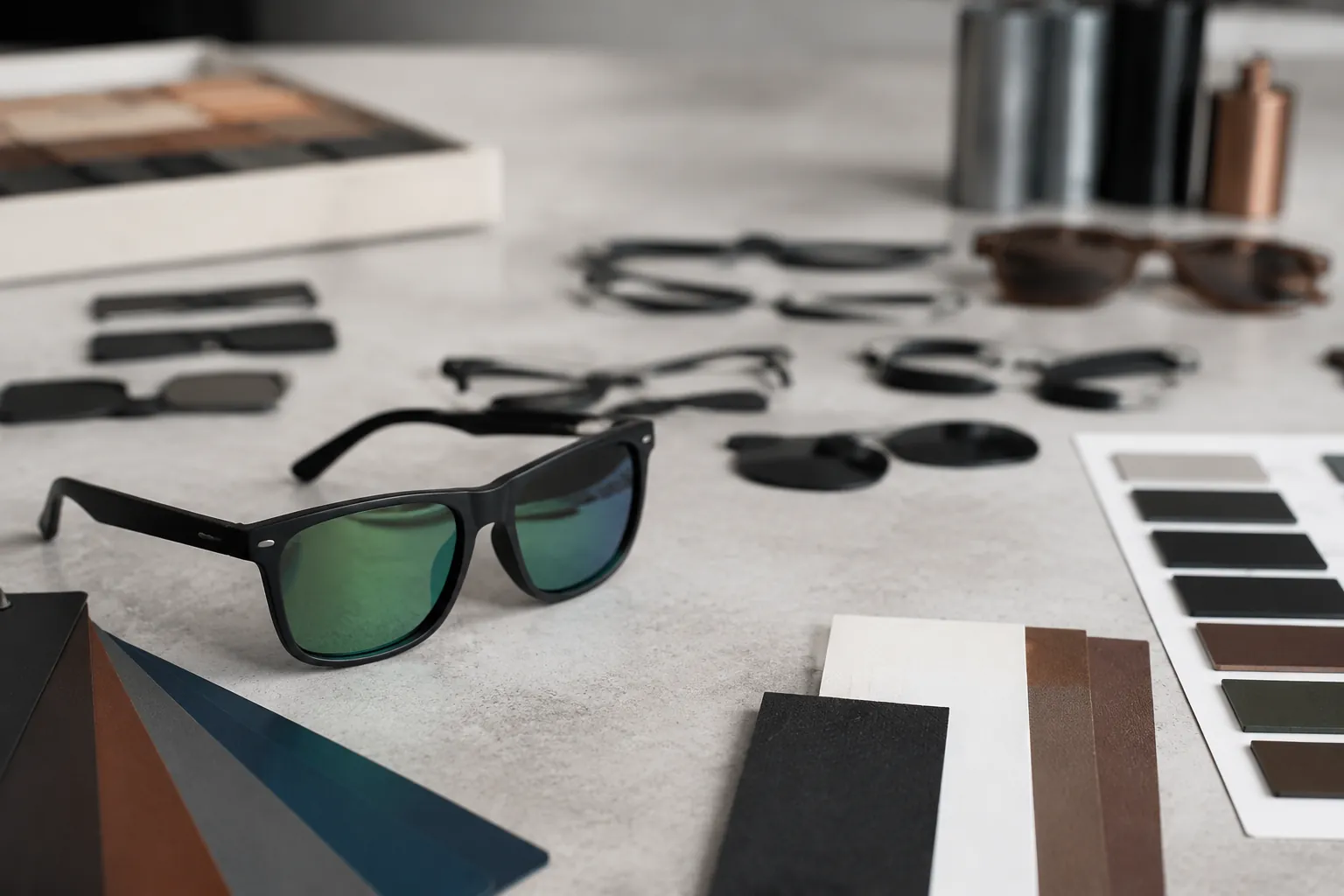
This guide is for eyewear brands, importers, and retail buyers comparing polarized lens options against a real budget and sales channel. PC, TAC, and nylon can all work. They do not solve the same problem. Each brings different tradeoffs in optics, impact behavior, processing, and quality-control risk. The goal is simple: match the lens construction to the target retail price, use case, compliance requirements, and production limits before sample approval and bulk ordering.
Start with the sales channel, not the material
Many buyers start by asking for a lens material. That is the wrong first question. Start with the sales channel, target retail price, intended use, and expected abuse level. A giveaway, a fashion private-label style, and a sport frame at a premium price do not need the same lens construction.
Use this filter before requesting quotations.
- Promotional, event, giveaway, or low-price bundle: PC polarized is often the first option to cost. It is widely available, impact resistant, and commercially practical for price-sensitive programs.
- Fashion retail and mid-market private label: TAC polarized often gives a competitive mix of appearance, polarization, and cost when the frame is not built for hard sport use.
- Sport, outdoor, driving, or premium positioning: Nylon is worth quoting when optical quality, low weight, and in-use performance matter more than the lowest unit cost.
This choice affects more than lens cost. It can change frame design, groove tolerances, coating options, sample-approval criteria, production yield, and complaint risk. The right lens is the one that fits the product brief, the frame build, and the compliance path for the destination market.
Head-to-head: cost, optics, and failure risk
| Lens type | Typical buyer use | Main strength | Main risk | Relative cost | Bulk lead-time effect |
|---|---|---|---|---|---|
| PC polarized | Entry-price sunglasses, promo, kids, active casual | High impact resistance, broad availability, cost efficiency | Surface scratching if coating is weak; optical quality depends on grade and processing | Lowest | Often the easiest to source in standard colors and curves |
| TAC polarized | Fashion and mid-market retail | Good visual performance for the price; common in non-sport sunglasses | Delamination, edge issues, or warpage if lamination or frame fit is poor | Mid | Usually manageable, but lamination quality control is critical |
| Nylon polarized | Sport, outdoor, premium retail | Low weight, strong optical performance, good suitability for performance-oriented builds | Higher material cost; tighter processing control needed | Highest | May require more sourcing and approval time for non-standard specs |
Total cost is not just the lens price. Include scrap, rework, field complaints, replacement rates, and the risk of approving a lens that fails in the intended frame.
Cost gaps often look larger at low order quantities because setup, sampling, and packaging are spread across fewer units. At higher volumes, processing control and spec discipline matter more. The short version: PC is usually the cost-first option, TAC is usually the value option, and nylon is usually the performance option.
PC polarized: efficient, but coating quality decides a lot
Polycarbonate polarized lenses are common for a reason. They are impact resistant, relatively light, and widely used in entry and mid-level sunglasses. For buyers chasing an aggressive price point, PC is often the first lens to quote.
Typical uses include:
- Promotional programs and event merchandise
- Children's sunglasses
- Casual sport and beach styles
- Large-volume private-label programs focused on cost control
The main buying mistake is assuming all PC polarized lenses are interchangeable. They are not. Results vary with resin grade, hard-coat quality, tint control, mirror application, and edge finishing. A weak hard coat can drive early scratch complaints. Poor edging or the wrong bevel can add stress in wrapped or tight-fitting frames.
During sample review, check scratch resistance, surface consistency, polarization uniformity, and fit in the actual frame. Not on the bench alone. PC is often the right commercial choice when the product story is price, style, and basic polarized function rather than premium optics.
TAC polarized: good value if lamination is under control
TAC is a laminated polarized lens construction made from multiple layers. That structure explains both its appeal and its risk. It can deliver strong visual performance at a competitive cost. It can also fail at the edge, in flatness, or over time if lamination control is weak.
TAC is common in fashion sunglasses and mid-range retail programs where buyers want a clear step up from very low-cost product without moving into sport-performance pricing.
During sampling and pre-production review, check these points closely:
- Edge integrity: confirm that cutting and beveling do not leave flaking, separation, or rough edges.
- Flatness and warpage: inspect the lens under normal viewing conditions and again after assembly.
- Polarization consistency: verify left-right matching, especially on mirrored or darker tints.
- Frame-fit stress: make sure the groove profile does not force the laminated edge under too much pressure.
TAC can be a strong middle-ground option. It still needs discipline. Ask for production-standard samples, not only development samples. A hand-finished prototype may look fine and still fail to represent bulk stability.
Nylon polarized: performance-led and priced that way
Nylon polarized lenses usually sit at the high end of this comparison. The reason is straightforward: low weight, strong optical performance, and good suitability for more demanding wear conditions. That makes nylon a common choice for sport, outdoor, and premium sunglass programs.
This lens type is worth evaluating for cycling, driving, fishing, and other uses where visual comfort, wrap geometry, and all-day wear matter. In those cases, customers notice lens quality. They use it longer. They compare it harder.
Nylon also requires tighter manufacturing control. Shape accuracy, edge finishing, base-curve matching, and retention in the assembled frame all need careful review. Sample approval should include retention and assembly-stress checks, not just a desk review of appearance.
Nylon is usually justified in three cases:
- You need a stronger optical and performance story for a premium retail channel.
- The product is intended for tougher wear conditions than a fashion-first frame.
- The margin structure can absorb the higher lens cost without weakening the program.
If customers are buying mainly on fashion color and price, nylon may be unnecessary. If they are buying for visual comfort and sustained use, it is often worth pricing.
Compliance is not optional
Lens selection has to support the compliance path for the market where the sunglasses will be sold. Material choice alone does not make a product compliant. The finished sunglasses, including lens performance, visible light transmittance, UV protection, labeling, and supporting documents, must match the relevant market requirements.
Standards and supply-chain references commonly requested in this category include: CE EN ISO 12312-1, ANSI Z80.3, AS/NZS 1067, REACH, FDA registration, ISO 9001, and BSCI.
For buyers, the practical reading is this:
- CE EN ISO 12312-1: a key standard for sunglasses sold in Europe, covering requirements such as transmittance, UV filtration, and product information.
- ANSI Z80.3: a recognized reference standard for non-prescription sunglasses in the US market.
- AS/NZS 1067: relevant for sunglasses sold in Australia and New Zealand.
- REACH: important for chemical compliance in EU-facing supply chains.
- FDA registration: often requested in supplier documentation for the US market, but it is not blanket proof that a specific sunglass model meets all performance requirements.
- ISO 9001: shows a quality-management system, not product certification.
- BSCI: relates to social compliance and supply-chain auditing, not lens performance.
Confirm the test plan before bulk production. This matters even more with mirrored coatings, light tints, gradient lenses, or market-specific category claims. A small color change can alter visible light transmittance and change the compliance result.
Lead times, MOQ, and where lens choice slows the schedule
Lens choice can affect development and production timing, but usually through sourcing complexity and approval risk rather than through the material name itself. Standard colors, standard base curves, and established lens constructions move faster than custom combinations. That is typical.
Here is where lens type most often changes the calendar:
- PC: usually the most direct option for standard colors and common frame constructions.
- TAC: timing is often stable when the lamination process is already established for that specification, but extra review may be needed if edge quality or warpage is a concern.
- Nylon: can need more development time when buyers request custom curves, specialized tints, or performance-oriented wrapped shapes.
MOQ and price breaks depend on the factory, frame construction, packaging, decoration, and whether the lens spec is standard or custom. Small orders absorb more setup cost and usually leave less room for process variation. Larger orders improve purchasing leverage, but only if the spec stays controlled. Too many near-identical variants hurt both pricing and production efficiency.
Ask a blunt question before approval: does this sample represent a stable bulk specification, or just a fast sample?
Buyer checklist: approve the right lens
Use this checklist before sample sign-off and purchase-order release.
- Define the sales channel. State the target retail price, customer use case, and expected wear conditions.
- Choose the lens family by product risk. Use PC for cost-sensitive and impact-conscious programs, TAC for mid-market value, and nylon for performance-led positioning.
- Confirm the coating package. Ask for the exact hard-coat, mirror, and tint specification rather than approving by material name alone.
- Check fit in the actual frame. Lens quality outside the frame does not confirm assembled performance.
- Review compliance against the destination market. Align the lens color, category, claims, and test requirements before bulk production.
- Test likely failure points. Review scratch resistance, wipe resistance, heat exposure, frame stress, and lens retention on assembled samples.
- Control the approved standard. Lock a master sample with the final lens color, logo placement, packaging details, and any compliance labeling requirements.
A better buying question is not "Which lens is best?" It is "Which lens fits our retail price, use case, compliance path, and complaint tolerance?" That question leads to a workable decision.
There is no universal winner across PC, TAC, and nylon. There does not need to be. The correct choice is the one that matches the product brief and can be produced consistently at the required quality level.
Have a custom sunglasses project in mind?
Send us your styles, target market and quantities and we will return a detailed quote with MOQ, lead time and a sample plan.
Get a QuoteWhy source this from Wenzhou with LumiShades
Wenzhou in Zhejiang Province is widely regarded as China’s eyewear manufacturing capital, producing a large share of the world’s sunglasses. That concentration matters to buyers: a deep local supply chain for acetate sheet, hinges, lens blanks, plating and packaging means shorter component lead times, easier color and material matching, and a workforce with decades of eyewear-specific skill. LumiShades has manufactured in this ecosystem since 2009, and our vertical integration — in-house injection molding, acetate cutting, CNC milling, lens tinting, decoration and quality control — means no part of your order is quietly subcontracted to a workshop you cannot audit.
For international buyers, that vertical control translates into accountability. When a single factory owns every step, defects are traced and fixed at source rather than bounced between vendors, and your specifications survive intact from first sample to bulk. We back this with 15+ years of experience, shipments to 60+ countries, more than 5 million pairs produced per year and a 98.5% on-time delivery rate. Our certifications — CE EN ISO 12312-1, FDA registration, ANSI Z80.3, AS/NZS 1067, REACH, ISO 9001 and BSCI audit — mean the compliance documentation your market requires already exists. Explore our manufacturing capabilities and quality control process to see how this works in practice.
Frequently asked questions
Is TAC always better than PC for polarized sunglasses? No. TAC is not automatically better than PC. TAC is often chosen for fashion and mid-market programs because it can offer good visual performance at a competitive price, but PC usually offers better impact resistance and is often more practical for budget, children's, and active-casual products. To decide between them, compare four points on the approved sample: scratch resistance, optical appearance, edge quality after fitting, and performance in the intended frame.
When should I pay more for nylon lenses? Pay more for nylon when the product is being sold on performance, not only on style. Typical cases include sport, outdoor, driving, and premium retail programs where low weight, optical comfort, and stable performance in wrapped or active-use frames matter to the end customer. Before approving nylon, confirm that the higher lens cost still works with your margin target and that the frame design has been tested for retention and fit with that lens specification.
What is the safest MOQ for a first private-label order? There is no universal safest MOQ because the right starting quantity depends on your budget, channel, and confidence in the approved sample. A low MOQ helps with market testing, but the unit cost is usually higher and process variation can be harder to absorb. For a first order, choose a quantity only after the final sample, packaging, labeling, and compliance requirements are fully locked. If the program is still changing, delaying bulk is usually safer than placing a larger order too early.
Can lens color changes affect compliance? Yes. Changing lens color, darkness, mirror coating, or gradient can affect visible light transmittance and therefore change how the finished sunglasses are classified or whether they meet target-market requirements. Any final production color should be aligned with the relevant test plan for the destination market, such as CE EN ISO 12312-1, ANSI Z80.3, or AS/NZS 1067, before bulk production starts.
What should I inspect on polarized lens samples besides appearance? Inspect the sample in the frame, not only as a loose lens. Check left-right color match, polarization consistency, optical distortion, edge finish, surface scratch resistance, mirror uniformity if applicable, fit stress in the groove, and lens retention after assembly. Also verify that the sample reflects the final coating and color specification, because a visually acceptable development sample is not enough if the bulk specification has changed.
Ready to start?
Explore our wayfarer sunglasses or request a quote — our sales team replies within 12 hours.
Request a Quote