
TAC vs PC Polarized Lenses for Bulk Sunglasses
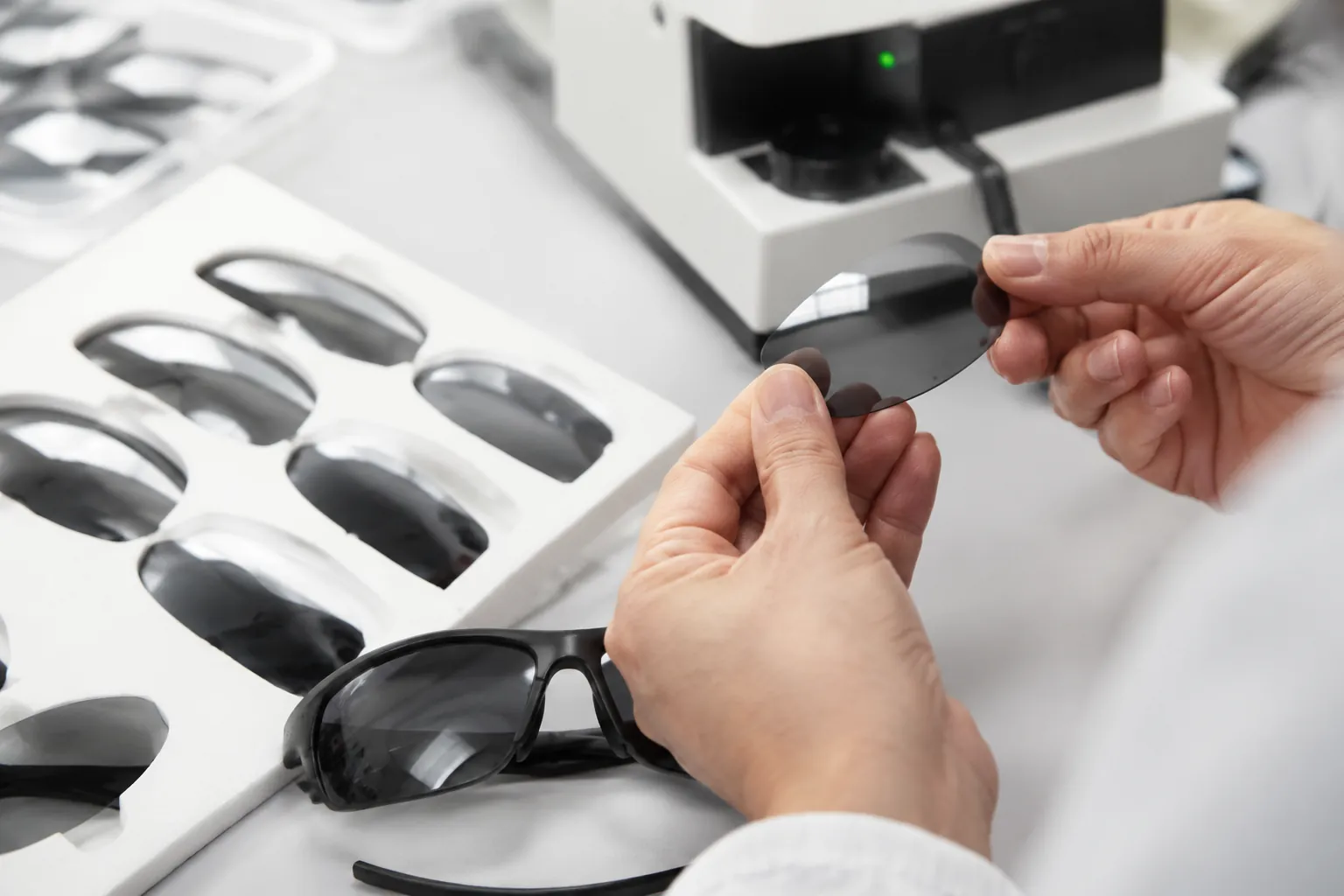
This guide is for brand owners, importers, distributors, and retail buyers sourcing polarized sunglasses in volume. The real question is not which lens material sounds better in general. It is which lens build fits your retail channel, compliance target, handling conditions, and tolerance for claims. TAC and polycarbonate polarized lenses behave differently in edging, coating, assembly, packing, and end use. That changes cost, lead time, QC focus, and return risk. Pick the lens to match the finished product brief, not the word "polarized" on its own.
Start with channel fit, not material preference
Many lens mistakes start with a weak brief. A buyer asks for polarized lenses, gets TAC and PC options, and chooses based only on unit cost or a vague idea of durability. That is how mismatches happen.
TAC polarized lenses are common in fashion, resort, gift, souvenir, and promotional sunglasses, where price control, appearance, and low weight matter most. PC polarized lenses are more often used in sport, driving, kids, fishing, cycling, and outdoor programs, where impact resistance and rougher handling matter more.
Neither material is automatically better. A lifestyle frame sold in a fashion chain does not need the same lens performance as a wrap frame sold through an outdoor retailer. The decision should reflect retail price, expected use, packaging protection, and the cost of returns if the product fails in the field.
- Choose TAC first for fashion-led, casual-use, and price-sensitive programs where low weight and competitive costing are priorities.
- Choose PC first for sport, kids, driving, and outdoor programs where impact resistance and tougher day-to-day handling are part of the use case.
- Quote both when one range serves more than one retail channel or when the same frame may be sold in different use environments.
- Compare claim risk as well as cost because the cheaper lens on paper may cost more after scratches, breakage, or consumer complaints.
How TAC and PC are built, and why production differs
TAC polarized lenses are usually laminated. In sourcing terms, that means a polarizing film is combined with TAC-based layers and then finished with the required treatments, such as tint, mirror, flash, or hard coating. This construction is widely used because it can deliver good visual performance at a competitive cost. Its weak point is the laminated structure itself, especially at the edge and during frame insertion.
PC means polycarbonate. A polarized PC lens uses polycarbonate as the base material, with polarization added through the lens build and finishing process. Polycarbonate is valued for low weight and impact resistance, which is why it appears so often in sport and youth-oriented eyewear. But there is a trade-off. The surface is relatively soft without an effective hard coat, so coating quality and handling control matter a lot.
For buyers, the key point is simple. TAC and PC usually fail in different ways. TAC programs are more sensitive to lamination quality, edge finishing, and assembly stress. PC programs are more sensitive to coating performance, scratch visibility, and optical control on higher-wrap or more curved lenses.
So do not stop at the material name. Review the full lens build, frame shape, finish, and assembly method before you approve bulk production.
Head-to-head: cost, durability, optics, and claim risk
Too many buyers compare TAC and PC on ex-factory price alone. That is not enough. A better comparison looks at likely after-sale issues: scratches, cracks, delamination, haze, distortion, and how the lens performs in the target channel.
| Factor | TAC Polarized | PC Polarized | Buyer Impact |
|---|---|---|---|
| Typical FOB position | Often lower on mainstream lifestyle builds | Often higher on like-for-like polarized builds | Affects margin buffer and target retail price |
| Impact resistance | Generally suitable for casual use, but less tolerant of hard impact than PC | Commonly preferred where higher impact resistance is required | Important for sport, kids, driving, and outdoor programs |
| Scratch behavior | Coating quality still matters, but casual-use expectations are often easier to meet | Hard-coat performance is especially important because the base material is more surface-sensitive | Poor coating control can create avoidable after-sale complaints |
| Optical consistency | Often commercially suitable for fashion and lifestyle sunglasses | Can perform well, but curve and process control matter on sport-oriented shapes | Important for comfort, perceived quality, and driving use |
| Edge or lamination risk | More sensitive to edge lift or lamination defects if poorly processed | Does not have TAC-style laminated edge issues, but coating and distortion risks remain | Changes QC focus and assembly controls |
| Best-fit channel | Fashion, resort, gift, promotional, lifestyle private label | Fishing, cycling, outdoor, kids, utility-driven retail | Improves fit between product spec and end use |
In many quotations, TAC wins the first price check for a casual lifestyle sunglass. PC is easier to justify when the channel expects harder use or when reducing breakage risk matters more than lowering lens cost. The right call depends on the finished product brief. Not on a generic idea of which material sounds more premium.
Where margins move: MOQ, coatings, decoration, and packing
Lens material is only one line in the BOM, but it affects several other cost and risk points. Look at the full build. Not the lens in isolation. In many RFQs, TAC is the easier route for a value-led polarized style. PC makes more sense when the retail price and use case can support it.
Small specification changes can shift both cost and production stability. Mirror and flash finishes tighten cosmetic tolerances. Hard-coat quality matters on both materials and matters even more on PC. Lens thickness and base curve affect fit, weight, and optical control. Decoration adds handling steps. Packing affects transit damage and store-floor condition.
- Mirror coating can improve shelf appeal but may require tighter cosmetic control for color and reflectivity consistency.
- Flash or revo finish adds visual impact but can make lot-to-lot consistency more important.
- Hard coating is essential for both materials and should be reviewed carefully when specifying PC polarized lenses.
- Lens thickness and base curve affect frame fit, perceived quality, weight, and optical behavior.
- Decoration method matters because pad print, laser engraving, and metal logo parts have different cost, durability, and handling implications.
- Packing choice influences protection during bulk transit, unpacking, and retail handling, which in turn affects complaint risk.
Lead time also shifts with complexity. A straightforward sample usually moves faster than a build with multiple lens finishes, custom hardware, or mixed branding methods. If the launch window is tight, ask which elements are standard and which need extra processing or inspection.
Compliance follows the finished build, not a generic lens claim
Lens choice should be tied to the target market before the purchase order is issued. Common compliance references in sunglasses sourcing include CE EN ISO 12312-1, ANSI Z80.3, AS/NZS 1067, REACH, FDA registration, ISO 9001, and BSCI. But buyers need to separate product standards, chemical requirements, factory certifications, and social audit results. They are not the same thing.
For sunglasses, the practical checkpoints usually include UV protection, visible light transmittance category, optical quality, lens consistency, and market-appropriate labeling. Polarization is not a compliance standard by itself. A polarized lens still has to meet the finished-product requirements for the market where it will be sold.
Be careful when a style changes after testing. A different lens color, mirror finish, lens thickness, or frame construction can change whether the existing documents still match production. A smoke TAC lens and a mirrored PC lens are not documentation equivalents just because the frame front is the same.
- Define the destination market before finalizing the sample.
- Lock lens material, lens color, and target category before approving bulk production.
- Confirm whether the supplier documentation covers the finished assembly you are ordering.
- Keep QC and compliance records tied to the exact style, colorway, and production batch.
- Check that labels, warnings, and carton marks match the approved compliance file for the destination market.
This protects margin. A product can be polarized and still create delays, relabeling costs, or retail rejection if the paperwork does not match the final build.
Failure modes to inspect before bulk approval
If you want fewer surprises, inspect the points most likely to fail in sampling, pilot production, or pre-shipment review. TAC and PC do not usually fail in the same places. Your checklist should reflect that.
For TAC polarized lenses, watch for edge lifting after insertion, bubbles or inclusions in the laminated structure, visible stress marks, left-right polarization mismatch, and cracking risk where the frame groove is tight or assembly pressure is high. These issues become more visible on wrapped frames or styles with demanding insertion conditions.
For PC polarized lenses, watch for fine scratches from normal handling, weak hard-coat performance, haze after coating, optical distortion on higher-base curves, and visible color variation between lots. Because PC depends heavily on coating quality, routine packing and unpacking simulation is worth doing during sample review.
| Failure Mode | More Common In | What To Check | Action Before Bulk |
|---|---|---|---|
| Delamination or edge lift | TAC | Inspect lens edges under direct light after fitting | Approve edge finish and assembly method on the final sample |
| Surface scratch complaints | Both, but often more visible on PC if hard-coat performance is weak | Simulate packing, unpacking, and normal handling | Review coating performance and improve packing protection if needed |
| Optical distortion | Both | Use straight-line viewing and wear trials on curved frames | Reject unstable lens lots before full assembly |
| Stress cracking in assembly | TAC in tighter grooves | Check frame flex, lens insertion pressure, and wear fit | Adjust groove tolerance or revise the lens specification |
A practical method is to request the same frame in TAC and PC versions and compare them using the same packing format and handling routine expected in the real sales channel. That gives you a cleaner comparison than testing two different styles made with two different materials.
A practical sourcing decision by buyer type
Channel usually gives the answer faster than material theory does. If you are a fashion brand launching seasonal colors into boutiques or e-commerce, TAC is often the first lens to quote because it supports cost-sensitive commercial positioning for casual wear. If you are a distributor supplying fishing stores, bike shops, workwear-adjacent retailers, or outdoor chains, PC is often the better first quotation because durability expectations are higher.
If you sell into more than one channel, a split strategy often works better than forcing one material across the whole range. TAC can suit fashion-forward core shapes where price pressure is strongest and use is lighter. PC can suit wrap styles, youth programs, or sport-influenced designs where rough handling is more likely.
For buyers testing a new private-label line, keep the comparison controlled: same frame, same finish, same packaging, same logo treatment, two lens builds. Then assess weight, visual clarity, cosmetic condition after handling, and the complaint points most likely in your own channel.
Simple rule: TAC is usually the commercial starting point for lifestyle and price-sensitive polarized sunglasses. PC is usually the safer starting point for tougher-use channels where impact resistance and handling durability matter more.
What to include in your RFQ so quotes are comparable
Many polarized-lens quotations are hard to compare because the RFQ is too vague. "Polarized lens" is not a complete sourcing specification. If you want a quote you can actually use, define the lens build, intended use, and compliance market in the same document.
- Lens material: specify TAC polarized or PC polarized.
- Lens color and finish: smoke, brown, green, mirror, flash, gradient, or solid.
- Performance target: casual fashion, driving, fishing, cycling, kids, or general lifestyle.
- Compliance market: EU, US, Australia/New Zealand, or mixed-market order.
- Frame material: injected plastic, acetate, metal, or combination construction.
- Order quantity: state the initial order and, if possible, the forecast by colorway.
- Decoration: pad print, laser engraving, hot stamp, metal logo plate, or no branding.
- Packing: polybag, pouch, box, barcode label, and carton mark requirements.
Also ask the supplier to confirm which compliance documents can be provided for the exact finished build and which checkpoints should be reviewed during sampling. A tighter RFQ makes quotations easier to compare and reduces the risk that two suppliers are pricing different specifications under the same headline description.
Have a custom sunglasses project in mind?
Send us your styles, target market and quantities and we will return a detailed quote with MOQ, lead time and a sample plan.
Get a QuoteWhy source this from Wenzhou with LumiShades
Wenzhou in Zhejiang Province is widely regarded as China’s eyewear manufacturing capital, producing a large share of the world’s sunglasses. That concentration matters to buyers: a deep local supply chain for acetate sheet, hinges, lens blanks, plating and packaging means shorter component lead times, easier color and material matching, and a workforce with decades of eyewear-specific skill. LumiShades has manufactured in this ecosystem since 2009, and our vertical integration — in-house injection molding, acetate cutting, CNC milling, lens tinting, decoration and quality control — means no part of your order is quietly subcontracted to a workshop you cannot audit.
For international buyers, that vertical control translates into accountability. When a single factory owns every step, defects are traced and fixed at source rather than bounced between vendors, and your specifications survive intact from first sample to bulk. We back this with 15+ years of experience, shipments to 60+ countries, more than 5 million pairs produced per year and a 98.5% on-time delivery rate. Our certifications — CE EN ISO 12312-1, FDA registration, ANSI Z80.3, AS/NZS 1067, REACH, ISO 9001 and BSCI audit — mean the compliance documentation your market requires already exists. Explore our manufacturing capabilities and quality control process to see how this works in practice.
Frequently asked questions
Is TAC always cheaper than PC for polarized sunglasses? No. TAC is often the lower-cost option on mainstream lifestyle sunglasses, but the final comparison depends on the full build. Mirror finish, hard-coat requirement, lens curve, frame design, packing method, and order volume can all change the price relationship. Ask suppliers to quote the same frame, same packaging, and same branding in both TAC and PC so you are comparing like for like.
Which lens is better for sport and outdoor channels? PC is usually the safer starting point for sport, outdoor, driving, kids, and other rough-use programs because polycarbonate is widely chosen for higher impact resistance. But do not approve PC on the material name alone. Review coating performance, scratch behavior, and optical quality on the final sample in the intended frame and packing format.
Can I use the same frame design with both TAC and PC lenses? Often yes, but only after sampling. Frame groove tolerance, lens edging, insertion pressure, and lens curve may need adjustment when switching materials. This matters most on wrapped frames, tight-fit styles, and designs with higher assembly stress. Ask for both versions in the exact same frame and review assembly fit, edge condition, and visual performance before bulk approval.
What compliance documents should I ask for on polarized sunglasses? Ask for documents that match your destination market and exact finished product. Common references include CE EN ISO 12312-1 for Europe, ANSI Z80.3 for the United States, AS/NZS 1067 for Australia and New Zealand, and REACH where chemical compliance applies. If a supplier mentions FDA registration, ISO 9001, or BSCI, confirm what those documents actually cover because they are not substitutes for finished-product performance testing. Make sure the paperwork matches the final lens color, finish, frame, and assembly you are ordering.
How should I compare samples before placing a bulk order? Compare the same frame in TAC and PC versions with the same packaging, branding, and lens color whenever possible. Check visual clarity, weight, cosmetic condition, scratch visibility after normal handling, and any edge or assembly stress around the frame groove. Simulate real handling by packing, unpacking, opening, closing, and wearing the samples under normal use conditions. Record the exact sample specification you approve so the bulk order can be matched against it.
Ready to start?
Explore our round sunglasses or request a quote — our sales team replies within 12 hours.
Request a Quote