
PC, TAC, or CR-39? Choose the Right Lens Material
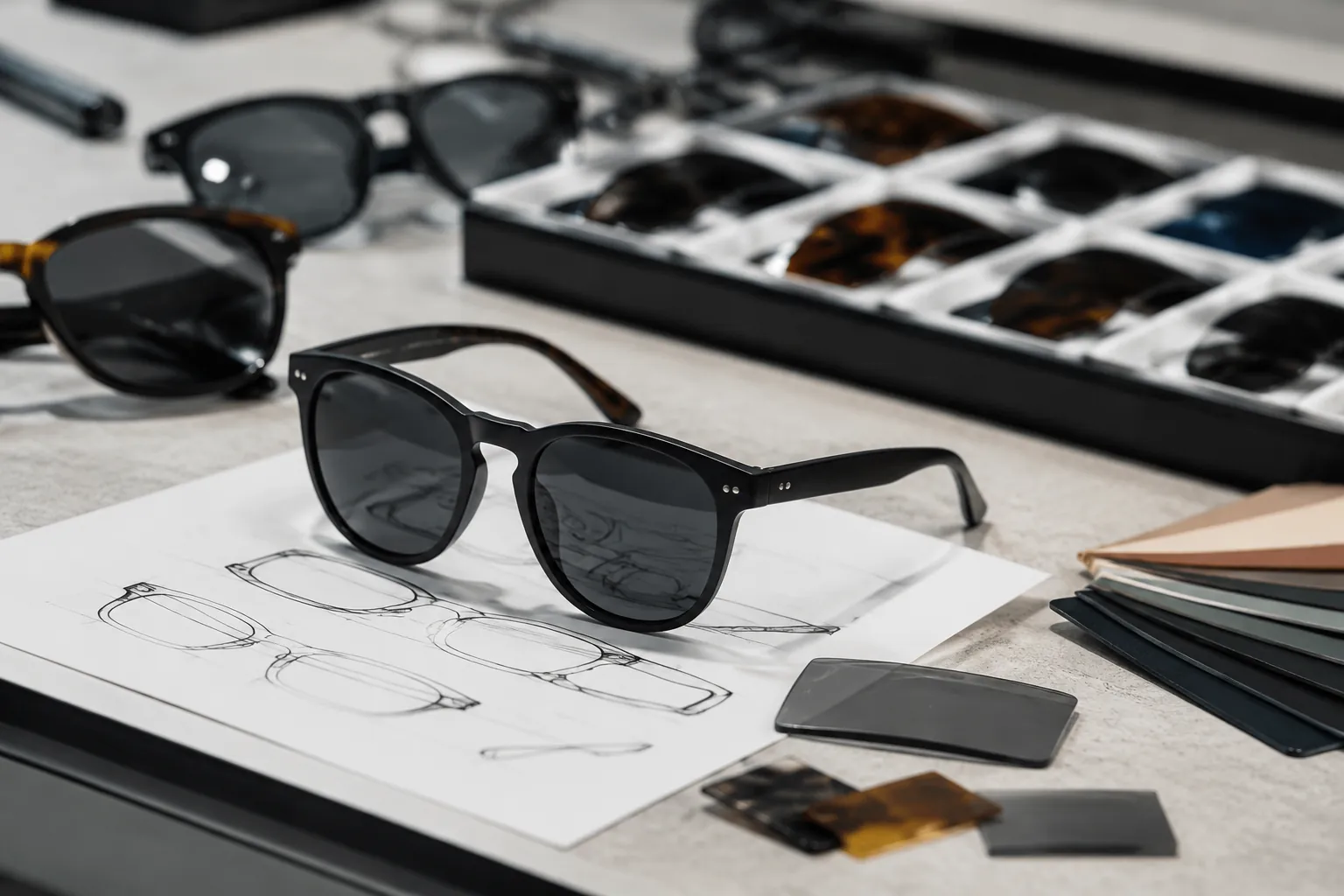
This guide is for brand owners, importers, distributors, and retail buyers choosing a sunglass lens material before requesting final pricing. Lens choice does not just change appearance. It affects ex-factory cost, breakage risk, compliance scope, production yield, and whether a frame makes sense for promo, fashion retail, sport, or a mid-tier private-label line. The real question is simple: which material fits the sales channel, target buy price, frame geometry, and compliance file with the least risk? The framework below compares PC, TAC, and CR-39 the way bulk programs are usually quoted, sampled, approved, and shipped.
Start with channel, price, and handling risk
Many sourcing mistakes start in the wrong place. Buyers look at a material datasheet before they define the commercial brief. That flips the process.
In bulk eyewear, the first filter is usually not a technical metric like Abbe value. It is where the product will be sold, what the importer can pay, how the product will be handled, and which claims will appear on the product and packaging.
A giveaway sunglass, a fashion e-commerce style, and a sport-channel frame may share a similar silhouette. They still do not need the same lens platform. Channel sets the acceptable failure rate, the lens claim a retailer expects, and how much lens cost the program can absorb.
Use this order when defining the lens:
- Sales channel: event promo, resort retail, fashion retail, sport, kids, online private label, or mass distribution.
- Target buy price and expected volume: for example a small pilot order, a standard retail launch, or a volume import program.
- Destination market and standard: CE EN ISO 12312-1 for Europe, ANSI Z80.3 for the United States, AS/NZS 1067 for Australia and New Zealand, plus REACH material compliance where required.
- Frame construction: flat fashion front, base-curve sun frame, sport wrap, shield, metal groove mount, or thicker acetate rim.
- Risk tolerance: acceptable scratch rate, tint variation tolerance, edge-stress risk, and whether the line can absorb retesting or rework.
This order matters. Lens material changes edging, coating options, assembly yield, and the compliance file. At sample stage, a wrong choice may only slow approval. In production, it can trigger rejects, claims, or a shipment that no longer matches the approved build.
What PC, TAC, and CR-39 do well
These three lens platforms are not interchangeable. They may look similar in a rendering or sales sample, but they behave differently in forming, coating, fitting, impact performance, and long-term claim rate.
| Lens platform | Typical thickness range | Best commercial fit | Main strengths | Main limits |
|---|---|---|---|---|
| PC | Usually 1.0 to 2.2 mm depending on style | Sport, kids, promo, value private label | High impact resistance, low weight, good fit for molded volume, suitable for wrap shapes and shields | Surface can scratch more easily without an effective hard coat, and optical performance depends on lens quality and processing |
| TAC | Often around 1.0 to 1.2 mm laminated construction | Fashion retail, polarized programs, mid-price e-commerce | Common route to polarized lenses, light weight, broad color availability, widely used in private-label sunwear | Delamination risk if lamination, storage, or edge finishing is poor; not ideal for aggressive wrap tension |
| CR-39 | Commonly 1.5 to 2.0 mm depending on edging and category | Classic sunwear, better fashion retail, premium private label | Good visual clarity, stable tint appearance, generally better scratch resistance than untreated PC | Heavier than PC, lower impact resistance, and less suitable for rough-use sport frames |
PC, or polycarbonate, is often the practical default when impact resistance, low weight, and shipping durability matter more than a premium optics position. It is widely used in molded lenses, mirrored sport styles, and deeper curves where buyers need a lens that is more forgiving in assembly and handling.
TAC is a laminated lens construction commonly used for polarized sunglasses. Buyers often choose it when the retail channel expects a polarized claim at a moderate cost. Quality control matters here. A lot. TAC performance depends on lamination quality, adhesive stability, and disciplined edge finishing.
CR-39 is often chosen for conventional sunglass shapes where buyers want a stronger optics story and a more classic retail presentation. It usually fits full-rim fashion frames better than high-wrap sport geometries with higher assembly stress.
Use price and MOQ to narrow the choice fast
Most buyers do not need a chemistry lesson. They need a shortlist that fits the price architecture. Fast.
In practice, one of the best screens is to match target buy price, expected order size, and required product claims. At lower quantities, setup costs, color confirmation, packaging coordination, and decoration preparation are spread across fewer units. As volume rises, suppliers can usually quote more efficiently and standardize production more easily.
That is why the same frame can be workable in one program and unworkable in another. Lens choice, polarization, and finishing details change the math.
Price should be judged as a full-build decision, not a lens-only decision. A switch from non-polarized PC to polarized TAC, or from a standard solid tint to a mirrored custom tone, changes material cost, processing steps, and reject risk.
| Program type | Typical MOQ logic | Lens that usually fits | Commercial reason |
|---|---|---|---|
| Event promo or giveaway | Usually volume-sensitive and highly price-driven | PC | Often the simplest path for non-polarized lenses with reasonable durability in freight and handling |
| Entry retail private label | Often starts with modest launch volume and selective SKU count | PC or TAC | PC when price pressure is primary; TAC when polarized is a required selling point |
| Mid-price fashion retail | Typically needs a clearer product story and more finish control | TAC or CR-39 | TAC supports polarized positioning; CR-39 supports a more premium optics story in classic shapes |
| Sport chain or outdoor line | Usually needs dependable assembly and handling performance | PC | Impact resistance and wrap compatibility typically matter more than premium clarity positioning |
In sourcing terms, if the target price is tight and the product is mainly a visual accessory with basic UV-performance requirements, buyers often review PC first. If the retail channel expects polarization because consumers treat it as a visible value marker, TAC is often the next practical option. If the frame is conventional and the line can support a higher lens cost for better perceived quality, CR-39 becomes more viable.
Failure modes that cause claims and margin loss
The smart lens choice is the one that reduces total risk, not just invoice cost. Each platform has predictable failure points. Good buyers spec around them early.
- PC: the common issue is surface scratching if the hard coat is weak or omitted. Lower-quality lenses can also show distortion, ripple, or inconsistent mirror appearance.
- TAC: the main risk is delamination or edge lifting after poor storage, weak adhesive bonding, or aggressive edging. Another issue is polarization inconsistency between left and right lenses.
- CR-39: the main risks are edge chipping during grooving or insertion, lower resistance to impact than PC, and more front weight in large frames.
These are not small technical footnotes. They show up as retailer complaints, incoming inspection failures, and reorder disputes. A TAC lens may look fine in a sales sample but become a problem if bulk edge finishing is inconsistent. A PC lens may pass routine visual inspection and still drive complaints if coating quality or left-right matching is weak.
So lock more than lens color during pre-production approval. The approval file should state lens material, nominal thickness, polarization status if applicable, lens category or transmission classification where needed, surface finish, and the destination-market standard. If one line uses mirrored smoke PC and another uses brown polarized TAC, treat them as separate constructions. Because they are.
How lens choice changes lead time and yield
Lens material changes the factory workflow. That affects timing.
Exact lead times vary by supplier capacity, lens availability, finishing complexity, and the number of approval rounds. The practical point is simpler: late material changes usually create delay because they can change sourcing, fitting, finishing, and documentation requirements.
A simplified production path usually looks like this:
- Specification lock: material, color, lens category, coatings, logo position, packaging claim, and destination market.
- Lens preparation: molded PC setup, TAC sourcing and cutting, or CR-39 edging preparation depending on the frame.
- Surface finish: solid tint, gradient, flash, mirror, or polarized verification.
- Assembly: lens insertion and fitting, especially important for wrap styles, metal grooves, acetate fronts, or shield constructions.
- QC and compliance checks: cosmetic inspection, left-right matching, logo placement, labeling review, and market-specific review before shipment.
PC is often efficient in larger-scale production because molded lenses can be repeatable once the process is stable. TAC can also run efficiently, but bottlenecks often come from polarized color availability, lamination consistency, and edge-finishing control. CR-39 usually needs more careful edging and handling, which can slow multi-SKU programs when many shapes are moving through assembly at once.
Decoration also affects yield and timing. Pad printing is common for lower-cost branding and widely used in volume programs. Laser engraving can create a cleaner premium look on some frame materials or lenses, but it adds placement and visibility decisions. Metal logo plates can raise perceived value, but they also add parts, alignment steps, and coordination risk. None of those choices are neutral in production planning.
If the launch date is fixed, do not assume one material can be swapped late without consequences. A change from PC to TAC, or TAC to CR-39, can shift tint appearance, lens fit pressure, assembly method, and the test file needed for shipment.
Compliance follows the actual construction
For importers, compliance is part of sourcing. Not a paperwork exercise after production. If sunglasses are going into regulated markets, the lens material must match the tested and documented construction.
Relevant standards and registrations may include CE EN ISO 12312-1, ANSI Z80.3, AS/NZS 1067, REACH, and FDA registration, plus factory-side systems such as ISO 9001 and BSCI. These do not do the same job. Product standards and market requirements relate directly to sunglass performance and labeling. REACH covers restricted substances. Factory system credentials do not replace product testing or market-specific documentation.
Buyers create avoidable risk when they approve one lens build and ship another under the same paperwork. A switch from non-polarized PC to polarized TAC is not a cosmetic edit. A move from CR-39 to PC on a sport frame is not a minor substitution. Material, polarization, coating, lens category, and frame reference should all match the approval file and shipment record.
To reduce dispute risk, ask the supplier to identify the exact tested configuration in the approval documents:
- Frame reference or SKU
- Lens material
- Lens category or visible light transmission classification
- Polarization status
- Coating or mirror finish
- Destination market
That level of detail helps confirm that the shipped goods match the approved sample and the technical file.
A practical framework for common buying scenarios
Most buyers do not need a theoretical ranking. They need a quick decision that reduces revisions and protects margin.
- Promotional giveaway under heavy price pressure: choose PC unless the brief specifically requires polarization. Keep lens colors standard, avoid complex mirror finishes, and minimize decoration changes across SKUs.
- Private-label fashion e-commerce brand: start with TAC when polarized is a visible consumer selling point. Move to CR-39 only if the price architecture supports it and the frame shape is conventional.
- Sport or outdoor channel: default to PC. It generally suits deeper base curves, lower breakage risk, and rougher handling in transport and retail.
- Mid-tier retail collection with a stronger optics story: evaluate CR-39 for classic shapes where visual clarity and finish help justify a higher ex-factory cost.
Before confirming the lens, pressure-test the choice with three questions:
- Will this lens survive the channel's real handling conditions, not just the sample review?
- Does this build support the packaging claims and compliance file without creating documentation gaps?
- Can the program still hold margin after decoration, reject allowance, freight, and reorder risk?
If the answer is weak on any point, re-spec before the final quote. A cheaper lens that creates returns is not cheaper. A premium lens in a discount or sport-driven channel may simply be over-specified.
What to lock before the final quotation
A supplier quote is only comparable when the lens brief is precise. If one factory quotes 1.1 mm polarized TAC and another assumes a basic non-polarized PC lens, the comparison is not meaningful even if both describe the product as black sunglasses.
Before requesting final pricing, lock the following points:
- Lens material: PC, TAC, or CR-39.
- Polarization: yes or no, with clear packaging intent.
- Lens color and finish: smoke, brown, green, gradient, mirror, flash, or custom tone.
- Target market: EU, US, Australia/New Zealand, or multi-market.
- Frame style: wrap sport, flat fashion, acetate, metal, injected plastic, or shield.
- Branding method: pad print, laser engraving, metal logo plate, or no logo.
- Expected order volume: the quantity range the supplier should use for pricing.
- Approved sample reference: the exact sample code or revision level that bulk goods must match.
Once these points are fixed, supplier comparisons get cleaner and compliance risk drops. The core rule is simple: lens material is a channel decision first and a technical decision second. Get that sequence right, and the rest of the sourcing process becomes faster, safer, and easier to price accurately.
Have a custom sunglasses project in mind?
Send us your styles, target market and quantities and we will return a detailed quote with MOQ, lead time and a sample plan.
Get a QuoteWhy source this from Wenzhou with LumiShades
Wenzhou in Zhejiang Province is widely regarded as China’s eyewear manufacturing capital, producing a large share of the world’s sunglasses. That concentration matters to buyers: a deep local supply chain for acetate sheet, hinges, lens blanks, plating and packaging means shorter component lead times, easier color and material matching, and a workforce with decades of eyewear-specific skill. LumiShades has manufactured in this ecosystem since 2009, and our vertical integration — in-house injection molding, acetate cutting, CNC milling, lens tinting, decoration and quality control — means no part of your order is quietly subcontracted to a workshop you cannot audit.
For international buyers, that vertical control translates into accountability. When a single factory owns every step, defects are traced and fixed at source rather than bounced between vendors, and your specifications survive intact from first sample to bulk. We back this with 15+ years of experience, shipments to 60+ countries, more than 5 million pairs produced per year and a 98.5% on-time delivery rate. Our certifications — CE EN ISO 12312-1, FDA registration, ANSI Z80.3, AS/NZS 1067, REACH, ISO 9001 and BSCI audit — mean the compliance documentation your market requires already exists. Explore our manufacturing capabilities and quality control process to see how this works in practice.
Frequently asked questions
Which lens material is usually best for a low-cost promotional sunglasses order? Usually PC, provided the brief does not require polarization. It is widely used for price-sensitive, non-polarized programs because it is light, impact resistant, and generally more forgiving in shipping and handling. When requesting quotes, state that you want PC lenses, confirm whether a hard coat is included, specify the lens color, and identify the destination market standard so the supplier prices the correct build.
Is TAC always better because it can be polarized? No. TAC is often selected because it is a common way to deliver polarized sunglasses at a workable cost, but that does not make it the best option for every frame or channel. For wrap sport frames, kids' programs, or products that will see rough handling, PC is often the safer choice because it tolerates impact and frame stress better. If you are considering TAC, ask the supplier to confirm the lamination quality, polarization consistency, and whether the frame geometry is suitable for that construction.
When should a buyer pay more for CR-39? CR-39 makes the most sense when the product is aimed at better fashion retail or a more premium private-label line, the frame shape is relatively conventional, and the selling price can support a higher lens cost. It is a more natural fit for classic full-rim sunwear than for aggressive wrap or rough-use sport styles. Before approving CR-39, confirm that the frame design, lens thickness, and target market requirements all suit that material.
Can I change from PC to TAC after approving samples if the frame looks the same? You can request the change, but treat it as a new technical review, not a minor cosmetic revision. Changing from PC to TAC can affect lens thickness behavior, edge finishing, color appearance, fit pressure, polarization status, and whether existing compliance documents still match the product. The practical step is to request a revised sample or written technical confirmation, then update the PO and approval file so the shipped construction matches the documentation.
What should be written on the PO to avoid lens disputes? State the lens material, polarization status, lens color and finish, frame reference or SKU, destination market, applicable standard, branding method, approved sample reference, and order quantity. If there is a specific lens category, visible light transmission classification, mirror finish, or coating requirement, include that as well. Avoid vague terms such as 'dark lens' or 'polarized lens' without a material and sample reference, because they leave too much room for interpretation in mass production.
Ready to start?
Explore our cat-eye sunglasses or request a quote — our sales team replies within 12 hours.
Request a Quote