
How Buyers Check Lens Tint Consistency by Batch
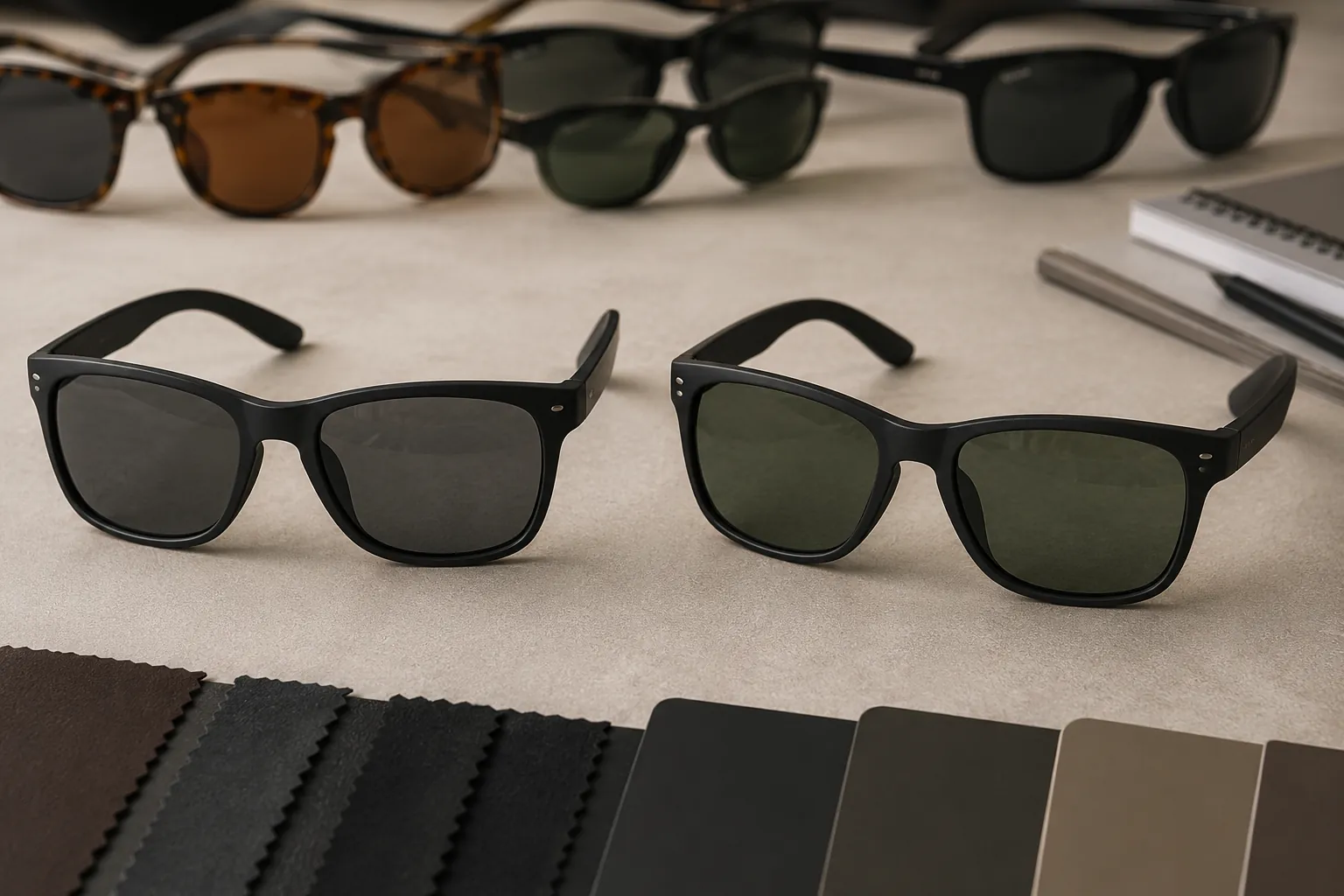
This guide is for brand owners, importers, distributors, and retailers buying custom sunglasses in volume. Small tint shifts between batches cause real problems: mixed shelf appearance, mismatched replacements, listing disputes, and possible compliance review. The fix is straightforward. Define the lens clearly. Approve and retain a master sample. Set measurable limits. Inspect every reorder against the same standard. The sections below focus on controls buyers can place in the PO, sample approval file, and QC checklist.
Why tint drift costs buyers money
Lens tint drift is not just cosmetic. It affects sell-through, after-sales service, photography accuracy, and sometimes product classification tied to visible light transmission.
The commercial damage usually shows up in four places:
- Mixed inventory looks wrong on shelf. Retailers may split lots, hold launch, or mark down part of the shipment.
- Replacement pairs do not match earlier stock. That creates friction in warranty programs and replenishment orders.
- Product images no longer match landed goods. If the lens looks lighter, greener, warmer, or more mirrored than the listing image, return risk rises.
- Compliance may need to be checked again. If VLT changes enough, the lens category or technical file may need review for the target market.
VLT is the main measurable control for sunglass tint. It does not describe the full appearance, but it does measure how much visible light passes through the lens. Treat it as a controlled product characteristic. Not a rough preference.
For buyers selling into markets that reference CE EN ISO 12312-1, ANSI Z80.3, or AS/NZS 1067, tint consistency should be managed with the same discipline used for frame color, logo artwork, or packaging. If a reorder uses a different material, tint method, mirror stack, or polarization construction, check whether the existing compliance file still applies.
What to specify before mass production
Most batch-matching problems start with vague instructions. Terms like "smoke lens," "G15," or "tea gradient" describe intent, not production. Different materials, thicknesses, and coating stacks can all produce different results under the same color name.
Your approved lens specification should include, at minimum:
- Base lens material: for example PC, nylon, TAC polarized construction, CR-39, or glass.
- Lens construction: plano or Rx-ready, single shield or twin-lens, and whether edge appearance matters.
- Nominal lens thickness: because thickness can change perceived darkness, especially on wrapped styles.
- Base color target: grey, brown, green, smoke, tea, blue, G15-style, and so on.
- Target VLT and tolerance: for example 15% ±2% or 22% ±3%.
- Gradient definition: top VLT and bottom VLT, plus fade-line position if relevant.
- Coating stack: hard coat, backside anti-reflective coating, hydrophobic layer, flash mirror, or full mirror.
- Visual standard: retained master sample code held by both buyer and supplier.
- Viewing condition: daylight-equivalent light source, white or neutral background, and fixed viewing angle.
For most programs, the practical rule is simple: visual match to approved master plus VLT within agreed tolerance. The exact tolerance depends on lens type, color depth, material, and market requirements. Dark standard tints are often easier to hold than pale transparent fashion colors. Gradients need more than one number.
| Lens type | Typical commercial VLT target | Practical buyer tolerance | Comment |
|---|---|---|---|
| Dark standard smoke/brown | Buyer-defined | Often wider than pale fashion tints | Usually easier to hold visually than very light transparent colors |
| Medium fashion tint | Buyer-defined | Case by case | Hue shift is often more visible than buyers expect |
| Light transparent fashion tint | Buyer-defined | Often tighter than dark tints | Small process drift can become obvious quickly |
| Gradient lens | Defined by top and bottom VLT | Case by case | Needs fade-line and density controls, not one number only |
The point: do not rely on a color name alone. Write the lens spec so another production team could reproduce it months later without guesswork.
What causes batch-to-batch tint shift
If you know what moves lens appearance, you can ask better questions during sampling and reorder planning. Most tint drift comes from routine process variation. Not one dramatic failure.
- Dye bath variation. Concentration, temperature, contamination, and bath age can change color uptake.
- Soak time drift. If immersion time is loose, density moves from lot to lot.
- Material-source change. A lens may still be called PC or nylon, but resin from a different source may absorb dye differently or show hue differently.
- Thickness variation. Wrapped or thicker lenses can look darker or denser, especially at the edge.
- Gradient setup inconsistency. Withdrawal speed, immersion depth, and fixture alignment can shift top density and fade-line position.
- Mirror coating variation. Flash mirror, full mirror, and backside coatings can alter front-view hue even when through-view VLT stays close.
- Operator judgment replacing written limits. If the rule is only "looks okay," drift builds over repeat orders.
Material behavior matters. PC is common in sunglasses and sports eyewear, but tint repeatability varies by supplier and process. Nylon is widely used in performance and wrapped styles, yet source variation can affect consistency. TAC polarized construction adds another variable because the laminated structure can look different from a simple solid-tinted lens. CR-39 and glass can produce different results again. So do not approve tint in isolation from material and construction.
A useful sourcing question during sampling is this: Which production variable is most likely to move this lens off standard? A capable supplier should answer directly: resin source, gradient setup, mirror batch, thickness control, or VLT measurement method.
Use a master sample plus measurable limits
The most reliable approval system uses two controls together: a retained master sample and measurable acceptance limits. A master without numbers becomes subjective. Numbers without a master can miss problems such as mirror hue, gradient shape, or front-view appearance.
Use this approval workflow:
- Approve final frame color, lens material, lens thickness, and coating stack during sampling.
- Retain at least three master sets: buyer, supplier, and QC or third-party inspector.
- Assign a master sample code and place that code on the PO, specification sheet, and final approval file.
- Record target VLT and agreed production tolerance.
- For gradients, record top VLT, bottom VLT, and fade-line position measured from the lens top edge.
- Define viewing conditions: daylight-equivalent light, neutral background, and a consistent viewing angle.
- Require pre-production lens confirmation before bulk starts.
Also identify the retained standard clearly so it cannot be mixed up later with a near match. Store one buyer master in a stable environment and keep photo records, but do not use photos as the approval standard. Cameras and screens distort color.
For repeat orders, compare against both the original approved master and the most recent accepted production sample. The original master protects brand intent. The latest accepted production sample helps track drift from shipment to shipment. If those two references already differ visibly, stop and decide which one controls before authorizing new bulk production.
Inspection methods buyers can actually use
Not every buyer needs a lab-grade color program. Every buyer does need a repeatable inspection method. The right level depends on whether the main risk is visual mismatch, regulatory drift, or both.
| Method | What it checks | Best use | Limits |
|---|---|---|---|
| Approved master under controlled light | Hue, darkness, gradient shape, mirror appearance | Incoming QC, pre-shipment approval, fashion programs | Subjective if lighting and angle are not standardized |
| VLT measurement | Visible light transmission consistency | Compliance-sensitive programs and reorder control | Does not fully capture hue shift or mirror-face difference |
| Side-by-side lot sampling | Uniformity within one bulk lot | Final inspection and packing control | Shows spread within lot better than historical mismatch |
| Third-party lab check against retained sample | Independent appearance and performance confirmation | Large reorders, disputed lots, regulated markets | Adds cost and time |
For most private-label sunglass programs, this is the minimum system:
- Every lot: visual comparison to the retained master under defined lighting.
- First production: VLT verification on the approved lens construction.
- Any reorder after material or coating change: repeat VLT check and visual re-approval.
- Gradients and mirrors: inspect from both front view and through-view because customer perception changes by angle.
If you use a third-party inspector, define the setup in writing. For example: use a daylight-equivalent lamp, a neutral or white background, and compare samples drawn from multiple cartons against the retained master at close range and normal viewing distance. If the instruction says only "check color," results will vary too much from inspector to inspector.
What to put in the PO and QC checklist
Many buyers understand tint control but fail to turn it into enforceable paperwork. Keep the language short and specific. Vague text does not help.
Your PO and QC sheet should state:
- Lens material and construction: PC, nylon, TAC polarized, CR-39, glass, and relevant structure details.
- Base curve and thickness if critical: especially for wrapped sports models or visually sensitive lenses.
- Tint description: base color, gradient instruction, and coating stack.
- Target VLT and tolerance: written numerically.
- Master sample reference code: exact approved sample held by both parties.
- Acceptance rule: no obvious visual mismatch to master under defined lighting and viewing conditions.
- Sampling points: pre-production, in-line, and final random inspection.
- Escalation rule: if mismatch is found, stop packing and segregate by production lot rather than by carton only.
Add one clause buyers often miss: historical retention. Require the supplier to keep one approved production lens set from the most recent accepted batch. Months later, that retained production sample is often the most practical reference for confirming continuity on a reorder.
If the product is sold into regulated markets, the paperwork should also identify the applicable standard or document path where relevant, such as CE EN ISO 12312-1, ANSI Z80.3, AS/NZS 1067, REACH, or applicable FDA registration records for market-entry documentation. If the supplier works under systems such as ISO 9001 or social compliance programs such as BSCI, that may support process control and audit readiness. It does not replace a product-specific lens spec.
How order planning affects tint control
Buyers often ask whether tighter tint control costs more. Sometimes it does. More often, the bigger issue is discipline: keeping the same material source, process settings, and approval references over time.
| Order scenario | Typical control level | Commercial effect | Buyer advice |
|---|---|---|---|
| Small trial or launch order | Visual master match with limited production history | High flexibility but greater risk on subtle tints | Use a clear written spec and avoid approving a complex signature tint too quickly |
| Repeat order on the same SKU | Better comparison to prior approved production | Improved continuity if records are retained | Require the supplier to reference the last accepted production sample and VLT record |
| Stable ongoing program | More consistent material and process history | Lower risk of reorder surprise | Ask for the tint recipe, material source, and coating path to stay linked to the SKU |
| Signature lens color across seasons | Highest need for documented control | Brand risk is high if appearance drifts | Use retained masters, periodic VLT checks, and formal change approval before any substitution |
Lead time matters too. If production is compressed hard, there is less room to rework or replace an out-of-spec lot before shipment. Buyers who care about tint consistency should leave time for pre-production confirmation, corrective action, and, if needed, third-party review. Tight delivery pressure often leads to acceptance of borderline differences that would have been rejected under a more realistic schedule.
The practical lesson is blunt: consistency improves when the buyer treats a signature lens as a repeat-controlled component, not a generic color recreated informally each season.
A reorder workflow that prevents surprises
Teams that avoid tint problems on reorders usually follow the same sequence:
- During development: finalize frame material, frame color, lens material, and coating stack before approving lens appearance.
- Before deposit or PO release: issue a written lens specification with VLT target, tolerance, coating stack, and master sample code.
- Before bulk starts: request pre-production lens confirmation against the retained master.
- During production: require in-line comparison by lot, especially for gradients, mirrors, and light transparent fashion tints.
- At final inspection: sample from multiple cartons and compare under controlled lighting, not random warehouse light.
- After receipt: archive one accepted production sample and the related inspection record for the next reorder.
This workflow is not complicated. It is disciplined. Both buyer and supplier need to know which sample controls the order, which measurements apply, and what changes require re-approval.
One last caution: if your sunglasses are sold into markets requiring CE EN ISO 12312-1, ANSI Z80.3, AS/NZS 1067, REACH, or market-entry documentation linked to FDA registration, do not assume a visually similar replacement lens is automatically equivalent. Any change in material, tint method, mirror stack, or polarized construction should trigger a documented review against the approved file.
Practical rule: if lens appearance is part of your brand identity, control tint like a specified component, not like a finish detail.
Have a custom sunglasses project in mind?
Send us your styles, target market and quantities and we will return a detailed quote with MOQ, lead time and a sample plan.
Get a QuoteWhy source this from Wenzhou with LumiShades
Wenzhou in Zhejiang Province is widely regarded as China’s eyewear manufacturing capital, producing a large share of the world’s sunglasses. That concentration matters to buyers: a deep local supply chain for acetate sheet, hinges, lens blanks, plating and packaging means shorter component lead times, easier color and material matching, and a workforce with decades of eyewear-specific skill. LumiShades has manufactured in this ecosystem since 2009, and our vertical integration — in-house injection molding, acetate cutting, CNC milling, lens tinting, decoration and quality control — means no part of your order is quietly subcontracted to a workshop you cannot audit.
For international buyers, that vertical control translates into accountability. When a single factory owns every step, defects are traced and fixed at source rather than bounced between vendors, and your specifications survive intact from first sample to bulk. We back this with 15+ years of experience, shipments to 60+ countries, more than 5 million pairs produced per year and a 98.5% on-time delivery rate. Our certifications — CE EN ISO 12312-1, FDA registration, ANSI Z80.3, AS/NZS 1067, REACH, ISO 9001 and BSCI audit — mean the compliance documentation your market requires already exists. Explore our manufacturing capabilities and quality control process to see how this works in practice.
Frequently asked questions
What is the simplest way to control tint consistency on repeat orders? Use two controls together: an approved retained master sample and a written VLT target with tolerance. Put both on the PO and lens specification sheet. Before each reorder starts, require the supplier to submit a pre-production lens confirmation against that master. After goods are accepted, keep one production sample from the shipment, labeled with date, SKU, lens material, and inspection result, so you have a reliable reference for the next order.
Can two batches have the same VLT and still look different? Yes. VLT measures transmitted visible light, but it does not fully describe hue, saturation, mirror-face color, or gradient shape. Two batches can test close on VLT and still look different from the front or on shelf. For that reason, buyers should never rely on VLT alone. Require both a visual comparison to the retained master under defined lighting and a VLT check where relevant.
Do subtle fashion tints need stricter control than dark smoke lenses? Usually yes. Light tea, blue, rose, and other transparent fashion tints often reveal small process changes faster than darker standard lenses. Gradients also need tighter visual control because fade-line position and top density matter in addition to overall transmission. If the lens is light, transparent, mirrored, or brand-signature, set a narrower buyer tolerance, define the viewing setup clearly, and require pre-production confirmation before each bulk run.
At what point should I ask for tighter process records from a supplier? Ask for documented control as soon as the style becomes a repeat program, not only when volume becomes large. At minimum, require the supplier to keep the approved master sample code, VLT target, lens material, coating stack, and the last accepted production sample. If the SKU is strategic, also ask the supplier to record any change in resin source, lens construction, mirror process, or tint method and to obtain your approval before using that change in bulk production.
Does changing lens material affect color match on reorders? Yes. PC, nylon, TAC polarized construction, CR-39, and glass can absorb, transmit, and present color differently. A lens that looks correct in one material may look lighter, darker, warmer, or cooler in another. If material changes for any reason, treat it as a new approval point: request a new sample, verify VLT on the actual construction, compare it to the retained master, and review whether the existing compliance documentation for CE EN ISO 12312-1, ANSI Z80.3, or AS/NZS 1067 still applies.
Ready to start?
Explore our square sunglasses or request a quote — our sales team replies within 12 hours.
Request a Quote