
TAC vs Nylon Polarized Lenses: B2B Buying Guide
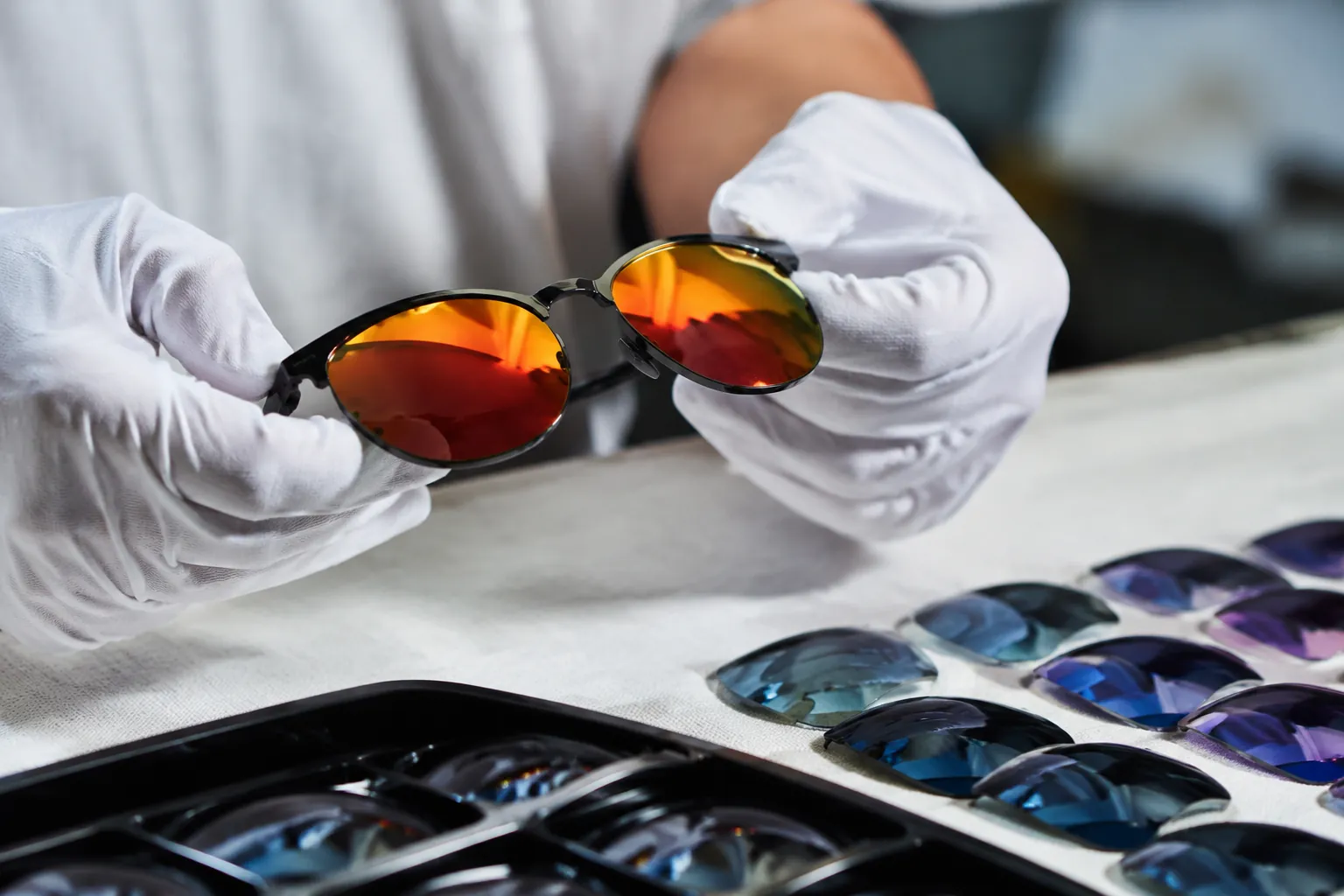
This guide is for brands, importers, distributors, and retail buyers comparing TAC and nylon polarized lenses for custom sunglasses. The wrong lens choice rarely fails on day one. It shows up later as edge cracking, visible distortion on wrap frames, coating complaints, higher return rates, or a retail price that no longer works for the channel. This article stays practical. It covers where TAC works well, where nylon earns its extra cost, which production tolerances matter, how pricing logic shifts by channel, and which compliance documents to request before bulk approval. The goal is simple: choose the lens your customer will notice, and avoid paying for performance your market will not reward.
Start with channel, price, and frame geometry
Many buyers start with the wrong question: Which lens material is better? A better starting point is more basic. Where will the product be sold? What retail price does it need to hit? How curved is the frame?
TAC polarized lenses are common in promotional programs, fast-turn fashion retail, online private label collections, resort shops, and entry outdoor assortments. In those channels, the job is usually simple: offer polarization at a workable cost. Not build a technical-performance SKU.
Nylon polarized lenses are more often considered for categories where the sunglasses are worn longer or used harder: sport-wrap styles, fishing and marine lines, driving programs, golf assortments, and premium outdoor retail. In those channels, buyers may be selling more than styling. They may be selling better comfort, lower distortion on curved frames, and lower risk of edge cracking or stress-related failure.
Frame geometry matters early. A flatter fashion frame with a standard base curve is usually a safer TAC candidate than a strong wrap frame. Move into larger shields or more aggressive wrap, and the optical and assembly demands go up. That is where nylon often becomes the lower-risk engineering choice.
- Choose TAC when the priority is offering polarized lenses within a tighter cost target.
- Choose nylon when the priority is improving durability and optical stability on performance-oriented styles.
- Do not pay for nylon when the customer is buying mainly on frame styling, logo, and shelf price.
- Sample both when entering a new category and you need proof the channel will support the upgrade.
Make this decision before final sampling. Lens choice affects frame curve, fit tolerance, coating specification, and the finished-product test plan.
What actually changes between TAC and nylon
Both TAC and nylon can be polarized, provide UV protection, and be used in sunglasses intended to meet market requirements. This is not about one being a "real" sunglass lens and the other not. It is about behavior in forming, fitting, impact, optical stability, and long-term complaint risk.
| Factor | TAC Polarized Lens | Nylon Polarized Lens |
|---|---|---|
| Basic structure | Multi-layer laminated construction with a polarized film between layers | Polyamide-based lens material used for lightweight, performance-oriented sunglass lenses |
| Optical consistency on wrap shapes | Often suitable for moderate curves; more sensitive to lamination quality and forming control | Often preferred for higher-wrap and sport-oriented geometries |
| Impact and flex behavior | Can be more vulnerable to edge damage or stress-related issues if fitting is poor | Generally chosen for better toughness and resistance to stress cracking in active-use products |
| Weight perception | Light and commercially versatile | Lightweight and commonly used where long-wear comfort matters |
| Cost level | Usually lower | Usually higher |
| Best commercial fit | Fashion, promo, value retail, online DTC | Sport, marine, driving, premium outdoor, wrap frames |
The practical read is straightforward: TAC is usually the more cost-efficient polarized option for commercial programs, while nylon is often a risk-reduction upgrade for categories where fit stress, edge durability, and optical stability matter more.
Do not overstate material choice. A poorly made TAC lens can fail early. A poorly made nylon lens can still show coating weakness, uneven tint, fit stress, or left-right mismatch. Material matters. Process control matters just as much.
Optical performance: where complaints begin
Buyers often discover optical problems only after products reach the market. Consumers rarely describe the issue in technical terms. They say the lens feels "off," causes eye strain, looks wavy at the edge, or shows rainbow-like patterns under certain lighting. In production, those complaints often trace back to lens flatness, lamination control, polarization alignment, or stress introduced during fitting.
TAC lenses are layered. On standard fashion shapes, that is often fine when lamination quality is stable and lens forming is controlled. But on higher base curves or wider wrap fronts, the manufacturing window gets tighter. Small errors in forming or insertion pressure can create distortion that shows up during side-angle viewing or longer wear.
Nylon is commonly selected for more demanding sport-style geometries because it generally handles curve and fit stress better. That does not mean every customer will notice the difference on a display wall. It means the difference is more likely to matter after hours of real use, especially on highly curved frames.
During sampling, ask for practical checks instead of generic claims:
- Polarization alignment check: confirm the left and right lenses show consistent polarization performance.
- Bright-light visual inspection: check for bubbles, haze, glue lines, edge whitening, or lamination marks.
- Side-angle distortion review: hold the sample against straight background lines and inspect for wave effects.
- Post-fitting stress check: inspect the mounted lens for twist, stress whitening, or visible optical change compared with the loose lens.
For repeat orders, pair matching also matters. A small tint shift that seems acceptable on one sample can become a retail problem at scale, especially with mirrored or gradient lenses. Ask how the supplier controls left-right matching and reorder consistency.
Durability and failure modes after shipment
Most post-shipment cost does not come from dramatic breakage. It comes from repeated minor defects across a batch: lenses chipped during assembly, coating complaints after short use, stress cracks on curved frames, or products that survive showroom handling but disappoint in active use.
TAC lenses can show several predictable failure modes when quality or fit is poor:
- Edge chipping during insertion into tight frame grooves
- Cracking after drops or repeated flex on highly wrapped fronts
- Lamination-related visual defects or separation risk in lower-quality constructions
- Visible scratching sooner when hard-coat performance is limited
Nylon lenses are often chosen for active conditions because they generally tolerate flex and fit stress better and are less likely to crack at the edge in demanding-use products. That is one reason sport and marine buyers may accept the higher cost. They are trying to reduce replacement cost and customer complaints, not just add a feature claim.
Still, durability is not only about lens material. The frame-lens relationship matters too. If groove depth is inconsistent, the bevel is wrong, or insertion pressure is too high, even a good lens can leave production already stressed. Good manufacturing control treats lens dimensions, frame groove tolerance, bevel finish, and insertion method as one process.
Commercially, the line is clear. For beach kiosks, seasonal fashion, or high-volume promotions, TAC is often sufficient. For cycling shops, driving assortments, or boating dealers, a small saving on lens cost can create a bigger cost later if the product is underbuilt for the use case.
Cost, MOQ, and margin logic
Most buyers do not choose between TAC and nylon on performance alone. They choose on margin, sell-through, and return risk.
As a rule, TAC is usually the lower-cost route and nylon usually carries a premium. The exact gap depends on lens specification, coating stack, frame shape, packaging, order quantity, and factory process. So compare quotes by finished specification, not by asking for a generic TAC-versus-nylon difference.
| Buyer scenario | TAC route | Nylon route | Commercial read |
|---|---|---|---|
| Promotional giveaway | Usually the logical option | Rarely justified | Keep cost low; polarization is the feature, not technical performance |
| Fashion private label | Strong fit for most standard shapes | Use selectively for premium capsule or wrap styles | Budget is often better spent on frame finish, packaging, and branding |
| Fishing or marine line | Possible on entry models | Often worth evaluating | Better durability and optics may reduce complaint risk in long-wear glare conditions |
| Sport wrap collection | Higher optical and fit risk | Often the better engineering choice | Better clarity and toughness may support a higher shelf price |
When comparing quotes, look beyond unit price. Ask what the lens upgrade changes in expected claim rate, replacement handling, and retailer friction. Saving a small amount on FOB does not help if the product creates more returns, more customer-service time, and more reshipments.
If the application is unclear, a split assortment is often the safest answer: TAC for standard fashion or entry-price SKUs, and nylon for wrap or performance-oriented SKUs.
Production flow, lead times, and decoration details
Lens choice affects development, but usually not as much as buyers expect. In many projects, the biggest delays are not lens-related. They come from late logo revisions, packaging changes, undecided lens color, or unresolved frame-curve details.
TAC programs are often easier to move through sampling on standard fashion shapes. Nylon programs usually require earlier confirmation of:
- Base curve and front wrap
- Target visible light transmission or tint depth
- Mirror finish or flash coating requirement
- Expected use case, such as driving, fishing, or sport
- Fit stress after mounting into the finished frame
A practical development sequence looks like this:
- Confirm channel, retail target, and target cost range.
- Lock frame material and silhouette.
- Select TAC or nylon based on use case and geometry.
- Approve lens color, mirror, and visual target.
- Confirm branding method and packaging.
- Review destination-market compliance requirements and test plan.
- Approve a pre-production sample before bulk start.
Decoration also affects timing and cost. A simple one-color temple print is usually faster to approve than a more complex branding treatment. Metal logo parts or multiple decoration steps can extend sample review because they add separate approvals for artwork, finish, and placement. Review lens choice, branding method, and packaging together. They all affect lead time and landed cost.
Compliance, documentation, and model-specific testing
Both TAC and nylon sunglasses can be built to comply with relevant market requirements, but one rule matters most: the finished product is what gets evaluated. Lens material alone is not a compliance certificate.
For overseas B2B buyers, the most common frameworks and documentation points include:
- CE EN ISO 12312-1 for general sunglasses in applicable markets
- ANSI Z80.3 for non-prescription sunglasses in the US market context
- AS/NZS 1067 for Australia and New Zealand requirements
- REACH for chemical compliance relevant to materials and finishes
- FDA registration as part of US-related operational documentation context
- ISO 9001 and BSCI as factory management and social compliance references, not lens performance standards
Ask whether the available reports cover the exact model and configuration being ordered. If you change lens tint, mirror treatment, front curve, lens category, or frame construction, older reports may no longer represent the finished SKU being shipped. Request the report scope, model reference, test date, and the exact configuration tested.
Buyer warning: "We have certificates" is not the same as "your exact SKU is covered." Ask for model-specific clarity before approving bulk.
For purchase approval, request at minimum: the applicable test report for the finished model, UV protection confirmation, lens category or transmission information where relevant, polarization confirmation if polarization is claimed, and material declarations needed for destination-market compliance review.
A practical checklist for range planning
If you need a fast internal decision, use this checklist.
- Pick TAC for value retail, fashion programs, promotions, resort channels, and price-led online collections.
- Pick TAC when the frame shape is relatively standard and the polarized feature is enough to support the sale.
- Pick nylon for sport-oriented, high-wrap, driving, fishing, boating, and premium outdoor products.
- Pick nylon when lower breakage risk, better optical stability, and lower complaint exposure matter more than the lowest first cost.
- Sample both when launching a new channel and you need proof that the market will pay for the upgrade.
- Do not skip fit testing on curved frames. Assembly stress can turn a good lens into a poor finished product.
For many B2B buyers, the best answer is not one lens material across the whole collection. It is a tiered assortment strategy: TAC for fashion and entry-price SKUs, nylon for technical or premium SKUs. That keeps the range commercially consistent. Customers paying for performance get a product designed for performance. Customers buying mainly on style and price still get a viable polarized option.
That approach usually does three things at once: supports sell-through, reduces avoidable complaints, and protects margin after shipment.
Have a custom sunglasses project in mind?
Send us your styles, target market and quantities and we will return a detailed quote with MOQ, lead time and a sample plan.
Get a QuoteWhy source this from Wenzhou with LumiShades
Wenzhou in Zhejiang Province is widely regarded as China’s eyewear manufacturing capital, producing a large share of the world’s sunglasses. That concentration matters to buyers: a deep local supply chain for acetate sheet, hinges, lens blanks, plating and packaging means shorter component lead times, easier color and material matching, and a workforce with decades of eyewear-specific skill. LumiShades has manufactured in this ecosystem since 2009, and our vertical integration — in-house injection molding, acetate cutting, CNC milling, lens tinting, decoration and quality control — means no part of your order is quietly subcontracted to a workshop you cannot audit.
For international buyers, that vertical control translates into accountability. When a single factory owns every step, defects are traced and fixed at source rather than bounced between vendors, and your specifications survive intact from first sample to bulk. We back this with 15+ years of experience, shipments to 60+ countries, more than 5 million pairs produced per year and a 98.5% on-time delivery rate. Our certifications — CE EN ISO 12312-1, FDA registration, ANSI Z80.3, AS/NZS 1067, REACH, ISO 9001 and BSCI audit — mean the compliance documentation your market requires already exists. Explore our manufacturing capabilities and quality control process to see how this works in practice.
Frequently asked questions
Is TAC good enough for polarized fashion sunglasses? Yes, in many cases. TAC is commonly used for fashion, resort, promotional, and value-oriented polarized sunglasses, especially on standard frame shapes. Before approving bulk, ask the supplier for a finished sample in the actual frame, review distortion against straight background lines, inspect the lens after mounting for stress marks, and confirm the model's compliance documents for the destination market.
When should I pay extra for nylon lenses? Pay extra for nylon when the product is meant for wrap frames, sport use, fishing, boating, driving, or longer-wear outdoor use where edge durability and optical stability matter more. The practical test is simple: if the frame has a stronger curve, the end user is more active, or returns would be costly for your channel, request side-by-side TAC and nylon samples in the same frame and compare optics, fit stress, and perceived quality before placing bulk.
Does nylon always pass compliance more easily than TAC? No. Compliance depends on the finished product meeting the required standard, not on lens material alone. Verify the exact model against the destination-market requirement, such as CE EN ISO 12312-1, ANSI Z80.3, or AS/NZS 1067, and confirm that the report matches the actual frame, lens tint, lens category, and construction being ordered.
Will choosing nylon increase lead time? Not necessarily. Nylon can require earlier confirmation of curve, tint, coating, and fit details, but project delays more often come from artwork changes, packaging revisions, or late sample approvals. To keep timing under control, lock the frame geometry early, approve the exact lens specification in writing, and request a pre-production sample for the final configuration before bulk starts.
Can I test both lens options before committing to bulk? Yes, and that is often the best move when the application is unclear. Ask for TAC and nylon samples in the same frame design so you can compare distortion, stress after mounting, cosmetic quality, and perceived value under the same conditions. Use that comparison together with the quote, target retail price, and compliance documentation to decide whether the nylon upgrade is commercially justified.
Ready to start?
Explore our cat-eye sunglasses or request a quote — our sales team replies within 12 hours.
Request a Quote