
VLT in Custom Sunglasses: Comfort, Look, Compliance
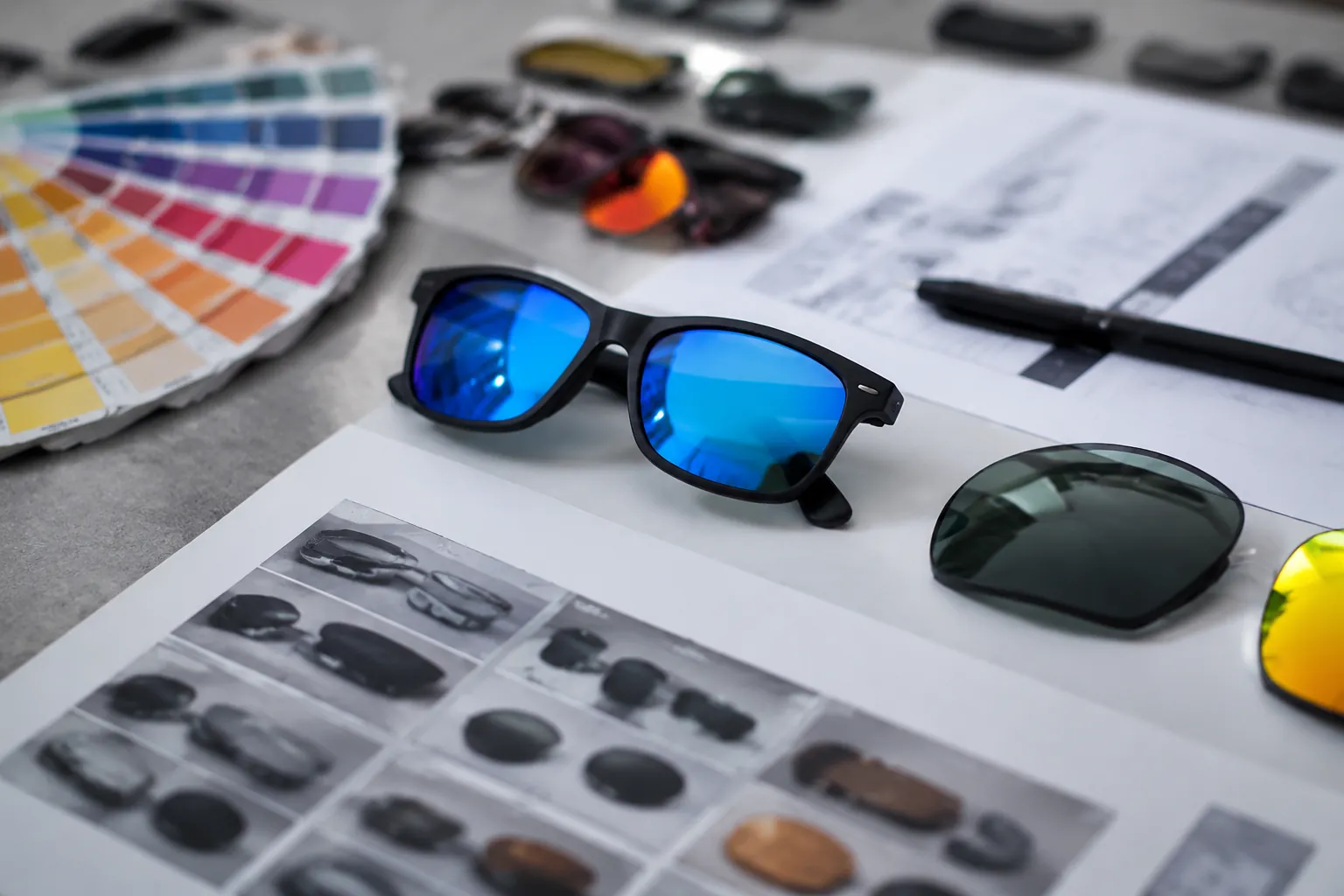
This guide is for buyers sourcing custom sunglasses at volume: brand owners, importers, distributors, and retail chains. Lens transmission is not just a style choice. It affects comfort in real use, how dark the product looks on shelf and on face, how the lens should be categorized and labeled, and whether the finished goods align with the destination standard. If lens darkness is chosen loosely, a sample may look fine while bulk production performs differently or lands in a different transmission category than expected. The practical fix is simple: specify lens color together with a target visible light transmission, an allowable tolerance, and the test basis before bulk production starts.
Start with VLT, not color
Lens transmission is usually expressed as visible light transmission, or VLT. It is the percentage of visible light that passes through the lens to the eye. Lower VLT means a darker lens. Higher VLT means a lighter lens.
Many buyers still approve lenses mainly by appearance: smoke, green, brown, gradient, mirror blue. That is not enough. Two lenses can look similar in a photo, rendering, or even a first sample, yet perform very differently in use if their actual VLT is different.
For sourcing, VLT affects three decisions right away:
- Comfort: whether the lens feels suitable for bright sun, mixed light, or lighter lifestyle use.
- Appearance: whether the eyes are hidden, partly visible, or clearly seen through the lens.
- Compliance: whether the finished lens falls into the correct transmission category for the applicable standard and product labeling.
A stronger lens brief should include at least these points: lens material, base color, coating stack, target VLT, acceptable tolerance, and whether the value applies to the finished lens before or after assembly. If tolerance is left undefined, the supplier may work to visual matching only. That invites lot-to-lot variation.
This matters because final appearance and transmission can shift with material, lens thickness, curve, and coating sequence. A color name is a design description. VLT is the measurable part of the spec.
A practical VLT decision table
For most custom sunglass programs, VLT can be narrowed quickly by channel, climate, and intended use. The table below is a practical starting point for bulk orders.
| VLT range | Wearer feel | Common use | Appearance effect | Buyer caution |
|---|---|---|---|---|
| 8% to 15% | Very dark in full sun; can feel too dim in shade or low light | Beach, high-glare outdoor use, dark fashion looks | Eyes are usually heavily obscured | Check market fit, transmission category, and labeling carefully |
| 16% to 25% | Generally comfortable in bright outdoor light | Mainstream sunwear, broad lifestyle programs | Classic sunglass look without being extremely dark | Often a practical starting band for general retail programs |
| 26% to 40% | Lighter feel; easier in mixed sun and shade | Lifestyle, urban wear, gradients, fashion tints | Eyes may remain partly visible; lens hue is more noticeable | Some consumers may perceive the lens as lighter than expected for sunwear |
| 41% to 80% | Light tint; limited glare reduction | Comfort tints, fashion, indoor-outdoor concepts | Lens color is obvious, shading is mild | May not meet consumer expectations for strong sun protection |
As a buying rule, darker bands fit strong-sun assortments better, while mid bands are often easier to sell across broader lifestyle channels. If eye visibility is part of the design language, a lighter tint may be the right commercial choice. Say so in the product positioning.
Do not pick a number from a chart and stop there. Review the target VLT with the frame style, lens color, and selling environment, then confirm the finished sample with an actual measurement report.
How VLT affects comfort in real use
Comfort is not about choosing the darkest lens possible. It is about matching lens darkness to the light conditions where the customer is likely to wear the product.
Three practical buying bands:
- Strong-sun holiday assortment: often suited to lower VLT values where customers expect a darker sunglass feel for beach, pool, or other high-glare environments.
- Daily lifestyle assortment: often better in a mid VLT band that remains usable across mixed weather and urban settings.
- Fashion tint assortment: often uses higher VLT values where eye visibility and lens color are part of the styling intention.
Lens base color also affects perceived comfort. Gray is commonly used when a neutral look is preferred. Brown often gives a warmer visual impression. Green is another common commercial option. But VLT remains the main measurable driver of overall darkness.
Material matters too. Polycarbonate, CR-39, nylon, and laminated polarized constructions can respond differently in tinting and coating. The end result can shift because of:
- lens thickness and curve
- tinting time and temperature
- hard-coat sequence
- mirror or flash coating density
- material batch variation
So ask for samples measured after final tinting and coating, and preferably in the same material and lens geometry intended for bulk. A loose early-stage lens or a digital rendering is not enough if comfort and compliance both matter.
Appearance: darkness, eye visibility, frame effect
VLT is a design tool as well as a technical spec. Lower transmission usually creates a stronger, more opaque sunglass look. Higher transmission makes the lens color itself more visible and allows more of the wearer's eyes to show through.
In product terms:
- Low VLT: often reads as classic sunglass, sport, premium, or statement fashion.
- Mid VLT: usually has the broadest commercial appeal.
- High VLT: is more style-led and should be sold with the right expectation about lighter shading.
Eye visibility matters more than many buyers expect. As VLT rises, the eyes become more visible depending on ambient light, background brightness, and lens color. That changes style perception, photography, ecommerce presentation, and in-store try-on response.
Gradient lenses need extra control. Buyers may approve them because the top band looks dark and premium, but the overall transmission still needs to fit the product concept and the applicable standard. If the top looks dark but the lens performs like a much lighter tint overall, the customer experience may not match the visual cue.
Frame construction also changes perceived darkness. The same lens can appear darker in a thick black acetate frame than in a light metal or rimless construction. Heavy rims, deep eye shapes, and strong frame contrast all influence how dark the finished product looks. Approve the finished sample, not just lens chips.
Compliance: where mistakes get expensive
Compliance problems usually appear when the tested finished lens does not match the approved concept, transmission category, or labeling. A lens can look acceptable and still create a market issue if its actual VLT falls into a different category than planned.
For export programs, buyers typically need alignment with the destination framework, such as CE EN ISO 12312-1, ANSI Z80.3, or AS/NZS 1067, depending on market and product type. Chemical requirements such as REACH may also apply to frame materials, paints, coatings, nose pads, and other components. Depending on the market and sales model, buyers may also need to verify supplier status or system controls such as FDA registration, ISO 9001, or BSCI, but those do not replace product testing to the relevant sunglass standard.
What matters in practice:
- the finished lens should test within the intended transmission range for the target market standard
- the labeled category should match the tested result
- the sample approved for bulk should represent the same material, coating stack, and tint process
- any change to tint depth, mirror layer, hard coat, polarization structure, or lens material should trigger a review of whether retesting is required
Very dark lenses can create suitability or labeling issues for some uses. Light fashion tints can create a gap between appearance and expected glare reduction. The expensive part is timing. If transmission is checked too late, relensing or relabeling can delay shipment and add scrap, labor, and freight cost.
The safer habit is to request a clear test basis: not "a similar lens passed before," but "this finished lens specification, with this material and coating stack, was tested or assessed against the relevant requirement."
How factories control transmission in production
One acceptable sample is easier to achieve than stable VLT across a production run. That is where process control matters.
A disciplined production flow usually looks like this:
- Confirm lens material, base color, curve, thickness, coating stack, and target VLT.
- Prepare pilot tint samples and measure actual transmission.
- Approve a sealed reference sample for both color appearance and VLT reading.
- Run bulk tinting with controlled time, concentration, and temperature.
- Check batch results by measurement, not visual inspection alone.
- Perform final QC on assembled goods because the finished product is what will be sold and, where required, tested.
A common buyer mistake is specifying only "dark smoke." A better specification is: smoke gray lens, target VLT, acceptable production tolerance, all finished goods to match the approved sample and the applicable market standard.
Before bulk starts, confirm three things in writing: the measured VLT of the approved sample, the allowed production tolerance, and the exact lens construction the measurement applies to. That record becomes the reference point if a pre-shipment or incoming inspection later raises a question.
Cost, MOQ, lead time, and approval checklist
Changing VLT does not necessarily change frame cost directly, but it can affect development time, reject risk, and approval complexity. Standard dark tints are usually easier to repeat than lighter fashion tints, strict-tolerance programs, or gradients.
| Lens program type | MOQ logic | Cost effect | Lead-time effect | Main risk |
|---|---|---|---|---|
| Standard dark tint, one VLT target | Usually the simplest setup for production efficiency | Lower complexity than multi-tint programs | Normally the easiest to schedule | Under-specifying tolerance or test basis |
| Two VLT options on one frame | Splits quantity by tint version | Can increase unit cost because of shorter runs and separate controls | May add an extra approval step | Inventory fragmentation and uneven sell-through |
| Gradient or fashion light tint | Requires firm physical sample sign-off before bulk | May increase cost because of tighter visual control and higher reject risk | May add time if shade revisions are needed | Mismatch between style expectation and glare performance |
| Very dark lens with strict tolerance | Usually works better in stable repeat programs | May add QC and rework cost | Can cause delay if retinting or relabeling is required | Transmission category or compliance mismatch |
In practical buying terms:
- Use small development quantities to compare darkness options only when demand is still uncertain.
- Consolidate volume into fewer tint versions once sales direction is clear.
- Expect better repeatability when lens specifications are standardized across colorways or reorder programs.
If a program includes unusual VLT targets, mirrored finishes, or several gradient versions, lock those details during development. In many cases, the margin risk comes less from the tint itself than from extra sample rounds, delayed approvals, and variant-heavy inventory planning.
Use this checklist before you release bulk production:
- Define the target use case: beach, everyday wear, driving-oriented, sport, or fashion tint.
- State the lens color, material, coating stack, and target VLT with tolerance.
- Confirm which standard framework applies in the destination market.
- Ask for the test basis on the finished lens specification, not on a similar historical lens.
- Approve a physical sample, not only photos, video, or renders.
- For gradients, confirm the overall commercial intent, not just the darkness of the top band.
- Check that mirror, flash, hard-coat, or polarization layers match the approved sample stack.
- Plan quantity by tint version carefully so MOQ does not create slow-moving variants.
If you remember one thing, make it this: buy VLT by use case first, then style around it.
That approach reduces complaints, supports compliance planning, and gives you a more consistent line architecture across seasons and reorders.
Have a custom sunglasses project in mind?
Send us your styles, target market and quantities and we will return a detailed quote with MOQ, lead time and a sample plan.
Get a QuoteWhy source this from Wenzhou with LumiShades
Wenzhou in Zhejiang Province is widely regarded as China’s eyewear manufacturing capital, producing a large share of the world’s sunglasses. That concentration matters to buyers: a deep local supply chain for acetate sheet, hinges, lens blanks, plating and packaging means shorter component lead times, easier color and material matching, and a workforce with decades of eyewear-specific skill. LumiShades has manufactured in this ecosystem since 2009, and our vertical integration — in-house injection molding, acetate cutting, CNC milling, lens tinting, decoration and quality control — means no part of your order is quietly subcontracted to a workshop you cannot audit.
For international buyers, that vertical control translates into accountability. When a single factory owns every step, defects are traced and fixed at source rather than bounced between vendors, and your specifications survive intact from first sample to bulk. We back this with 15+ years of experience, shipments to 60+ countries, more than 5 million pairs produced per year and a 98.5% on-time delivery rate. Our certifications — CE EN ISO 12312-1, FDA registration, ANSI Z80.3, AS/NZS 1067, REACH, ISO 9001 and BSCI audit — mean the compliance documentation your market requires already exists. Explore our manufacturing capabilities and quality control process to see how this works in practice.
Frequently asked questions
What VLT range is safest for a mainstream sunglass program? For a broad commercial program, many buyers start in the mid-dark range rather than at the extreme dark end. A practical approach is to review one darker option, one mid option, and one lighter option on the same frame, then choose based on intended use and the destination standard. Do not rely on a generic target alone. Ask the supplier for measured VLT on the finished sample and confirm the transmission category and labeling implications for your market.
Can I approve lens darkness from photos or video only? No. Photos and video are useful for shortlisting, but they are not a reliable basis for final approval because lighting, reflections, camera exposure, and background all affect how dark a lens appears. Final approval should be based on a physical sample and a measurement report showing VLT on the finished lens specification. If the lens has mirror, flash, gradient, or polarization, make sure those features are included in the approved sample stack.
Does changing from gray to brown lens automatically change compliance status? No. Color by itself does not determine compliance status. What matters is whether the finished lens, in its final material and coating construction, meets the applicable requirements of the target standard and is labeled in the correct transmission category. If you change lens color, tint depth, coating stack, or material, ask the supplier whether the existing test evidence still applies or whether the lens should be retested or re-evaluated.
Will a tighter VLT tolerance increase cost? Often yes. A tighter tolerance can require more development work, more inline measurements, and a higher rejection or rework risk during production. The buyer action point is simple: set tolerance only as tight as the product really needs. If the program is fashion-led and the exact darkness is visually critical, tighter control may be justified. If the program is a broad commercial style, an overly narrow tolerance can add cost without meaningful sales benefit.
How should I handle multiple lens darkness options on one frame style? Treat each VLT option as a separate SKU with its own demand plan, compliance review, and approval sample. Before adding multiple darkness levels, check whether order volume per version remains commercially efficient and whether each version will need its own testing or labeling treatment in the target market. A practical rollout is to start with one core tint, test an additional version only where there is a clear channel need, and avoid splitting volume across too many low-turn variants.
Ready to start?
Explore our cat-eye sunglasses or request a quote — our sales team replies within 12 hours.
Request a Quote