
4-Base vs 6-Base vs 8-Base Sunglass Lenses
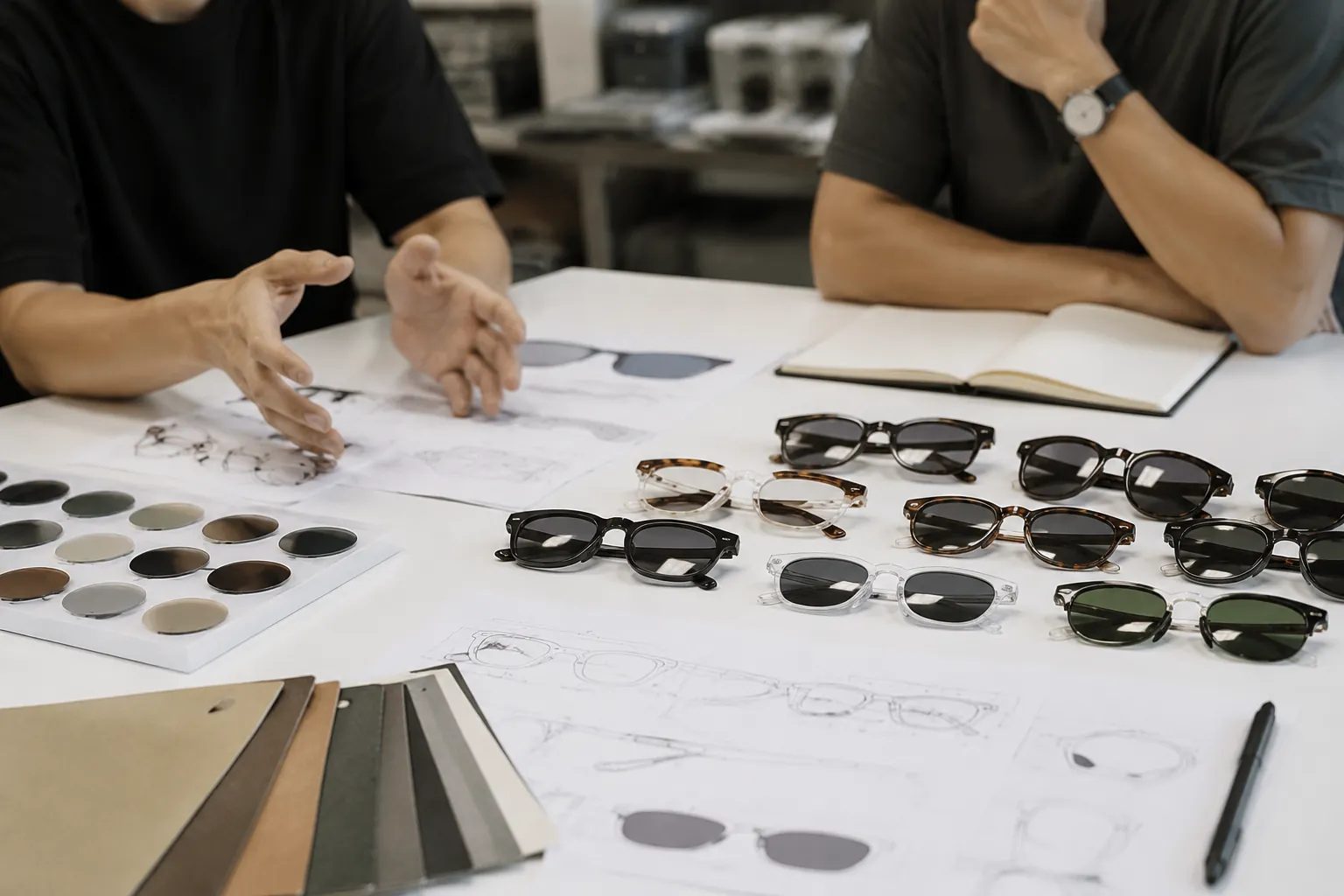
Base curve is not a minor style detail. It affects front wrap, lens fit, side coverage, assembly difficulty, and the odds of optical complaints after launch. Get it wrong and the problems show up later: edge distortion, lens stress during insertion, temple pressure, or a frame that simply looks wrong on face. This guide compares 4-base, 6-base, and 8-base curves in buying terms, with a focus on fit, materials, tooling, sampling, and quality control.
What base curve means in production terms
Base curve describes the front surface curvature of the lens. In sourcing terms, 4-base is fairly flat, 6-base is moderate wrap, and 8-base is strong wrap. Simple enough. But the choice affects far more than appearance.
Base curve influences frame-front geometry, lens blank or molded lens selection, bevel design, groove angle, temple opening behavior, and even how decoration reads on a curved surface. Buyers should treat it as a system decision, not just an optical spec.
A 4-base sunglass front usually works more easily with flatter acetate or metal constructions. A 6-base front is often the most flexible commercial option for mainstream sunwear. An 8-base front demands better coordination between frame shape, lens edge, and temple angle. If that geometry is off, assembly gets unstable fast.
As wrap increases, process control gets tighter. Lens cutting accuracy matters more. So does frame-front consistency and lens-seat geometry. If the molded or formed front drifts from target shape, the lens may seat under stress or fail to sit cleanly. That is why experienced buyers lock base curve early in the tech pack, before tooling is released and before decoration positions are approved.
Late changes are rarely small. Moving a project from 6-base to 8-base can mean a different front geometry, a different lens source, revised edge finishing, and a fresh fit review.
4-base, 6-base, and 8-base side by side
| Base curve | Typical front wrap | Best channel fit | Optical risk level | Common materials | Factory control points |
|---|---|---|---|---|---|
| 4-base | Low | Fashion retail, promo, classic lifestyle | Generally lowest edge-distortion risk | Acetate, metal, TR, injection PC | Flatter front geometry, easier lens insertion, broader decoration area |
| 6-base | Medium | Core retail, private label, active lifestyle | Moderate if geometry is inconsistent | Acetate, TR90, injection PC, bio-based injection materials | Balanced mold design, temple angle control, consistent bevel fit |
| 8-base | High | Sport, outdoor, wrap fashion | Highest risk of noticeable edge effects and assembly stress | TR90, PC sport frames, performance nylons | Accurate curve matching, lens edge finish, hinge opening angle, front-shape consistency |
There is no universal best option. Most broad retail programs are safer at 4-base or 6-base because they align with mainstream styling and reduce the risk of visual complaints. Many sport programs prefer 8-base for side coverage and a more technical look, but only if the full design supports it.
One blunt rule helps: do not pick 8-base just because it looks sporty. Pick it only if the brief truly requires wrap, wind management, or side-glare control. If not, 6-base is often the better business choice.
How base curve changes fit, coverage, and comfort
On face, base curve changes three things people notice fast: how close the frame sits to the cheek and temple area, how much side light gets in, and whether the style reads as fashion or performance.
A 4-base frame usually looks calmer and feels easier for all-day casual wear. It suits many face shapes in retail settings. Side coverage is lower, but often good enough for city, travel, and general lifestyle use. A 6-base frame sits a bit closer to the face and gives a more current profile without looking extreme. That is one reason it works well for private-label sunwear. An 8-base frame wraps more clearly and can reduce side glare, wind exposure, and peripheral light leakage. That matters in cycling, boating, fishing, and running.
More wrap also means more fit risk. Check these four areas hard:
- Temple pressure: too much wrap combined with an aggressive temple opening angle can create pressure above or behind the ear.
- Cheek interference: high-wrap fronts may touch the cheek on smaller faces or when the wearer smiles.
- Lens stress: if a lens is forced into an incompatible seat, whitening, cracking, or later pop-out risk can appear.
- Back-surface reflections: curved lenses can show distracting internal reflections if lens type, coatings, and fit are not considered together.
Do not rely on one quick in-house fitting. Check samples on more than one head size. Review front wrap, pantoscopic angle, and lens-to-face clearance together. A wrap style can look fine on the bench and still fail in wear.
Optical distortion risk: what to ask your supplier
Distortion risk usually rises as wrap increases, especially near the outer lens zones. That does not automatically mean the product is faulty. The real question is simpler: is the optical behavior right for the use case, price point, and customer?
Base curve alone does not answer that. Two 8-base lenses can perform differently based on lens width, horizontal wrap angle, optical center position, thickness profile, and the final eye shape cut from the lens blank. A large aggressive wrap shape will often show more edge behavior than a smaller wrapped lens, even if both are called 8-base.
Ask the supplier for direct information, including:
- the lens material used, such as TAC polarized, PC, nylon, or CR-39 style plano sun lens
- whether the lens is molded to the required curve or cut from stock matched to that curve
- nominal center thickness and expected edge-thickness range
- how the optical center is positioned relative to the finished eye wire shape
- whether a back-surface anti-reflective treatment is recommended for the selected wrap and lens color
For non-prescription sunwear, a practical buyer check is straightforward. Look through the outer lens area at straight lines such as shelving, door frames, or signage. Then move the head naturally. Mild edge change may be acceptable on a wrap sport style. Strong bending, swimming, or visible instability is a warning sign.
Compliance is separate. The finished sunglass still needs evaluation against the target market requirement, such as CE EN ISO 12312-1, ANSI Z80.3, or AS/NZS 1067, as applicable. If chemical compliance is required, buyers should also confirm that materials and components are managed in line with REACH where relevant. Base curve does not replace testing. It changes the geometry that must be represented in the tested sample.
Tooling, materials, and process impact
Base curve affects tooling strategy and material behavior more than many buyers expect. In injection programs, flatter fronts are usually easier to control because the geometry is less demanding. At 6-base, production is still routine in capable factories, but front stability and lens-seat consistency matter more. At 8-base, small variation in tooling, cooling, molding, or post-mold relaxation is more likely to show up during lens fitting or final inspection.
Material choice matters too:
- Acetate: well suited to many 4-base and 6-base lifestyle frames; stronger wrap is possible, but forming and finishing become more demanding.
- TR90 or similar sport-oriented materials: commonly used for 6-base to 8-base frames because they support active fit and wrap geometry.
- PC injection frames: common in value sport and promotional wrap programs; efficient at volume, but lens-seat accuracy still matters.
- Metal: usually more straightforward on flatter constructions unless the design is specifically engineered for wrap.
Decoration changes with curve as well. Pad printing on a flatter 4-base surface is usually easier to keep visually consistent. On higher-wrap surfaces, artwork can appear stretched or awkward if it crosses a bend transition. Laser marking can work well on suitable metals and some coated surfaces, but the result still needs to be checked from the wearer's angle. Metal logo plates need a stable landing area. Too close to a curve break, they can look tilted.
Lead time depends on whether the program uses existing tooling, modified tooling, or a fully new mold. It also depends on material, lens type, decoration, packaging, and test requirements. Ask the supplier to break out three timelines in writing: sampling, tooling if any, and bulk production after approval. If the factory holds certifications such as ISO 9001 or social-audit documentation such as BSCI, treat those as signs of management systems or audit status, not proof that a specific wrap frame will perform correctly. Geometry still needs its own review.
Choosing by channel: retail, private label, promo, and sport
Channel should drive base-curve selection. Not personal taste. Different routes to market can tolerate different levels of wrap, fit risk, and development complexity.
| Channel | Recommended curve | Why it works | Main caution |
|---|---|---|---|
| Fashion retail | 4-base or soft 6-base | Broad face appeal, familiar visual language, lower complaint risk on optics | May not deliver the side coverage expected for outdoor positioning |
| Private label core range | 6-base | Modern enough for current market, still commercially balanced | Fit must be checked carefully to avoid light temple pressure or cheek contact |
| Promo / volume gifting | 4-base | Lower complexity, easier quality control, neutral wear experience | Can look generic if color, lens tint, and branding are weak |
| Outdoor / sport | 8-base | Wrap, coverage, technical appearance, better control of side light and wind | Higher development and QC burden |
Commercial planning should match the channel. MOQ, price, and development effort vary by supplier, material, and whether the program uses standard components or custom tooling. Ask for a quotation that separates unit price, tooling if any, decoration charges, packaging, and testing costs. That makes it easier to compare a lower-risk 4-base or 6-base concept with a more demanding 8-base sport concept.
In practice, 8-base is not always expensive. It is just less forgiving. The hidden cost often appears in extra sample rounds, tighter assembly control, and more careful fit review, not only in material cost.
Buyer checklist before sample approval
- Confirm the sales channel first. State clearly whether the frame is for fashion retail, core private label, promotional use, or sport. That sets the acceptable wrap range.
- Specify the base curve in the tech pack. Do not describe the style only as "wrap." State 4-base, 6-base, or 8-base and note the intended lens material.
- Review the frame-lens system together. Ask for front curvature, lens geometry, and temple opening angle in the same review.
- Check fit on multiple wearers. At minimum, test on medium and larger head sizes for 6-base and 8-base styles.
- Inspect edge distortion. Use straight architectural lines, shelving, or signage and look through the outer lens zones while moving naturally.
- Check lens stress after assembly. Watch for difficult insertion, whitening, creaking, uneven seating, or any sign the lens is under force.
- Review decoration placement. Confirm that pad print, laser marks, foil logos, or metal plates are not placed across unstable curve transitions.
- Confirm the compliance path. Match the exact final geometry to the required standard, such as CE EN ISO 12312-1, ANSI Z80.3, or AS/NZS 1067, and verify any supporting material or chemical compliance needs such as REACH where relevant.
A good rendering is not enough. Neither is a sales sample that only looks right in photos. Inspect front symmetry, wear the sample for several minutes, and assess it in motion. Many avoidable claims on wrapped sunwear can be caught here.
A practical sourcing rule
If you want one rule, use this: choose the flattest base curve that still delivers the function the product needs.
For broad fashion retail, start with 4-base. For many private-label sun programs, start with 6-base. For real sport, outdoor, or high-wrap performance positioning, move to 8-base only if the brief clearly requires side coverage, wind management, or a technical silhouette.
The safest sourcing sequence is simple: define the channel, confirm the target curve, choose the material, sample the exact geometry, test wear and optical behavior, then release tooling and decoration. Skip that order and problems get expensive.
Base curve looks like a small number on a spec sheet. It is not. It is an early engineering and fit decision, and it should be treated that way.
Have a custom sunglasses project in mind?
Send us your styles, target market and quantities and we will return a detailed quote with MOQ, lead time and a sample plan.
Get a QuoteWhy source this from Wenzhou with LumiShades
Wenzhou in Zhejiang Province is widely regarded as China’s eyewear manufacturing capital, producing a large share of the world’s sunglasses. That concentration matters to buyers: a deep local supply chain for acetate sheet, hinges, lens blanks, plating and packaging means shorter component lead times, easier color and material matching, and a workforce with decades of eyewear-specific skill. LumiShades has manufactured in this ecosystem since 2009, and our vertical integration — in-house injection molding, acetate cutting, CNC milling, lens tinting, decoration and quality control — means no part of your order is quietly subcontracted to a workshop you cannot audit.
For international buyers, that vertical control translates into accountability. When a single factory owns every step, defects are traced and fixed at source rather than bounced between vendors, and your specifications survive intact from first sample to bulk. We back this with 15+ years of experience, shipments to 60+ countries, more than 5 million pairs produced per year and a 98.5% on-time delivery rate. Our certifications — CE EN ISO 12312-1, FDA registration, ANSI Z80.3, AS/NZS 1067, REACH, ISO 9001 and BSCI audit — mean the compliance documentation your market requires already exists. Explore our manufacturing capabilities and quality control process to see how this works in practice.
Frequently asked questions
Is 8-base always better for sports sunglasses? No. An 8-base lens can improve wrap, side coverage, and control of wind or side light, but it is only the right choice when the brief requires those benefits. Before approval, ask the supplier for the exact lens material, eye shape, and frame-front geometry; review the sample for cheek contact, temple pressure, and visible edge distortion; and confirm that the finished style will be tested to the target market standard, such as CE EN ISO 12312-1, ANSI Z80.3, or AS/NZS 1067.
Can one frame be offered in 4-base and 6-base versions? Sometimes, but buyers should treat them as separate developments unless the supplier can show that the same frame platform was engineered for both. A base-curve change may require a different front shape, different lens blank, adjusted bevel, or changes to temple opening behavior. Ask for separate samples, separate fit confirmation, and confirmation of which version will be used for compliance testing and final production records.
How early should I confirm base curve in development? Before final tooling release and before decoration locations are locked. In practice, base curve should be written into the tech pack at the concept stage and rechecked during the first functional sample review. If it changes late, ask the supplier to confirm in writing whether the front geometry, lens source, assembly process, or testing plan also changes.
What is a safe default for a new retail program? For many mainstream retail and private-label programs, 6-base is the safest starting point because it gives a modern look without the higher fit and optical risk of stronger wrap. To validate that choice, request a sample, check comfort on more than one wearer, inspect the outer lens area for distortion, and confirm that the style still fits the visual language of the target channel.
Does base curve change compliance testing? It can change which sample needs to be tested, even if the legal framework stays the same. If the final production style uses a different curve, lens geometry, or frame fit from the tested sample, buyers should confirm with the supplier and testing partner whether a new submission is required. Make sure the tested sample reflects the real production configuration, and where relevant also verify supporting requirements such as REACH for materials and components. If the product is sold in the US, ask whether any FDA registration obligations apply to the supplier's product category and business model.
Ready to start?
Explore our round sunglasses or request a quote — our sales team replies within 12 hours.
Request a Quote