
PC vs TAC vs Nylon: Choose the Right Lens Base
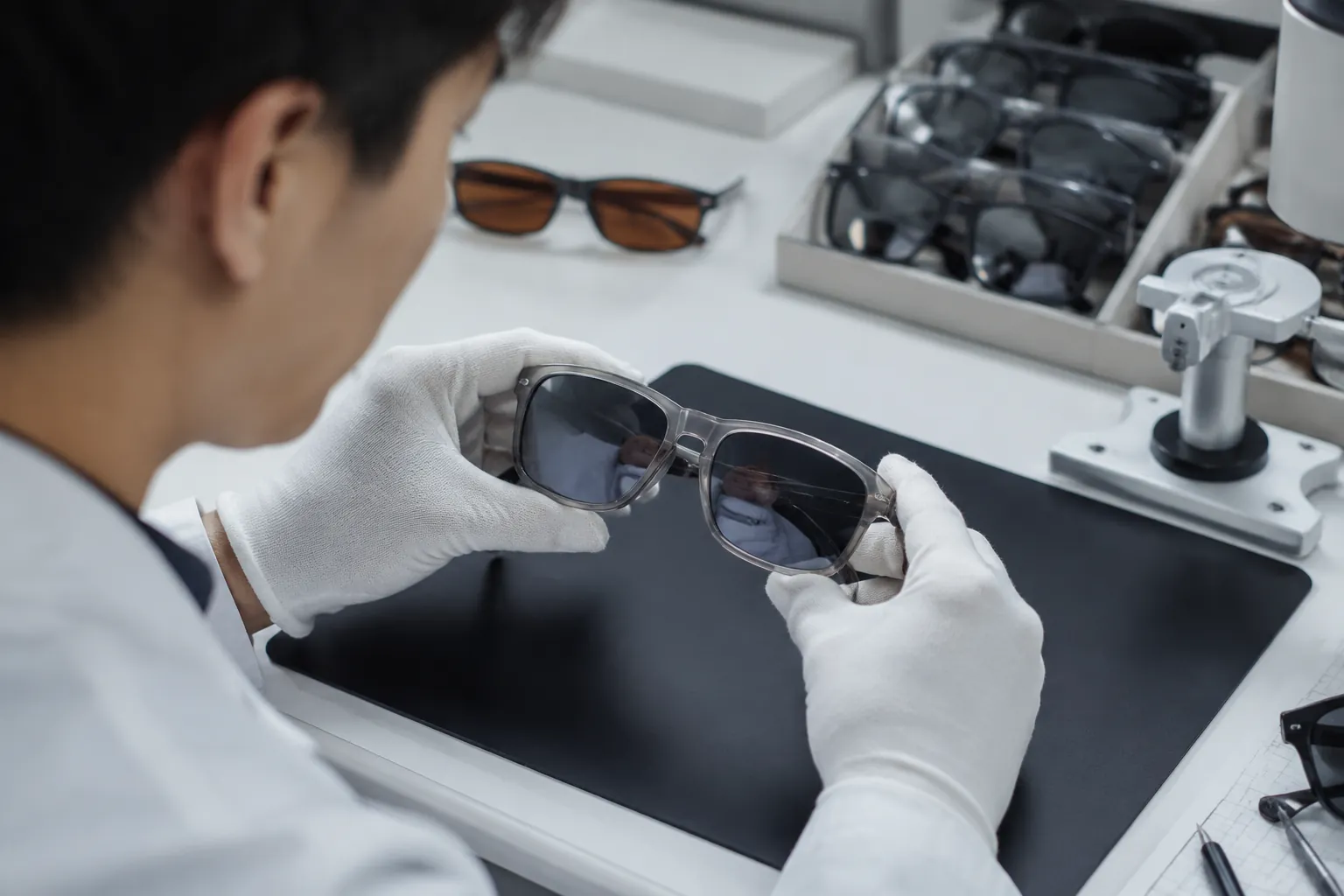
This guide is for buyers who need a lens platform that fits the product they sell, not the one that sounds strongest in development. In sunglasses, lens choice affects cost, returns, optical performance, and production stability. A low-cost promo style, a fashion polarized style, and a wrapped sports frame should not all follow the same lens logic. That is the point. The question is not which material is best in general. It is which material fits the channel, use case, claim set, and compliance requirements. Below is a buyer-focused framework for choosing PC, TAC, or nylon, with attention to optics, durability, polarization, manufacturing risk, and the checks to confirm before bulk approval.
Start with channel, retail promise, and complaint risk
Bad lens decisions usually start with the wrong question. Buyers ask for the "best" lens. That is too vague. Start with channel and use case instead.
A promo sunglass handed out at an event has a different job from a fashion style on a retail wall or a wrap frame built for cycling. The lens should match how the product is sold, how it is worn, and which complaints will hurt most after shipment.
Use this order before naming any material:
- Define the channel: promo, fashion retail, lifestyle polarized, sports, or private label.
- Set the retail and cost framework: decide whether the product is cost-led, feature-led, or performance-led.
- Confirm destination market: EU, US, Australia/New Zealand, or mixed export, because lens performance and labeling must match the market.
- Decide which failure matters most: scratching, optical distortion, lamination failure, color inconsistency, breakage, or excess scrap.
- Then lock the lens substrate: PC, TAC, or nylon.
This order cuts rework later. Changing lens type after sample approval is rarely minor. A switch from PC to TAC, or TAC to nylon, can mean new sourcing, tint matching, fit checks, and fresh verification of transmission and product claims.
As a planning rule, lens choice matters most when your return tolerance is low. If the item is short-life and price-driven, the commercially correct choice may not be the technically strongest one. If the product is sold on optics, comfort, or polarized performance, the lens platform needs closer review before the frame is finalized.
What PC, TAC, and nylon do well
All three lens platforms can be tinted. All three can work in sunglasses if the product is designed and controlled properly. The real differences show up in impact behavior, optics, weight, polarization options, edge behavior, and process sensitivity.
| Lens platform | Typical thickness / build | Main strengths | Main weak points | Best-fit channel |
|---|---|---|---|---|
| PC | Single-piece lens construction; thickness depends on design and performance target | Good impact resistance, broad commercial availability, practical for high-volume tinted sunglasses | Scratch performance depends heavily on coating quality; optical quality may be less suitable for demanding wrap applications if processing is weak | Promo, entry fashion, value private label, casual active use |
| TAC | Layered polarized lens construction; build varies by supplier and specification | Accessible polarization, familiar retail feature story, widely used for driving and lifestyle sunglasses | Lamination quality is critical; poor edge finishing, heat exposure, or weak process control can lead to peeling, bubbles, haze, or warpage | Fashion retail, polarized lifestyle, mid-range private label |
| Nylon | Performance-oriented polyamide lens; thickness depends on design, curve, and use case | Low weight, strong optical performance, good stress behavior in wrapped shapes, premium wear feel | Higher material and processing cost; tighter tint and handling control required | Sports, technical outdoor, premium private label |
PC is often the commercial default. It can give a workable mix of cost, durability, and manufacturability. It is common in non-polarized sunglasses and many general-use styles. But not all PC lenses are equal. Coating quality, molding quality, and inspection standards make a big difference.
TAC is not just a better version of PC. In sourcing terms, it is usually chosen because polarization is part of the sales story. If the package, product page, or sales staff will push a polarized claim, TAC is a common route. Still, the buyer should verify lamination quality and edge finishing, not just the word "polarized."
Nylon matters more when the frame is technical, strongly wrapped, or built for sport. In those cases, lower weight and better optical behavior can improve comfort and reduce distortion complaints. In a giveaway or low-price fashion program, nylon often adds cost without adding enough retail value.
Failure modes that cause real returns
Source against likely complaints, not ideal material descriptions. Most lens-related returns come from the same small set of problems.
- PC: visible scratching after normal cleaning, uneven hard-coat performance, cosmetic marks from assembly, and optical complaints in highly curved shapes if processing and inspection are weak.
- TAC: edge peeling, trapped bubbles, haze, warpage, or delamination if lamination and cutting control are poor or if the lens sees unsuitable heat during production, storage, or use.
- Nylon: color variation between lots, avoidable scrap if the factory is not used to handling performance lenses, and tolerance issues if frame-lens fit is not controlled tightly.
Frame geometry matters. A lens that looks acceptable in a flatter fashion front may become risky in a deeper-wrap sports frame. As base curve and edge stress rise, distortion risk and fitting sensitivity rise too. That is one reason nylon is often preferred in technical wraps. Lower-spec PC or unstable TAC builds can be less forgiving.
If the channel cannot tolerate optical complaints, test the sample outdoors in real wear conditions. Not just under office lights.
Approval checks should include left-right color consistency, edge finish, visible stress around the groove or rim, and clarity through the outer viewing zones, not only the center of the lens.
Cost logic: where to spend and where to protect margin
Lens selection only makes sense if it matches the product's selling logic. Do not ask only which material costs less. Ask which material supports the claim set and the acceptable return rate.
In simple buying terms:
- PC is usually the most practical low-cost route for non-polarized programs.
- TAC usually costs more than basic non-polarized PC, but adds a polarized feature that is easy to explain at retail.
- Nylon usually carries higher material and processing cost, so it needs a channel that can recover that spend through price, positioning, or lower complaint risk.
For a low-price promo program, nylon often hurts margin without improving sell-through. For a mid-range private-label style built around a polarized story, TAC often gives a better balance of feature value and cost control than jumping straight to nylon. For a sport wrap sold through specialty retail, paying more for nylon may be rational if it reduces distortion complaints or fit-related production risk.
Spend more on the lens when one or more of these are true:
- The frame has a wrapped geometry and edge stress is meaningful.
- The product is sold with a polarized claim and buyers or end users will expect that claim to be genuine and consistent.
- The style sits next to stronger branded products where optics and finish will be compared directly.
- The cost of returns, rework, or damaged retailer confidence is higher than the cost of upgrading the lens platform.
Do not overspend on performance the customer will not notice. That is a common buying mistake.
Compliance and testing: what the lens must prove
Lens material does not replace compliance. The buyer should define the destination market and claim language before bulk production starts. Depending on market and product scope, the standards discussion commonly includes CE EN ISO 12312-1 for Europe, ANSI Z80.3 for the US market, and AS/NZS 1067 for Australia and New Zealand.
Tint and visible light transmission matter as much as substrate. A smoke, brown, green, or mirrored lens still needs to match the sunglass category and labeling rules for the target market. If the product is marketed as polarized, that claim should be verified through testing or supplier documentation. REACH may also matter for chemical compliance in relevant markets. FDA registration may appear in US-facing supplier documents, but it is not proof that a sunglass lens meets optical performance requirements.
Put the testing plan in writing before bulk starts:
- Confirm the exact substrate: PC, TAC polarized, or nylon.
- Confirm tint recipe and target visible light transmission range by lens color.
- Confirm the market claim set printed on packaging, inserts, labels, or online copy.
- Approve decoration placement so no print, foil, or metal component interferes with the vision area.
- Retain an approved reference sample for comparison during production and final inspection.
Useful supplier discussions may also include ISO 9001 and BSCI. These do not replace product testing, but they can show whether the factory has structured quality and audit systems behind the program.
A practical lens-selection matrix by buyer scenario
Here is the short version most buyers can use during RFQ planning.
| Buyer scenario | Recommended lens | Why it fits | Watch-outs |
|---|---|---|---|
| Promo campaign, high volume, tight landed-cost target | PC | Commercially practical cost, good impact behavior, straightforward tinting for general-use sunglasses | Set realistic scratch expectations; avoid making premium optics claims without validating them |
| Fashion retail, polarized story, moderate margin target | TAC | Polarization adds clear perceived value without moving to the cost level usually associated with nylon sport lenses | Check lamination quality, edge finishing, and stability during fitting and handling |
| Sports wrap, cycling, running, outdoor specialty | Nylon | Better optics and lower weight are often more suitable for technical wrapped shapes | Higher cost; color approval and tolerance control should be locked early |
| Mid-range private label sold across mixed channels | PC or TAC | PC for value-led assortments; TAC when polarization is central to the range | Use nylon only if the retail story and margin clearly support it |
If you are choosing between PC and TAC, ask one direct question: Is polarization part of the real selling promise, or is it only being considered because it looks stronger on packaging? If polarization is central to the SKU, TAC is often the practical choice. If not, a well-controlled PC lens may be the more honest and more profitable specification.
How lens choice changes process steps and lead time risk
Unit cost gets attention. Process risk often does not. That is a mistake.
Different lens platforms need different controls in development and production, and that matters when the launch window is fixed.
A typical development flow includes:
- Buyer confirms frame drawing, lens type, tint, logo method, and packaging.
- Factory prepares a development sample.
- Buyer approves fit, appearance, optics, and claim wording.
- Bulk production proceeds only after the approved specification is locked.
- Final QC checks cover lens appearance, color consistency, assembly fit, logo placement, hinge function, and packaging accuracy.
PC programs are often the easiest to scale for value-driven styles. TAC programs need more attention to polarized consistency, laminate handling, and edge finishing. Nylon programs usually need tighter approval on color, wrap geometry, and fitting tolerances, especially for sports shapes.
Decoration can also affect lens risk. Common methods include pad printing, screen printing, hot stamping, laser marking, and metal logo application. Problems start when excess heat, debris, or rough handling affects the lens during assembly or packing. So decoration near the eyewire or lens groove should be reviewed carefully before bulk approval.
One rule saves time: lock lens color before finalizing packaging and claims. A late tint change may require fresh transmission verification and may also change how the product should be labeled in the destination market. Likewise, switching from non-polarized PC to TAC after approval should be treated as a new lens program, not a small revision.
What to put on the RFQ and sample-approval sheet
A vague RFQ creates avoidable production risk. Buyers get more stable results when they define not only the lens material, but also the tolerances that matter and the variations that will be rejected.
- Lens substrate: PC, TAC polarized, or nylon.
- Lens color and target visible light transmission range.
- Frame use case: promo, fashion, driving, sports, or mixed retail.
- Destination market and compliance target: CE EN ISO 12312-1, ANSI Z80.3, AS/NZS 1067, plus REACH where relevant.
- Cosmetic standard: scratches, pits, flow marks, haze, edge quality, and left-right color match.
- Polarization claim: yes or no.
- Decoration method near the lens area, if any.
- Packaging type, because handling and cosmetic risk can change between bulk pack, polybag, pouch, and retail box formats.
During sample approval, check these points in person if possible:
- Optical comfort outdoors, not just indoors.
- Tint consistency from left lens to right lens.
- Lens seating under light pressure, with no visible stress at the groove or rim.
- Surface sensitivity after normal wiping with an appropriate cloth.
- Final appearance in the intended packaging, where small cosmetic issues may be easier to see.
Good buying is not about choosing the most advanced material every time. It is about matching the lens platform to the market, then controlling the details that drive claims, rework, and missed ship dates.
Have a custom sunglasses project in mind?
Send us your styles, target market and quantities and we will return a detailed quote with MOQ, lead time and a sample plan.
Get a QuoteWhy source this from Wenzhou with LumiShades
Wenzhou in Zhejiang Province is widely regarded as China’s eyewear manufacturing capital, producing a large share of the world’s sunglasses. That concentration matters to buyers: a deep local supply chain for acetate sheet, hinges, lens blanks, plating and packaging means shorter component lead times, easier color and material matching, and a workforce with decades of eyewear-specific skill. LumiShades has manufactured in this ecosystem since 2009, and our vertical integration — in-house injection molding, acetate cutting, CNC milling, lens tinting, decoration and quality control — means no part of your order is quietly subcontracted to a workshop you cannot audit.
For international buyers, that vertical control translates into accountability. When a single factory owns every step, defects are traced and fixed at source rather than bounced between vendors, and your specifications survive intact from first sample to bulk. We back this with 15+ years of experience, shipments to 60+ countries, more than 5 million pairs produced per year and a 98.5% on-time delivery rate. Our certifications — CE EN ISO 12312-1, FDA registration, ANSI Z80.3, AS/NZS 1067, REACH, ISO 9001 and BSCI audit — mean the compliance documentation your market requires already exists. Explore our manufacturing capabilities and quality control process to see how this works in practice.
Frequently asked questions
Is PC always the cheapest option for custom sunglasses? PC is often the most practical option for basic non-polarized sunglasses, especially in promotional, entry-fashion, and value-led programs. But buyers should compare the full specification, not just the substrate name. Coatings, tint, mirror treatments, frame design, packaging, testing, and inspection standards all affect total cost. Ask the supplier to quote the complete build and state clearly whether the PC lens includes hard coating and any added surface treatments.
Should I choose TAC only if I need polarization? Polarization is the main reason buyers choose TAC, and in many sourcing programs it is the clearest justification. If your packaging, product page, or sales team will actively sell the style as polarized, TAC is a practical option to evaluate. Before approval, ask the supplier for details on lamination quality, edge finishing, and any internal or third-party verification used to support the polarized claim. If polarization is not important to the SKU, compare TAC against a well-made PC lens instead of assuming TAC is automatically better.
Can nylon lenses be justified for a mid-range private-label line? Yes, but only when the product story supports it. Nylon is easier to justify when the line includes wrapped sport frames, outdoor use, low-weight positioning, or a premium optics message. For ordinary fashion shapes, many buyers will struggle to recover the added cost. A practical approach is to use nylon selectively on technical styles and compare sample performance against PC or TAC under real wear conditions before locking the range.
What certifications should I ask the factory to discuss for sunglass lenses? Start with the destination market and ask for documentation relevant to that market: CE EN ISO 12312-1 for Europe, ANSI Z80.3 for the US, and AS/NZS 1067 for Australia/New Zealand where applicable. Ask separately about REACH if chemical compliance is relevant. If a supplier mentions FDA registration, treat it as a documentation point, not proof of sunglass optical performance. You can also ask whether the factory operates under ISO 9001 and whether it has BSCI status, but remember that management-system and social-audit credentials do not replace product testing on the actual lens and tint you are buying.
How do lead time and development risk affect lens-platform choice? PC is often the easiest lens platform for a straightforward value-driven program because it usually involves fewer lamination-related variables than TAC and fewer performance-fit variables than nylon. TAC needs tighter control of polarization consistency and laminate quality. Nylon often needs closer review of tint consistency, curve behavior, and lens seating in wrapped frames. To reduce delay risk, lock the lens substrate, tint, target transmission range, and claim language before bulk starts, and require the supplier to submit an approval sample that reflects the final specification rather than a near-match.
Ready to start?
Explore our sport wrap sunglasses or request a quote — our sales team replies within 12 hours.
Request a Quote