
How to Choose Sunglass Lens Tints by Sales Channel
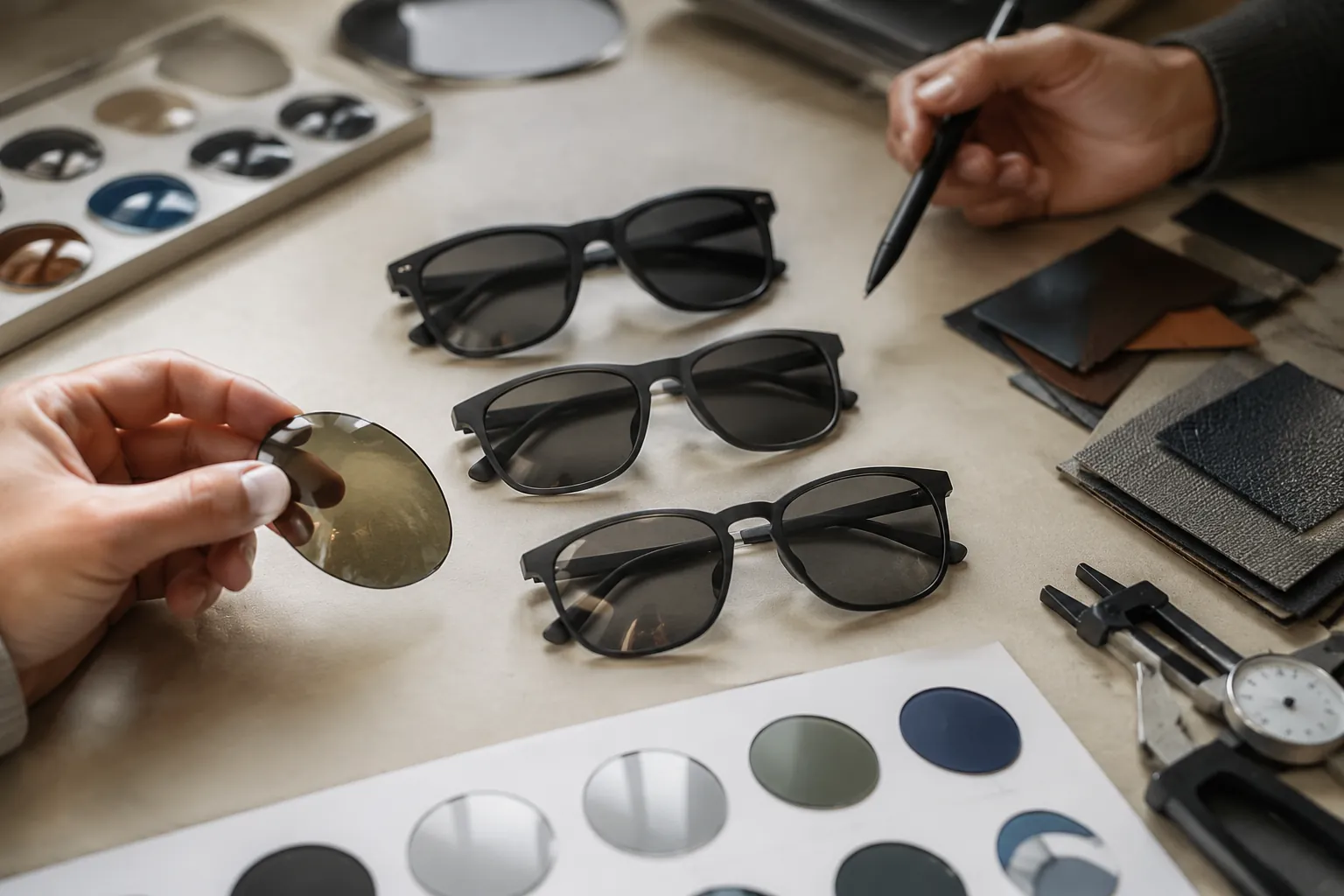
This guide is for brand owners, importers, distributors, and retailers buying custom sunglasses in volume. The question is not which tint looks best on a color card. It is which tint fits the sales channel, the use case, and the production controls behind the order. A lens can look good in sampling and still fail later through weak retail sell-through, comfort complaints, coating damage, or visible shade drift between lots. Buyers who choose tints by channel usually cut that risk. The framework below is built for bulk programs. It focuses on sourcing realities: use environment, lens material behavior, MOQ and cost logic, compliance targets, decoration compatibility, and repeatability from sample to reorder.
Start with the channel, not the color chip
Many buyers start by asking for smoke, brown, green, gradient, or mirror. Wrong starting point. First define the sales channel: retail, promotional, or sports. Each channel rewards different tint choices and exposes different failure points.
Retail programs live or die on sell-through. The lens has to look right on shelf, work in e-commerce images, and feel wearable to a broad customer base. If the tint is too dark, too yellow, or too trend-specific, returns and slow-moving stock become more likely.
Promotional programs are usually more sensitive to cost, speed, and repeatability. Buyers often need a simple lens that can be approved fast and reproduced with minimal variation across a deadline-driven order. In this channel, plain solid tints usually beat more process-sensitive looks.
Sports programs put more pressure on comfort and on-use performance. End users notice glare, low contrast, excessive darkness, and lens distortion quickly. Sports buyers should care less about shelf drama and more about the link between base tint, wrap shape, light conditions, and coating durability.
Factory process matters here too. Tint consistency is usually easier to control when one supplier manages lens production, decoration, and final QC under one quality system instead of splitting the job across multiple parties.
- Retail channel: broad appeal, strong shelf presentation, low return risk.
- Promo channel: cost discipline, easy approval, reorder consistency.
- Sports channel: comfort, glare control, stable optical performance.
Use this filter order: use case, material, volume, compliance
Before approving a tint, run four filters in order. This keeps buyers from specifying a fashionable lens that does not fit the actual program.
- User environment: beach, city, driving, festival, golf, cycling, fishing, or running. Bright open sun often supports a darker practical lens. Mixed light may support a warmer base tint. Driving and fashion retail may support gradients if the look justifies the added control requirements.
- Lens material and finish: common volume constructions include PC lenses, TAC polarized lenses, and other standard sunglass lens builds depending on target price and performance needs. PC is widely used where impact resistance matters, especially in sports and value-driven programs. Polarized TAC can raise perceived value and reduce reflected glare in some use cases, but it also adds cost and spec complexity. Basic solid dyed lenses are usually the easiest to reproduce consistently.
- Volume plan and target price: not every tint scales well. Simpler lens programs are easier to approve at low volume and easier to repeat at higher volume. More complex looks such as gradients and mirrors require tighter QC and can raise rejection risk if the approval standard is vague. Cost depends on frame material, lens construction, decoration, packaging, and order size, so ask for a quote tied to the exact build instead of using generic price assumptions.
- Compliance target: the finished product must meet destination-market requirements, not just visual expectations. Common references include CE EN ISO 12312-1, ANSI Z80.3, AS/NZS 1067, and REACH, depending on market and claim. Buyers may also review supplier-level controls such as FDA registration, ISO 9001, and BSCI where relevant to sourcing due diligence. Ask for records tied to the actual product specification, not a generic statement.
Keep the order simple: define use case first, choose the tint family second, lock the decoration method third, then confirm compliance and repeatability. Reverse that order and risk goes up.
Which tints fit retail, promo, and sports best
| Tint option | Best channel | Typical visible light impression | Main buyer advantage | Common risk | Repeatability in bulk |
|---|---|---|---|---|---|
| Smoke/Grey solid | Retail, promo, sports | Neutral, medium to dark | Broad consumer acceptance; limited color distortion; easy to pair with most frames | Can look basic if the frame and branding do not carry enough value | High |
| Brown solid | Retail, lifestyle sports | Warm, comfortable in mixed light | Good perceived comfort; supports premium or lifestyle positioning | Less universal than grey in some markets | High |
| Green solid | Retail, vintage styling | Classic, cooler premium look | Strong style identity; works well with metal and acetate concepts | Shade variation can be easier to notice than with smoke | Medium to high |
| Gradient smoke or brown | Retail, driving styles | Darker top, lighter bottom | Higher perceived value; fashion-friendly; useful for some driving-oriented products | Requires control of top-bottom density and left-right symmetry | Medium |
| Mirror over base tint | Sports, youth fashion retail | High visual impact | Strong shelf appeal; performance look | Coating durability varies by specification and process | Medium |
| Light fashion tint | Fashion retail, event promo | Trend-led, lighter transmission | Differentiated look for campaigns and capsules | May not match customer expectations for strong sun protection | Medium |
If a buyer needs one low-risk answer across multiple channels, smoke is usually the safest choice. It preserves a neutral view, works with most frame styles, and is generally the easiest reference for repeat orders. Brown is a strong second option for lifestyle retail and outdoor programs that want a warmer viewing experience. Green can signal premium or vintage styling, but it needs tighter visual matching. Gradients and mirrors can add value. They also demand better process control and clearer approval criteria.
Retail: optimize for sell-through, photo appeal, and low returns
Retail buyers should treat tint as a commercial decision, not just a design choice. The best retail lens is often the one customers understand at a glance. Solid smoke and solid brown usually perform well because they suit a wide range of styles, photograph cleanly for online listings, and create fewer complaints about unusual color shifts in use.
Gradient lenses can raise perceived value, especially in women's fashion, driving styles, and premium lifestyle collections. But gradient programs need stricter approval discipline. Do not approve by eye alone. Check top density, bottom density, and left-right consistency under controlled viewing conditions. If one lens is visibly darker than the other, customers will notice.
Retail buyers should also review how the tint interacts with the frame material:
- Injection-molded frames: usually pair well with simple solid tints where mass appeal and cost control matter.
- Acetate frames: often support green, brown, or gradient lenses better because the overall product position is more premium.
- Metal or mixed-material fashion frames: benefit from exact frame-lens coordination, especially where trim and logo details raise perceived value.
For sampling, an assembled approval sample matters more than a loose lens chip. The same lens can look different once mounted in a black, crystal, tortoise, or bright-color frame. Decoration changes perception too. A bold white temple print can make the lens appear darker than a subtle laser mark. Review the final frame-lens-logo combination before bulk approval.
Retail rule: choose the most wearable tint that still supports the collection story. Fast sellers are usually the easy-to-understand ones.
Promo: keep the tint simple and the reorder path clean
Promotional sunglasses are usually constrained by target cost, event timing, and branding clarity. That pushes many successful promo orders toward solid smoke on standard cost-efficient lens constructions. It is usually the easiest tint to reproduce, the easiest to approve, and the least likely to create disputes between sample and bulk.
Promo buyers should think in terms of variation control. A standard solid tint has fewer process variables than a mirror or gradient. Mirror adds a surface coating over a base lens. Gradient adds a density transition that must stay balanced from left to right. Every added step increases QC pressure.
Decoration choice affects both look and process risk:
- Pad printing: common, cost-efficient, and suitable for many temple-logo applications.
- Laser marking: more permanent on compatible materials, but visibility depends on surface and color.
- Metal logo plate: stronger perceived value, but adds hardware, tooling, and assembly complexity.
Volume logic matters. At low volume, specialty tints can become disproportionately expensive because setup, matching, and inspection are spread over fewer units. As volume rises, standardizing one lens tint across multiple frame colors can simplify purchasing, QC, and future reorders. For repeat programs, ask the supplier to keep a retain sample and document the approved tint against that exact reference. If the order is deadline-driven, avoid last-minute tint changes after sample approval.
Practical promo guidance: if the campaign depends on timing and logo visibility, keep the lens plain and let the branding do the work.
Sports: base tint, wrap shape, and coating spec matter most
Sports buyers should focus on actual use conditions. Grey remains the default safe choice because it keeps color perception relatively neutral and works across general outdoor use. Brown can improve subjective contrast in mixed light for some users, which is why it is often considered for running, golf, and lifestyle outdoor categories. Mirror coatings can reduce perceived brightness and add a performance look, but the base tint still does most of the visual work.
Frame geometry matters too. A higher-wrap sports frame already blocks more peripheral light than a flatter fashion frame. In many cases, a medium or dark solid grey lens is enough without a heavy mirror coating. If mirror is chosen mainly for appearance, specify the coating clearly and ask how abrasion resistance and adhesion are controlled.
Sports buyers should ask suppliers direct technical questions:
- What is the base lens material: PC, TAC polarized, or another construction?
- Is the product intended for occasional lifestyle wear or repeated outdoor use?
- What light conditions is the lens intended for?
- How is left-right lens matching checked after tinting or coating?
- What test records support the compliance claim for the target market?
Compliance matters more in this channel because the customer expects real sun protection, not just a dark appearance. Confirm that the lens program is built and tested to the applicable market standard. Keep claims aligned with what the documentation actually supports.
What makes tint repeatable at scale
Repeatability is where many good-looking programs fail. The approved sample looks right. The bulk order arrives slightly greener, slightly lighter, or mismatched left to right. That usually points to weak process definition or weak QC criteria.
Buyers should ask how the supplier manages three control points: raw lens consistency, tinting or coating stability, and final inspection standards. In-house control can help, but the real question is whether the supplier uses a documented quality process and keeps approvals tied to a physical reference sample.
A practical bulk-control sequence should include:
- Physical master sample approval: approve a fully assembled pair with the exact frame, exact lens, and exact decoration.
- Shade-range definition: especially important for green, gradient, and mirror programs. The acceptable range should be agreed before production begins.
- First-piece confirmation: review the initial production result after tinting or coating and before full-volume assembly proceeds.
- Assembly-stage inspection: verify left-right lens match, gradient alignment, edge fit, and visible coating or surface defects.
- Retain sample storage: keep a sealed approval pair for later reorders.
Decoration should be checked on the assembled product, not on parts alone. A bright frame, bold print, or metal badge can change how dark the lens appears. Reorder failures often come from poor reference control, not from the tint name itself.
For repeat business, document the approved tint together with quantity, packaging, logo placement, compliance target, and lead-time assumptions. A stable reorder is a controlled full-product match, not just a color match.
Buyer sign-off checklist before bulk production
Use this checklist before paying a deposit or authorizing production:
- Channel defined: retail, promo, or sports, with the main selling environment stated clearly.
- Tint family selected: smoke, brown, green, gradient, mirror, or light fashion tint, with the base tint identified if mirror is used.
- Lens material confirmed: PC, TAC polarized, or another construction tied to price and performance goals.
- Decoration method fixed: pad print, laser marking, or metal logo plate, reviewed on the final assembled sample.
- Compliance target listed: CE EN ISO 12312-1, ANSI Z80.3, AS/NZS 1067, REACH, and any market-specific requirement relevant to the order.
- Supplier documentation reviewed: request test records for the actual product specification and confirm whether supplier systems such as ISO 9001, BSCI, or FDA registration are relevant to your sourcing process.
- Quantity plan set: sample quantity, first bulk run, and expected reorder volume.
- Price basis understood: know how lens construction, tint complexity, decoration, and packaging affect unit cost.
- Lead time confirmed: sample and bulk timing should be stated in writing based on the approved specification.
- Retain sample agreed: one approved pair kept for future reorders and dispute reference.
If the supplier cannot answer those points clearly, the buyer is carrying unnecessary risk. Tint problems are cheapest to fix before production, not after packing.
Have a custom sunglasses project in mind?
Send us your styles, target market and quantities and we will return a detailed quote with MOQ, lead time and a sample plan.
Get a QuoteWhy source this from Wenzhou with LumiShades
Wenzhou in Zhejiang Province is widely regarded as China’s eyewear manufacturing capital, producing a large share of the world’s sunglasses. That concentration matters to buyers: a deep local supply chain for acetate sheet, hinges, lens blanks, plating and packaging means shorter component lead times, easier color and material matching, and a workforce with decades of eyewear-specific skill. LumiShades has manufactured in this ecosystem since 2009, and our vertical integration — in-house injection molding, acetate cutting, CNC milling, lens tinting, decoration and quality control — means no part of your order is quietly subcontracted to a workshop you cannot audit.
For international buyers, that vertical control translates into accountability. When a single factory owns every step, defects are traced and fixed at source rather than bounced between vendors, and your specifications survive intact from first sample to bulk. We back this with 15+ years of experience, shipments to 60+ countries, more than 5 million pairs produced per year and a 98.5% on-time delivery rate. Our certifications — CE EN ISO 12312-1, FDA registration, ANSI Z80.3, AS/NZS 1067, REACH, ISO 9001 and BSCI audit — mean the compliance documentation your market requires already exists. Explore our manufacturing capabilities and quality control process to see how this works in practice.
Frequently asked questions
Which lens tint is the safest choice for a first retail order? Solid smoke is usually the safest first option for a broad retail launch. It has wide consumer acceptance, keeps color perception relatively neutral, works across many frame styles, and is easier to match in repeat production than gradient or mirror lenses. Before approving, ask for an assembled sample in the final frame color and with the final logo application, because lens appearance changes once mounted.
Do gradient lenses increase production risk? Yes. Gradient lenses require tighter control of top-to-bottom density and left-right visual symmetry than solid lenses. Do not approve them by tint name or photo alone. Approve a physical finished sample, define the acceptable shade range in writing, and ask the supplier how gradient consistency is checked during production and final inspection.
Are mirror lenses a good idea for promotional programs? They can work, but only if the campaign truly needs the look and the budget allows for tighter process control. Mirror finishes add a coating step, which can create more variation and more durability concerns than a plain solid tint. If you choose mirror for a promo order, confirm the base tint, request a finished approval sample, and ask what inspection standard will be used for coating appearance and surface defects.
How do MOQs and volume affect tint choice? Lower-volume orders usually benefit from simpler lens choices because they are easier to approve and reproduce without excessive setup or inspection cost. As volume increases, buyers can justify more specialized lens options if the supplier has clear controls. Compare quotes for at least two options: a standard solid tint and your preferred upgraded tint. Then review not only unit price, but also lead time, reject risk, and reorder consistency.
What certifications and records should I ask for on sunglasses lenses? Ask for documentation based on the destination market and the exact product claim. Common product-level references include CE EN ISO 12312-1, ANSI Z80.3, AS/NZS 1067, and REACH where relevant. Ask for records tied to the actual finished specification or equivalent construction, not a generic certificate. For supplier due diligence, you may also review ISO 9001, BSCI, and FDA registration if those matter to your internal compliance process. A useful buyer request is: test report, report date, tested construction, issuing lab, and confirmation that the bulk build matches the tested specification.
Ready to start?
Explore our aviator sunglasses or request a quote — our sales team replies within 12 hours.
Request a Quote