
Scratch-Resistant Sunglass Lenses: Specs vs. Sales Talk
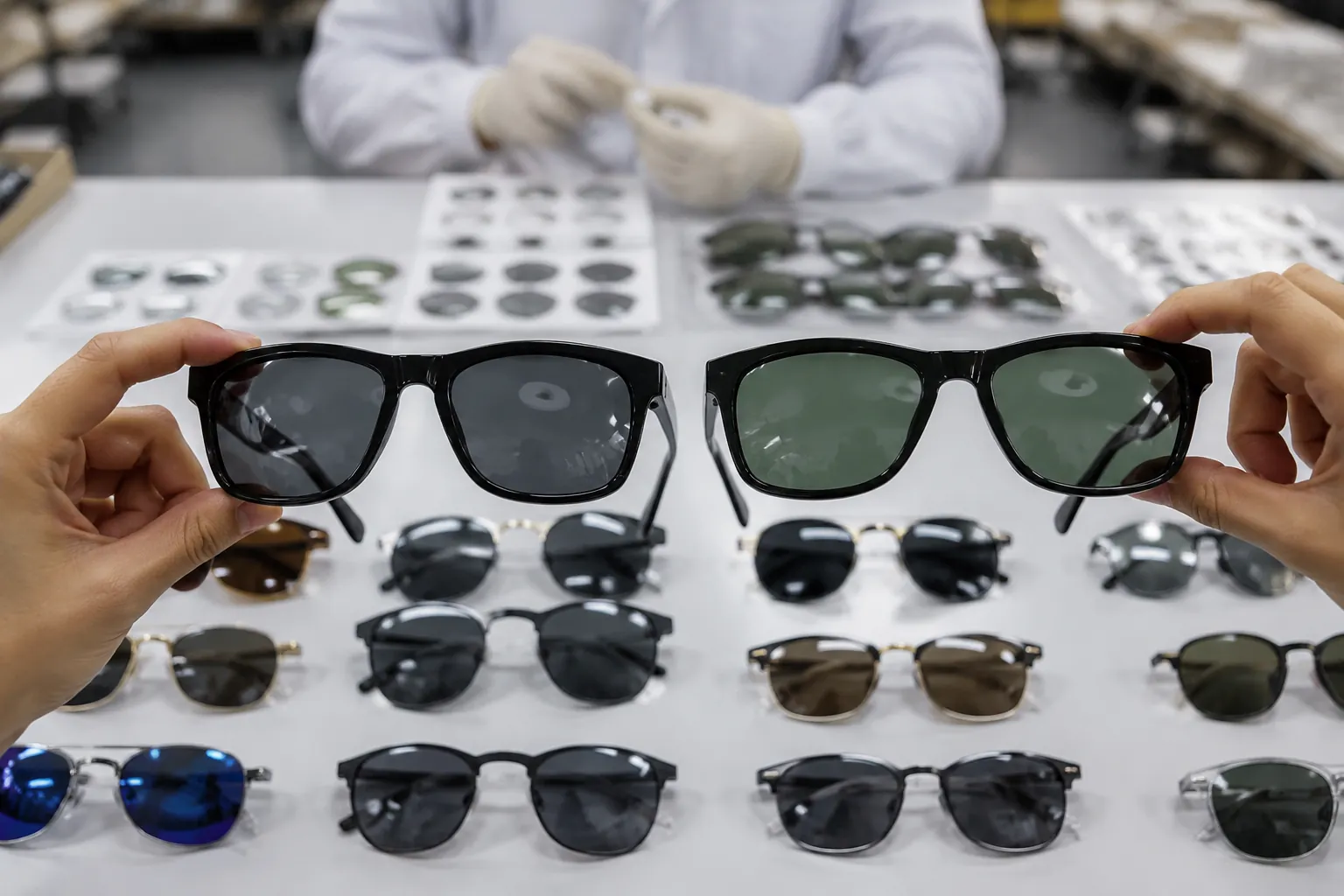
This guide is for importers, brand owners, distributors, and retailers buying custom sunglasses in volume. It is not a brochure rewrite. It is meant to help you tell the difference between a lens with real scratch-resistance control and one with only a sales claim behind it. Below are PO-ready spec points, process checks, material trade-offs, and QC language you can use for sample approval and bulk production. That matters because on a custom order, vague terms like anti-scratch or premium lens often end in avoidable disputes. If the substrate, coating, test method, and acceptance standard were never defined, the claim means very little.
First, the hard truth: no sunglass lens is scratch-proof
Buyers should treat scratch-resistant as a relative claim, not an absolute one. Polycarbonate, TAC, nylon, CR-39, and acrylic lenses can all be scratched by abrasive particles, rough handling, dirty cleaning cloths, hard contact in packing, or consumer misuse.
That is the reality. No exceptions.
What a supplier can control is how well the finished lens resists visible surface damage during manufacturing, shipping, retail handling, and normal use.
The technical issue is simple: lens materials have different natural surface hardness, and many commercial sunglass materials benefit from a hard-coat layer. Polycarbonate (PC) is the clearest example. It is lightweight and impact resistant, but it usually needs a hard coat to achieve acceptable abrasion resistance in commercial use.
Buyers should separate three things that suppliers often blur into one claim:
- Base material: affects impact behavior, weight, optics, flexibility, and baseline scratch tendency.
- Hard-coat layer: a thin cured surface coating that improves abrasion resistance. It reduces risk. It does not eliminate it.
- Finished-product durability: affected by lens insertion force, frame design, folded temple clearance, pouch material, tray spacing, transport vibration, and store handling.
If a supplier cannot explain those three points separately, the anti-scratch claim is probably weak. Ask a better question: What is the lens substrate, what hard-coat process is used, and how is performance checked before shipment?
What to write into the PO and sample approval
If you want better lens durability, specify it. Do not approve on appearance alone.
A usable lens specification for custom sunglasses should include clear commercial and technical points:
- Substrate: PC, TAC, nylon, CR-39, or acrylic.
- Construction: single-piece lens or laminated TAC polarized; base curve such as 4C, 6C, or 8C; nominal thickness as applicable to the design.
- Hard-coat requirement: one side or both sides. Some price-driven programs use coating on the external surface only, so state the exact requirement.
- Visual criteria: no haze, pinholes, streaks, rainbow marks, coating skips, or edge pull-back beyond agreed tolerance.
- Edge standard: define how much coating skip is acceptable at the perimeter and whether any edge area remains visible after assembly.
- Adhesion check: state the factory's internal adhesion method and the required pass result.
- Abrasion test: state the method, load, cycle count, inspection light, and pass criteria versus an approved control sample.
- Packing standard: non-abrasive sleeve or polybag, lens-facing orientation, tray density, and no metal-to-lens contact after folding.
A short approval note works best when it is specific. Example: PC smoke lens, specified thickness and base curve per approved sample, both-side hard coat, no visible central viewing-area rub marks after agreed internal abrasion test, no visible edge coating defect in exposed areas, packed in clean non-abrasive sleeve.
That is far safer than writing premium anti-scratch lens. It also gives your inspector something real to verify during pre-production and final random inspection.
Material reality check: where hard coat matters most
| Lens material | Natural scratch resistance | Impact / handling behavior | Typical commercial use | Hard-coat priority |
|---|---|---|---|---|
| Polycarbonate (PC) | Relatively low without coating | High impact resistance, light weight, widely used | Fashion, sport, kids, mass retail | Very high |
| TAC polarized | Depends on outer layers and lamination quality | Laminated structure; edge condition and assembly pressure matter | Polarized sunglasses across multiple price tiers | High |
| Nylon | Often better than PC, depending on grade and finish | Flexible, suitable for wrap and performance styles | Sport / performance eyewear | Medium to high |
| CR-39 | Generally better surface hardness than PC | Good optical quality; lower impact resistance than PC | Optical-style sunwear | Medium |
| Acrylic | Generally weak | Low-cost option with limited durability margin | Promotional and budget programs | High, but gains may be limited |
PC causes the most sourcing problems. It is popular because it is light, impact resistant, and easy to source at scale. But uncoated or poorly coated PC marks easily during assembly, wiping, or pouch insertion. In practice, market performance depends less on the label and more on whether the hard-coat process is stable and then protected through packing.
TAC polarized needs a different kind of attention. Surface scratching is one risk, but buyers should also watch for edge whitening, film exposure, and delamination if edging or insertion pressure is too aggressive. For TAC, inspect the perimeter after assembly, not just the front surface. If the edge shows stress or layer separation under normal insertion, the fit is too tight or the process is not controlled.
Nylon and CR-39 can improve wear performance in the right tier, but buyers should still ask a basic question: does the retail positioning justify the added cost or complexity? A well-controlled PC hard-coat program can perform better in the market than a nominally upgraded substrate paired with weak process control.
How hard-coat performance is actually made
Real abrasion resistance comes from process control, not sales wording.
A typical route includes cleaning, deionized-air blow-off, surface preparation, coating application, leveling or flash-off, curing, cooling, inspection, and protected transfer to edging or assembly.
Buyers should ask whether the factory controls these points:
- Pre-cleaning: dust, oil, release residue, and static should be removed before coating.
- Coating application method: dip coating and flow coating are both used; consistency matters more than the label.
- Cure window: UV or thermal curing should be controlled and recorded by batch.
- Post-cure handling: coated lenses should not be pushed into abrasive handling before the process is complete.
- Protected transfer: trays, separators, gloves, and workstation cleanliness all affect the final result.
The most common failures are not exotic chemistry problems. They are ordinary production failures: a contaminated coating bath, unstable viscosity, poor drying before cure, overheated lenses, thin coating near the edge, rack contact marks, or rough tray handling. Any one of those can produce a lens that looks acceptable at first glance but scratches too easily in use.
Also, lens protection has to continue after coating. On custom programs with pad printing, silk screen, laser logo, or metal temple badges, later operations can undo good coating work fast. A properly coated lens can still be damaged if fronts are dropped into bins, if folded hardware touches the lens, or if packed product shifts in transit. Hard coat is only one control point in the chain.
Claims that mean little without a test method
Buyers hear the same phrases over and over: anti-scratch, hard coated, premium lens, durable finish. On their own, they mean almost nothing.
A claim matters only if the supplier can define the test behind it.
Factories use different abrasion checks. Some use controlled rub tests. Some use steel wool methods. Some use eraser-style abrasion rigs. Some compare against retained controls under fixed lighting. The buyer does not need to force every supplier into one lab setup at quotation stage, but each supplier should declare the internal method clearly enough to compare.
Weak spec: Lens must be scratch-resistant.
Better spec: Lens must pass supplier's declared internal abrasion test, with stated load, cycle count, inspection condition, and pass criteria, and show no unacceptable scratching in the central viewing area versus approved reference sample.
Keep compliance claims in the right lane. CE EN ISO 12312-1, ANSI Z80.3, and AS/NZS 1067 address sunglass performance and market requirements such as lens category and UV-related performance. They do not by themselves prove superior scratch resistance. REACH relates to restricted substances. FDA registration may matter for certain U.S. market claims or product categories, but it is not evidence of abrasion performance. ISO 9001 relates to quality-management systems, and BSCI relates to social compliance. Useful credentials, yes. Proof of scratch resistance, no.
A declared abrasion method and a retained approval sample are far more useful than a page of unrelated certificates.
QC checkpoints to use before bulk shipment
The safest way to control lens durability is to inspect at more than one stage. Final carton closeout is too late.
- Golden sample stage: approve material, lens color, category, coating claim, logo placement, and visual standard. Keep one signed sample with the buyer and one with the factory.
- Pre-production stage: confirm that the bulk lens source, substrate, and coating route match the approved sample. If the supplier changes lens vendor or construction, that change should be disclosed and reapproved.
- In-line stage: check coating defects before assembly and check for insertion damage during frame mounting.
- Final random inspection: verify cosmetics, comparative rub resistance, folded clearance, pouch cleanliness, and tray/carton protection.
On the QC sheet, define the inspection zone. For example:
- Zone A: central viewing area; no visible rub lines or obvious coating defects acceptable at the agreed inspection distance and lighting condition.
- Zone B: secondary visible area; only minor defects acceptable if they do not affect appearance in normal use.
- Zone C: concealed edge area; limited defects acceptable only if hidden by the frame and within the agreed tolerance.
Packing is a major source of pre-retail scratching. Common causes include dirty microfiber pouches, lens-to-lens contact in trays, excessive folding pressure that lets the temple tip or metal component touch the lens, and transport vibration that creates repeated contact.
Simple issues. Expensive claims.
For third-party inspection, ask the inspector to perform at least a comparative visual rub check against the retained control sample, inspect pouch interiors for debris, confirm that accessories are not creating contact marks, and photograph any repeated lens-contact risk found in packout.
Cost, MOQ, and lead-time trade-offs
| Buyer scenario | Likely lens program | Commercial logic | MOQ / timing reality |
|---|---|---|---|
| Trial launch | PC with basic hard coat | Useful for validating shape, fit, branding, and market response before scale-up | MOQ and lead time depend on factory capability, lens color, tooling status, and packaging complexity |
| Branded volume order | PC or TAC polarized with defined coating standard | Consistency becomes more important than chasing the lowest nominal unit price | Lead time is more stable when lens spec, color, and packaging are locked early |
| Repeat program | Controlled PC or upgraded polarized program | Process repeatability, retained controls, and packaging discipline matter more on repeat buys | Requires batch planning and disciplined change control |
| Performance-focused line | Nylon or upgraded lens package | Higher lens cost may be justified by use case, wrap geometry, and retail positioning | Material sourcing may require longer forecasting and stricter approval management |
Buyers should think in total cost, not just lens upcharge. A better-controlled hard coat may reduce rework, returns, replacement stock, and customer-service cost.
But not every order needs the same durability target.
A low-cost event giveaway and a performance or polarized retail line should not be written to the same lens standard. Frame design also changes the answer. High-wrap sport frames, tight groove tolerances, mirror finishes, and aggressive hardware all increase handling risk. If the sunglasses use premium branding or upgraded packaging, under-specifying the lens often creates an avoidable mismatch in perceived quality.
Buyer checklist for sample approval and reorder control
Use this checklist before bulk release and again before reorder confirmation:
- Confirm substrate: PC, TAC, nylon, CR-39, or acrylic. Record it on the sample card and PO.
- Confirm lens category and target market: align with CE EN ISO 12312-1, ANSI Z80.3, or AS/NZS 1067 as applicable.
- Confirm nominal thickness and base curve: record the approved construction so substitutions are easier to detect.
- Ask for declared hard-coat process: the supplier does not need to disclose proprietary chemistry, but should declare the production route and whether coating is applied on one side or both.
- Inspect under standard light: look for haze, rainbowing, pinholes, edge pull-back, streaking, and handling marks.
- Run a comparative rub check: compare to the retained approved sample or to an agreed lower-spec control.
- Review assembly fit: confirm that lens insertion creates no edge chipping, whitening, film exposure, or coating damage.
- Review decoration interaction: check that pad print fixtures, metal logos, hinges, and folded temples do not contact the lens.
- Review pouch and packout: confirm clean sleeve material, tray spacing, and no abrasive inserts or loose debris.
- Retain controls: keep one with the buyer, one with the supplier, and ideally one with the inspection agency.
This is not complicated. It is disciplined sourcing. For overseas buyers, especially on private-label programs, that clarity often decides whether a reorder runs smoothly or turns into an argument over what scratch-resistant was supposed to mean.
Have a custom sunglasses project in mind?
Send us your styles, target market and quantities and we will return a detailed quote with MOQ, lead time and a sample plan.
Get a QuoteWhy source this from Wenzhou with LumiShades
Wenzhou in Zhejiang Province is widely regarded as China’s eyewear manufacturing capital, producing a large share of the world’s sunglasses. That concentration matters to buyers: a deep local supply chain for acetate sheet, hinges, lens blanks, plating and packaging means shorter component lead times, easier color and material matching, and a workforce with decades of eyewear-specific skill. LumiShades has manufactured in this ecosystem since 2009, and our vertical integration — in-house injection molding, acetate cutting, CNC milling, lens tinting, decoration and quality control — means no part of your order is quietly subcontracted to a workshop you cannot audit.
For international buyers, that vertical control translates into accountability. When a single factory owns every step, defects are traced and fixed at source rather than bounced between vendors, and your specifications survive intact from first sample to bulk. We back this with 15+ years of experience, shipments to 60+ countries, more than 5 million pairs produced per year and a 98.5% on-time delivery rate. Our certifications — CE EN ISO 12312-1, FDA registration, ANSI Z80.3, AS/NZS 1067, REACH, ISO 9001 and BSCI audit — mean the compliance documentation your market requires already exists. Explore our manufacturing capabilities and quality control process to see how this works in practice.
Frequently asked questions
Is a hard-coated PC lens good enough for fashion sunglasses? Usually yes, if the hard coat is real, applied consistently, and protected through assembly and packing. For buyers, the key steps are simple: specify PC in the PO, require the supplier's declared abrasion test method, approve and retain a control sample, and check that folded temples or hardware cannot touch the lens in final packout. PC is often commercially suitable. Weak process control is usually the bigger risk.
Do CE EN ISO 12312-1 or ANSI Z80.3 guarantee scratch resistance? No. Those standards address sunglass performance and market compliance, including lens category and UV-related requirements, but they are not blanket proof of high abrasion resistance. Buyers should ask for a separate declared scratch or abrasion test, tie acceptance to an approved sample, and make sure the inspection report covers lens cosmetics and comparative rub performance.
How should I compare two suppliers if they use different scratch tests? Ask each supplier to document the method, test media, load, cycle count, inspection distance, lighting condition, and pass criteria. Then compare physical samples side by side under the same light and keep both as references. If one supplier cannot describe its method clearly, treat the claim as weak regardless of the sales language.
What is the most common cause of scratches before the goods reach retail? Handling and packing are common causes. Damage often happens during frame insertion, tray transfer, pouch insertion, or shipment when folded temples, metal parts, dirty pouches, or debris contact the lens surface. To reduce risk, ask your inspector to check folded clearance, pouch cleanliness, tray density, and whether any accessory can rub the lens during transport.
Should I specify scratch resistance in the PO or only in the sample approval? Both. In the PO, state the substrate, lens construction, hard-coat requirement, visual standard, packing standard, and the supplier's declared abrasion-test reference. In sample approval, sign and retain a physical control sample that defines acceptable appearance and rub performance. Using both gives you a commercial reference and an inspection reference.
Ready to start?
Explore our wayfarer sunglasses or request a quote — our sales team replies within 12 hours.
Request a Quote