
Polarized Lens Testing Before Bulk Production
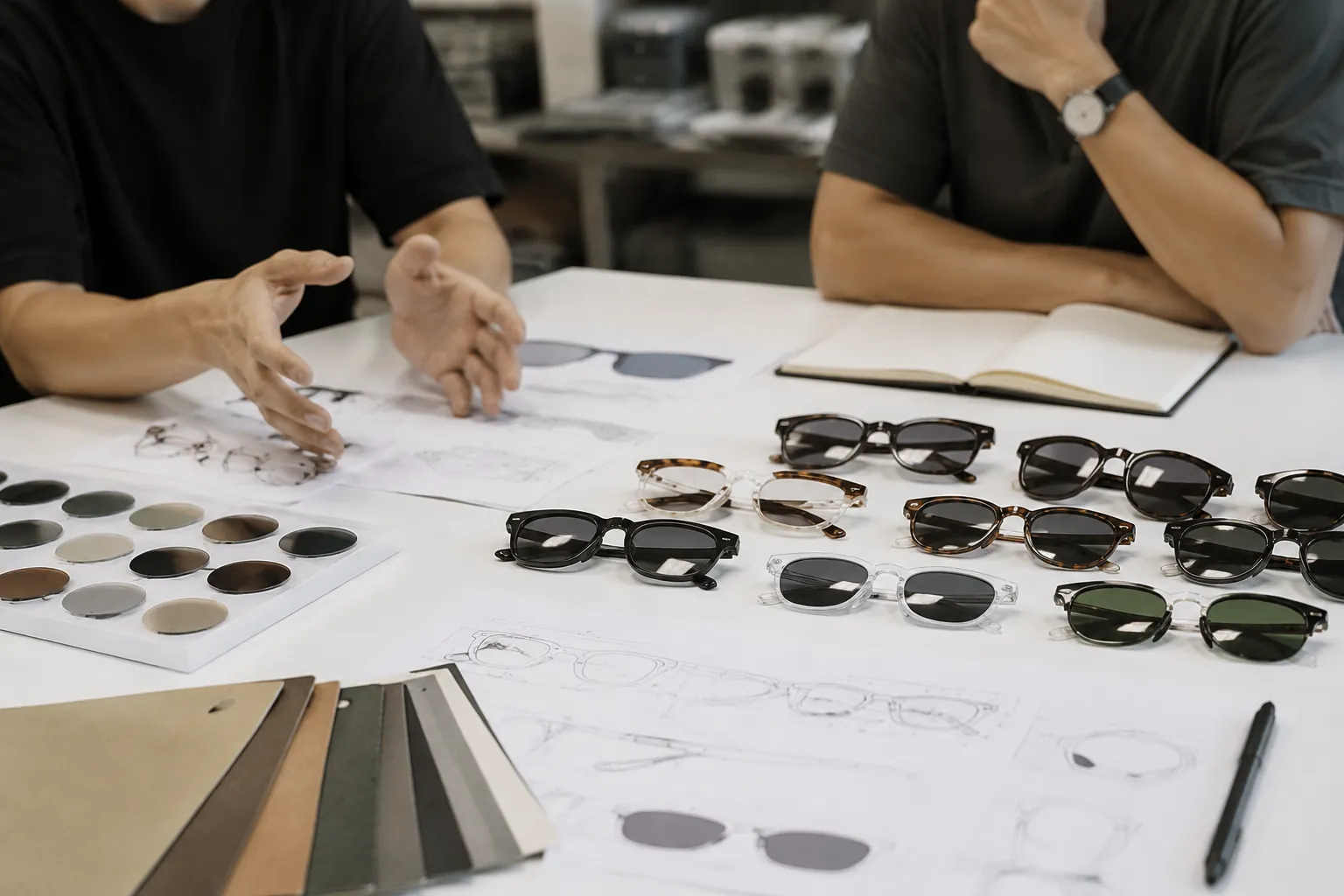
This article is for brands, importers, distributors, and retailers sourcing polarized sunglasses in volume. The goal is simple: verify polarization performance, optical quality, lamination stability, tint consistency, and market-specific compliance before bulk production is released. Skip those checks at pre-production stage, and the problems usually show up later as glare complaints, visual distortion, peeling at the lens edge, color mismatch, shipment holds, or returns that are much harder to fix after the goods leave the factory.
What buyers should verify first
Do not start with price. Start with a written product specification. A polarized lens program only works when the supplier and buyer are testing the same thing in the same way. Define the lens material, polarization construction, tint target, UV requirement, coating stack, logo method, and the test method or standard used to verify each item. If the supplier cannot explain how polarization, visible light transmission, or optical quality will be checked, the process is not under control.
For private-label and distributor programs, the first review should cover four basics: visible light transmission category, polarization performance, optical distortion, and adhesion or delamination risk. Also define the visual reference for tint under controlled lighting. Do not approve a color name such as gray, brown, or green without a retained master sample. Names are not enough.
These checks belong before final packing. Once a defective lens is assembled, packed, and shipped, the issue becomes a claim problem instead of a production problem. Keep the checklist short and direct:
- Confirm the lens material: TAC, polycarbonate, nylon, or glass.
- Confirm whether the polarization layer is laminated film or another declared construction.
- Confirm the target tint, visible light transmission category, and any mirror finish requirement by color.
- Confirm the compliance standard for the destination market.
- Confirm the decoration method: silk print, laser mark, hot stamp, or molded logo.
Material choice changes the risk profile. TAC polarized lenses are widely used because they are practical and common in fashion sunglasses, but edge integrity and lamination quality must be checked carefully after cutting. Polycarbonate lenses are often chosen where impact resistance matters more, but surface quality and coating performance need tight control. Nylon lenses appear in some sport programs and should be reviewed for curve consistency and optical comfort. Glass can provide strong optical clarity, but weight and breakage risk limit its use in some programs.
Market requirements come next. For Europe, buyers commonly request support to EN ISO 12312-1 and REACH-related material information. For the U.S., buyers often request ANSI Z80.3 support, and they may also ask for FDA registration details for the manufacturer where applicable. Australia and New Zealand buyers commonly ask for AS/NZS 1067 support. ISO 9001 and BSCI can matter as supplier-management references, but they are not substitutes for product testing. Match the test plan and the document pack to the market before sampling starts.
Polarization tests that matter
A polarized lens can look fine in hand and still perform badly in use. The core check is whether the lens shows consistent polarization performance under a controlled polarized light source or suitable test equipment. Buyers do not need lab jargon. They do need a repeatable method, a clear pass/fail rule, and a record of how the test was done.
Ask the supplier for a simple three-step test plan. First, verify that the lens reacts correctly when rotated relative to a polarized reference source. Second, compare the left and right lenses in the same pair. Third, check more than the lens center. Surface consistency matters, especially near the edge and on larger or more curved lenses where uneven performance is more likely to appear.
The report should also record the setup. If a supplier uses a digital polarimeter, transmission meter, or other measuring device, ask for the device ID and calibration status. If the method is visual, standardize it with a fixed light source, viewing position, and rotation procedure. Without that, results are hard to compare from one sample round to the next.
- Test the lens in at least two rotation positions, such as aligned and crossed.
- Compare left and right lens readings or observations from the same lot.
- Check multiple points on each lens surface, including center and near-edge areas.
- Record any uneven blocking, bright bands, weak corners, or visible light leaks.
If the supplier uses laminated polarized film, ask how alignment is controlled during lamination, cutting, and edging. If the supplier uses another declared polarization construction, ask how batch consistency is maintained and verified. In both cases, expect a written acceptance rule tied to a sample or test record. Not a verbal statement like "good polarization."
Distortion, haze, and visual comfort
Polarization has little value if the wearer sees warping or feels visual strain. Distortion testing is a core approval step, especially on curved lenses or wrapped styles where edge performance can break down. Ask for a visual distortion check using a grid, checkerboard, or straight-line target, and review how the image changes as the lens moves through the viewing field.
In plain terms, the lens should not create obvious waviness, prism-like image shift, or a swimming effect during normal use. A simple method works well: hold the lens in front of a straight-line chart and move it slowly side to side and up and down while watching the center and edge zones. If lines bend, wobble, or appear displaced in a noticeable way, the optical quality needs correction before bulk approval. That is the call.
Haze matters too. A lens can be polarized and still look cloudy, milky, or scattered. Common causes include poor raw material, contamination, coating imbalance, weak lamination, or process variation during tinting or curing. Edge finishing does not fix a cloudy lens core. Clarity has to be checked before assembly and again after.
Ask for these checks on production samples:
| Check | What the buyer looks for | Typical failure signal |
|---|---|---|
| Grid distortion | Straight lines remain visually stable through the lens | Wavy lines, image shift, swimming effect |
| Haze / clarity | Uniform clarity across the lens | Milkiness, cloudy patches, surface scatter |
| Pair matching | Left and right lens look and feel consistent | One lens appears darker, duller, or optically different |
| Surface defects | No pits, bubbles, scratches, or visible inclusions | Specks, streaks, scratches, coating marks |
If straight lines look wrong or the lens creates visible discomfort in a controlled check, stop the approval round and find the cause. It is cheaper to reject an unstable lens before assembly and freight than to handle customer complaints after delivery.
Adhesion and delamination checks
For laminated polarized lenses, adhesion is a real risk. Heat, humidity, handling, and cleaning can expose weak bonding between layers or at the cut edge. A lens that bubbles, peels, or shows edge lift after shipping should be treated as a production failure that should have been screened earlier.
Ask for at least three adhesion-related checks before mass approval. First, inspect the cut edge after shaping to confirm that the lamination is intact and that there is no visible separation or whitening. Second, ask the supplier to apply controlled heat and humidity exposure, then repeat the visual inspection for edge lift, bubbling, or clouding. Third, verify that normal cleaning and handling do not create visible haze, movement, or separation in the stack.
The exact internal protocol can vary by supplier and lens construction, but the logic should stay the same: stress the bond before the market does. Check the edge after cutting and polishing, especially around high-curve shapes, tight corners, or more demanding decorative finishes. That is where weak construction shows up first.
Where a supplier states that lens finishing, decoration, and QC are handled in-house, that can improve traceability and shorten response time. Still, the buyer should ask for evidence from the finished lens, not raw semi-finished material alone. Some defects appear only after edging, coating, or logo application. Small trial orders need the same discipline. Low MOQ does not reduce the need for adhesion review.
Buyer rule: if the supplier cannot show stable cut edges and no visible lamination failure after finishing and stress review, the polarized lens construction is not ready for volume approval.
Color, tint, and lot consistency
Polarized sunglasses are often sold by color as much as by shape. Once tint drifts across pairs or batches, retailers end up with mismatched displays and avoidable returns. Check tint against a retained master sample under the same light source, viewing angle, and background every time. Keep the comparison boring. Consistency matters more than opinion.
Ask the factory to keep an approved master sample on file and identify it clearly in the production record. Then compare pre-production samples and pilot-lot samples to that master under controlled lighting. Phone photos are not reliable enough for approval, especially for mirrored, gradient, or subtle tint differences. A light booth or stable white-light inspection station is a better baseline. If the program needs tighter control, a visible light transmission reading can support the visual comparison.
Check consistency at three levels: lens-to-lens within the same pair, pair-to-pair within the same lot, and lot-to-lot across repeat orders. If the tint, mirror effect, curve, or logo method changes during development, treat that as a new approval condition and review the sample again against an updated record.
Decoration can also affect yield and consistency. Silk screen printing can work well when curing and placement are controlled. Laser marking can reduce ink-related variation, but the result can differ between coated and uncoated surfaces. Hot stamping can produce a premium finish, but it depends heavily on process control. Molded logos may be more repeatable once tooling is fixed, but they are less flexible for short runs. Lock the decoration method before final sample approval so rejection criteria stay stable from sample to bulk.
Compliance documents to request
Compliance is not a generic file bundle. It is the record that supports market access, buyer due diligence, and claim handling. For polarized lens orders, ask for the standards and records relevant to the destination market, and make sure the supplier can link those records to the quoted product.
Request the following where applicable: EN ISO 12312-1 test support for sunglasses intended for the EU market, ANSI Z80.3 test support for the U.S. market, AS/NZS 1067 support for Australia and New Zealand, REACH-related material compliance information, and FDA registration details for the manufacturer where relevant to the supply chain. If supplier qualification matters to your program, you may also request ISO 9001 certification and BSCI audit status. Those documents help assess management systems and social compliance expectations, but they do not replace product performance testing.
Also ask for batch traceability records that connect the approved master sample, incoming material, internal production record, and finished carton or lot code. If a claim arises later, traceability decides whether the issue can be isolated quickly or whether the whole shipment becomes suspect. That is why it matters.
| Market | Buyer should ask for | Why it matters |
|---|---|---|
| EU | EN ISO 12312-1 test support, REACH material information | Supports sunglass performance review and restricted-substance due diligence |
| U.S. | ANSI Z80.3 test support, FDA registration details | Supports functional eyewear review and supplier traceability |
| Australia / New Zealand | AS/NZS 1067 test support | Aligns the product file with local sunglass requirements |
| All markets | Batch traceability, QC records, approved master sample | Makes complaints, investigations, and corrective action manageable |
Do not accept wording such as "compliant for export" without supporting detail. Ask for the exact standard, report date, issuing lab or source, sample identification, and the link between the tested sample and the production style you intend to buy.
How to structure pre-production approval
The best way to reduce avoidable quality problems is to make approval structured and repeatable. Start with a written specification, move to samples, then a pilot lot, then bulk production. Each stage needs a clear sign-off point, and each sign-off should lock the variables that matter: lens material, tint, polarization construction, coating, logo decoration, packaging, and destination-market requirements.
Lead time only matters if the approved sample actually reflects the intended bulk process. A fast sample turnaround has limited value if the supplier later changes lens source, decoration method, or finishing process before bulk production. Ask whether the pilot lot uses the same materials, process flow, and QC checkpoints planned for mass production. If not, the sample is not a real reference.
- Freeze the lens specification: material, tint, polarization construction, coating, logo decoration, and target market standard.
- Approve a physical master sample and identify it in writing.
- Request pre-production samples made with the intended bulk process.
- Test polarization performance, distortion, adhesion, and tint consistency on arrival.
- Release a pilot lot before the full production run.
- Lock the QC checkpoints for bulk production and final inspection.
If a supplier handles injection molding, acetate machining, lens processing, decoration, and QC internally, that can simplify communication and improve traceability. It can also move mistakes through the line faster if hold points are weak. That is why the pilot lot matters. It is the point where the buyer confirms that the approved sample can be repeated under production conditions without drift in tint, edge condition, or logo placement.
Questions before the PO
Before issuing the purchase order, ask direct questions and ask for records where possible. The goal is to turn quality requirements into evidence that can be checked later. No guesses. No soft language.
- What exact polarization test method do you use, and what is the acceptance rule?
- How do you check lens distortion across the full surface, including edge zones?
- What adhesion or delamination check do you run after cutting, edging, or decoration?
- How do you control tint consistency from sample to bulk, and what reference sample is retained?
- Which compliance documents support my target market, and which sample or style do they relate to?
- Can you provide batch traceability from raw material to finished carton code?
- Do you hold ISO 9001 certification or a current BSCI audit, and if so, can you share the current status?
- Which decoration method is being used, and does it change rejection risk or production timing?
Low-MOQ programs still require full discipline. A 50-pair test order may be useful, but it should not bypass the same checks used for a larger order. If the supplier answers clearly and supports those answers with sample references, test records, and traceability documents, the buying decision becomes easier to defend. If the answers stay general, slow the process down until the evidence is clear.
That is the filter before PO release: measurable performance, consistent samples, controlled decoration, traceable production, and market-specific compliance support.
Have a custom sunglasses project in mind?
Send us your styles, target market and quantities and we will return a detailed quote with MOQ, lead time and a sample plan.
Get a QuoteWhy source this from Wenzhou with LumiShades
Wenzhou in Zhejiang Province is widely regarded as China’s eyewear manufacturing capital, producing a large share of the world’s sunglasses. That concentration matters to buyers: a deep local supply chain for acetate sheet, hinges, lens blanks, plating and packaging means shorter component lead times, easier color and material matching, and a workforce with decades of eyewear-specific skill. LumiShades has manufactured in this ecosystem since 2009, and our vertical integration — in-house injection molding, acetate cutting, CNC milling, lens tinting, decoration and quality control — means no part of your order is quietly subcontracted to a workshop you cannot audit.
For international buyers, that vertical control translates into accountability. When a single factory owns every step, defects are traced and fixed at source rather than bounced between vendors, and your specifications survive intact from first sample to bulk. We back this with 15+ years of experience, shipments to 60+ countries, more than 5 million pairs produced per year and a 98.5% on-time delivery rate. Our certifications — CE EN ISO 12312-1, FDA registration, ANSI Z80.3, AS/NZS 1067, REACH, ISO 9001 and BSCI audit — mean the compliance documentation your market requires already exists. Explore our manufacturing capabilities and quality control process to see how this works in practice.
Frequently asked questions
What is the most important test for polarized lenses before bulk production? Start with a documented polarization performance check, but do not approve on that result alone. Review four areas together: polarization performance, optical distortion, adhesion or delamination risk, and tint consistency. Ask the supplier to show the test method used, the pass/fail rule, the sample ID tested, and whether the result came from a pre-production sample or a pilot-lot sample.
Can a lens pass polarization testing and still be a bad product? Yes. A lens can show acceptable polarization behavior and still fail commercially because of haze, distortion, lamination failure, surface defects, or poor left-right matching. That is why buyers should review the lens under a straight-line or grid target, inspect edge condition after finishing, compare both lenses in a pair, and check tint against a retained master sample under controlled lighting.
What should I request from a supplier for EU or U.S. orders? For EU programs, ask for EN ISO 12312-1 test support and REACH-related material information tied to the relevant product or material. For U.S. programs, ask for ANSI Z80.3 test support and FDA registration details for the manufacturer where applicable. In both cases, request the report date, sample identification, and a clear link between the tested sample and the style you plan to order.
How many samples should I test before approving bulk? Do not approve from a single display-quality pair. Review multiple samples from the same development round and, before bulk release, review pilot-lot units made with the intended production process. At minimum, compare left and right lenses, inspect center and edge zones, check tint against the master sample, and confirm that the supplier can repeat the result across more than one pair.
Does a low MOQ mean I can skip full QC? No. A small order can fail in exactly the same ways as a large order. Even for low-MOQ programs, the buyer should still require a written specification, a retained master sample, polarization and distortion checks, edge and adhesion review, tint comparison under controlled lighting, and basic traceability records. The order size changes the commercial exposure, not the need for quality control.
Ready to start?
Explore our round sunglasses or request a quote — our sales team replies within 12 hours.
Request a Quote