
UV400 Testing Questions to Ask Before You Place a PO
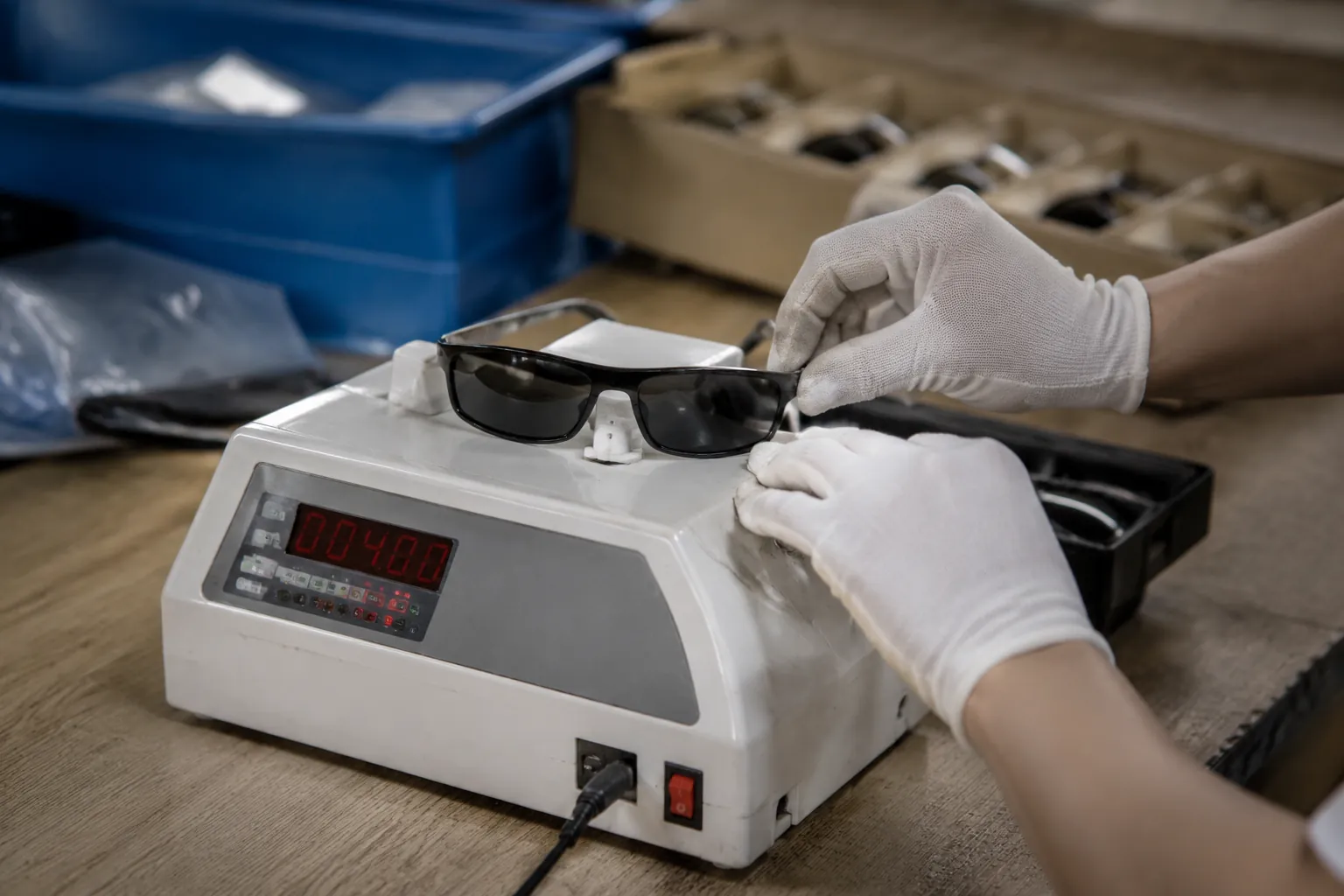
If you buy custom sunglasses for a brand, chain, or import program, do not assume UV400 is covered. Ask exactly what was tested, to which standard, on which lens color, and whether the paperwork matches production. This guide lays out the questions to ask before you issue a PO, so you do not end up with attractive samples and useless compliance files. It is written for overseas buyers who need documented protection, not vague claims.
Start with the claim: what does UV400 actually mean?
UV400 means the lens is intended to block ultraviolet radiation up to 400 nm. In plain buyer terms, that covers the UVB and UVA range relevant to sunglasses protection. It is not the same as "dark lens," "polarized," or "premium coating." A lens can look dark and still fail the UV requirement if the material, tint, or coating does not block ultraviolet wavelengths properly.
Ask the supplier to put the claim in writing and tie it to the exact product configuration. If your order is for a 1.8 mm TAC lens in smoke gray, do not accept a test report for a 1.5 mm brown PC lens. Same style. Different result.
Ask these first questions before you talk price:
- What standard or test method is being used to verify the UV claim?
- Which exact lens color, material, and thickness was tested?
- Is the protection coming from the base material, the tint, the coating, or a combination of these?
- Does the report show the wavelength range and measured transmittance for the tested lens?
For sunglasses, the variables that matter most are resin, tint concentration, curing, and coating. A small shift in tint ratio or coating process can change the transmitted light curve. Visual inspection is not proof. Not even close.
If a factory controls frame molding, lens tinting, decoration, and QC in one process chain, it is easier to connect the tested sample to the shipped product. That matters because UV performance can drift if raw material, tint masterbatch, or coating settings change between sample approval and bulk production.
Which test report do you actually need?
Do not ask for "a certificate" and stop there. Ask for the actual test report and the document that links it to your SKU. A useful report should show the model name, lens material, lens color, test method, result, and the issuing lab or testing entity. A generic PDF with no product reference is not enough for a serious purchase file.
For export programs, buyers commonly see references to CE EN ISO 12312-1, ANSI Z80.3, and AS/NZS 1067 for sunglass performance. UV400 is the protection claim. The standard tells you how the product is evaluated and how the result is recorded. If you sell into a retail chain, distributor network, or marketplace with document review, the report needs to name the exact lens variant and report number.
A useful UV file should include:
- Product name or SKU
- Lens material and color
- Thickness, if relevant to the report
- Wavelength range tested
- Transmittance result or pass/fail criterion
- Test date, report number, and issuing lab
- Standard or test method used
Reports vary in rigor. Internal factory testing is useful for screening samples and catching obvious failures. Third-party reports are stronger for final approval, especially when the order is for retail or import documentation. If the supplier cannot show a report tied to the exact lens variant you want, do not approve production.
If the order includes multiple lens colors, ask whether each color was tested separately. Smoke, tea, green, mirror smoke, and gradient smoke can behave differently because the dye load, reflective layer, and topcoat change the optical stack. One report does not automatically cover all shades.
Match the report to the production spec, not just the sample
This is where buyers get caught. The sales sample shows UV400. The report is for a different tint. Then the PO calls for a mirror coating, gradient finish, or a switch from TAC to PC lens material, and nobody retests. The finished goods no longer match the evidence behind the approval.
Lock the spec before mass production. At minimum, confirm these variables in writing:
| Spec item | Why it matters for UV testing | Buyer action |
|---|---|---|
| Lens material | PC, TAC, nylon, and acrylic can behave differently under UV exposure, heat, and tinting | Approve the exact resin and thickness range |
| Lens color / tint density | Transmission changes with tint concentration and shade family | Test the actual colorway, not a "similar" one |
| Mirror or flash coating | Reflective layers add another process variable and may affect transmission | Request retest if the coating stack changes |
| Gradient tint | Top-to-bottom density varies, so the optical result is not uniform | Ask whether the lab tested the darkest zone or the full lens area |
| Base curve / lens geometry | Does not determine the UV claim by itself, but can affect production setup and coating consistency | Keep geometry stable across sample and bulk |
There is also a tolerance issue. If the approved sample is 1.6 mm thick and the bulk runs at 1.45 mm to reduce weight, the optical file may no longer match even if the style looks identical. Ask the supplier what tolerance they hold on lens thickness, tint density, and coating appearance. You need a stated production window, not "same as sample."
When the factory controls injection molding, acetate cutting, CNC milling, lens tinting, decoration, and QC in one operation, it is easier to manage change control. For buyers, fewer handoffs usually means fewer mistakes between sample approval and bulk execution. If the lens color or coating is changing, ask for a production sign-off sample and a retained master sample before the PO is released.
Questions to ask before you approve the PO
Put these questions in writing before you pay the deposit. Keep them short, specific, and hard to dodge.
- Which standard will the production lot be tested to: CE EN ISO 12312-1, ANSI Z80.3, or AS/NZS 1067?
- Will the UV400 claim apply to all lens colors in the order, or only one approved shade?
- Will mirror, gradient, polarized, or photochromic versions be retested separately?
- Can you show the report number and the exact SKU referenced in the report?
- What is the acceptable tolerance for lens color, thickness, and coating appearance?
- Who signs off the first bulk sample before packing starts?
- What happens if the final lens tint differs from the approved sample beyond the agreed limit?
- Which mark will appear on the lens or frame, and does it match the compliance file?
Do not accept "same material, same protection" as a final answer. That is not process control. Ask the factory to define the change-control rule. If the resin source, tint formula, coating stack, or printed decoration changes, the product should go back through validation. Good factories treat this as normal.
If the supplier cannot tie the UV claim to a specific model, color, and report number, you do not have a compliance file. You have a promise.
Also ask about decoration methods, because they may affect approval flow even if they do not change UV performance directly. Pad printing, laser engraving, hot stamping, and metal logo badges may require different finishing steps. If a logo is added after lens testing, the UV report still covers the lens only, but the final product may need a separate sign-off for appearance, curing, and packing. Keep those checkpoints separate so the compliance file stays clear.
How to compare testing claims from different suppliers
Not all UV400 claims are equal. Some suppliers rely on internal testing only. Some have third-party reports. Some mix general product standards with optical protection claims. Compare them line by line, not by the number of logos on the page.
| Option | What you get | Risk level | Buyer use case |
|---|---|---|---|
| Internal UV test only | Fast, low-cost, useful for screening samples | Higher | Early development, not final proof |
| Third-party report tied to SKU | Better evidence, easier for retail and compliance review | Medium | Most private label and distributor programs |
| Standard-based file set: CE EN ISO 12312-1 / ANSI Z80.3 / AS/NZS 1067 plus UV report | Stronger documentation package | Lower | Retail chains, regulated markets, larger import programs |
Now compare the commercial logic, not just the paperwork. A factory may quote a low sample price and then raise the bulk price if the lens requires a different resin, a higher-grade coating, or a second testing round. That is normal. What you want is transparency. Some custom programs use a 50-pair MOQ per design, a 7-10 day sample lead time, and 25-35 days for bulk after sample approval. Those are planning figures, not compliance claims, and they only work if the UV file is settled early.
Volume affects the economics too. A pilot run of 50-200 pairs often includes setup time, color matching, and one-off decoration costs. At 300 pairs, the unit price may improve. At 1,000 pairs and above, the cost curve often improves further because setup cost is spread over more units. At larger volumes, the spec must stay locked. If you change the lens tint after the quote, the factory may need to retint, re-approve color, and update documents.
Do not choose a supplier solely because the number is lowest. A slightly higher quote from a factory that can produce the correct report, color, decoration, and packing on time is usually cheaper than a low quote that fails retailer review.
What a clean UV400 documentation package should contain
Ask for one folder, not scattered files. If the supplier is organized, every document should use the same SKU name, lens description, and color code. If names do not match, stop and reconcile before production.
- Quotation or proforma invoice with SKU, color, and lens spec
- Approved sample photos with front, side, temple, and lens close-up views
- UV test report tied to the exact lens color, material, and thickness
- Relevant compliance references for the destination market
- Final artwork, marking file, or lens etching reference
- Change-control note if anything differs from sample to bulk
- Packing reference showing carton count, inner pack, and label format
For export programs, also check REACH if you are selling into Europe or to a customer who requires chemical compliance paperwork. REACH is not a UV standard, but it belongs in a serious compliance file. If your customer also requires FDA registration for the facility or product category in the United States, confirm that status separately. FDA registration is not a UV claim and does not replace product testing. ISO 9001 and BSCI can help with supplier qualification, but they do not prove UV400 compliance.
In production, ask how often the factory checks quality during the run. A serious process may include first-article approval, in-line inspection, and final AQL sampling before packing. If the factory says "we tested the sample, so bulk is fine," push back. A large run needs in-process checks, not just one-time approval.
Ask whether the factory retains a sealed master sample and how long it is kept. If a dispute appears later, that retained sample is often the easiest reference point for the approved color, coating, and finish.
A practical pre-PO checklist for buyers
Use this before you release the deposit. Keep it simple and enforce it every time.
- Exact lens SKU and color are listed on the PO
- UV400 claim is written, not verbal
- Test report number matches the approved lens variant
- Standard required by the market is stated
- Any mirror, gradient, polarized, or coated lens is separately confirmed
- Change-control rule is agreed in writing
- Artwork and markings match the compliance file
- Bulk sample approval is required before mass packing
- Lens thickness, tint, and finish tolerances are recorded
- Packing format and carton marks match the export spec
If your supplier is quoting a low price, do not let that blur the compliance discussion. On custom sunglasses, the expensive mistake is not the test fee. It is a container of stock that cannot pass retailer review, marketplace gating, or importer audit. A good factory will answer these questions clearly. If they dodge them, move on.
If the production program includes a defined sample lead time and bulk lead time, treat those as planning targets only. Compliance documents should be approved before tooling, tinting, and mass production begin. That sequence reduces rework and avoids delays at the packing stage.
Final rule: treat UV400 as a documented process, not a label. Once the exact lens color, material, decoration method, and market standard are fixed, the rest becomes manageable. Until then, every promise is still only a promise.
Have a custom sunglasses project in mind?
Send us your styles, target market and quantities and we will return a detailed quote with MOQ, lead time and a sample plan.
Get a QuoteWhy source this from Wenzhou with LumiShades
Wenzhou in Zhejiang Province is widely regarded as China’s eyewear manufacturing capital, producing a large share of the world’s sunglasses. That concentration matters to buyers: a deep local supply chain for acetate sheet, hinges, lens blanks, plating and packaging means shorter component lead times, easier color and material matching, and a workforce with decades of eyewear-specific skill. LumiShades has manufactured in this ecosystem since 2009, and our vertical integration — in-house injection molding, acetate cutting, CNC milling, lens tinting, decoration and quality control — means no part of your order is quietly subcontracted to a workshop you cannot audit.
For international buyers, that vertical control translates into accountability. When a single factory owns every step, defects are traced and fixed at source rather than bounced between vendors, and your specifications survive intact from first sample to bulk. We back this with 15+ years of experience, shipments to 60+ countries, more than 5 million pairs produced per year and a 98.5% on-time delivery rate. Our certifications — CE EN ISO 12312-1, FDA registration, ANSI Z80.3, AS/NZS 1067, REACH, ISO 9001 and BSCI audit — mean the compliance documentation your market requires already exists. Explore our manufacturing capabilities and quality control process to see how this works in practice.
Frequently asked questions
Is UV400 the same as 100% UV protection? UV400 means the lens is intended to block ultraviolet radiation up to 400 nm. Do not rely on the label alone. Ask for the test report, the standard used, and the exact lens variant named in the report. If the report does not match the product you are buying, treat the claim as unverified.
Do I need a new UV report if only the lens color changes? Usually yes if the color, tint density, coating stack, or material changes, because those variables can affect the optical result. The safest rule is simple: the report should match the exact production lens variant. If it does not, request retesting before approving bulk production.
Can I use one test report for all models in the range? Only if the report clearly covers those models, materials, thicknesses, and lens colors. A report for one SKU does not automatically cover a whole range. Ask the supplier to map each PO item to a specific report number before you release production.
What standards should I ask for on export orders? For sunglasses, common references are CE EN ISO 12312-1, ANSI Z80.3, and AS/NZS 1067. For Europe, you may also need REACH-related chemical compliance documentation. If your customer asks for ISO 9001 or BSCI, those can support supplier qualification, but they do not replace product testing.
What should I do if the supplier only gives a UV400 claim with no report? Do not approve the PO. Ask for the report number, test method, exact SKU, and lens color. If the supplier cannot provide a report tied to the product you are buying, treat the claim as unsupported and keep the order on hold until the evidence is available.
Ready to start?
Explore our shield & oversized sunglasses or request a quote — our sales team replies within 12 hours.
Request a Quote