
Specify UV400 Sunglasses Correctly
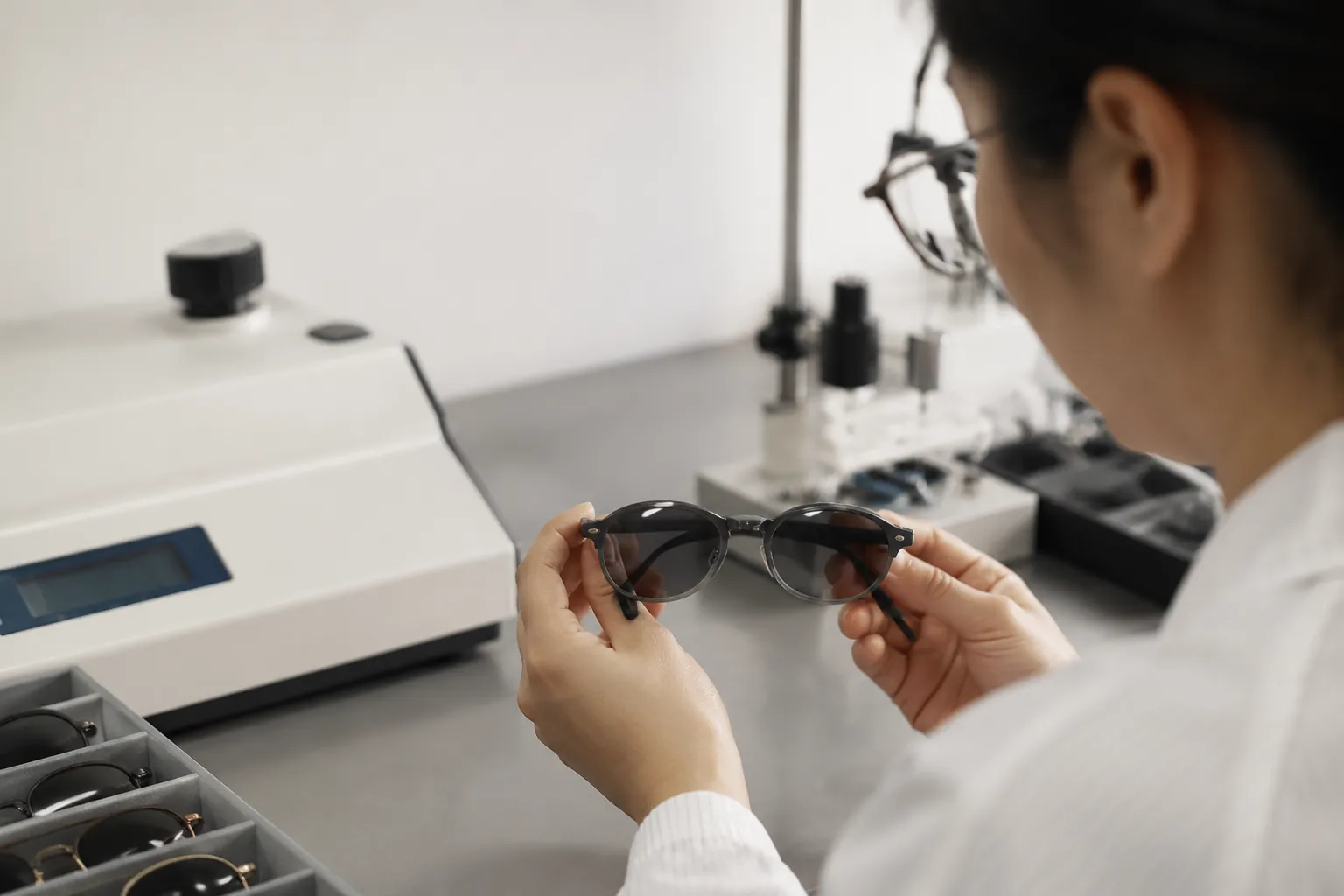
This guide is for brand owners, importers, distributors, and retail buyers sourcing custom sunglasses at scale. UV400 sounds simple. It is not. Suppliers, artwork teams, and even buyers often use the term too loosely. This article explains what UV400 actually covers, where claims and reports drift apart, and how to write a purchase specification that matches production reality and destination-market requirements. If you need packaging claims, lens performance, and compliance files to match before bulk starts, use this as your checklist.
First principle: UV400 is a lens claim, not a full product standard
Buyers often use UV400 as shorthand for a compliant sunglass. That is too loose for commercial purchasing. UV400 is a lens performance claim. It indicates that the lens is intended to block ultraviolet radiation up to 400 nm. By itself, it does not prove that the finished sunglasses meet all product requirements in the destination market.
Keep these three layers separate:
- Marketing claim: "UV400" printed on a temple, lens sticker, hangtag, pouch, carton, or web listing.
- Lens performance: the actual lens material and treatment provide the claimed UV protection.
- Finished-product compliance: the complete sunglasses, as sold, meet the relevant standard and labeling rules for the market.
This matters because a dark lens is not proof of UV protection. Visible darkness relates to VLT (visible light transmission). UV protection relates to ultraviolet transmission. Those are different things. A lightly tinted lens can block UV well. A dark lens can still fail.
For export programs, buyers commonly work against EN ISO 12312-1 for Europe, ANSI Z80.3 for the United States, and AS/NZS 1067 for Australia/New Zealand. Chemical compliance may also apply, including REACH. Supplier-management credentials such as ISO 9001 and BSCI can help you assess factory controls, but they are not product test evidence. If you are shipping into the US, confirm whether the supplier also maintains relevant FDA registration where required for its business activities and product scope.
The buying rule is simple. If the product or packaging says UV400, your technical file should show exactly which lens construction supports that claim and exactly which finished style was tested.
The usual failure: the claim says UV400, but the file proves something else
This is where many orders go wrong. The artwork says UV400. The sample card says UV400. But the report covers a different lens color, a different material, an older build, or only unfinished lens material rather than the finished sunglasses.
Typical mismatch points include:
- Different SKU tested: the report shows style A, but production is style B with different dimensions, curvature, or lens geometry.
- Different color tested: one lens color passed, but the ordered gradient, mirror, or alternative tint was never included.
- Different material tested: the tested sample used one lens material, while bulk production uses another.
- Old report reused: the report predates a lens supplier change, coating revision, frame update, or other engineering change.
- Raw material only: the lab result covers lens sheet, blanks, or material data, not the finished sunglasses sold to the customer.
So lock the tested construction into the PO package. Freeze the frame material, lens material, lens thickness range, lens color code, VLT or filter-category target, surface treatment, and style number in the approved file.
Be specific. Do not write "black frame with mirror lens" and stop there. State the exact frame material, lens material, lens color, finish, and target classification. If the lens is polarized, identify the polarized version clearly. Do not assume a non-polarized report covers it.
Small commercial changes can trigger technical consequences. Lens color, gradient layout, mirror treatment, and material changes can affect visible light transmission, category classification, labeling, and permitted use. A supplier may treat those as variants. A buyer should treat them as technical changes unless the report scope clearly says otherwise.
What to put in the purchase spec
If your PO says only "fashion sunglasses, UV400," it is incomplete. Attach a one-page technical sheet. It does not need to be complex. It does need to be precise enough that a QC inspector and a lab can identify the same product.
Minimum fields to include:
- Style ID: your internal SKU plus supplier style number.
- Frame construction: injected PC, TR90, acetate, metal, or mixed construction; note key dimensions if critical.
- Lens material: PC, TAC, CR-39, nylon, acrylic, or other.
- Lens thickness: state the nominal thickness or approved range.
- Lens color and finish: solid, gradient, G15, brown, smoke, flash, mirror, polarized, or other defined finish.
- Target UV claim: exact wording to be used on product or packaging.
- Applicable standard: EN ISO 12312-1, ANSI Z80.3, or AS/NZS 1067, depending on market.
- VLT or filter category target: specify the intended category or measured VLT requirement, not just "dark lens."
- Decoration method: pad print, screen print, laser engraving, hot foil, or metal logo insert.
- Required markings and warnings: model code, origin marking, care text, and market-specific warning language where applicable.
- Chemical requirement: REACH conformity for applicable materials, coatings, paints, plastics, and components.
- Approval basis: bulk must match the sealed sample and the referenced report.
Add two more controls. First, define change control: if the factory changes lens supplier, resin family, tint formula, mirror treatment, polarized construction, or another technical input that could affect compliance, re-approval is required. Second, define acceptance criteria for appearance and labeling items tied to the claim, such as lens shade consistency, left/right lens matching, and the presence of required warnings and marks.
This is not admin for its own sake. It prevents the common failure where the hangtag says UV400, the lens sticker says UV400, and the shipment file cannot support the claim.
Read the test report like a buyer
You do not need to be a lab engineer to catch most report problems. You do need to compare the report to the approved sample line by line. Ask one basic question: is the tested build actually the production build?
| What to check | What a good report shows | Red flag | Why it matters |
|---|---|---|---|
| Sample identification | Style number, lens color, material, and clear product description | Generic wording like "sunglasses" only | You cannot tie the result to your SKU |
| Standard used | EN ISO 12312-1, ANSI Z80.3, or AS/NZS 1067 clearly stated | No standard, incomplete citation, or wrong market standard | The claim may not support the destination market |
| UV result | Measured values or explicit pass result under the cited standard | Only "UV400" typed on a cover page | That is not evidence by itself |
| VLT/category | Visible light transmission stated for the tested lens | No VLT data for dark, gradient, mirror, or flash lens | Category drives usability and warning language |
| Date and sample photo | Current report with identifiable sample image | Old file or unrelated sample photo | Often indicates reused paperwork |
For sunglasses, VLT category matters almost as much as UV blocking. It affects product positioning, user warnings, and in some cases driving suitability. Check whether the report states measured VLT for the actual lens tested, especially if the lens is dark, mirrored, flashed, or gradient.
Also check whether special versions are separately covered. A polarized lens is not automatically covered because the base style passed with a non-polarized lens. A gradient version is not automatically covered because the solid lens passed. If you are buying multiple colorways, ask whether all of them are included in the report scope or whether support is needed by colorway.
Last point. Make sure the report covers the finished product, not just a component or material. A material data sheet or raw lens transmission result can be useful background. It is not the same as a compliance report for the sunglasses as sold.
Material choice affects how stable UV400 is in bulk
Not all lens materials behave the same way in sourcing. The question is not only whether a material can achieve UV400 in principle. The real question is whether the supplier can reproduce the approved build consistently in mass production.
| Lens material | Typical use case | Main strengths | Common production risks |
|---|---|---|---|
| PC | Fashion sunglasses and high-volume commercial programs | Light weight, impact resistant, widely used in volume production | Surface performance depends on coating control; lens-to-lens consistency must be managed |
| TAC polarized | Private-label sunglasses with polarization | Common route to polarized consumer styles | Lamination defects, edge quality issues, haze, or delamination if process control is weak |
| CR-39 / nylon | Optical and performance-oriented programs | Can support premium positioning and stronger optical expectations | Higher sourcing complexity and tighter process control requirements |
PC is common in commercial sunglass production and can work well for custom programs if the approved material and coating system are controlled. Do not assume all PC lenses behave the same way across suppliers or builds.
TAC polarized can support a stronger retail value proposition, but it adds manufacturing variables because the lens is a laminated structure. If cutting, edging, or lamination control is weak, quality issues can appear even if the first sample looked fine.
CR-39 or nylon may suit programs with stronger optical or performance positioning, but they usually need closer technical review.
In production, UV-related failures usually trace back to one of three causes: the wrong raw material, the wrong tint or coating process, or an uncontrolled substitution during replenishment. That is why buyers should require written approval for material changes and keep the approved lens construction tied to the report reference.
Match the claim to the market before approving artwork
Many avoidable compliance problems start with bad timing. The design team approves temple print, lens stickers, or hangtags before the compliance basis is confirmed. That is backward.
Use this order:
- Confirm destination market and which standard will support the file.
- Approve lens material, tint, coating, and target VLT or category.
- Review the report against the exact approved sample.
- Approve warnings, product markings, and carton text.
- Release temple print, sticker, hangtag, and packaging artwork.
For Europe, buyers commonly build the file around EN ISO 12312-1. For the United States, ANSI Z80.3 is a common reference point for non-prescription sunglasses. For Australia/New Zealand, AS/NZS 1067 is a key reference. In parallel, chemical compliance such as REACH may still apply to relevant materials and finishes. If your supplier cites FDA registration, verify what that registration actually covers. Do not treat it as a substitute for sunglass performance testing under the applicable eyewear standard.
If the same style ships to multiple markets, expect possible market-specific artwork. Warning statements, symbols, and labeling conventions may differ. Separate artwork files are usually cheaper than relabeling inventory after shipment.
The control point is clear: do not approve a UV400 claim in artwork until you know which standard supports it, which exact build was tested, and what warnings or use limits apply to the final category.
A simple approval workflow for custom sunglass orders
For private-label programs, a basic workflow prevents most UV400 disputes:
- RFQ stage: send the target market, estimated quantity, intended claim set, and ask which lens materials and constructions the supplier proposes.
- Sampling stage: request the exact intended colorways and finishes, including decoration such as pad print, laser engraving, screen print, or metal logo plates.
- Spec lock: freeze frame material, lens material, thickness, color code, coating, hinge type, logo process, and packaging text.
- Compliance review: compare report details to the sealed sample. Check UV claim wording, VLT or category, and warning language.
- Bulk release: issue the PO with the technical sheet attached and state that substitutions require written approval.
- Pre-shipment QC: verify labeling, lens shade consistency, logo location, hinge function, carton assortment, and packaging claims before final payment.
This matters even more on repeat orders. A supplier may keep the same style number while changing a component source or lens process. If your file does not define change control, a repeat order can drift away from the tested build without obvious warning.
Use one final pre-approval checklist before signing off UV400 on-pack:
- The approved sample and report describe the same style, lens color, and material.
- The applicable standard is clearly stated for the destination market.
- The UV400 claim is supported by test evidence, not just catalog copy.
- VLT or category is recorded for each intended colorway.
- Polarized, gradient, mirror, or flash variants are covered if required.
- REACH or other required chemical documents are included in the supplier file.
- Packaging text and warnings match the approved compliance basis.
- The PO states that material or lens substitutions require approval.
If any one of those points is missing, stop the file. Fix it before mass production. Most UV400 problems are not technical mysteries. They are control failures that started at quotation, sampling, specification, or artwork release.
Have a custom sunglasses project in mind?
Send us your styles, target market and quantities and we will return a detailed quote with MOQ, lead time and a sample plan.
Get a QuoteWhy source this from Wenzhou with LumiShades
Wenzhou in Zhejiang Province is widely regarded as China’s eyewear manufacturing capital, producing a large share of the world’s sunglasses. That concentration matters to buyers: a deep local supply chain for acetate sheet, hinges, lens blanks, plating and packaging means shorter component lead times, easier color and material matching, and a workforce with decades of eyewear-specific skill. LumiShades has manufactured in this ecosystem since 2009, and our vertical integration — in-house injection molding, acetate cutting, CNC milling, lens tinting, decoration and quality control — means no part of your order is quietly subcontracted to a workshop you cannot audit.
For international buyers, that vertical control translates into accountability. When a single factory owns every step, defects are traced and fixed at source rather than bounced between vendors, and your specifications survive intact from first sample to bulk. We back this with 15+ years of experience, shipments to 60+ countries, more than 5 million pairs produced per year and a 98.5% on-time delivery rate. Our certifications — CE EN ISO 12312-1, FDA registration, ANSI Z80.3, AS/NZS 1067, REACH, ISO 9001 and BSCI audit — mean the compliance documentation your market requires already exists. Explore our manufacturing capabilities and quality control process to see how this works in practice.
Frequently asked questions
Is UV400 the same as CE compliance? No. UV400 is a lens UV-filtration claim. CE-related compliance for sunglasses in Europe is tied to the finished product and the applicable standard, commonly EN ISO 12312-1 for non-prescription sunglasses. Ask for a report or technical file that links the exact finished style to the applicable standard, then confirm that the UV400 wording used on product or packaging matches that file.
Can I use one test report for all lens colors in the same style? Not by default. Different tints, gradients, mirror finishes, and polarized constructions can change visible light transmission and category classification. Ask the supplier to identify exactly which colorways and lens constructions are covered by the report. If the report names only one lens color or one construction, do not assume the other versions are included.
Does a dark lens automatically mean better UV protection? No. Darkness is about visible light transmission, not necessarily UV blocking. A dark lens without proper UV filtration can create added risk because the pupil may dilate while UV is still transmitted. Do not approve lenses by appearance alone. Require test evidence for both UV performance and VLT/category under the applicable standard.
What should I put on the PO to control UV400 claims? At minimum, include the style number, frame construction, lens material, lens thickness, lens color and finish, intended market, applicable standard, VLT or filter-category target, exact UV claim wording, required markings and warnings, and a statement that bulk must match the approved sample and referenced report. Also add a change-control clause requiring written approval before any material, lens, coating, or supplier substitution.
How early should compliance review happen in a custom sunglasses order? Before artwork release and before bulk production. The right order is: confirm market, finalize the lens build, review the report against the approved sample, then approve warnings and packaging text. If compliance review happens only after goods are packed, your options are limited to relabeling, retesting, rework, or shipment delay.
Ready to start?
Explore our shield & oversized sunglasses or request a quote — our sales team replies within 12 hours.
Request a Quote