
Which Eyewear Tests Matter Before You Scale?
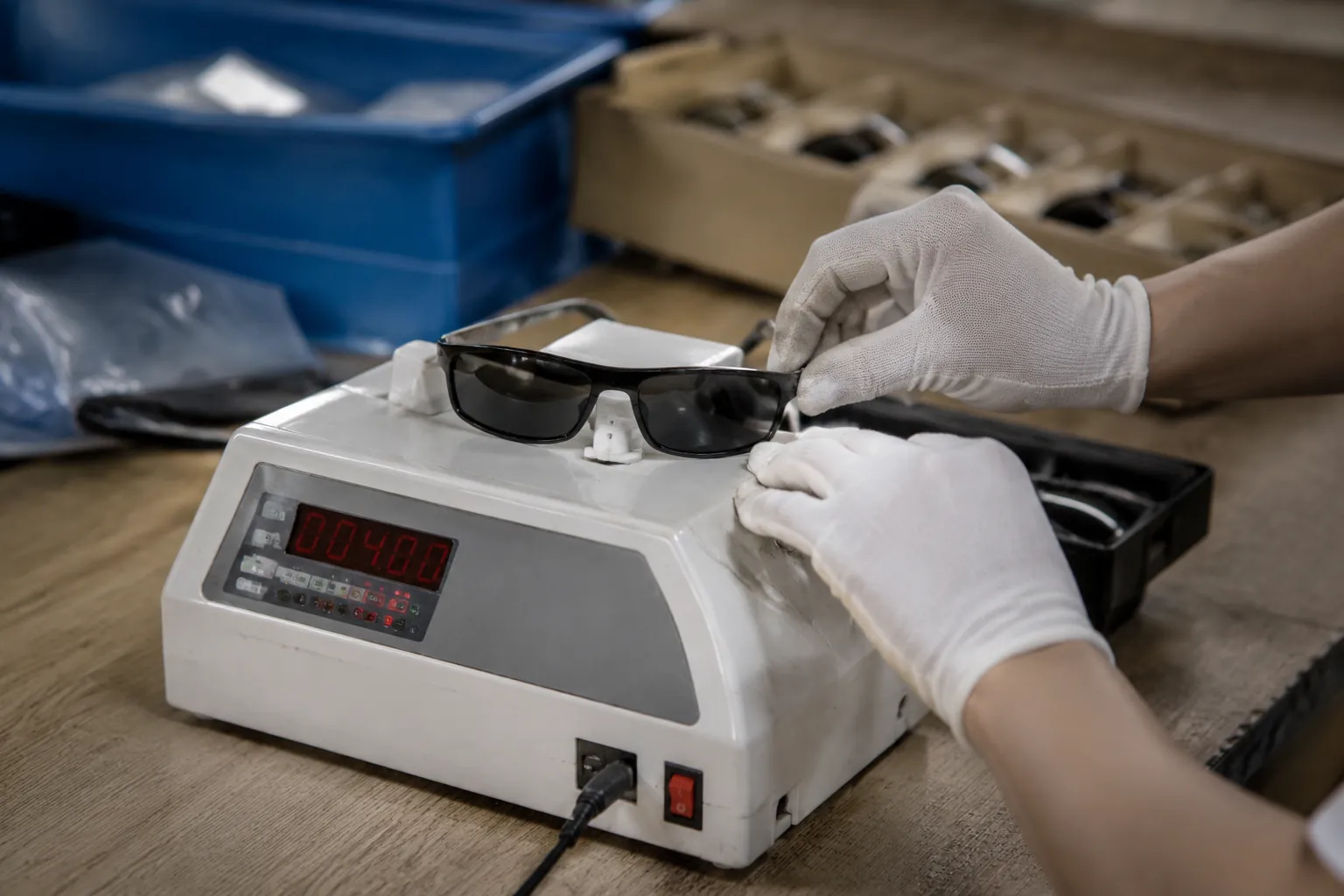
This guide is for brand owners, importers, distributors, and retail buyers moving a sunglass style from approved sample to bulk production. The problem is usually not a lack of tests. It is picking the right ones. The goal is simple: match testing to the product, the market, and the actual failure risk. Below, common eyewear lab and durability checks are translated into buying decisions, with a focus on what each test does, what it does not prove, and which factory controls determine whether a passing sample can be repeated at scale.
Start with market, construction, and failure risk
Many buyers get a quotation with impact, pull, corrosion, adhesion, UV, and chemical tests listed together, then approve the full set to feel covered. That is rarely the best use of budget. Start with three questions: where will the product be sold, what is it made from, and what failure will hurt most.
If the market is the EU, the usual starting point for sunglasses is EN ISO 12312-1, along with chemical compliance requirements that may involve REACH depending on materials and program scope. In the US, buyers often reference ANSI Z80.3 for non-prescription sunglasses. FDA registration may matter for supplier records or retailer onboarding, but it does not replace product testing. Australia and New Zealand commonly point to AS/NZS 1067. These standards deal with legal saleability. They are not the same as durability checks.
Next, review the bill of materials. Construction drives risk.
- Injected plastic frames: usually consistent in shape, but hinge insert areas and thin sections still need control
- Acetate frames: more manual fitting and polishing, so alignment and lens fit need closer review
- Metal frames: more exposure to plating, solder, screw, and corrosion issues
- Polycarbonate lenses: strong impact performance, but coating adhesion still matters
- CR-39 lenses: common in fashion programs, but impact behavior differs from polycarbonate
Then define the failure that matters most. On a low-cost fashion sunglass, the expensive problems are often loose hinges, alignment issues, scratched lenses, weak logo durability, or inconsistent lens transmission. On a premium acetate or metal-accent style, corrosion, decorative part failure, or lens retention may create faster claims.
That is the logic. Test for the risks the product actually has.
What each common test actually tells you
| Test | What it checks | Best fit product types | Main buyer value |
|---|---|---|---|
| Drop ball / impact | Resistance of lens or mounted eyewear to specified impact conditions and, in some cases, lens retention under shock | Sports styles, kids programs, higher-wrap frames, retention-sensitive constructions, polycarbonate lens programs | Reduces breakage risk and supports channel requirements where impact performance matters |
| Temple pull / hinge pull | Strength of temple attachment, screws, rivets, hinge inserts, and surrounding material | Acetate with pinned hinges, injected plastic with inserts, metal temples, styles with added trims | Catches weak assembly or weak substrate before bulk shipment |
| Salt spray / corrosion | Resistance of plated parts, exposed screws, nose pad arms, and trims to corrosion under test conditions | Metal sunglasses, spring hinges, plated logo plates, mixed-material premium frames | Important for humid, coastal, resort, and sweat-exposed use cases |
| Lens transmittance / UV | Visible light transmission category and ultraviolet protection performance | All sunglasses | Core compliance and labeling check |
| Coating adhesion / rub | Bond strength of mirror, hard coat, paint, pad print, or similar cosmetic finish | Mirrored lenses, painted temples, printed logos, rubberized or coated surfaces | Reduces early cosmetic complaints and retailer rejection |
| REACH chemical testing | Screening for restricted substances in applicable materials and components | EU programs, plated trims, metal frames, coated or decorated products | Reduces chemical compliance and customs risk |
The key distinction is between validation and production control. Validation is lab work done when a style is new, when the market changes, or when a key material or component changes. Production control is what happens on every run: incoming checks, in-process checks, final inspection, and shipment review.
If the frame material, lens material, hardware, plating, decoration, and process stay the same, earlier test work may still help. If the hinge supplier, plating source, tint process, coating, or decorative part changes, the old report may no longer describe the goods being shipped.
That is why serious buyers ask for two things: test reports and the controls behind them.
Impact and drop ball: use it where it earns its keep
Impact testing is often overused on low-risk fashion programs and underused on styles that actually need it. Do not ask whether drop ball sounds reassuring. Ask whether the design, end use, or retail channel creates a real impact or lens-retention risk.
Move impact testing up the list if you have:
- Polycarbonate lens programs positioned for active or outdoor use
- Kids sunglasses, where buyer scrutiny is often higher
- High-wrap styles that may place more stress on mounted lenses
- Thin-rim metal constructions or designs with limited lens retention margin
- Retailers or distributors that require impact data before approval
Factory details matter here. A development sample can pass and bulk can still fail if lens edging changes, groove depth shifts, frame fronts distort during polishing or heating, or assembly adds excess stress during lens insertion. On injected frames, consistency is often better than on hand-finished acetate, but retention still depends on stable tooling, molding conditions, and assembly. On acetate, manual fitting raises the need for control of groove quality, front shape, and insertion force.
For many basic fashion sunglasses, UV protection and visible light transmission come first because they affect legal saleability and labeling. Impact testing matters more when the construction, use case, or customer requirement makes it relevant. Not before.
Where possible, pair external impact work with internal controls such as:
- Lens material verification by lot
- Dimensional checks on lens shape and eyewire fit
- Assembly checks for lens seating and retention
- Final inspection for warp, stress, and fit consistency
One approved sample proves very little about bulk consistency.
Pull testing and hinge durability: often the most useful extra check
If a buyer adds one durability check beyond baseline market compliance, temple pull or hinge-related testing is often the best choice. Most consumers never create laboratory impact conditions in normal wear. They open and close the temples. They throw the frame into a bag. They remove it with one hand. They leave it in heat. Returns often start there.
Weak points depend on construction:
- Acetate: hinge pin installation, screw retention, and substrate stability around the hinge area
- Injected plastic: wall thickness around hinge inserts, insert anchoring, and consistency in molded stress zones
- Metal: soldered or joined areas, bend points, spring hinge performance, and screw stability
Pay attention if the approval sample already shows uneven opening force, visible hinge gap, screw loosening, asymmetrical temple position, or poor alignment. Those are not small details. They are warnings. If they appear on the sample, they usually become worse in volume unless the factory changes the component source, assembly method, or process control.
This is where process discipline matters more than brochure claims. A temple that feels tight may simply hide poor hinge alignment. A decorative logo plate near the hinge may pass a basic static check but still weaken the substrate. A pinned hinge may look secure and still fail later if installation is inconsistent.
Bottom line: if the style has hinges, temple inserts, or decorative features near stress points, a pull-related durability check usually gives more useful risk information than an extra low-priority lab item.
Salt spray, sweat, and cosmetic wear: easy to skip, costly to ignore
Salt spray is one of the first tests buyers cut and one of the most painful to miss on plated or mixed-material eyewear. Corrosion complaints usually show up after launch, when goods are already in humid markets, beach stores, travel retail, or direct-to-consumer use.
Prioritize corrosion-related checks when the frame includes:
- Plated metal fronts or temples
- Metal logo plates set into acetate or injected temples
- Spring hinges, exposed screws, nose pad arms, or decorative chains
- Distribution in coastal, tropical, boating, travel, or sweat-heavy channels
Typical root causes include poor pre-plating cleaning, inconsistent plating thickness, contamination before top coating, unsuitable hardware, or weak finishing control. A sample can look fine and still corrode later if the production process is unstable.
Do not stop with corrosion. Add cosmetic wear checks wherever finish quality is part of the selling point:
- Mirror coatings that may fail if curing or surface preparation is poor
- Pad-printed logos that may rub off during pouch contact or handling
- Paint-filled details that may chip if curing is incomplete
- Rubberized coatings that may become sticky, peel, or wear unevenly
For metal-rich premium styles, salt spray plus finish adhesion is often more valuable than an extra optical check with little relevance. Customers may forgive a dented outer carton. They will not forgive visible corrosion or trim failure on the frame.
A practical test plan by product type and order stage
| Product scenario | Sample stage | Pre-bulk stage | Bulk QC focus |
|---|---|---|---|
| Basic injected fashion sunglass, no metal trim | UV/transmittance, fit review, logo adhesion, visual QC | Applicable market compliance route; REACH if required for EU program | Lens category consistency, hinge function, scratches, visual defects |
| Acetate premium style with metal core and logo plate | UV/transmittance, pull test, decorative part review, color match | Target-market compliance, REACH if applicable, salt spray on metal parts, decoration adhesion | Hinge alignment, decorative part retention, polishing consistency, plating appearance |
| Sports wrap with polycarbonate lens | UV/transmittance, fit, retention review, coating check | Impact testing, target-market standard, coating adhesion | Lens retention, frame warp, coating appearance |
| Low-MOQ retailer trial | Basic compliance path, packaging check, wear checks on decoration | Limit additional tests to known material or channel risks | AQL inspection, labeling accuracy, final appearance |
Order stage changes the plan. At pilot stage, the goal is to confirm legal saleability and obvious product risks without loading the project with unnecessary cost. As the program scales, recurring defects become more expensive because they affect more units, more stores, and more markets.
Lead time matters too. Plan testing before artwork is frozen, before packaging is printed, and before all bulk components are committed. If a test fails after hardware, lenses, or finished cartons are locked, correction gets slower and more expensive. Fast.
If a supplier holds management or social-audit credentials such as ISO 9001 or BSCI, that may support confidence in process discipline or audit readiness. It does not replace product-level compliance or performance testing.
Tie lab tests to process controls and release documents
External reports help. They do not control production by themselves. Buyers should ask how a sample result will be maintained through incoming inspection, assembly, finishing, and final QC.
Ask for the control points behind the report:
- Incoming checks on lenses, frame parts, hinges, screws, trims, coatings, and packaging
- Dimensional checks after molding, machining, polishing, or frame fitting
- Lens transmittance verification by lot where category consistency matters
- Hinge function, opening balance, and alignment review during assembly
- Adhesion checks after pad printing, painting, mirror coating, or decorative bonding
- Final QC for scratches, warp, logo position, left-right symmetry, and carton labeling
Examples make this clearer. If a style passes UV and transmission in development, production still needs control of lens source, tint process, and lot verification so finished goods stay within the intended category. If a decorative metal part passes an attachment check on the first sample, the factory still needs a stable process for surface preparation, adhesive use, placement, and cure. If a plated component performs well in corrosion testing once, incoming hardware and finishing conditions still need to remain unchanged and documented.
Buyers should also ask which changes trigger revalidation. Useful trigger points include changes in lens material, frame material, hinge supplier, plating supplier, coating type, decorative metal parts, or target market standard. That question quickly shows whether testing is being treated as a one-time paperwork exercise or as part of real quality control.
Buyer release checklist before bulk production
Before paying a bulk deposit, confirm the validation logic in writing. At minimum, the approval record should cover:
- Target market and applicable standard: EN ISO 12312-1, ANSI Z80.3, or AS/NZS 1067 as required
- Whether REACH or other chemical screening is required for the program
- Lens category target and UV protection requirement
- Frame material, lens material, hinge type, plating, and all decorative metal parts
- Which durability tests are included and which are intentionally excluded
- Approved sample reference for color, fit, logo location, lens effect, and packaging
- Lead time for samples, bulk, and any external lab work
- Inspection method at shipment, including cosmetic criteria for scratches, alignment, print quality, and labeling
Keep the buying logic simple. A metal-trim acetate style sold into the EU needs a different test stack from an all-plastic promotional sunglass sold in one domestic market. Over-testing wastes time and margin. Under-testing shows up later as returns, retailer claims, or customs delays. The right plan sits in the middle and stays tied to construction, market, and channel.
Have a custom sunglasses project in mind?
Send us your styles, target market and quantities and we will return a detailed quote with MOQ, lead time and a sample plan.
Get a QuoteWhy source this from Wenzhou with LumiShades
Wenzhou in Zhejiang Province is widely regarded as China’s eyewear manufacturing capital, producing a large share of the world’s sunglasses. That concentration matters to buyers: a deep local supply chain for acetate sheet, hinges, lens blanks, plating and packaging means shorter component lead times, easier color and material matching, and a workforce with decades of eyewear-specific skill. LumiShades has manufactured in this ecosystem since 2009, and our vertical integration — in-house injection molding, acetate cutting, CNC milling, lens tinting, decoration and quality control — means no part of your order is quietly subcontracted to a workshop you cannot audit.
For international buyers, that vertical control translates into accountability. When a single factory owns every step, defects are traced and fixed at source rather than bounced between vendors, and your specifications survive intact from first sample to bulk. We back this with 15+ years of experience, shipments to 60+ countries, more than 5 million pairs produced per year and a 98.5% on-time delivery rate. Our certifications — CE EN ISO 12312-1, FDA registration, ANSI Z80.3, AS/NZS 1067, REACH, ISO 9001 and BSCI audit — mean the compliance documentation your market requires already exists. Explore our manufacturing capabilities and quality control process to see how this works in practice.
Frequently asked questions
Do I need drop ball testing for every fashion sunglass order? No. First confirm the applicable market standard for where the sunglasses will be sold, then verify UV protection and visible light transmission. Add drop ball or other impact testing when the product is meant for active use, includes polycarbonate lenses, uses a retention-sensitive construction, targets children, or when the retailer specifically requires impact data. Action step: ask your lab or supplier to confirm whether impact testing is required by your target standard or only recommended based on product risk and customer requirement.
Which matters more for a low-cost program: salt spray or pull testing? Usually pull testing matters more on all-plastic fashion styles because hinge and temple failures are a common cause of returns. Salt spray becomes more important when the frame has meaningful metal content such as plated parts, exposed screws, spring hinges, nose pad arms, or decorative metal trims. Action step: review the bill of materials first. If the style is mostly plastic with no exposed metal, prioritize hinge and temple durability. If metal appearance is part of the design, add corrosion testing.
Can I use one lab report for repeat orders? Only if the product is genuinely unchanged. A prior report may still be useful when the frame material, lens material, hinge, screws, plating, coating, decoration, and factory process are the same. If any of those change, especially the lens source, hinge supplier, plating supplier, coating type, or decorative metal part, the old report may no longer represent the shipment. Action step: ask the supplier for a change log and define in advance which component or process changes will require retesting.
When should I expand testing beyond the basics? Expand beyond baseline compliance when one of three things happens: the construction gets more complex, the market or retailer has stricter expectations, or the commercial risk of failure increases. That usually means adding targeted durability or corrosion checks when moving from a simple pilot to a broader launch, when entering multiple markets, or when adding metal parts, coatings, mirrors, or higher-risk lens constructions. Action step: make a short risk map for each style covering market, material, finish, and channel, then add tests only where that map shows a credible failure risk.
How should I build testing into the development calendar? Plan testing before packaging is printed, before bulk components are fully committed, and before the production schedule becomes hard to change. Leave time not just for the lab result, but also for corrective action if the style fails. Action step: at sample approval, confirm three dates in writing with the supplier: sample completion, lab submission, and the latest decision point for changing hardware, lens, coating, or packaging without delaying bulk.
Ready to start?
Explore our wayfarer sunglasses or request a quote — our sales team replies within 12 hours.
Request a Quote