
Why Custom Sunglasses Samples Get Delayed
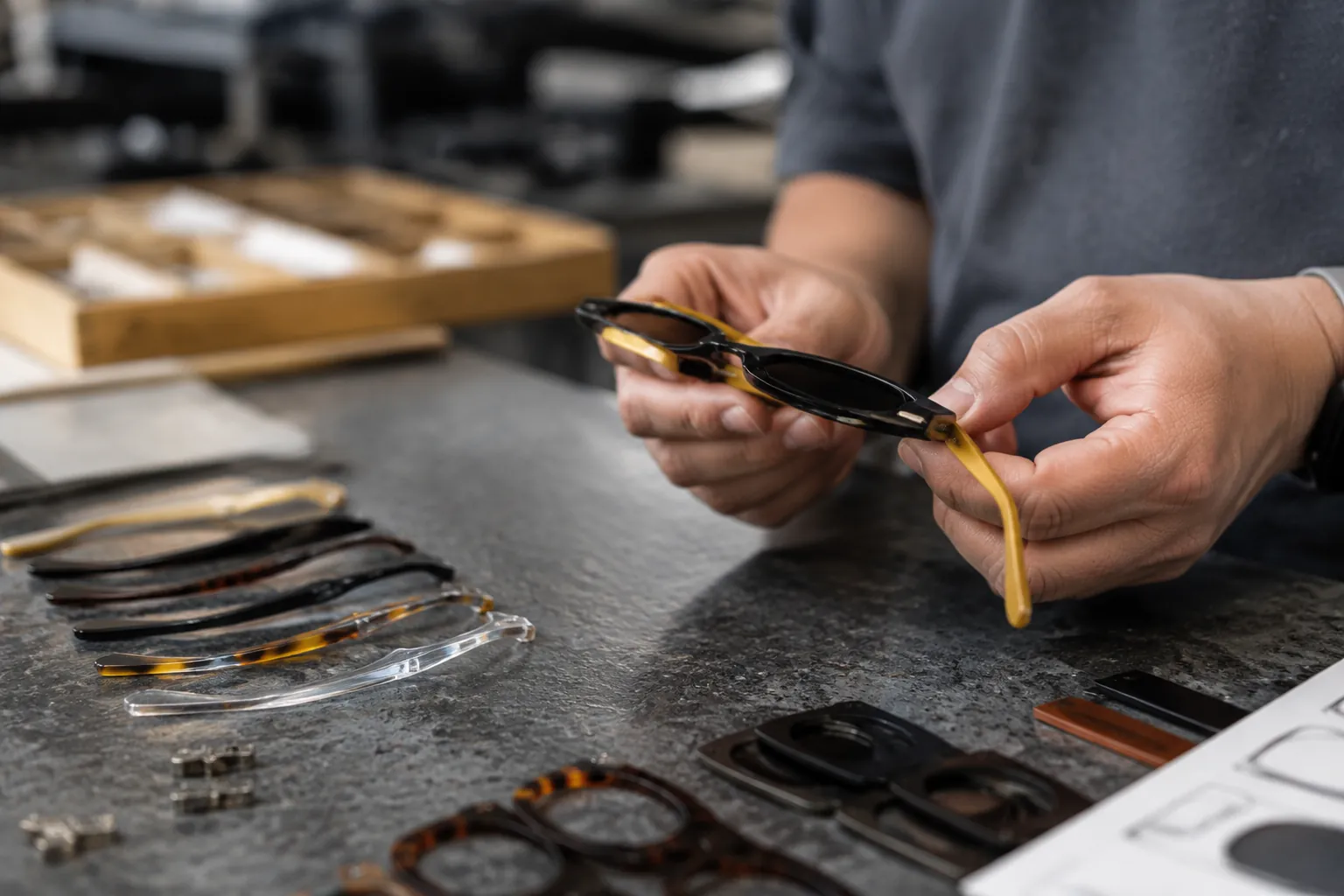
This guide is for brand owners, importers, distributors, and retail buyers sourcing custom sunglasses at volume. When sample timing slips, bulk production usually slips too. That means missed launch dates, extra courier charges, repeated setup work, and too many revision rounds. Factory speed is rarely the only issue. Most delays start earlier, with incomplete specs, non-production-ready artwork, photo-only color approvals, vague packaging scope, or compliance requests raised after lens sampling is already underway.
Where sample delays usually begin
Most sample delays start before any frame is cut, injected, polished, or decorated. A factory can move fast on a carry-over style or a clear brief. Lead time stretches as soon as the project contains open decisions.
Usually, one missing input does not cause the whole delay on its own. The problem is cumulative. Small gaps force the team to stop, clarify, revise, and restart.
The common risk points are predictable: frame dimensions, hinge construction, lens color target, logo artwork, material selection, finish, packaging scope, and destination-market compliance. Leave several of those vague after sample payment, and the factory either pauses or makes assumptions. Assumptions often come back as revisions.
A sample schedule is only reliable when the supplier already has what it needs: front and side references, core dimensions in millimeters, color standards, decoration files, and a clear statement on whether the sample is visual only or meant to follow the final compliance direction. A front-view sketch with no temple detail is not enough. Neither is a color name with no reference. Neither is a logo size change after decoration prep has started.
Many buyers treat sampling like a creative review stage. It works better as an engineering step. If the goal is approval in one or two rounds instead of three or four, the first brief has to remove guesswork.
The five failure points that add days fast
| Failure point | What happens on the factory side | Typical delay added | How to prevent it |
|---|---|---|---|
| Unclear artwork | Logo file cannot be used for pad printing, laser engraving, or metal plate sizing without redraw or vector tracing | Additional review and file preparation time | Send AI, EPS, or vector PDF artwork with exact size and placement |
| No color standard | Factory matches by interpretation, buyer rejects tone, and recolor or retint is required | Extra sample revision cycle | Approve Pantone for solid references, a physical chip, or a signed counter-sample |
| Changing frame specs | CNC path, acetate cutting size, hinge position, or mold setup must be revised | Rework before the next sample can proceed | Freeze eye size, bridge, temple length, and key profile details before start |
| Late compliance request | Lens category direction, VLT target, markings, or material choice must be rechecked | Possible remake of lenses, markings, or labels | Confirm destination market and compliance path at RFQ stage |
| Mixed packaging assumptions | Factory prepares frame-only sample while buyer expected pouch, box, barcode, and inserts | Separate packaging follow-up round | List every sample component in writing before payment |
These delays stack quickly. A logo redraw, a lens recolor, and a temple-length change can turn a straightforward review into a multi-round process. Then the next round starts from a revised baseline.
The root issue is usually spec control. Factories do make mistakes. But repeated rounds are often driven by buyer-side changes after work has already started. Clean inputs reduce courier cycles and speed approvals.
- Freeze core dimensions before cutting or molding starts.
- Approve one color standard for the frame and one for the lens.
- State the decoration method, not just the logo itself.
- Confirm whether packaging is included in the sample pack.
- Nominate one final approver on the buyer side.
Artwork errors look small on screen and costly in production
Artwork blocks sample progress more often than buyers expect. Buyers see branding. The factory sees a manufacturing instruction. Those are different things.
A logo that looks fine on a website header may still fail in production. Pad printing, laser engraving, hot stamping, and stamped metal plates all have technical limits.
For pad printing, line weight matters. Fine strokes may fill in or break, especially on curved temples or textured surfaces. For laser engraving, readability depends on the substrate, coating, and resulting contrast. For a metal logo plate, the factory needs width, height, thickness, corner radius, finish, plating color, and attachment method, such as pins, adhesive, or inlay routing. If those details are missing, work stops while the supplier redraws and asks for confirmation.
Placement also has to be measurable. "Center it by eye" is not a production instruction. "Logo width 8.0 mm, positioned 12.0 mm from hinge center" is.
| Decoration method | Best use | Key technical limit | Typical approval detail needed |
|---|---|---|---|
| Pad printing | Simple temple logos and one- or two-color marks | Fine lines can spread; curved surfaces affect clarity | Vector artwork, Pantone reference, print area, width, and position |
| Laser engraving | Metal parts, coated temples, subtle branding | Contrast depends on substrate and coating | Engraved area, finish reference, and placement |
| Metal logo plate | Premium acetate or fashion styles | Requires exact sizing and attachment design | Plate size, thickness, plating, fixing method, and location |
| Hot stamping | Foil-style marks on selected materials | Heat and pressure vary by surface | Foil color, stamping area, and substrate confirmation |
The safe approach is simple. Send vector artwork. Specify all dimensions in millimeters. Mark placement from a fixed reference point such as hinge center or temple tip. That cuts avoidable back-and-forth before decoration starts.
Color approvals fail when photos are the only reference
Color is where many sample schedules drift. Verbal descriptions are too loose. Terms such as "warm grey lens," "light smoke," or "transparent olive" may sound clear internally, but they are not measurable standards.
Material behavior makes color harder to control. Injection frames can shift in appearance based on resin base, pigment loading, wall thickness, and gloss level. A translucent TR90 or polycarbonate part may look lighter at one thickness than another. Acetate adds more variation because tortoise, marble, laminated, and striped sheets naturally vary by sheet and batch. Lens color also changes with material, base curve, thickness, and target visible light transmission. Same color name. Different result.
Photo approval helps with early direction. It is weak as a final control method. Screen calibration, camera white balance, and lighting conditions can distort both frame and lens tone. If color consistency matters across a launch, final approval should rely on a Pantone reference for nearest-match solids, a physical swatch, or a signed counter-sample.
It also helps to define acceptable variation. For example, a buyer can state that a transparent frame must remain within the approved visual family with no visible shift toward another hue under daylight comparison. For patterned acetate, the practical control is usually pattern density and color family, not exact duplication from one panel to the next.
- Use photos for early concept review only.
- Use Pantone mainly for solid colors and logo inks.
- Use physical swatches or signed samples for production control.
- Assign one person to give final color approval.
That last point matters. If teams in different offices send conflicting comments, the factory has no clear reference to follow. One decision-maker often prevents an unnecessary sample round.
Lock compliance before lens sampling starts
Compliance is not paperwork added at the end. It affects the lens sample, markings, packaging language, and sometimes material choice. If the product is intended for the EU, US, or Australia and New Zealand, those requirements should be aligned before the first confirmed sample is tinted or assembled.
For sunglasses, buyers commonly ask about CE EN ISO 12312-1, ANSI Z80.3, and AS/NZS 1067. Chemical control discussions may also involve REACH, and some US buyers ask suppliers about FDA registration status where relevant to the company or product documentation context. These are not interchangeable labels. They relate to different markets, testing expectations, and documentation paths.
The risk is simple. A frame can look right cosmetically and still be wrong for the intended market. If the first sample uses the wrong lens category direction, lacks required markings, or follows the wrong labeling path, the lenses may need to be remade, the temple marking revised, and the packaging artwork updated.
A useful buyer brief should state the selling market by country or region, whether the sample is appearance-only or intended as a compliance-reference build, and any required marking or labeling language. It should also confirm whether the lens target is cosmetic direction only or tied to a final performance category.
Raise compliance requirements at RFQ stage. Then repeat them in the sample brief. If a supplier claims support for standards such as CE EN ISO 12312-1, ANSI Z80.3, AS/NZS 1067, REACH, FDA registration, ISO 9001, or BSCI, ask what that claim actually covers and request supporting documentation where appropriate.
Build a sample brief that survives first review
The best sample briefs are not necessarily long. They are complete. A short brief with the right technical data is more useful than a long presentation full of mood images and missing dimensions.
- Lock the frame platform. State material, overall front width, eye size, bridge, temple length, hinge type, and key profile notes. If it is based on an existing style, mark every deviation against that style.
- Define color with a real reference. Give frame color standard, lens color standard, finish, transparency level, and any pattern-density note for acetate or tortoise.
- Attach production-ready branding files. Send vector artwork and list decoration method, size, finish, and exact placement.
- State compliance direction. Identify destination market and whether the sample is visual only or intended to reflect the final compliant lens route.
- List the sample pack scope. Specify frame only, assembled sunglasses, pouch, case, cloth, carton label, barcode, hangtag, insert card, or retail box.
- Name one approver. Consolidate all internal comments before sending the revision list back.
This matters at any order size. Lower MOQs can help a buyer test a market, but repeated sample rounds usually hurt small runs more because setup, decoration prep, and freight are spread across fewer units. Larger orders often deliver better unit economics once the specification is stable enough to move from sample to production without repeated resets.
MOQ flexibility can help with market entry. It does not reduce the cost of indecision. Clear briefs do.
What a realistic one-or-two-round workflow looks like
Strong buyers do not eliminate every revision. They eliminate avoidable revisions. They also separate subjective comments from measurable corrections.
Round one should confirm shape, fit, color direction, logo position, and overall finish. The sample should be built from a frozen spec file, even if some aesthetic details remain open for final tuning. Once the sample arrives, comments should go back in one consolidated list from one approver or one internal decision group.
Round two should address measurable changes only. Typical examples include moving a temple logo, tightening hinge resistance, darkening the acetate family, changing lens direction, or switching print color. If round two introduces a new front width, different material, new hinge architecture, and revised packaging concept, it is no longer a correction round. It is a reset.
The fastest sample approvals happen when the buyer freezes engineering decisions first, then refines aesthetic preferences within those limits.
Factories with in-house molding, acetate processing, lens tinting, decoration, and QC may reduce handoff delays compared with supply chains split across multiple subcontractors. Even so, in-house capability does not solve moving targets. The supplier can shorten execution time. The buyer still has to hold the spec line.
A realistic target is simple: align the brief, complete one informed first sample review, make one measured correction round if needed, then release bulk production only after final approval.
A blunt checklist before you release sample payment
Use this checklist before telling the supplier to start. If several items are unresolved, delay is likely.
- Frame material confirmed: injection, acetate, or metal-combination construction.
- Core dimensions confirmed in millimeters, including eye size, bridge, temple length, and overall width.
- Lens color direction and intended performance category confirmed for the target market.
- Destination market and required standard confirmed: CE EN ISO 12312-1, ANSI Z80.3, AS/NZS 1067, REACH, or FDA registration context where relevant.
- Logo file supplied in vector format with decoration method, size, and position.
- Surface finish confirmed: gloss, matte, rubberized, transparent, crystal, or approved pattern family.
- Sample contents confirmed, including any case, pouch, cloth, box, barcode label, insert, or hangtag.
- One person on the buyer side owns final approval.
- Courier address, consignee contact, and customs phone number checked.
That last point sounds minor. It is not. A correct sample can still lose time because shipping paperwork is incomplete or the receiver cannot be reached for customs clearance.
The goal is straightforward: a stable brief, a controlled sample review, and a clean handoff to production after approval. Buyers who treat the brief like a production-control document usually move faster than buyers who treat it like a sketchpad.
Have a custom sunglasses project in mind?
Send us your styles, target market and quantities and we will return a detailed quote with MOQ, lead time and a sample plan.
Get a QuoteWhy source this from Wenzhou with LumiShades
Wenzhou in Zhejiang Province is widely regarded as China’s eyewear manufacturing capital, producing a large share of the world’s sunglasses. That concentration matters to buyers: a deep local supply chain for acetate sheet, hinges, lens blanks, plating and packaging means shorter component lead times, easier color and material matching, and a workforce with decades of eyewear-specific skill. LumiShades has manufactured in this ecosystem since 2009, and our vertical integration — in-house injection molding, acetate cutting, CNC milling, lens tinting, decoration and quality control — means no part of your order is quietly subcontracted to a workshop you cannot audit.
For international buyers, that vertical control translates into accountability. When a single factory owns every step, defects are traced and fixed at source rather than bounced between vendors, and your specifications survive intact from first sample to bulk. We back this with 15+ years of experience, shipments to 60+ countries, more than 5 million pairs produced per year and a 98.5% on-time delivery rate. Our certifications — CE EN ISO 12312-1, FDA registration, ANSI Z80.3, AS/NZS 1067, REACH, ISO 9001 and BSCI audit — mean the compliance documentation your market requires already exists. Explore our manufacturing capabilities and quality control process to see how this works in practice.
Frequently asked questions
How detailed should my first sample brief be? Detailed enough that the factory does not need to guess. Include material, overall width, eye size, bridge, temple length, hinge type, front and side references, frame finish, lens color target, intended lens performance direction, logo artwork, decoration method, placement, packaging scope, and destination market. The practical goal is one approval sheet the supplier can work from without pulling key data from scattered emails or image files.
Can I approve lens and frame color from photos only? Use photos for concept direction only, not as the final production standard. For solid frame colors and logo inks, provide a Pantone reference where appropriate. For translucent materials, acetate patterns, and tinted lenses, use a physical swatch or signed counter-sample. If you approve from photos early, state clearly that the approval is provisional until a physical reference is confirmed.
What usually causes a second or third sample round? The most common causes are late changes to artwork, frame size, hinge details, lens direction, color standard, or packaging scope. Another frequent cause is fragmented feedback from multiple reviewers. To reduce extra rounds, collect all comments internally, remove duplicates and subjective conflicts, and send one consolidated revision list with measurable instructions only.
Does MOQ affect the sample process? Yes, mainly on cost rather than approval logic. The same revision loop can be more expensive on a low-MOQ project because tooling setup, decoration preparation, and courier charges are spread across fewer units. Ask the supplier to separate sample charges, tooling charges, and bulk unit pricing so you can see how repeated revisions affect total landed cost before approving another round.
When should I raise compliance requirements? At RFQ stage and again in the sample brief. State the exact selling market, the standard or documentation path involved, and whether the sample is visual only or intended to follow the final compliance route. If CE EN ISO 12312-1, ANSI Z80.3, AS/NZS 1067, REACH, or FDA registration-related documentation questions are raised only after sampling starts, the supplier may need to revise lenses, markings, labels, or packaging, which adds delay and cost.
Ready to start?
Explore our shield & oversized sunglasses or request a quote — our sales team replies within 12 hours.
Request a Quote