
UV400 Claims in Sunglass Production: Spec to Shipment
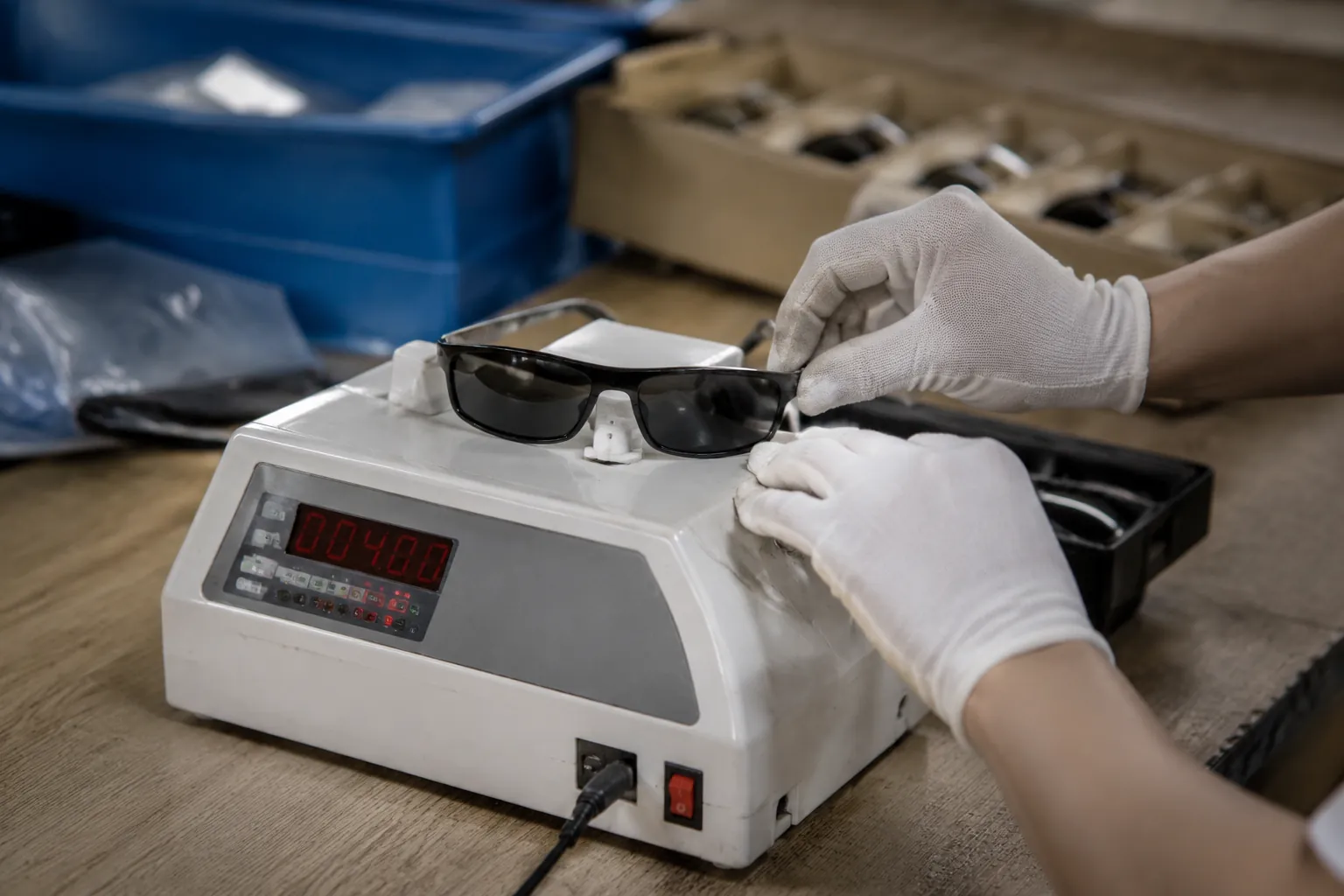
UV400 sounds simple. It is not. It is a production claim, a test claim, and a paperwork claim at the same time. For overseas brands, importers, distributors, and retailers, the real risk is not only weak UV performance. It is a mismatch between lens material, tint, coating, test method, and file content. If any one of those changes, a shipment can pass sample approval and still fail in bulk, at customs, or in a third-party lab. This article explains what to specify, what to verify, and what to document before you place volume orders.
What UV400 means in a factory spec
In buyer language, UV400 means the lens is intended to block ultraviolet radiation up to 400 nm, covering UVA and UVB. In factory language, that is a measurable requirement. It must match the exact lens material, tint, coating, and final build.
Do not trust appearance. A dark lens can still fail if the resin is wrong, the tint bath drifts, or the coating is damaged in handling. A light lens can still pass if the base material contains UV-absorbing additives or the coating system does its job. Darkness is not proof.
Write the claim as a full spec, not a slogan. For example: polycarbonate lens, smoke grey tint, UV400 claim, tested to CE EN ISO 12312-1, with batch-linked QC retained. That gives the factory a material target, a finish target, a market target, and a recordkeeping target.
If the factory outsources lens sourcing, tinting, or finishing, ask who owns the resin lot, the tint bath control, and the final QC signoff. UV400 is only as reliable as the weakest handoff. Also, treat each style-color-material combination as a separate approval case unless the supplier can prove equivalent performance across the range. Same frame family is not the same thing.
How to write the claim into the spec sheet
Put the claim into three layers: product, test, and document. That keeps the conversation clear and prevents the usual "we thought they meant…" problem later.
- Product: lens material, tint code, coating type, frame material, lens geometry, and any mirrored or polarized finish.
- Test: target standard, sample quantity, wavelength range, pass criteria, and whether the test applies to finished goods or lens blanks.
- Document: test report, batch record, QC photos, traceability code, and importer-specific declaration if required.
A strong line item might read: Adult fashion sunglasses, polycarbonate lens, smoke grey tint, UV400 protection, tested to EN ISO 12312-1 for EU shipment, with style-level and batch-level records retained for the shipment file. That is specific enough to quote and specific enough to audit.
For multi-market programs, one report rarely fits every market. CE EN ISO 12312-1, ANSI Z80.3, and AS/NZS 1067 are different standards. Different checks. Different file expectations. Map the destination countries first, then freeze the spec.
Also define what counts as a change. If the tint changes, the coating supplier changes, the base resin lot changes, or the manufacturing site changes, retest unless the supplier has a controlled equivalency process. "Same as sample" is vague. "Same material, same process, same supplier, same result" is better.
If the supplier cannot explain the standard in process terms, that is a warning sign. Ask for the exact lens type, the exact test basis, and the exact file that travels with the shipment. A supplier that understands UV400 should not hide behind slogans.
Material choices that affect UV performance
UV performance starts with the substrate. Different lens materials behave differently in molding, cutting, tinting, and coating. Two styles can look similar and still perform differently on the line.
Polycarbonate is often the easiest route to stable UV blocking because the material itself typically provides strong intrinsic protection. It is also impact-resistant, so it fits many volume programs. The tradeoff is process sensitivity. Barrel temperature, mold temperature, cooling time, and gate control all matter. If the molding window drifts, expect haze, stress marks, or uneven edge thickness.
CR-39 and other resin lenses can also perform well, but they depend more heavily on the raw compound, additive package, and coating integrity. That means tighter control over incoming resin and finish processes. If the coating is not cured consistently, or if the supplier swaps resin lots, UV performance can shift even though the lens still looks fine under shop lighting.
Acetate frames with inserted lenses, or cut lenses used in premium and fashion builds, add another layer of variation. The lens blank may test well, but cutting, edging, and mounting can change the edge finish or expose a weak zone if the lens is stressed. For those builds, ask for proof on the exact lens lot and the exact finished configuration, not only the raw blank.
Mirror and flash coatings are often misunderstood. They can reduce glare and change the look. They do not guarantee UV protection. If the base lens is weak, a mirrored surface will not save it. Polarized lenses reduce reflected glare, but polarization is not the same as UV blocking. Separate claims. Separate checks.
| Lens / build option | Typical UV behavior | Production risk | Buyer note |
|---|---|---|---|
| Polycarbonate lens | Usually strong intrinsic UV blocking | Heat control, molding pressure, and stress management matter | Good fit for volume programs with impact-resistance requirements |
| CR-39 / resin lens | Can perform well if the additive package and coating are controlled | More sensitive to resin lot changes and coating cure variation | Request lot traceability and retest rules |
| Acetate cut lens or inserted lens build | Depends on blank quality and finishing process | Cutting, edging, and mounting can create variation | Ask for proof on the exact tint, edge finish, and lens lot |
| Mirror or flash coating | May improve glare control, not UV by default | Coating adhesion, thickness, and curing consistency | Mirrored does not equal protected |
On real lines, the common failure points are boring. Wrong pellets. Recycled material in the batch. Tint variation across tanks. Coating contamination. Weak traceability. If the factory cannot tell you which resin batch and tint batch were used, you are relying on luck, not control.
Testing methods buyers should ask for
A UV400 claim only matters if the factory can show how it is verified. "We tested it" is too vague. Ask what was tested, how it was tested, and how the result links to the shipment.
A practical factory control flow has four steps. First, incoming material check: confirm the lens resin or blank source, supplier batch, and declared material type. Second, in-process verification: monitor tint concentration, immersion time, coating thickness, curing time, and visible defects. Third, final UV test: verify transmission across the required wavelength range on the finished lens. Fourth, recordkeeping: link the result to style, color, lens lot, and production date.
The report should match the exact lens color and exact build that will ship. A green tint report does not prove a smoke grey lens. A report on a lens blank does not always prove the final assembled sunglass. If the factory uses multiple lens colors in one frame family, each color should be in the test matrix unless the supplier can justify a shared material path.
Retest rules matter as much as the first report. If the tint changes, the coating recipe changes, the resin supplier changes, or the manufacturing site changes, refresh the report. Otherwise the file can look current while the product has drifted.
Press the factory with three items at once: the standard, the sample ID, and the batch ID. If they cannot connect those three, they do not have enough control for a serious export order.
What compliance documents matter by market
UV400 is one layer of compliance, not the whole stack. The destination market decides what else must travel with the product.
For EU-bound eyewear, buyers usually want a conformity file aligned with CE EN ISO 12312-1, along with the right labeling, traceability, and supporting declarations. For US-bound programs, the importer still carries responsibility for the product file and regulatory path, so a foreign lab report alone is not enough. For Australia and New Zealand, AS/NZS 1067-aligned documentation is typically expected, and an EU-only file is not a substitute. For general B2B import programs, keep material records, carton labels, batch traceability, and retained test reports.
The common gap is not the absence of a certificate. It is the mismatch between the claim and the file. A style may be sold as UV400, but the evidence may only show a generic tint result or a test on a different lens color. That leaves the buyer exposed if customs or a downstream customer asks for proof.
Only document certifications and registrations you can support. For eyewear programs, relevant examples in a supplier file may include CE EN ISO 12312-1, ANSI Z80.3, AS/NZS 1067, REACH, FDA registration where applicable, ISO 9001, and BSCI. None of these are interchangeable. The factory should be able to say which one applies to which market and product family.
If one style will sell in several regions, map the standards before sampling. Then the lens spec, labeling, and test plan are designed once. Not patched later. Retroactive compliance is slow, expensive, and usually avoidable.
How to avoid gaps at sample and bulk stages
Most UV400 failures do not start with a bad sample. They start when bulk drifts from the approved sample. That drift usually comes from weak change control, not bad intent.
Freeze the critical variables before mass production starts. Lock the lens material, fix the tint code, name the coating spec, and require written approval before any material substitution. If the style was approved in a specific smoke grey, do not accept "close enough" in bulk.
- Freeze the lens spec: material, tint, coating, and supplier.
- Approve the exact color: not a "similar" shade or daylight guess.
- Lock the QC limits: scratch rate, bubble rate, coating haze, lens fit, and surface distortion.
- Keep a golden sample: signed, dated, and stored by both buyer and factory.
- Require pre-production confirmation: before bulk cutting, molding, tinting, or coating begins.
Small process changes matter. A small edge difference, a different tint bath time, or a coating supplier change can alter appearance, yield, and sometimes performance. On higher-volume lines, that is not small. It is the process.
Ask about pricing logic across order tiers too. A serious supplier can explain why MOQ pricing exists and where the step-downs happen. A small colorway run may need separate setup, color mixing, and QC time, while a larger order can be more efficient once tooling and material are already committed. That is why sample and bulk lead times should be written down. A 7-10 day sample window and a 25-35 day bulk window may be realistic when materials are ready, but only if the spec is frozen and no retest is triggered.
Decoration can create hidden risk if it is not sequenced correctly. Laser engraving, pad printing, metal logo plates, and hot stamping should be planned so they do not interfere with lens handling and QA. Put that sequence on the route card so the factory knows the order of operations.
A buyer checklist before you place the PO
Use this checklist before you pay a deposit. It cuts back-and-forth and reduces avoidable compliance gaps.
- Confirm the exact UV claim wording for the destination market.
- Ask which standard the style is being built to and whether the report will match the final lens color.
- Request the lens material, tint code, coating spec, and any polarization or mirror layer details.
- Ask for sample and bulk lead times in writing.
- Confirm MOQ and price breaks for the style and colorway.
- Require batch traceability, final QC checkpoint records, and retest triggers for any material or process change.
Buyer rule: if the seller cannot connect claim, standard, and batch, do not treat the UV400 line as finished. It is still a draft.
Also ask where decoration happens relative to verification. If the logo is added after the lens test, the supplier should explain how they prevent handling damage or file confusion. If printing, engraving, or a metal plate changes the process route, it belongs in the approval record.
One more question separates organized factories from improvisers: what are the final QC limits for coating haze, lens fit, and surface defects? A supplier that knows those numbers is usually controlling the process. A supplier that guesses is usually managing complaints later.
What serious buyers should ask the factory
Good sourcing is not about asking for more promises. It is about asking precise, process-based questions that force the factory to show control.
- Which lens material is used for this style, and is it the same for all colors?
- Which UV standard is the report tied to, and does it cover finished goods or only lens blanks?
- What changes trigger a retest, and who approves that decision?
- Can you trace each batch to lens lot, tint run, and coating batch?
- What are your final QC limits for haze, fit, scratches, bubbles, and coating adhesion?
If the answers are vague, the risk is real. You may still receive good-looking sunglasses, but the compliance file will be weak, the evidence trail will be incomplete, and the claim may not survive a customer audit or customs inquiry. That is how shipments get delayed and margins shrink.
A solid factory should answer in process language: material, test method, record, batch, retest trigger, release criteria. That is the whole point. UV400 is not just a statement on the lens spec. It is a controlled production outcome.
For overseas buyers, the safest move is simple: treat the claim like a controlled property, not a slogan. When the lens formula, test basis, and paperwork all match, UV400 is easy to sell. When they do not, even a good-looking pair can become a compliance problem.
FAQ: UV400 claims in production
Is UV400 the same as 100% UV protection?
In buyer language, it is usually understood that way, but the claim still needs support from the correct product test and the market standard you are selling into. Ask the factory to show the exact report and the exact lens version it covers.
Can a dark tint prove UV400 performance?
No. Darkness only changes visible light transmission. UV protection depends on the lens material, coating, or both, and the result must be verified on the finished product.
Do I need separate reports for EU, US, and Australia?
Very often, yes. CE EN ISO 12312-1, ANSI Z80.3, and AS/NZS 1067 are different standards, so ask the supplier which report applies to each destination before you approve the order.
What should I request from a factory before bulk production?
Request the exact lens spec, the test basis, a batch traceability method, a golden sample, the retest triggers, and the written lead time. If the supplier cannot provide those in writing, the risk is still open.
Does a supplier's FDA registration mean the product is automatically compliant?
No. FDA registration is not the same as product compliance. You still need the correct product file and testing for the intended market.
What is the biggest mistake private label buyers make with UV claims?
They approve a sample based on appearance and fail to lock the lens material, tint, coating, and retest rules. Bulk then drifts from the approved sample.
Should decoration happen before or after UV verification?
Usually after the lens system is verified, unless the factory has a controlled route showing decoration does not affect lens performance or handling quality. Ask the factory to document the sequence.
Have a custom sunglasses project in mind?
Send us your styles, target market and quantities and we will return a detailed quote with MOQ, lead time and a sample plan.
Get a QuoteWhy source this from Wenzhou with LumiShades
Wenzhou in Zhejiang Province is widely regarded as China’s eyewear manufacturing capital, producing a large share of the world’s sunglasses. That concentration matters to buyers: a deep local supply chain for acetate sheet, hinges, lens blanks, plating and packaging means shorter component lead times, easier color and material matching, and a workforce with decades of eyewear-specific skill. LumiShades has manufactured in this ecosystem since 2009, and our vertical integration — in-house injection molding, acetate cutting, CNC milling, lens tinting, decoration and quality control — means no part of your order is quietly subcontracted to a workshop you cannot audit.
For international buyers, that vertical control translates into accountability. When a single factory owns every step, defects are traced and fixed at source rather than bounced between vendors, and your specifications survive intact from first sample to bulk. We back this with 15+ years of experience, shipments to 60+ countries, more than 5 million pairs produced per year and a 98.5% on-time delivery rate. Our certifications — CE EN ISO 12312-1, FDA registration, ANSI Z80.3, AS/NZS 1067, REACH, ISO 9001 and BSCI audit — mean the compliance documentation your market requires already exists. Explore our manufacturing capabilities and quality control process to see how this works in practice.
Frequently asked questions
Is UV400 the same as 100% UV protection? In buyer language, it is usually understood that way, but the claim still needs support from the correct product test and the market standard you are selling into. Ask the factory to show the exact report and the exact lens version it covers.
Can a dark tint prove UV400 performance? No. Darkness only changes visible light transmission. UV protection depends on the lens material, coating, or both, and the result must be verified on the finished product.
Do I need separate reports for EU, US, and Australia? Very often, yes. CE EN ISO 12312-1, ANSI Z80.3, and AS/NZS 1067 are different standards, so ask the supplier which report applies to each destination before you approve the order.
What should I request from a factory before bulk production? Request the exact lens spec, the test basis, a batch traceability method, a golden sample, the retest triggers, and the written lead time. If the supplier cannot provide those in writing, the risk is still open.
Does a supplier's FDA registration mean the product is automatically compliant? No. FDA registration is not the same as product compliance. You still need the correct product file and testing for the intended market.
What is the biggest mistake private label buyers make with UV claims? They approve a sample based on appearance and fail to lock the lens material, tint, coating, and retest rules. Bulk then drifts from the approved sample.
Should decoration happen before or after UV verification? Usually after the lens system is verified, unless the factory has a controlled route showing decoration does not affect lens performance or handling quality. Ask the factory to document the sequence.
Ready to start?
Explore our cat-eye sunglasses or request a quote — our sales team replies within 12 hours.
Request a Quote