
UV400 Checks Before Sunglasses Ship
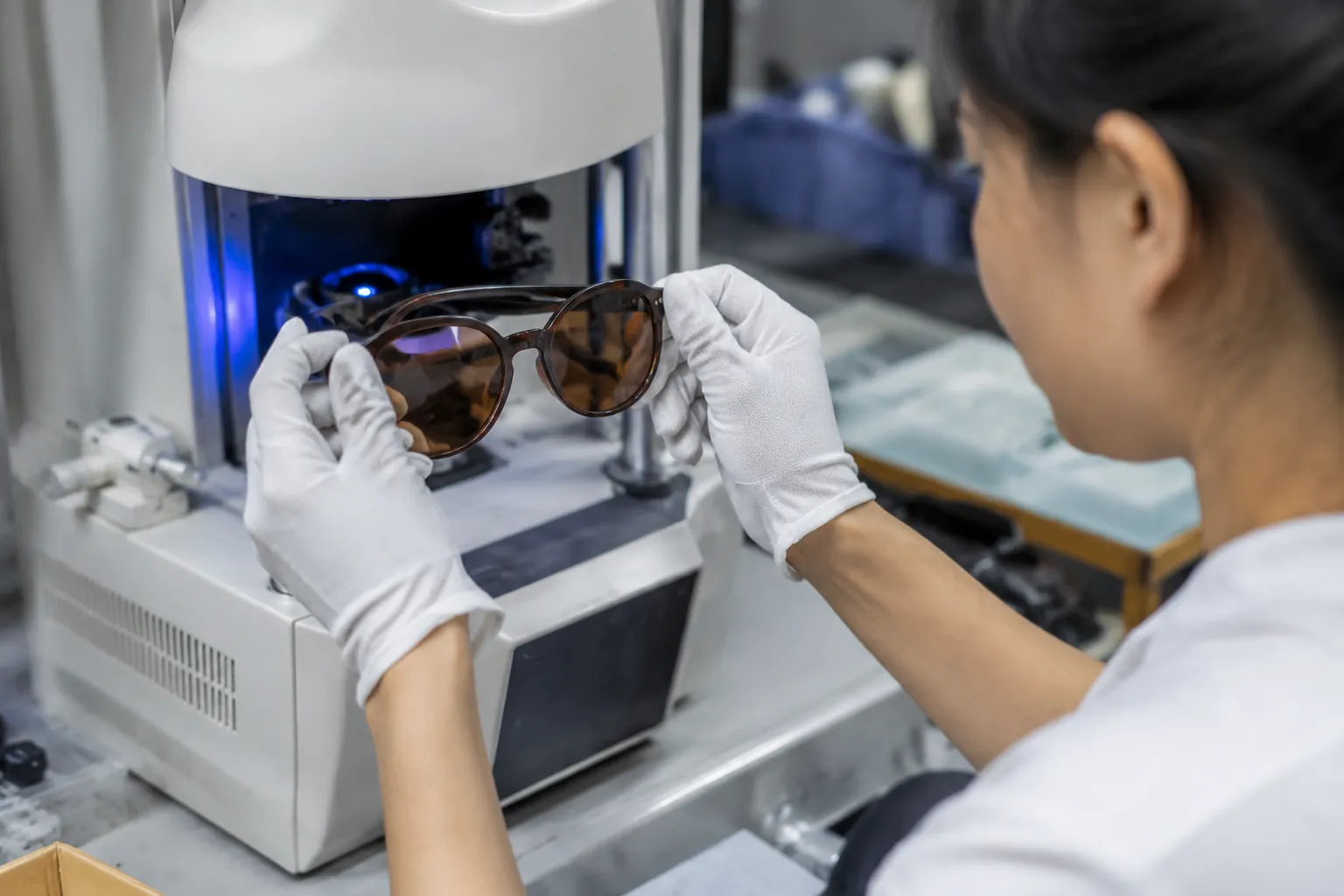
This guide is for overseas eyewear buyers ordering private-label or custom sunglasses and needing proof that finished lenses block ultraviolet radiation before shipment. It explains what to request from the factory, what an inspector can check, and where a third-party lab still matters. The goal is simple: verify the exact production lens, not the label.
Start With the Standard, Not the Sticker
UV400 on a hangtag, lens sticker, or temple print is a claim. It is not proof. The real question is whether the finished lens blocks UVA and UVB up to 400 nm under the standard that applies to the destination market and the exact lens variant being shipped.
For Europe, ask for testing to EN ISO 12312-1 and the related declaration of conformity where applicable. For the United States, ANSI Z80.3 is the usual product reference for non-prescription sunglasses, while FDA registration is a facility matter, not a product certification. For Australia and New Zealand, AS/NZS 1067 is the common benchmark. REACH is separate. It covers restricted substances in materials and components, not UV transmission.
Traceability matters more than marketing language. A report should identify the lens material, tint, coating, polarization type, and the exact sample tested. If the supplier cannot show that the tested lens matches the shipped lens, the report is weak.
If the design, lens material, coating stack, or tint recipe changes, treat the old report as stale until the new production lens is verified. No shortcuts here.
Documents Buyers Should Request Before Production Ends
Request documents early enough to fix a problem before cartons are sealed. If you wait until the shipment is ready, your choices narrow fast: delay, accept risk, or pay for rework.
- Current lens test report: It should name the exact lens material, tint, coating, polarization type, wavelength range, test method, test date, and lab or instrument used. A report that only says UV400 without specimen detail is too weak for serious buyer files.
- Variant linkage: The report should map to the exact SKU, lens color, mirror finish, gradient style, or polarized version ordered. One lens color does not automatically cover another.
- Declaration of conformity: For CE orders, request the declaration tied to the applicable product standard and the responsible manufacturer or exporter of record.
- Material compliance files: For EU programs, ask for REACH-related declarations covering frame resin, acetate, coatings, nose pads, and decorative parts.
- QC inspection record: The record should show lot number, inspection date, sampled quantity, UV result, visual defect checks, frame alignment checks, and the inspector's name or stamp.
Supplier quality-system evidence such as ISO 9001 and BSCI, if available, can help you judge process discipline. It does not replace product-specific UV testing.
For first orders, new lens recipes, or higher-risk retail programs, do not accept a generic UV400 summary without clear specimen identification and traceability. Ask for the details.
Compare the Main Verification Options
There is no single verification method that fits every order. A 500-pair fashion run, a 5,000-pair retail program, and a repeat order of a known bestseller do not carry the same risk. Match the method to the order value and channel risk.
| Method | What it proves | Best used for | Limitations |
|---|---|---|---|
| Factory UV spectrometer check | Screens the actual production lenses in-house against the target UV range | Repeat orders, routine QC, and lower-risk channels | Depends on calibration, operator discipline, and whether the sample is representative |
| Third-party lab report | Independent test data against EN ISO 12312-1, ANSI Z80.3, or AS/NZS 1067 | First orders, retail programs, import files, new lens constructions, and regulated channels | Adds cost and lead time; the tested lens must match the shipped lens exactly |
| Pre-shipment inspection with UV device | Checks randomly selected finished goods from packed or semi-packed cartons | Mixed SKUs, private-label launches, and lots where the buyer wants shipment-side screening | Portable meters are useful for screening, but not as detailed as a lab spectrophotometer |
| Retain sample comparison | Compares bulk goods with the approved sample for lens color, coating, marking, and general conformity | Custom logo programs, mirror or gradient orders, and repeat production | Only works if the approved sample was tested and archived correctly |
For many buyers, the most balanced setup is a factory UV check on every production lot plus third-party testing for the first order or any new lens recipe. That keeps cost under control and gives you defensible records if a retailer, customs broker, or marketplace asks questions later.
The more a design changes from the approved sample, the more you should prefer independent confirmation over internal screening alone.
How to Write a Sampling Instruction That Works
Vague instructions create vague inspections. "Check UV400" is too loose to be useful. State which SKU, which cartons, which lens sides to test, and what happens after a failure. Write it so an inspector can follow it without calling the buyer.
A practical instruction should say: select finished goods from multiple carton positions, cover every SKU and lens variant, test both lenses on each sampled pair, record the lot number and carton number, and hold the shipment if any tested unit fails or if traceability is incomplete. If you use an AQL scheme, define the AQL level and the accept/reject rules in the purchase order or inspection brief.
For mixed orders, sample by variant risk rather than only by quantity. Clear, tinted, gradient, mirror, polarized, kids', and adult versions do not always behave the same way in production. If the order includes several lens colors, pull all of them. If the order mixes matte and glossy finishes, inspect both. If the supplier uses different coating lines or lens sources, reflect that in the sample plan.
A shipping decision should be based on the exact mix leaving the factory, not on a generic statement that the order is compliant.
Lens Types That Need Extra Attention
Most UV failures are not dramatic. They come from substitution, batch drift, or assumptions. The frame looks fine, the sticker says UV400, and the problem sits inside the lens stack or coating process.
- Polycarbonate lenses: They often provide strong inherent UV attenuation, but the finished lens still needs verification because additives, tint, and coatings can vary.
- Acrylic and TAC lenses: These can perform well, especially in polarized constructions, but film quality, adhesive thickness, and lamination temperature matter.
- Gradient lenses: Test the lightest viewing area, not only the darkest top edge. The wearer looks through the lower portion too.
- Mirror lenses: Mirror finish is cosmetic; it does not prove UV protection. The base lens still needs validation.
- Kids' sunglasses: Treat them as higher scrutiny items because retailers and regulators often expect clearer documentation.
If the supplier controls tinting in-house, ask for lot records for resin batch, tint mix, press settings, and test result. That makes it easier to isolate whether a failure came from the lens recipe, the process settings, or a material substitution.
Material behavior matters too. Polycarbonate is impact-resistant and often UV-stable, but it can show optical strain if molded or cooled badly. TAC polarized lenses can look excellent but are more sensitive to lamination defects. Acetate frames pair well with premium fashion lenses, yet polishing residue and groove fit can affect final alignment and presentation. Check the lens chemistry and the frame process together.
What the Inspector Should Check Besides UV
A lens can pass UV testing and still fail as a sellable sunglass. Pre-shipment inspection should combine compliance checks with product-quality checks. Otherwise you may receive compliant scrap.
- Confirm model, lens color, frame color, logo method, barcode, pouch, and carton marks against the approved sample and purchase order.
- Check lens surface for scratches, coating pinholes, dust spots, bubbles, edge chips, and tint unevenness under consistent white light.
- Check optical distortion by moving the lens over a grid or straight-line target. Obvious waviness is a reject even if UV performance passes.
- Check frame alignment on a flat surface. Temples should open evenly, lenses should sit flush, and the frame should not rock heavily.
- Check hinge function, screw tightness, nose-pad fit, and metal logo plate placement if used.
- Check decoration durability for laser engraving, pad printing, hot stamping, or metal logo plates with the agreed rub or tape method.
Decoration deserves specific attention because it often sits at the edge of the production process. Pad printing can smear if curing is short or the ink formula is weak. Laser engraving can burn too deep on coated acetate. Hot stamping can lift at the edges after heat cycling. Metal badges can loosen if adhesive cure is rushed. None of these issues affect UV directly, but they do affect returns, retailer rejection, and brand perception.
For acetate sunglasses, watch polishing residue near hinges and lens grooves. For injection frames, check gate marks, flow lines, and warpage. CNC-milled parts need attention around sharp inside corners where stress marks can appear. These are factory-floor issues, not paperwork issues, and they should be part of the same pre-shipment checklist.
Set Clear Pass, Fail, and Hold Rules
Buyers should define release rules before inspection. If the rules are written after a problem appears, the discussion gets political fast. Clear thresholds make it easier for both sides to act quickly and avoid arguments.
Use three categories. Pass means sampled units meet the applicable UV requirement, labeling is correct, and documents match the shipment. Hold means the UV data is missing, the report does not match the lens variant, the sample set missed one or more SKUs, or lot traceability is incomplete. Fail means any tested production lens does not meet the agreed UV requirement, or there is a pattern suggesting substitution or uncontrolled production.
For a hold, ask the factory to separate stock by lot, color, and lens type, then run expanded sampling or confirm the result with a lab before release. For a fail, do not accept a discount as the first solution. Replacement lenses, rework, or cancellation may be the only sensible options if the shipped goods would carry the wrong UV claim.
Blunt rule: if the sunglasses are labeled UV400 but production testing cannot support that claim, do not ship them under your brand.
This is especially important for importers supplying retailers. A retailer may ask for reports months after delivery. Keep the purchase order, approved sample record, production report, inspection photos, carton labels, and compliance documents in one file per SKU so you can answer quickly when the question comes back.
A Practical Timeline for a New Custom Order
Good UV verification does not have to slow down a normal order. Build it into the schedule. The point is not more paperwork; it is placing checks where the production line can still fix the problem cheaply.
| Stage | Buyer action | Factory action | Timing |
|---|---|---|---|
| RFQ | State the target market and required standard: EN ISO 12312-1, ANSI Z80.3, AS/NZS 1067, REACH, or FDA-related documentation | Confirm available lens materials, MOQ, price tier, and existing report coverage | Before quotation approval |
| Sample | Approve frame, lens color, logo, packaging, and testing plan | Make the sample and test the actual lens variant | Before sample approval |
| Pre-production | Sign off the golden sample and define sampling rules | Lock lens source, bill of materials, and QC checkpoints | Before mass production |
| Bulk production | Request interim photos or records for higher-risk orders | Run molding, cutting, tinting, decoration, assembly, and in-line QC | During production |
| Pre-shipment | Review the test report, inspection record, packing list, and release decision | Provide lot records and hold any suspect stock for recheck | Before balance payment or shipment release |
A custom program uses lead time as a control point, not just a calendar. If you change lens type, coating, or packaging, review the compliance file again before goods are packed.
Volume does not replace verification. The bigger the order, the more important it is to keep the product file organized and the release criteria explicit.
Have a custom sunglasses project in mind?
Send us your styles, target market and quantities and we will return a detailed quote with MOQ, lead time and a sample plan.
Get a QuoteWhy source this from Wenzhou with LumiShades
Wenzhou in Zhejiang Province is widely regarded as China’s eyewear manufacturing capital, producing a large share of the world’s sunglasses. That concentration matters to buyers: a deep local supply chain for acetate sheet, hinges, lens blanks, plating and packaging means shorter component lead times, easier color and material matching, and a workforce with decades of eyewear-specific skill. LumiShades has manufactured in this ecosystem since 2009, and our vertical integration — in-house injection molding, acetate cutting, CNC milling, lens tinting, decoration and quality control — means no part of your order is quietly subcontracted to a workshop you cannot audit.
For international buyers, that vertical control translates into accountability. When a single factory owns every step, defects are traced and fixed at source rather than bounced between vendors, and your specifications survive intact from first sample to bulk. For procurement review, buyers can request process records, approved samples, quality checkpoints and project-specific compliance files before placing a bulk order. Required testing and documentation are confirmed against the destination market and product specification rather than assumed from a generic certificate list. Explore our manufacturing capabilities and quality control process to see how this works in practice.
Frequently asked questions
Is a UV400 sticker enough for customs or retailer review? No. Treat stickers and hangtags as claims, not evidence. Keep a product-specific test report, the applicable declaration of conformity where relevant, a production QC record, and a traceability file for each SKU and lens variant.
Should I test every lens color separately? Yes, unless a qualified test report explicitly covers the full set of variants and the construction is truly the same. In practice, treat each distinct material, color, coating, polarization, or gradient configuration as a separate variant until documented otherwise.
Can factory testing replace a third-party lab report? Factory testing can support internal release on repeat, low-risk orders, but it does not replace independent testing for first orders, new lens variants, retail programs, or regulated destinations. Use the factory result as screening and the lab result as the stronger record.
What should I do if one sampled pair fails UV testing before shipment? Stop release, quarantine the shipment by lot, color, and lens type, and expand sampling. Compare the failing unit against the approved sample and documents, then confirm the root cause before deciding on rework, replacement, or cancellation.
What compliance documents should the supplier be able to provide? At minimum, ask for the product test report to the applicable standard, the declaration of conformity where relevant, REACH declarations for materials, and evidence of supplier quality control such as ISO 9001 or BSCI if the supplier has them. FDA registration is a facility record, not proof that a particular lens passed UV testing.
Ready to start?
Explore our wayfarer sunglasses or request a quote — our sales team replies within 12 hours.
Request a Quote