
UV400 Sunglasses Claims: How Buyers Verify Them
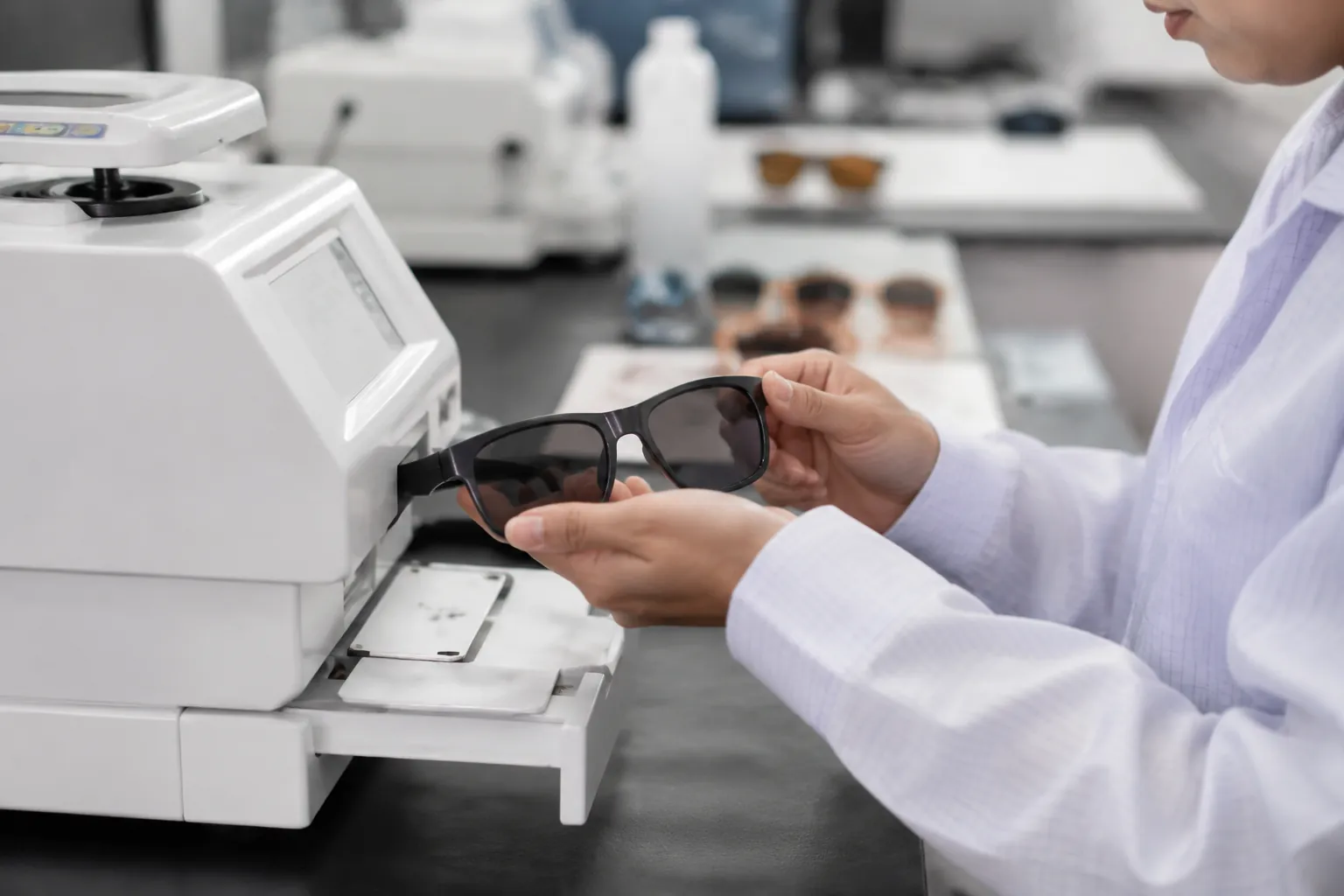
This guide is for importers, eyewear brands, distributors, and retailers buying custom sunglasses in volume. It explains how to make a UV400 claim verifiable before bulk production starts: which standards to name, which lens variables to control, what documents to collect, and what to write into the purchase order. The goal is simple: fewer rejected shipments, fewer relabeling problems, and less risk during customs, marketplace, or retailer compliance review.
Start With What UV400 Means
UV400 is a performance claim. It is not a style description.
In buying terms, UV400 means the lenses are intended to block ultraviolet radiation up to 400 nm, covering UVA and UVB. A dark lens does not automatically provide UV400 protection. A light smoke, yellow, pink, or almost clear lens can still provide UV protection if the lens material, additive, film, or coating is designed and verified for that purpose.
Procurement teams should treat UV400 as a controlled specification. Put it in the product specification sheet, approved sample record, purchase order, packaging artwork, and inspection checklist. If the claim appears only in a sales email or a generic catalog page, it is weak evidence.
The main buying risk is substitution. A buyer approves the frame shape and lens color, then assumes the lens supplier will handle UV protection. That is risky. UV performance can change with lens material, tint recipe, coating supplier, mirror process, polarized film, or replacement batches. Grey smoke PC, brown gradient PC, TAC polarized lenses, nylon lenses, and coated mirror lenses should not be treated as the same just because they fit the same frame.
For custom sunglasses programs, one frame may be ordered with several lens colors, finishes, and logo methods. Treat each lens construction as its own compliance item unless the test report or compliance rationale clearly covers the variation. The frame mold may be unchanged. The UV400 evidence must follow the actual lens supplied.
Match the Standard to the Market
Do not ask a supplier for "the UV certificate" without naming the destination market. Sunglasses requirements overlap, but test methods, user information, filter category language, markings, and accepted documentation differ by region. A report that satisfies one retailer may not satisfy another marketplace, customs broker, or compliance team.
| Market or Use | Common Requirement | Buyer Should Request | Practical Detail |
|---|---|---|---|
| European Union | EN ISO 12312-1 with CE marking where applicable | Product-relevant test report, filter category, user information, Declaration of Conformity support, and CE marking plan | CE is not just a logo. Technical documentation should match the sunglass model, lens construction, markings, and intended market. |
| United States | FDA registration/import expectations and ANSI Z80.3 commonly requested by buyers | FDA registration evidence where applicable plus ANSI Z80.3 report or equivalent evidence if required by the buyer or retailer | FDA registration does not prove UV400 performance. Retailers and marketplaces may require product-level test evidence. |
| Australia / New Zealand | AS/NZS 1067 | Report showing UV and visible light category compliance, plus correct category wording and warnings | Category wording and warnings matter. Do not use casual "fashion only" claims if the product is sold as sun-protective eyewear. |
| Chemical Safety | REACH or buyer restricted substance list | Material declaration or test report covering relevant materials such as frame, lenses, coatings, inks, nose pads, and metal parts | REACH evidence for the frame alone does not automatically cover printed logos, coatings, nose pads, or metal decorations. |
| Factory Qualification | ISO 9001, BSCI, buyer audit | Current certificates, scope, validity dates, and audit summary where available | Useful for supplier approval, but not proof that a specific sunglass lens meets UV400. |
Keep the scope clear. EN ISO 12312-1, ANSI Z80.3, AS/NZS 1067, REACH, FDA registration, ISO 9001, and BSCI can all be relevant, but they answer different questions. Product test reports support product performance. REACH supports chemical compliance for tested materials. FDA registration supports U.S. device or import documentation where applicable. ISO 9001 and BSCI support factory qualification. Do not use any document beyond its actual scope.
Control Lens Construction, Not Just Color
UV400 verification is easier when the approved lens construction is described in operational terms. "Brown lens" is not enough. A useful specification identifies material, thickness range where relevant, coating, polarization, filter category, visible light transmission category where required, and visual tolerance.
Common sunglasses lens materials behave differently. PC lenses are widely used for promotional, fashion, and sports-style sunglasses, but grade, additive, coating, and supplier all matter. TAC polarized lenses reduce glare and are popular for driving, fishing, and outdoor programs. But polarization is not UV protection. Nylon lenses are often used for performance eyewear because of optical quality and toughness. Acrylic lenses may be economical, but they should be validated carefully against the optical, UV, and impact-related requirements for the target market.
Set tolerances before production. Frame color may be approved against a Pantone reference or physical master sample. Lens color may be controlled by approved sample plus visual comparison under defined lighting. Logo position may be controlled within an agreed tolerance based on the decoration method. Lens fitting gaps should be checked after assembly, not only after cutting. If your retail channel has strict cosmetic criteria, define AQL levels and defect categories before the factory starts.
- Lens material: PC, TAC polarized, nylon, acrylic, or another specified material.
- Lens color and finish: smoke, brown, green, gradient, mirror, flash mirror, clear UV, or custom tint.
- Coating: UV coating, mirror coating, anti-scratch, anti-reflective, hydrophobic, or another coating if used.
- Optical claim: UV400, polarized, filter category, and visible light transmission range if required by the destination standard or retailer.
- Decoration link: confirm whether UV400 appears on the temple, lens sticker, hangtag, pouch, retail box, carton label, or online listing.
If the same frame may later be sold with more lens colors or in more markets, lock the lens construction at sampling. Record which evidence supports each variation. Clarifying the specification is cheap. Relabeling, retesting, or replacing a wrong lens batch is not.
Require Documents Before Sample Approval
Before approving bulk production, require documents tied to the exact sample or approved construction. Generic certificates can help at the RFQ stage, but they do not control a shipment. You need traceability. The factory, buyer, and inspector should all know which lens construction, markings, and packaging were approved.
The minimum approval package should include a product specification sheet, artwork proof, sealed reference samples, and UV evidence. For higher-risk retail programs, regulated markets, marketplace review, or first-time production, ask for third-party laboratory testing before shipment or before full production release. For lower-risk or repeat programs, a product-relevant prior report plus batch-level QC records may be acceptable if your compliance team and customer agree.
- Product specification sheet: frame material, hinge type, lens material, lens color, coating, polarization, filter category, logo method, packaging, and destination market.
- UV or sunglasses test report: issued by a qualified laboratory or supported by accepted internal QC records where appropriate. It should identify the tested lens type, test method, sample description, and applicable standard.
- Reference samples: two to four sealed approval samples marked with date, SKU, lens batch or sample code where available, and buyer approval.
- Bill of materials lock: not necessarily full supplier disclosure, but enough to prevent unapproved changes to lens material, coating, lens source, tint process, and decoration components.
- Artwork proof: UV400 claim, CE mark if applicable, filter category wording, warnings, barcode, country-of-origin label, retail box, pouch, and carton mark.
Use sampling to approve more than appearance. Approve the compliance route too. If your customer needs EN ISO 12312-1, ANSI Z80.3, AS/NZS 1067, REACH evidence, or FDA registration documentation, ask before the deposit, tooling release, or packaging print approval. Late compliance requests cause delays. They also create relabeling risk.
Watch for UV Drift During Production
UV failure is not always caused by fraud. Many failures come from loose process control. A lens supplier runs short and substitutes another base sheet. A tint bath is adjusted by eye to hit a darker color. A mirror coating vendor changes process parameters. A production team mixes two lens batches under one SKU because they look similar in normal light. The sunglasses may look right in a showroom photo while transmission data changes.
Higher-risk constructions include very light tints, fashion gradients, low-cost lenses with limited material traceability, bright mirror finishes, mixed lens colors under one SKU, and polarized TAC lenses bought from multiple sources. Polarization needs separate attention. A demo card can show glare reduction, but it does not prove UV400. Verify UV protection and polarization separately.
A practical factory control plan does not need to be complex. Assign a lens batch number before assembly. Record that batch against the sales order and SKU. Pull first-piece samples after lens cutting or fitting, not only after final packing. Check lens color, surface defects, fitting pressure, logo position, and UV transmission using calibrated equipment or an agreed laboratory route. Keep retain samples from the beginning, middle, and end of the run, especially where one order is packed under multiple SKUs or label sets.
Factory capability matters only if it creates records. Useful records include lens batch number, material or coating change approval, operator or line record, inspection date, UV measurement record where used, retained sample reference, and final packing confirmation. Without records, it is hard to prove that the shipped product matches the tested or approved construction.
Make Markings Match the Test Result
Many compliance problems appear after the lens has passed. The issue is often the claim printed on the product, packaging, or online listing. UV400 on a hangtag, CE on a temple, a filter category icon, and an e-commerce product page must not contradict the test report or destination market requirements.
Decoration method affects risk. Laser engraving is durable and clean on metal or some acetate surfaces, but a permanent "UV400" temple mark is risky if the same frame is later sold with different lens options. Pad printing is flexible and economical for logos, model codes, and simple claims, but ink adhesion and position should be checked after rubbing and packing. Metal logo plates can add chemical compliance issues, including restricted substances and nickel release depending on market and contact point. Lens stickers and hangtags are useful for variable claims, but the text must still match the lens construction.
| Decoration Method | Best Use | Control Point | UV400 Claim Risk |
|---|---|---|---|
| Laser engraving | Premium logo on temple or metal part | Position, depth, contrast, surface damage | High if UV400 is permanent and lens options vary |
| Pad printing | Brand logo, model code, simple claim | Ink adhesion, color match, agreed placement tolerance | Medium; easier to change than engraving but still can be wrong |
| Metal logo plate | Fashion or retail programs | Attachment strength, plating, restricted substances | Low for UV claim unless the claim is stamped or printed on the plate |
| Hangtag or label | Variable UV400, category, warnings, barcode | SKU match, wording, language, barcode scan | Lowest when lens options differ by SKU, provided the label is controlled |
For EU-bound sunglasses, plan CE marking, user information, and Declaration of Conformity support before mass packaging. For Australia and New Zealand, handle category wording under AS/NZS 1067 carefully. For the U.S., retailer compliance teams may ask for ANSI Z80.3 alignment and FDA registration evidence where applicable. Ask for pre-production photos of all markings. Then recheck final packed cartons before balance payment.
Plan Cost, MOQ, and Lead Time Early
Verification adds steps. It should not derail the schedule if planned from the start. The right verification level depends on destination market, sales channel, lens construction, claim language, and order risk. Confirm MOQ, sample timing, bulk lead time, testing timing, and document availability in the supplier's written quotation. Do not rely on assumptions from a previous project.
Not every order needs the same testing budget. Verification should match the market risk, sales channel, and claim. A small online run still needs accurate labeling if UV400 is advertised. A retailer or marketplace order usually needs stronger documentation, batch records, and pre-shipment evidence because the product may be reviewed before listing, during import, or after a customer complaint.
| Order Stage | Buyer Action | Timing | Risk if Skipped |
|---|---|---|---|
| RFQ | State destination market, lens type, UV400 claim, decoration, packaging, and required standard | Before quotation | Factory quotes the wrong lens, coating, test route, or label set |
| Sampling | Approve physical sample and request matching UV evidence | Before sample sign-off | Good-looking sample with weak compliance file |
| Pre-production | Confirm PO clauses, artwork, batch control, and sealed samples | Before deposit, tooling release, or bulk material purchase | Material or marking changes happen informally |
| Bulk production | Check first-piece lens batch, color, fitting, markings, and retain samples | During production | Failure discovered only after full packing |
| Pre-shipment | Collect reports, QC records, packing photos, and label proofs | Before balance payment and shipment booking | Shipment leaves with unresolved UV400 claim risk |
Do not save a small unit cost by removing the controlled lens specification if your sales page, hangtag, or retailer listing advertises UV400. If the claim helps sell the product, control it like a real product requirement.
Write UV400 Into the PO
Your purchase order should make UV400 measurable. Avoid vague phrases such as "good UV lens," "standard sunglasses quality," or "same as last time" unless the exact prior construction, test report, approved sample, and SKU are referenced. A procurement manager should be able to hand the PO to QC and know what to inspect.
- Define the claim: lenses must provide UV protection up to 400 nm and comply with the agreed market standard, such as EN ISO 12312-1, ANSI Z80.3, or AS/NZS 1067, where applicable.
- Lock the approved sample: bulk production must match the sealed approval sample for lens material, color, coating, filter category, markings, and packaging claims.
- Require notification: no change of lens supplier, material, coating, tint recipe, polarized film, mirror process, filter category, or claim wording without written buyer approval.
- Set document timing: test report, batch record, final artwork, packing photos, and retain sample confirmation must be provided before shipment booking or final payment.
- State remedy: nonconforming UV performance or incorrect claim marking allows rejection, rework, replacement, relabeling, retesting, or agreed credit before final payment release.
Example PO wording: "All lenses for SKU [insert SKU] shall meet UV400 performance and comply with [insert applicable standard] for the stated filter category. Bulk lenses must match the approved sample dated [insert date]. Supplier shall not change lens material, coating, tint process, polarized film, mirror process, lens source, filter category, or claim wording without written buyer approval. Product-relevant test evidence or agreed batch UV QC records, marking proofs, retain sample confirmation, and final packing photos are required before shipment."
Use this checklist before mass production or shipment release:
- Destination market and applicable standard confirmed.
- Lens material, color, coating, polarization, and filter category recorded.
- Approved samples sealed, dated, and linked to SKU codes.
- UV400 claim supported by product-relevant test report or agreed QC evidence.
- PO blocks unapproved changes to lens construction, source, process, and claim wording.
- Artwork checked for UV400, CE where applicable, warnings, barcode, category wording, and origin label.
- Batch records, retain samples, and final packing photos required before shipment.
For repeat orders, do not assume last season's report automatically covers the new run. If nothing changed, reference the prior construction, report, approved sample, and SKU, then require batch confirmation. If lens color, coating, material, supplier, process, or markings changed, treat it as a new compliance review.
Have a custom sunglasses project in mind?
Send us your styles, target market and quantities and we will return a detailed quote with MOQ, lead time and a sample plan.
Get a QuoteWhy source this from Wenzhou with LumiShades
Wenzhou in Zhejiang Province is widely regarded as China’s eyewear manufacturing capital, producing a large share of the world’s sunglasses. That concentration matters to buyers: a deep local supply chain for acetate sheet, hinges, lens blanks, plating and packaging means shorter component lead times, easier color and material matching, and a workforce with decades of eyewear-specific skill. LumiShades has manufactured in this ecosystem since 2009, and our vertical integration — in-house injection molding, acetate cutting, CNC milling, lens tinting, decoration and quality control — means no part of your order is quietly subcontracted to a workshop you cannot audit.
For international buyers, that vertical control translates into accountability. When a single factory owns every step, defects are traced and fixed at source rather than bounced between vendors, and your specifications survive intact from first sample to bulk. For procurement review, buyers can request process records, approved samples, quality checkpoints and project-specific compliance files before placing a bulk order. Required testing and documentation are confirmed against the destination market and product specification rather than assumed from a generic certificate list. Explore our manufacturing capabilities and quality control process to see how this works in practice.
Frequently asked questions
Is UV400 the same as polarized? No. UV400 refers to ultraviolet protection up to 400 nm. Polarization reduces glare from reflective surfaces. A lens can be polarized, non-polarized, UV400, or not UV400 depending on its construction. Ask for UV evidence separately from any polarization demo card or polarization claim.
Can one UV test report cover all lens colors in an order? Only if the report scope supports that conclusion. Check whether the report identifies the same lens material, coating, supplier, tint family, mirror finish, polarization structure, and filter category. If the order includes different materials, coatings, mirror treatments, very light tints, or multiple lens suppliers, request separate test evidence or batch-level QC records for each relevant construction.
Should UV400 be printed on the temple or only on the hangtag? Use permanent temple marking only if every lens option sold with that frame meets the UV400 claim and the claim is allowed for the destination market. If lens options vary by SKU, a SKU-specific hangtag, label, lens sticker, or packaging claim is easier to control. In all cases, the marking must match the test report, filter category, and approved artwork.
What should I ask for before paying the balance? Request the product-relevant test report or approved UV QC record, lens batch record, final packing photos, marking and label proofs, retain sample confirmation, and written confirmation that bulk production matches the approved sample. Also verify that carton labels, barcodes, country-of-origin labels, warnings, CE marking where applicable, and online listing claims match the approved documentation.
Does FDA registration prove the sunglasses are UV400? No. FDA registration supports U.S. supplier or device import documentation where applicable, but it does not prove the UV transmission performance of a specific sunglass lens. For UV400 performance, request product-relevant UV test evidence, ANSI Z80.3 evidence if required by your buyer, or agreed batch-level UV QC records.
Can small MOQ orders still require compliance documents? Yes. Order size does not remove the need for accurate claims. Even for small custom runs, confirm the destination market, applicable standard, approved lens construction, artwork, and claim wording. Full third-party testing depends on market risk, retailer rules, and whether the product will be sold publicly or scaled later, but the UV400 claim should still be documented.
Ready to start?
Explore our aviator sunglasses or request a quote — our sales team replies within 12 hours.
Request a Quote