
UV400 Sunglasses Sourcing: Specs, Tests, QC
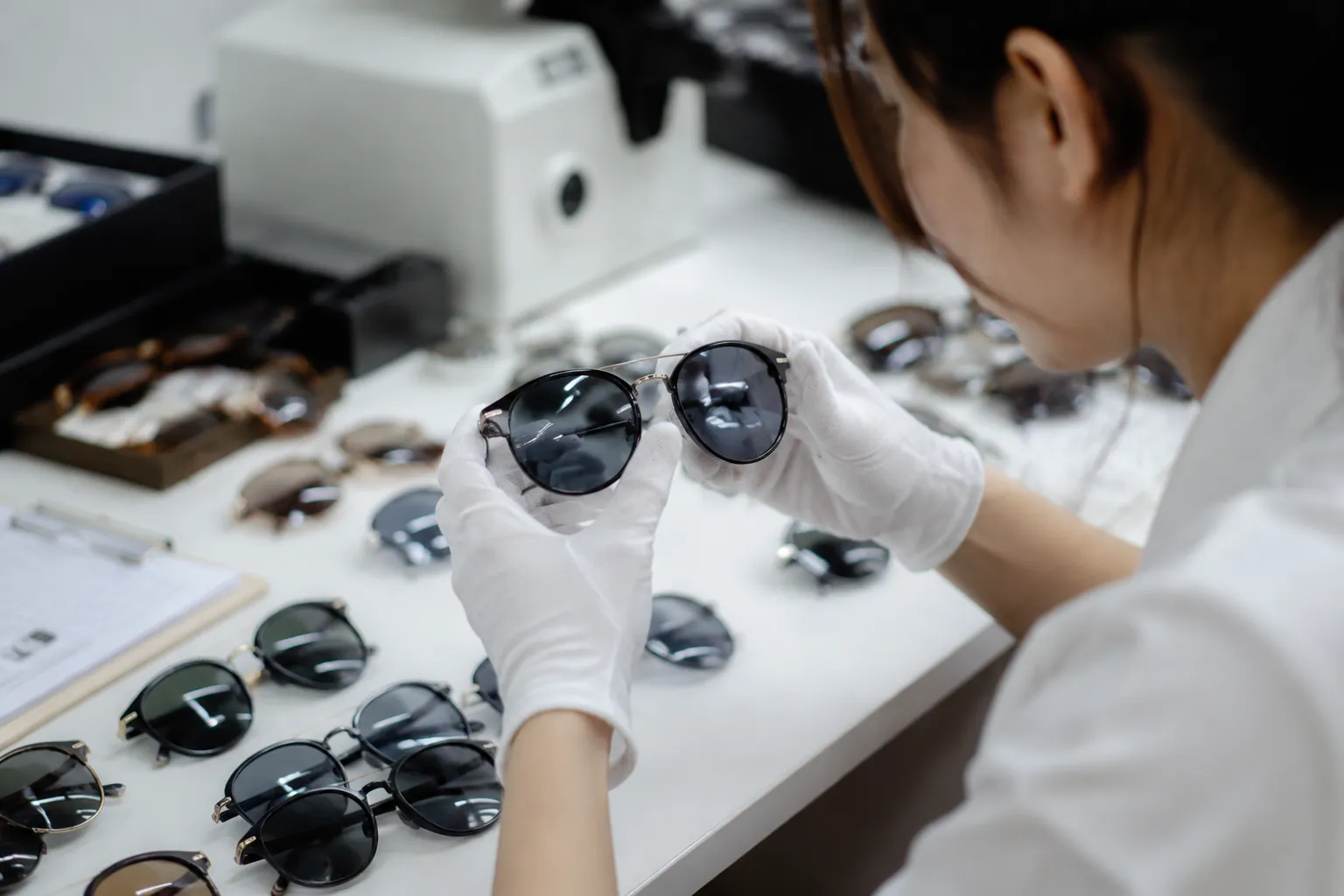
This guide is for brands, importers, distributors, and retailers buying custom sunglasses in volume. It shows how to turn a vague UV400 claim into a purchase specification, inspection plan, and document pack your compliance team can review. The aim is simple: fewer failed inspections, fewer relabeling jobs, fewer lens disputes, and fewer compliance problems after production has started.
Separate UV Protection from Lens Darkness
Many buyers still treat UV400 as a tint description. It is not. UV400 is a protection claim. It means the lens is intended to block ultraviolet radiation up to 400 nm, including UVA and UVB wavelengths.
Dark lenses are not automatically safe. A very dark smoke lens can still have weak UV protection if the material or coating is wrong. A nearly clear lens can provide UV protection if the substrate or UV absorber is suitable.
Do not write only UV400 lenses on a purchase order. That phrase is too broad for production, inspection, and compliance review. Use a measurable requirement instead: finished lenses shall provide ultraviolet protection up to 400 nm and shall comply with the applicable sunglass standard for the destination market after tinting, mirroring, polarization, hard coating, cutting, and assembly are complete. Then name the standard or regulatory requirement.
Also separate UV protection from visible light transmission. Lens category is about how much visible light passes through the lens, usually expressed as visible light transmission, or VLT. A category 3 sunglass lens transmits less visible light than a category 1 fashion tint. Both still need suitable UV performance if UV400 is claimed.
Gradient lenses need extra care. Transmission can vary from top to bottom, so category marking and consumer information must match the applicable market standard and the way the product is sold.
Common references include EN ISO 12312-1 for the EU, ANSI Z80.3 for the United States, AS/NZS 1067 for Australia and New Zealand, REACH for restricted substances in the EU, and FDA registration or listing where U.S. importers or retailers request it. ISO 9001 and BSCI are factory-level management or social-audit references. Useful, yes. Product tests, no. They do not replace sunglass compliance testing.
Buyer rule: UV400 is a protection claim. Lens category is a visible-light transmission claim. Treat them as separate line items in the specification, labeling, and test plan.
Write a Spec the Factory Can Build Against
A good UV400 sunglass specification does not need to be long. It does need to be exact. It should tell the factory what to mold, cut, tint, decorate, mark, inspect, and pack.
This matters most on mixed-SKU orders. The same frame may run with smoke, brown, green, gradient, mirrored, or TAC polarized lenses. If the spec is loose, production will fill in the gaps. That is where problems start.
- Frame material: PC injection, TR90, acetate, stainless steel, alloy, or mixed construction. State whether the finish is raw color, spray coating, rubber coating, pattern transfer, plating, or another approved finish.
- Lens material: PC, TAC polarized, nylon, CR39, or another approved material. State thickness or thickness range if it affects fit, weight, impact performance, or retailer requirements.
- UV requirement: UV400 protection up to 400 nm, verified on finished production-equivalent lenses. Do not rely only on raw sheet or unfinished lens testing if the bulk product will later be tinted, mirrored, polarized, hard coated, cut, or assembled.
- Visible light category: state the target category and acceptable VLT range under the destination standard. This is critical for EU and AS/NZS labeling and consumer information.
- Fit and assembly tolerances: define acceptable temple opening, hinge resistance, lens seating, screw security, bridge and nose-pad alignment, frame symmetry, and absence of sharp edges. Use approved samples and inspection photos to remove guesswork.
- Decoration: define logo method, size, position, color, and durability requirement. Pad printing, laser engraving, metal logo plates, hot stamping, and lens stickers all have different setup and inspection needs.
- Packaging: specify pouch, hard case, microfiber cloth, polybag warning, hangtag, user instructions, barcode, country of origin, carton marks, and retailer label placement.
Put these details into the tech pack before paying for production samples. If the first sample is only a style sample, label it that way. Do not use a style sample as compliance approval unless it was made with final production material, final lens color, final coating, final decoration process, and final packaging information.
Choose Materials and Processes by End Use
UV400 performance depends on material choice, lens treatment, and process control. Do not assume it from a sticker or catalog claim.
PC lenses are widely used for fashion, promotional, and sport-style sunglasses because they are light and impact resistant. But PC can scratch more easily without a suitable hard coat. Coating quality and handling matter.
TAC polarized lenses reduce certain reflected glare, such as glare from roads, water, or glass. They are common for driving, fishing, beach, and outdoor styles. Their risk is lamination quality. Inspect for bubbles, delamination, visible stress, and uneven polarization.
Frame material changes the production risk. Acetate has a premium hand feel and richer color options than many injection frames, but it needs cutting, tumbling, polishing, and manual fitting. TR90 is flexible and useful for active styles, but color matching and dimensional stability should be checked during sampling. Metal frames add plating, soldering, nose pads, screws, and corrosion-resistance concerns.
Decoration choices affect schedule and QC. Pad printing is economical for temple logos, but it needs artwork setup, fixture control, and ink-adhesion checks. Laser engraving is durable on suitable metal or coated parts, but contrast can shift by material and color. Metal logo plates can look better, but adhesive or mechanical fixing must be controlled. Lens stickers should remove cleanly without coating damage or residue. Mirrored lenses are unforgiving. Scratches and fingerprints show fast.
| Option | Best use | Process risk | Buying note |
|---|---|---|---|
| PC lens | Fashion, promo, low-MOQ programs | Scratching, coating inconsistency, tint variation | Specify coating expectations and approve the final tint sample |
| TAC polarized lens | Driving, fishing, outdoor retail | Film bubbles, delamination, uneven polarization | Test and inspect after lamination, cutting, and assembly |
| Mirror coating | Fashion drops and sport styles | Pinholes, scratches, color drift between batches | Use a signed master sample and inspect under consistent light |
| Gradient tint | Fashion and lifestyle sunglasses | Left-right mismatch, unclear category marking | Define top-to-bottom direction, VLT target, and acceptable shade range |
Match the Standard to the Sales Market
UV400 wording alone will not clear a compliance review. The sales market decides which standard, label, user information, and documents matter.
If one design will be sold in several regions, plan for that at the start. Build the document set for each destination, or separate SKUs, packaging, and instructions by market. One label rarely fits all markets.
| Market | Common compliance reference | What buyers should specify | Common sourcing mistake |
|---|---|---|---|
| European Union | CE marking supported by EN ISO 12312-1; REACH for restricted substances | UV protection, filter category, user information, Declaration of Conformity support, and restricted-substance documentation | Using a UV400 sticker without correct category marking, user information, or CE-related documentation |
| United States | ANSI Z80.3; FDA registration or listing where applicable or requested | UV transmittance, optical quality, impact-related requirements within the applicable scope, and importer or retailer document needs | Assuming FDA registration is the same as product approval or a complete optical test report |
| Australia/New Zealand | AS/NZS 1067 | Lens category, UV performance, consumer labeling, and warnings required by the applicable category | Shipping EU-style labels without checking AS/NZS category wording and warnings |
| Multi-country distributor | Market-specific combination | One master product spec with separate label, instruction, and document versions by destination | Using one hangtag and one carton label for all countries, then relabeling under time pressure |
Ask the supplier for current, legible copies of relevant certificates, registrations, and test reports before production starts. Buyers may request CE EN ISO 12312-1 documentation, ANSI Z80.3 test support, AS/NZS 1067 test support, REACH documentation, FDA registration or listing information, ISO 9001, and BSCI.
Be careful with changes. A new custom lens color, mirror coating, TAC polarized construction, or private-label SKU may still need product-specific or SKU-specific testing. A factory certificate helps qualify the supplier. It may not prove that a changed product construction complies.
Control UV400 Before Final Packing
By final packing, many expensive mistakes are already built into the goods. Final QC can catch defects and document errors. It cannot add UV protection to a nonconforming lens.
Control starts earlier: material selection, lens tinting, coating, curing, cutting, edging, pairing, and final assembly. Each step can affect the finished product.
For injection PC sunglasses, UV performance may come from the resin, lens additive, coating, or a combination. For TAC polarized lenses, the film stack, adhesive, cutting orientation, and heat exposure can affect final performance and appearance. For mirrored lenses, vacuum coating and handling control are critical because cosmetic defects can cause rejects even where UV transmittance is acceptable. For gradient lenses, inspectors must check both appearance and the claimed category because the lens is intentionally non-uniform.
Require practical traceability. The supplier should be able to identify the approved lens material, lens color, coating process, production batch, and inspection record for each SKU. If a gray sample passed but bulk lenses look warmer, lighter, or greener, start with batch records, tint records, coating lot information, and approved master samples. Do not guess.
- Approve signed master samples: keep one for each frame color, lens color, coating, and logo method.
- Lock material substitution rules: no change of lens sheet, resin, coating supplier, polarized film, or packaging text without written approval.
- Measure after final process: UV and visible-light checks should represent shipped goods, not unfinished lens blanks.
- Inspect left-right matching: pay special attention to gradient, mirror, brown, and green lenses where mismatch is easy to see.
- Check functional assembly: smooth hinges, secure screws, no lens rattle, no frame twist, no sharp edges, and stable nose pads where used.
Set the Test and Inspection Plan Early
A serious test plan does not need to be complex. It needs timing, sample definition, pass criteria, and responsibility. Agree on those points before the deposit.
For small runs near a supplier's minimum order quantity, buyers often use existing compliant frames and lens options. Then they request available test reports, internal QC records, and retained samples. For retail orders with multiple barcodes, colors, or packaging versions, pre-shipment inspection becomes more important. Label and carton errors can delay receiving even when the sunglasses are acceptable.
For higher-volume or regulated retail programs, plan third-party lab testing and SKU-level document control before production. Not after a retailer asks for missing reports.
- Sample stage: confirm frame fit, lens color, logo placement, packaging concept, and whether the sample is compliance-representative.
- Pre-production: approve the golden sample, final tech pack, UV400 wording, lens category, destination standard, label text, and document list.
- During production: check lens color, coating defects, hinge function, temple alignment, screw tightness, logo position, and carton label content.
- Final inspection: use AQL or another agreed sampling plan. Check cosmetics, assembly, markings, barcodes, packaging, carton marks, and retained samples.
- Lab testing: submit final-production lenses or finished sunglasses when product-specific reports are required. Do not test an earlier substitute and assume it covers bulk goods.
Lead time should include sampling, approvals, production, inspection, possible corrective action, sample dispatch to a laboratory, laboratory queue time, and report review. Production time is not the full compliance calendar. If a launch date is fixed, build the test plan backward from that date.
Plan Cost, MOQ, and Lead Time Realistically
UV400 protection itself is usually not the main cost driver when a factory is already using suitable sunglass-grade lens materials. Costs rise more clearly with polarization, mirror coating, custom lens colors, low-MOQ colorways, new molds, acetate construction, metal logo plates, premium cases, retailer-specific packaging, and third-party testing.
LumiShades' MOQ starts at 50 pairs per design. That can suit brand trials, influencer drops, distributor sampling, and small private-label programs. Still, quote against the final specification. Small orders do not remove setup work.
Pad printing one logo on a small run and printing it on a large run both require artwork checking, fixture alignment, ink testing, sample approval, and QC. The unit cost changes. The process steps do not disappear.
| Order size | Typical buyer goal | Spec recommendation | Main risk |
|---|---|---|---|
| 50 pairs/design | Market test or sales sample | Use existing compliant frame and lens options; keep packaging simple | Over-customizing and creating a unit cost that does not reflect future production |
| 300 pairs | Small retail launch | Lock UV400 claim, category, logo method, label text, and barcode before sample approval | Approving style only, then discovering compliance or labeling gaps late |
| 1000 pairs | Distributor or seasonal program | Add retained samples, stronger inspection, and SKU-level document control | Mixing lens colors or packaging versions without separate tracking |
| 5000+ pairs | Volume retail or import program | Consider SKU-specific lab testing and tighter carton documentation | A small label, barcode, or test-report error becomes a large inventory problem |
Confirm sample lead time, bulk lead time, and testing time in the quotation and purchase order. Custom acetate color, new mold work, special mirror lenses, unusual packaging, or retailer-specific manuals can add time. Rushed approvals often show up later as crooked logos, mismatched lenses, weak coating, wrong barcodes, incomplete instructions, or missing documents.
Build the Final Document Pack
Documents should match the actual product, not just the factory name. A clean UV400 order file normally includes the purchase order, final tech pack, approved sample photos, material and lens specification, applicable certificates or test reports, inspection report, packing list, commercial invoice, carton marks, and retained sample record.
For EU orders, buyers usually need CE-related support under EN ISO 12312-1 plus REACH documentation. For U.S. orders, ANSI Z80.3 relevance and FDA registration or listing information may be requested by importers or retailers. For Australia and New Zealand, AS/NZS 1067 documentation and correct consumer labeling are important.
Keep the links clear: SKU, lens color, frame color, production date, purchase order, and report reference. If the document trail breaks, the review gets harder.
Reject weak paperwork. A report for a black PC lens may not cover a new blue mirror TAC polarized lens. A certificate with no model, material, or standard reference may help with supplier qualification, but it may not satisfy a retailer's SKU compliance review. Altered, expired, or mismatched documents create legal and commercial risk.
- UV400 written as a measurable requirement: not just a sticker, website claim, or catalog phrase.
- Destination standard named: CE EN ISO 12312-1, ANSI Z80.3, AS/NZS 1067, REACH, or FDA-related requirement as applicable.
- Lens category confirmed: especially for EU and Australia/New Zealand labeling.
- Final lens material approved: PC, TAC polarized, nylon, CR39, or other agreed material.
- All treatments included in approval: tint, gradient, mirror, polarization, and hard coating.
- Logo method locked: pad print, laser engraving, hot stamp, or metal logo plate with approved size and position.
- Packaging checked: hangtag, user instruction, barcode, country of origin, polybag warning, carton marks.
- Test plan agreed: who tests, when testing happens, what samples are tested, and which standard applies.
- Document pack listed on the PO: do not rely on verbal promises or after-the-fact requests.
- Lead time includes testing buffer: factory production timing is not the same as a full compliance calendar.
If a supplier cannot answer these points clearly, pause the order. The lowest unit price does not matter if the sunglasses cannot be sold in the target market.
Have a custom sunglasses project in mind?
Send us your styles, target market and quantities and we will return a detailed quote with MOQ, lead time and a sample plan.
Get a QuoteWhy source this from Wenzhou with LumiShades
Wenzhou in Zhejiang Province is widely regarded as China’s eyewear manufacturing capital, producing a large share of the world’s sunglasses. That concentration matters to buyers: a deep local supply chain for acetate sheet, hinges, lens blanks, plating and packaging means shorter component lead times, easier color and material matching, and a workforce with decades of eyewear-specific skill. LumiShades has manufactured in this ecosystem since 2009, and our vertical integration — in-house injection molding, acetate cutting, CNC milling, lens tinting, decoration and quality control — means no part of your order is quietly subcontracted to a workshop you cannot audit.
For international buyers, that vertical control translates into accountability. When a single factory owns every step, defects are traced and fixed at source rather than bounced between vendors, and your specifications survive intact from first sample to bulk. For procurement review, buyers can request process records, approved samples, quality checkpoints and project-specific compliance files before placing a bulk order. Required testing and documentation are confirmed against the destination market and product specification rather than assumed from a generic certificate list. Explore our manufacturing capabilities and quality control process to see how this works in practice.
Frequently asked questions
Is UV400 the same as polarized? No. UV400 refers to ultraviolet protection up to 400 nm. Polarization reduces certain reflected glare, such as glare from water, roads, or glass. A lens can be UV400 without being polarized, and a polarized lens still needs UV testing. If you want both features, write both into the purchase spec: UV400 protection under the applicable market standard and polarized lens construction with an agreed inspection method.
Do I need a new test report for every lens color? Not always, but do not assume one report covers every variation. A new report is more likely to be needed when the lens material, tint, mirror coating, polarization film, coating stack, supplier, or manufacturing process changes. A gray PC lens report may not support a blue mirror TAC polarized SKU. For strict retailer programs, multi-country sales, or higher-volume imports, ask the test lab or compliance team to define which SKUs can be grouped and which require separate testing.
Can low-MOQ custom sunglasses still meet UV400 requirements? Yes. Low MOQ does not prevent UV400 compliance if the order uses proven lens materials, the supplier follows the approved specification, and testing or documentation is suitable for the sales market. For a 50-pair trial, the safer route is to use an existing compliant frame and lens option, keep decoration simple, and request available reports and retained samples. Avoid a new lens construction unless you have time and budget to verify it.
What should be printed on the product or packaging? Requirements depend on the destination market and lens category. Before production, confirm the UV claim wording, filter or lens category, user instructions, warnings, country of origin, barcode, model or SKU, carton marks, and any required compliance marks. Do not approve packaging artwork until the lens category and target market are confirmed. A label that works in one market may be incomplete or misleading in another.
Should testing be done on loose lenses or finished sunglasses? For the most useful compliance file, test final-production lenses or finished sunglasses after all relevant processes are complete: tinting, mirroring, polarization, hard coating, cutting, edging, assembly, and cleaning. Early raw-material tests can help qualify a material, but they may not represent the goods that ship. If loose lenses are tested, make sure they are production-equivalent and from the same material, coating, color, and process as the finished order.
Ready to start?
Explore our cat-eye sunglasses or request a quote — our sales team replies within 12 hours.
Request a Quote