
UV400 Sunglasses: Verify Protection Before Shipment
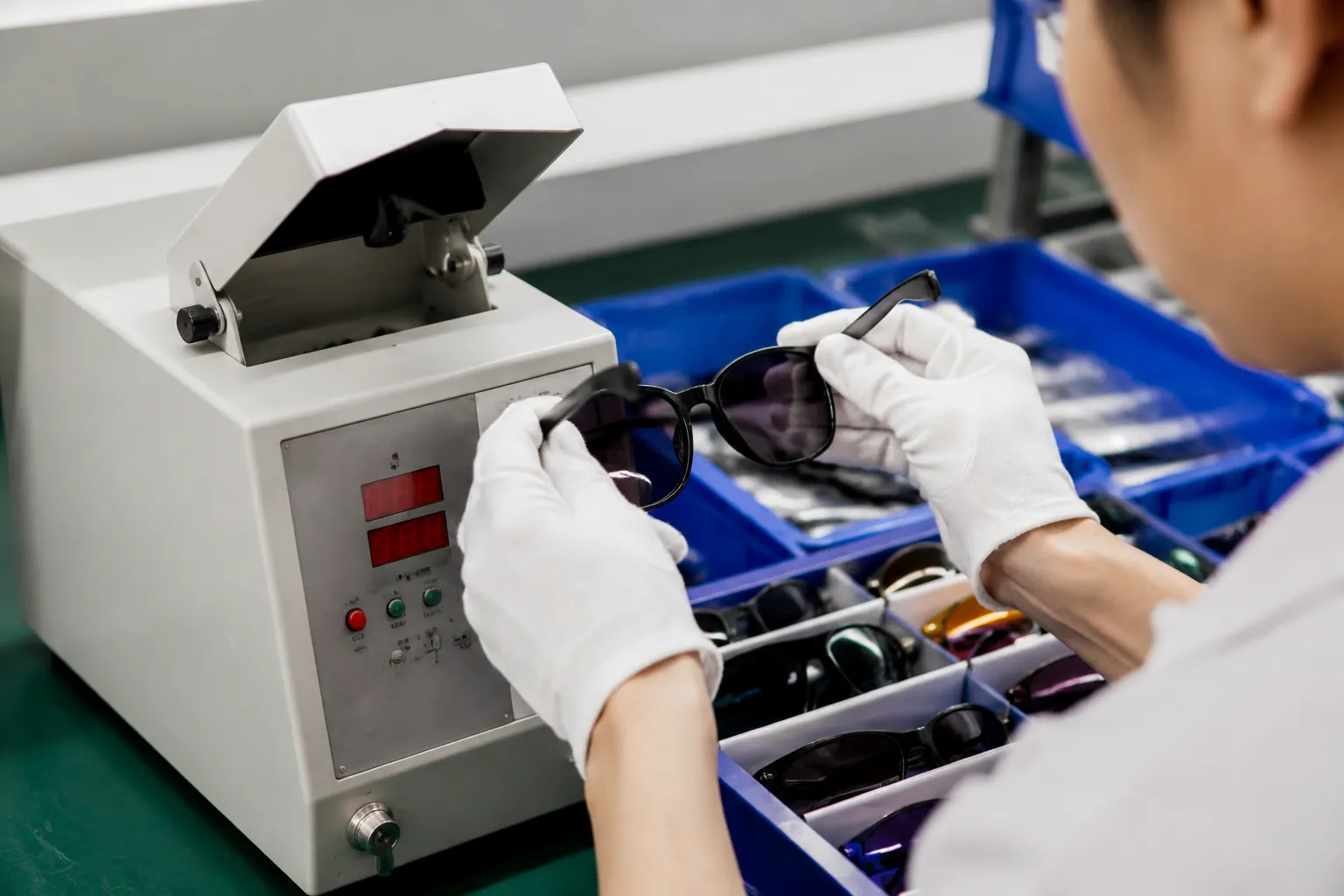
This guide is for brands, importers, distributors, promotional buyers, and retail sourcing teams ordering UV400 sunglasses from overseas factories. It explains how to verify UV protection before goods leave China, not after they reach your warehouse. Use it to tighten purchase orders, read test reports, prevent lens substitutions, and add practical inspection checks to the production schedule.
Define UV400 as a purchase-order requirement
UV400 is not a style term. It is a measurable lens claim. In sourcing terms, it should mean the finished lens blocks ultraviolet radiation up to 400 nm, covering the UVA and UVB range used for sunglasses verification.
Write the requirement into the purchase order, sample approval sheet, artwork file, packaging claim, and inspection checklist. Do not leave it to memory. Do not rely on a chat message.
A strong PO line is specific: "Finished lenses must comply with EN ISO 12312-1 for sunglasses and provide UV protection up to 400 nm. Approved lens: 1.1 mm smoke gray TAC polarized, category 3, silver mirror coating. Test evidence and pre-shipment UV checks required for this lens color and construction."
A weak PO line says only "UV lens," "anti-UV," or "UV protection." Those phrases are too loose. A black PC lens, brown TAC polarized lens, pink gradient lens, and mirrored fashion lens can all look acceptable in photos while performing differently in testing. Tint, coating, film lamination, resin supplier, and lens thickness can all affect the final result.
The key control point is sample lock. Before bulk production starts, the approved sample record should freeze the frame model, lens material, nominal lens thickness, base tint, coating, visible light transmittance category, decoration method, logo position, packaging claim, and target-market standard. Keep one retained sample with the buyer and one with the factory. Photos help. They are not enough.
Choose the right standard for the sales market
Different markets use different compliance language. A supplier may have several documents on file, but that does not mean every lens in your order is covered. Connect the standard, report, and label claim to the exact product being shipped.
| Sales market or control area | Relevant requirement | Buyer check before shipment |
|---|---|---|
| European Union | EN ISO 12312-1 and CE marking | Report should cover sunglasses, UV transmittance, visible light transmittance, filter category, and product labeling. CE claim must match the model and lens type. |
| United States | FDA registration where applicable and ANSI Z80.3 | Check supplier registration information and confirm the optical requirements are tested against the correct sunglass standard, not only an internal factory declaration. |
| Australia and New Zealand | AS/NZS 1067 | Confirm lens category, warning text, and labeling. Category mismatch is a common issue for fashion and very dark lenses. |
| Chemical compliance | REACH or market-specific restricted-substance rules | Not a UV test. It relates to materials such as frame plastics, paints, coatings, nose pads, metal parts, and printed inks. |
| Factory management | ISO 9001 and BSCI | Useful for process and social-compliance review, but they do not prove that a finished lens is UV400. |
Use only the certifications and registrations that apply to the order. A certificate for another model, another color, or another lens construction does not approve your shipment. Product identity matters most: the document must match the lens material, color, construction, and market requirement in your order.
Know how lens material and processing affect UV
UV protection comes from material selection and process control. Polycarbonate often has strong inherent UV-blocking properties, but performance still depends on resin grade, thickness, additives, and coatings. TAC polarized lenses use a layered structure, so the polarizing film, adhesive, dyed TAC layers, and hard coating must stay consistent. Nylon and specialty lenses can also perform well, but the resin grade and coating route should be documented.
Define the lens in production language, not only marketing language. Useful fields include material, nominal thickness, color code, coating type, polarization, visible light transmittance category, curve, and whether the lens is cut from sheet or injection molded. "1.1 mm TAC polarized, smoke gray, category 3, UV400, hard coat both sides" is clear. "Gray polarized UV lens" is not.
- PC injection lenses: Good impact resistance and efficient for volume production. Watch for resin substitutions and inconsistent tint batches.
- TAC polarized lenses: Common for retail and promotional sunglasses. Verify each color because dye and film-stack changes can affect optical results.
- Nylon lenses: Often used for higher-performance styles. Require stable resin grade and coating control.
- Gradient lenses: Check representative points because visible darkness changes across the lens, even if UV blocking remains consistent.
- Mirrored lenses: Approve both appearance and optical performance after coating. Do not approve mirror color by photo only.
For mixed-color orders, test more than one lens. A 300-pair order with smoke, brown, and pink lenses should have each color verified. On larger runs, the cost of checking each lens family is small compared with a failed import, retailer rejection, or customer complaint.
Read the UV test report before you approve bulk
Many failures start with a report that was filed but never read. A useful report should identify the tested sample, lens material, lens color, model or sample description, test standard, test date, laboratory name, and measured transmittance data. If the report only says "sunglasses passed," ask for detail before approving production.
Check the report against these points:
- Product match: The report should match your lens material and color. A black PC report does not automatically cover pink gradient TAC or blue mirror lenses.
- Standard match: EU orders should reference EN ISO 12312-1. US orders may need ANSI Z80.3 and FDA-related documentation. Australia and New Zealand orders should consider AS/NZS 1067.
- UV range: Confirm protection up to 400 nm, not only a vague "UVA/UVB" claim.
- Visible light transmittance: UV400 and lens darkness are different issues. A light fashion tint and a dark category 3 lens can both block UV, but labeling requirements may differ.
- Report age: Old reports are weaker if the factory has changed resin supplier, coating supplier, dye process, lens structure, or production site.
- Lab credibility: Prefer recognized third-party labs. If the factory uses internal equipment for production screening, ask for calibration records.
Also check whether the test covers finished lenses or only raw lens material. A raw sheet report is useful background. It may not prove the final cut, coated, mirrored, or assembled sunglasses. If the report cannot be matched to the approved production lens, treat it as reference only.
Control substitutions, decoration, and assembly
UV compliance can fail after sample approval if someone makes a small change. Common examples include changing TAC sheet supplier to meet price, using a different mirror coating, switching from category 3 to category 2 tint for appearance, or mixing leftover lenses from another order. Stop this in writing. The PO should state that lens material, color, coating, and supplier cannot change without written buyer approval.
Decoration also needs control because it changes production flow and inspection points. Common methods include injection molding, acetate cutting, CNC milling, lens tinting, laser engraving, pad printing, heat-transfer printing, and metal logo plate decoration. Each method has different risks. Pad printing on temples requires ink adhesion checks. Laser logos need position control and should not weaken thin parts. Metal logo plates require plating checks and glue or rivet checks. Lens engraving must sit outside critical vision areas and must not damage coatings.
Use practical tolerances in the approval file. Logo position can be controlled within a small tolerance on stable temple surfaces. Handmade acetate finishing may need a wider cosmetic tolerance. Lens color should be approved against a physical master sample under consistent lighting, not only by Pantone reference. For mirror coatings, approve the front appearance and backside comfort. Excessive reflection toward the eye can create complaints.
For MOQ planning, focus on process control instead of price promises. Smaller orders can be used for market tests. Larger orders require tighter material planning and decoration control. Lower unit price should never come from weakening the lens specification.
Build an inspection plan that catches real failures
A pre-shipment inspection should not focus only on scratches, hinge tension, logo alignment, and packaging. Those checks matter. But UV protection must be on the checklist.
Use two layers: factory in-process control and buyer-side final inspection.
- Incoming lens verification: Factory checks lens material, color, and supplier batch against the approved sample before assembly.
- First-piece check: After tinting, coating, cutting, or edging, the first finished lenses are checked for appearance, fit, and UV performance.
- Assembly patrol inspection: QC confirms the correct lens is fitted into the correct frame SKU, especially for multi-color orders.
- Finished-goods sampling: Random cartons are opened after packing. Inspectors check UV performance, lens category, hangtags, barcode, carton marks, and any UV400 claim.
- Hold-and-release rule: Shipment is not released until failures are sorted, reworked, replaced, and documented.
For small runs, test each lens color and retain the tested samples. For medium and large runs, test multiple finished pairs per color from different cartons. For higher-volume orders, use a written random sampling plan agreed before production. Do not negotiate the sampling method after a failure appears. Write the release rule into the purchase order.
If UV meters are used during inspection, record the device model, calibration status, date, tested SKUs, carton numbers, number of pieces tested, and results. If a random check fails, stop shipment. Pull more samples from several cartons. Compare them with the retained approved sample and isolate the affected lens batch. Likely causes include wrong lens material, mixed stock, coating error, or incorrect SKU packing.
Plan testing cost and timing into the schedule
UV verification is easiest when planned before the order is placed. Sample and bulk timelines vary by frame material, mold status, decoration, lens type, packaging, and quantity. A simple promotional style with one-color pad printing moves faster than a custom acetate frame with metal plates, gradient polarized lenses, and retail gift-box packaging.
| Order stage | Buyer action | Timing impact |
|---|---|---|
| RFQ and quotation | State sales market, UV400 requirement, lens material, lens color, decoration, packaging claim, and document needs. | No delay if included from the start. |
| Sample approval | Approve physical frame and lens. Record lens code, category, coating, and decoration method. | Usually fits within the normal sample window if the design is straightforward. |
| Pre-production | Freeze lens supplier, tint, coating, logo method, and carton labeling. | Prevents rework during bulk production. |
| Bulk production | Run first-piece and in-process checks for each lens color or lens family. | Usually no schedule impact if planned. |
| Pre-shipment | Open random cartons, run UV screening, check labels, and review the document pack. | Can delay shipment if failures require sorting, retesting, or replacement. |
If you wait until final packing day to request a new third-party report, shipment may slip. For repeat orders using the same approved frame and lens, the process is faster because baseline reports and retained samples already exist. For new colors, new coatings, or new markets, budget time for fresh verification.
Request the document pack before balance payment
Before paying the balance, request a document pack that matches your order. Do not accept a random folder of certificates. The pack should be clear enough for your compliance team, customs broker, retail customer, or marketplace reviewer to understand.
Request these items:
- Commercial invoice and packing list showing the correct SKU, model, quantity, country of origin, and carton count.
- Applicable compliance documents for the sales market: EN ISO 12312-1, ANSI Z80.3, AS/NZS 1067, FDA registration information, or REACH documentation as required.
- UV400 report or QC record tied to the approved lens material, construction, color, and coating.
- Pre-shipment inspection report showing sampling quantity, cartons opened, defects found, UV check results, and release decision.
- Photos of product labeling, hangtags, polybags, cartons, barcodes, warnings, and UV400 or lens-category claims.
- Approved sample record with order number, model, lens code, approval date, and buyer sign-off.
- Change-control record if any material, coating, logo method, or packaging claim changed after approval.
Do not pay the balance only because production photos look good. Sunglasses can look perfect and still contain the wrong lens. Physical samples, test evidence, inspection results, and packaging claims must agree. That is what protects the buyer before the goods leave the factory.
Have a custom sunglasses project in mind?
Send us your styles, target market and quantities and we will return a detailed quote with MOQ, lead time and a sample plan.
Get a QuoteWhy source this from Wenzhou with LumiShades
Wenzhou in Zhejiang Province is widely regarded as China’s eyewear manufacturing capital, producing a large share of the world’s sunglasses. That concentration matters to buyers: a deep local supply chain for acetate sheet, hinges, lens blanks, plating and packaging means shorter component lead times, easier color and material matching, and a workforce with decades of eyewear-specific skill. LumiShades has manufactured in this ecosystem since 2009, and our vertical integration — in-house injection molding, acetate cutting, CNC milling, lens tinting, decoration and quality control — means no part of your order is quietly subcontracted to a workshop you cannot audit.
For international buyers, that vertical control translates into accountability. When a single factory owns every step, defects are traced and fixed at source rather than bounced between vendors, and your specifications survive intact from first sample to bulk. For procurement review, buyers can request process records, approved samples, quality checkpoints and project-specific compliance files before placing a bulk order. Required testing and documentation are confirmed against the destination market and product specification rather than assumed from a generic certificate list. Explore our manufacturing capabilities and quality control process to see how this works in practice.
Frequently asked questions
Is UV400 the same as polarized? No. UV400 refers to ultraviolet blocking up to 400 nm. Polarized lenses reduce certain glare. A lens can be polarized without meeting a UV400 requirement, and a UV400 lens does not have to be polarized. Treat them as separate specifications and verify both if both are claimed.
Can one UV test report cover every lens color in my order? Only if the report clearly covers the same lens material, construction, tint family, coating, and production process. For mixed colors, gradient lenses, mirrored lenses, or polarized versions, ask the factory to confirm coverage in writing or test each lens family separately. The safest rule is simple: the report must match the exact lens you will ship.
Should I accept a factory declaration instead of a lab report? A factory declaration can support internal control, but it should not replace market-required evidence when compliance is part of the deal. For import, distributor, or retailer approval, ask for documentation tied to the relevant standard, such as EN ISO 12312-1, ANSI Z80.3, or AS/NZS 1067. Make sure the document identifies the correct product.
At what order size should I do pre-shipment UV checks? Do them on any order size if you claim UV400. For small runs, test each lens color. For medium runs, test multiple finished pairs from different cartons. For larger runs, use a written random sampling plan plus retained approved samples. Order size changes the sampling method, not the need to verify UV protection.
What is the most common UV400 sourcing mistake? Approving the frame, color, and logo while leaving the lens specification vague. The PO should freeze lens material, tint, coating, UV400 requirement, target-market standard, labeling, and documentation before bulk production starts. If those details are not written down, substitution risk rises.
What documents should I ask for before balance payment? Ask for the commercial invoice, packing list, applicable compliance documents, UV report or QC record tied to the approved lens, pre-shipment inspection report, product-label photos, approved sample record, and any change-control record. The pack should match the exact SKU and lens construction you ordered.
Can a lens be UV400 even if it looks light in color? Yes. UV protection and visible darkness are separate properties. A light lens can still block UV up to 400 nm if the material, dye, and coating are correct. Verify both the UV claim and the visible light transmittance category when the market requires it.
Which certifications are relevant for UV400 sunglasses? Use only the documents that apply to the product and market: CE EN ISO 12312-1, ANSI Z80.3, AS/NZS 1067, REACH, FDA registration where applicable, ISO 9001, and BSCI. ISO 9001 and BSCI help assess process and social compliance, but they do not prove UV400 performance by themselves.
Ready to start?
Explore our aviator sunglasses or request a quote — our sales team replies within 12 hours.
Request a Quote