
UV400 Sunglasses Claims: Importer Checks Before Production
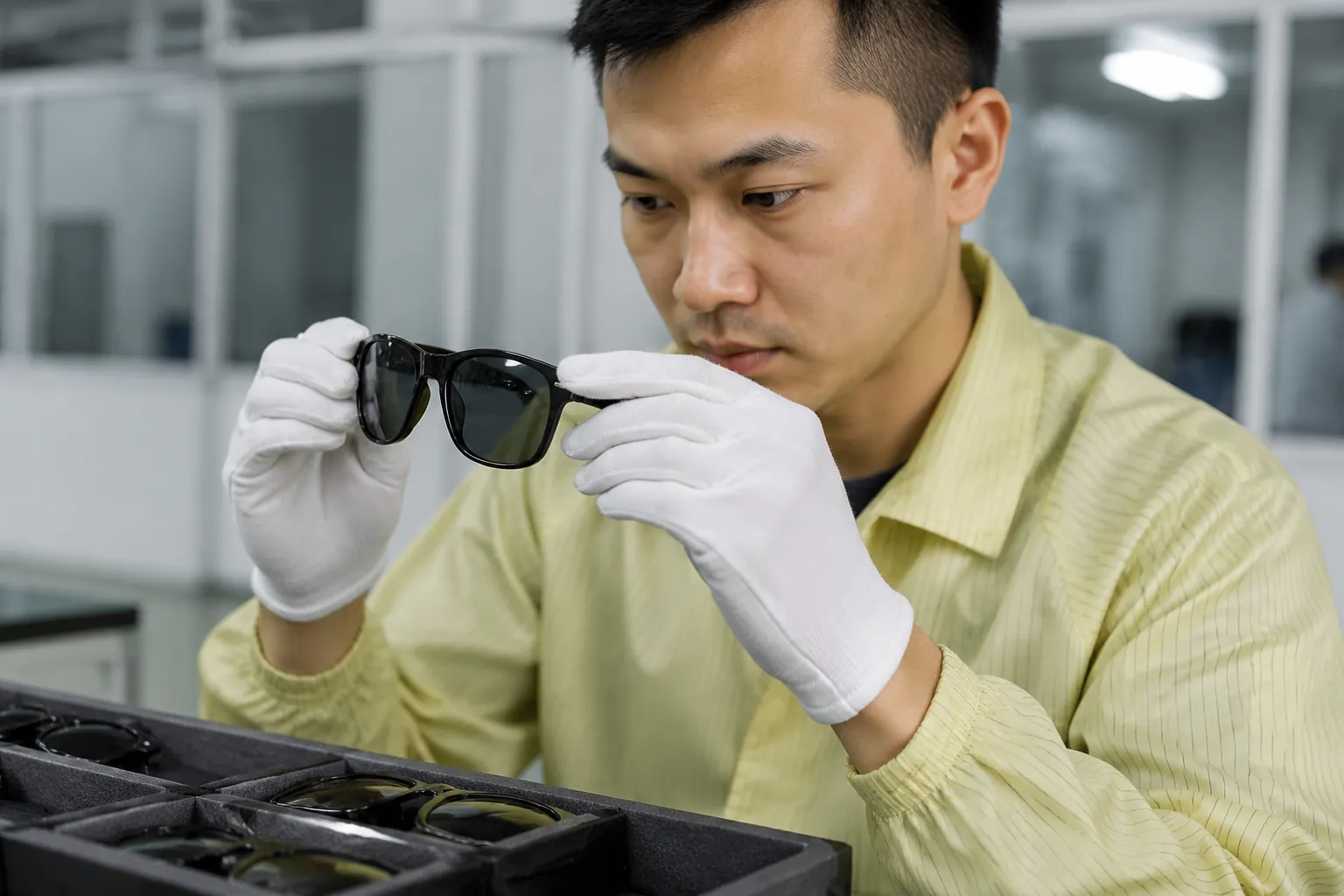
This guide is for overseas buyers who plan to use UV400 claims on sunglass lenses, temples, hang tags, packaging, product pages, invoices, or customs documents. UV400 is not just a sales phrase. It is a measurable performance claim, and it must match the lenses shipped. The aim is simple: avoid rejected shipments, false advertising risk, retailer disputes, and costly relabeling after production. Use this process to check standards, reports, lens specifications, samples, labels, tolerances, materials, and QC controls before releasing a custom sunglasses order.
The Risk Is the Claim, Not the Sticker
UV400 is commonly used to describe lenses designed to block ultraviolet radiation up to 400 nm, including UVA and UVB wavelengths. The risk starts when that claim appears anywhere: product page, hang tag, pouch, retail box, invoice, temple print, lens sticker, or distributor specification sheet. At that point, the importer has made a testable claim.
Retailers may ask for a report before listing. Market surveillance authorities may buy samples and test them. A distributor may request proof after a complaint. If UV400 is already printed on lenses, packaging, and sales materials, a failed or unsupported claim can trigger relabeling, repacking, shipment delay, product withdrawal, chargebacks, or lost sales channels.
The buyer must verify three things before bulk production: which standard applies, which lens was tested, and whether that tested lens matches the production order. A generic supplier statement such as "all lenses are UV400" is not enough for a private-label order unless it is backed by product-specific documents and production controls.
Small changes matter. A black smoke PC lens, a pale pink gradient TAC lens, and a silver mirror nylon lens can look similar in photos but differ in UV transmittance, visible light transmittance, optical quality, and labeling category. Treat UV400 as a technical requirement in the purchase order. Not as a sticker choice.
Standards and Documents by Destination Market
Different sales regions use different sunglass standards and compliance files. They may overlap on UV protection, visible light transmittance, optical quality, and labeling, but they are not interchangeable. The correct file depends on where the sunglasses will be sold and what claims appear on the product and packaging.
| Market or file type | Common document to request | What it normally covers | Buyer verification point |
|---|---|---|---|
| European Union | CE file with EN ISO 12312-1 test report and EU Declaration of Conformity where applicable | UV transmittance, visible light category, optical requirements, traffic signal recognition, labeling, warnings | Check the lens category, warnings, sample description, report scope, and whether the tested lens matches your ordered lens color and coating. |
| United States | ANSI Z80.3 documentation; FDA registration or listing information where applicable | Nonprescription sunglass performance, optical requirements, transmittance, and impact-related requirements under the cited standard | Do not use "FDA approved" unless you have a specific legal basis. FDA registration is not FDA approval. |
| Australia and New Zealand | AS/NZS 1067 documentation | Lens categories, UV protection, labeling, and driving suitability information | Confirm category and driving-suitability wording before printing packaging, especially for fashion tints and low-transmission lenses. |
| Chemical compliance | REACH documentation where required | Restricted substances in frames, nose pads, coatings, colorants, inks, and accessories | UV performance does not prove chemical compliance. Check chemical documents separately. |
| Factory control | ISO 9001, BSCI, and internal QC records | Quality management and social compliance systems | Useful for supplier qualification, but they do not prove that a specific lens in your order meets a UV400 claim. |
LumiShades can provide documentation for CE EN ISO 12312-1, ANSI Z80.3, AS/NZS 1067, REACH, FDA registration, ISO 9001, and BSCI where applicable to the product and order. Buyers should request current copies and connect each document to the ordered specification: frame material, lens material, lens color, visible light category, coating, decoration, packaging claim, and destination market.
The Report Must Match the Lens
Most UV400 claim risk sits in the lens, not the frame. One frame model may be sold with many lens options. A report for one lens does not automatically cover the others. This is especially important for pale fashion tints, gradients, yellow lenses, transparent colors, mirror coatings, polarized constructions, and low-cost substitutions.
Before paying a deposit or approving packaging artwork, request a lens-level specification. It should be clear enough for a third party to understand what was tested and what will be produced. At minimum, confirm:
- Lens material: PC, TAC, nylon, CR39, acrylic, or another specified material. Each material and construction can perform differently in processing and testing.
- Lens thickness and curve: confirm nominal thickness and base curve where relevant. High-wrap and sports styles need closer checks for optical distortion and lens seating.
- Lens color and tint: black smoke, grey, brown, green, pink, yellow, blue, clear fashion tint, gradient, mirror base, or another exact description.
- Visible light transmittance category: confirm the correct category before printing EU or AS/NZS labels. Category 0 or 1 fashion lenses are not the same as darker sun lenses.
- Coatings and layers: mirror, flash mirror, hard coating, polarized film, anti-reflective coating, printed lens artwork, hydrophobic coating, or other treatments.
- Report identification: SKU or model, internal model number, report number, lab name, issue date, sample description, and sample photos if included.
Use a hard rule: if the report says "black PC lens" and the order says "light pink gradient PC lens with silver mirror," do not treat that report as proof for the new order without further confirmation. The lens may pass. It still needs verification for UV transmittance, visible light category, and labeling. Buyers can request production-intent lens swatches or finished samples before bulk production.
Pre-Production Checks for Custom Orders
A fixed verification sequence prevents disputes after cartons are packed. Use it before deposit when possible. At the latest, complete it before lens tinting, coating, material cutting, and packaging print begin.
- Freeze the claim: Decide the exact wording, such as "UV400," "UVA/UVB protection," a lens category, a driving warning, or no visible UV claim. Do not let marketing copy change after artwork approval unless the compliance file is reviewed again.
- Confirm the destination market: Tell the supplier whether the goods are for the EU, United States, Australia/New Zealand, or multiple markets. Check multi-market packaging against each target market before printing.
- Select production-intent materials: Confirm frame material such as PC, acetate, TR90, recycled PC, stainless steel, or metal alloy. Confirm lens material, tint, coating, and category at the same time.
- Request matching documents: Ask for reports and compliance files relevant to the product, claim, and market. More certificates do not help if none match the actual lens and label.
- Approve physical samples: Use production-intent lenses and packaging, not old showroom samples. Ask whether the sample uses the same lens source, tint recipe, coating, and decoration process planned for production.
- Check artwork and markings: Verify UV400 wording, category, country of origin, SKU, warning text, barcode, pouch print, hang tag, and carton label before mass printing.
- Lock QC checkpoints: Define incoming lens inspection, color comparison, transmittance check where available, hinge and screw checks, logo placement tolerance, packaging inspection, and final inspection level.
- Keep a technical file: Store test reports, approved sample photos, artwork proofs, purchase order, batch records, retained samples, and inspection reports in one folder.
This sequence usually saves time. Buyers who approve lens color, UV claim, documents, and packaging together are far less likely to face emergency rework during production.
Factory-Floor Failure Points to Control
Unsupported UV400 claims usually come from undocumented changes. A supplier may not intend to create risk, but a change in lens source, material, tint recipe, or coating sequence can affect UV transmittance, visible light category, and labeling accuracy.
Lens substitution is the first risk. A cheaper smoke lens may look close to the approved sample but use a different material or UV absorber system. Visible darkness does not prove UV blocking. Require written approval before any change to lens material, tint, coating, supplier source, or polarized construction.
Gradient inconsistency is common in fashion eyewear. The top of a gradient lens may be dark while the lower area is much lighter. For gradients, ask how the finished lens is evaluated. Do not rely only on the darkest area.
Mirror coating assumptions cause avoidable mistakes. A mirror finish may reduce visible glare or change the look, but the base lens still needs verified UV performance. Mirror coating is not a substitute for a matching UV report.
Process variation can affect optical quality and consistency. Lens molding, tinting, coating, cutting, and assembly should be controlled so production lenses match the approved sample. For curved lenses, check left-right symmetry, lens seating, and distortion.
Decoration methods add another control point. Temple logos may use pad printing, silk screen printing, laser engraving, hot stamping, metal plaques, or epoxy badges. Lens marks may use printing or removable stickers. Agree on logo position, color, adhesion, and scratch resistance before production. Ink adhesion can be checked with agreed rub or tape-test methods before packing.
LumiShades handles injection molding, acetate cutting, CNC milling, lens tinting, decoration, assembly, and QC in-house. That helps trace where an issue came from, such as tinting, coating, assembly, or packaging. Buyers should still write UV claims, labeling rules, and change-control requirements directly into the purchase order. Written requirements beat verbal approval.
MOQ, Price, Lead Time, and Verification Trade-Offs
UV verification does not mean every reorder needs a new laboratory test. The decision depends on whether the lens material, coating, tint, supplier source, destination market, and claim are unchanged. Plan cost and schedule around specification risk, not only order quantity.
| Order scenario | Recommended buyer action | Typical lead-time impact | Risk if skipped |
|---|---|---|---|
| Repeat order, same lens, same packaging | Check existing report, retained sample, batch record, and PO clause against unauthorized changes | Usually limited if the specification is unchanged | Moderate if the lens source, tint, or coating changed without notice |
| New color on existing frame | Approve a production-intent lens swatch or full sample; confirm UV transmittance and visible light category | Sampling or testing may add time before production release | High for light tints, gradients, mirrors, yellow lenses, and pink lenses |
| New market using same product | Review EN ISO 12312-1, ANSI Z80.3, or AS/NZS 1067 requirements before artwork release | Document review may be quick; new testing may add time | High if category, driving suitability, warnings, or claim wording are wrong |
| Large private-label launch | Use a matching report, golden sample, final inspection plan, and retained samples | Plan verification before packaging print and production start | Very high because claims are public and packaging can be expensive to remake |
| Low-MOQ trial order | Use existing documented lens options and avoid strong claims unless the documentation matches | Minimal if using standard verified materials | Lower volume risk, but still real for online listings, customs questions, and retailer review |
LumiShades supports custom sunglasses programs at different order quantities, but buyers should confirm the current MOQ, sample schedule, unit price, and testing needs for the exact design. The cheapest lens option is not always the lowest-risk option. If it requires new testing, relabeling, repacking, or retailer reapproval, total landed cost can rise fast.
Document Checklist Before Bulk Production
Use a focused document pack. Do not collect random certificates just to fill a folder. Ask for documents that support the exact product, lens, market, and claim being shipped.
- Product specification sheet: frame material, lens material, thickness, tint, category, coating, dimensions, hinge type, decoration, packaging, SKU, and destination market.
- Applicable test reports: CE EN ISO 12312-1, ANSI Z80.3, AS/NZS 1067, and REACH as required. Check report number, lab name, sample description, date, and scope.
- FDA registration information: for the US import context where applicable, using accurate wording. Registration is not approval.
- Artwork proof: every UV400 claim, category mark, warning, barcode, country-of-origin mark, pouch logo, hang tag, and carton label shown exactly as printed.
- Golden sample record: approved sample photos, lens color reference, logo position, packaging proof, and signed approval date.
- QC plan: incoming lens check, in-process inspection after tinting or coating, assembly inspection, final inspection, packaging check, and retained samples.
- Purchase order clause: no change to lens material, tint, coating, category, supplier source, decoration, packaging claim, or destination-market labeling without written buyer approval.
For volume orders, keep retained samples from both pre-production and final shipment. If a distributor, retailer, or authority questions the UV400 claim later, a clean technical file lets the importer respond with documents, samples, and batch records. Not guesses.
Example: EU Retail Order With Brown Gradient Lenses
Consider a brand ordering custom acetate-style sunglasses for EU retail. The frame has a printed temple logo, brown gradient lenses, a microfiber pouch, and UV400 printed on the hang tag. The buyer wants the launch to pass retailer document review.
The risky path is to approve only the frame shape and logo, then request "standard UV400 lenses." That leaves gaps. What is the lens category? Does the gradient lens match the report? Does the warning text match the category? Is the EN ISO 12312-1 report tied to brown gradient lenses, or only to a black stock lens?
The controlled path is specific. First, the buyer sends the EU destination, claim wording, packaging layout, SKU list, and retailer requirements. LumiShades prepares a production-intent sample or lens swatch using the intended material, tint, and coating. The buyer checks fit, frame color, lens gradient, logo position, hinge feel, pouch print, hang tag wording, barcode, and country-of-origin marking. The compliance file is reviewed against CE EN ISO 12312-1 and REACH where required.
If the same style is later sold in the United States, the buyer should review ANSI Z80.3 documentation and FDA registration wording before US packaging or product pages are released. If it is later sold in Australia or New Zealand, AS/NZS 1067 labeling and driving-suitability wording should be checked before printing.
Only then should bulk production start. During production, QC should compare lens color against the golden sample, check logo placement, verify packaging claims, inspect assembly quality, and keep retained samples. This is basic discipline. It is also the difference between a controlled launch and inventory that cannot be confidently sold with the claimed UV protection.
Have a custom sunglasses project in mind?
Send us your styles, target market and quantities and we will return a detailed quote with MOQ, lead time and a sample plan.
Get a QuoteWhy source this from Wenzhou with LumiShades
Wenzhou in Zhejiang Province is widely regarded as China’s eyewear manufacturing capital, producing a large share of the world’s sunglasses. That concentration matters to buyers: a deep local supply chain for acetate sheet, hinges, lens blanks, plating and packaging means shorter component lead times, easier color and material matching, and a workforce with decades of eyewear-specific skill. LumiShades has manufactured in this ecosystem since 2009, and our vertical integration — in-house injection molding, acetate cutting, CNC milling, lens tinting, decoration and quality control — means no part of your order is quietly subcontracted to a workshop you cannot audit.
For international buyers, that vertical control translates into accountability. When a single factory owns every step, defects are traced and fixed at source rather than bounced between vendors, and your specifications survive intact from first sample to bulk. For procurement review, buyers can request process records, approved samples, quality checkpoints and project-specific compliance files before placing a bulk order. Required testing and documentation are confirmed against the destination market and product specification rather than assumed from a generic certificate list. Explore our manufacturing capabilities and quality control process to see how this works in practice.
Frequently asked questions
Is UV400 the same as polarized? No. UV400 is a UV protection claim related to ultraviolet blocking up to 400 nm. Polarization is a glare-reduction feature. A lens can be UV400 and not polarized, or polarized and still need UV verification. If you want both claims, request documentation for both UV performance and polarized lens construction.
Can one CE report cover all colors in my sunglass range? Not automatically. A report may support multiple options only if its scope clearly covers the same lens material, tint range, coating system, category, and construction. Do not assume that a black lens report covers pink, yellow, gradient, clear fashion, or mirror lenses. Ask the supplier to map each ordered lens SKU to the relevant report or confirm what additional testing is needed.
Should I print UV400 on every product to improve sales? Only print UV400 when the claim is supported by matching documentation and production controls. Before printing, confirm the lens material, tint, coating, report scope, and destination-market labeling. If evidence is incomplete, remove the claim from packaging and product pages until the actual lens is verified.
Does FDA registration mean my sunglasses are FDA approved? No. FDA registration is not FDA approval. Do not write "FDA approved" unless you have a specific legal basis for that wording. For US sales, use accurate wording, keep FDA registration or listing information where applicable, and maintain relevant performance documentation such as ANSI Z80.3 records.
What should I do before changing lens color after sample approval? Treat the change as a new specification. Ask the manufacturer to confirm whether the new lens color, tint density, gradient, mirror coating, or polarized layer affects UV transmittance, visible light category, driving suitability, and labeling. Do not print packaging or release bulk production until the revised lens is documented and approved.
How early should I request UV compliance documents? Request them before deposit or before material preparation whenever possible. At minimum, review documents before approving samples and packaging artwork. Printed UV400 claims, category marks, and warnings are expensive to correct after production starts.
What should be written in the purchase order for a UV400 sunglasses order? List the exact lens material, tint, coating, visible light category, UV claim, destination market, packaging wording, and required documents. Add a change-control clause stating that lens material, tint, coating, supplier source, category, decoration, and labeling cannot be changed without written buyer approval.
What is the most common buyer mistake with UV400 claims? The most common mistake is treating UV400 as a generic sticker instead of a lens-specific performance claim. Match the report to the actual production lens, approve production-intent samples, check packaging wording, and keep retained samples and inspection records for the shipment.
Ready to start?
Explore our wayfarer sunglasses or request a quote — our sales team replies within 12 hours.
Request a Quote