
UV400 Sunglasses: Specify, Test, Document
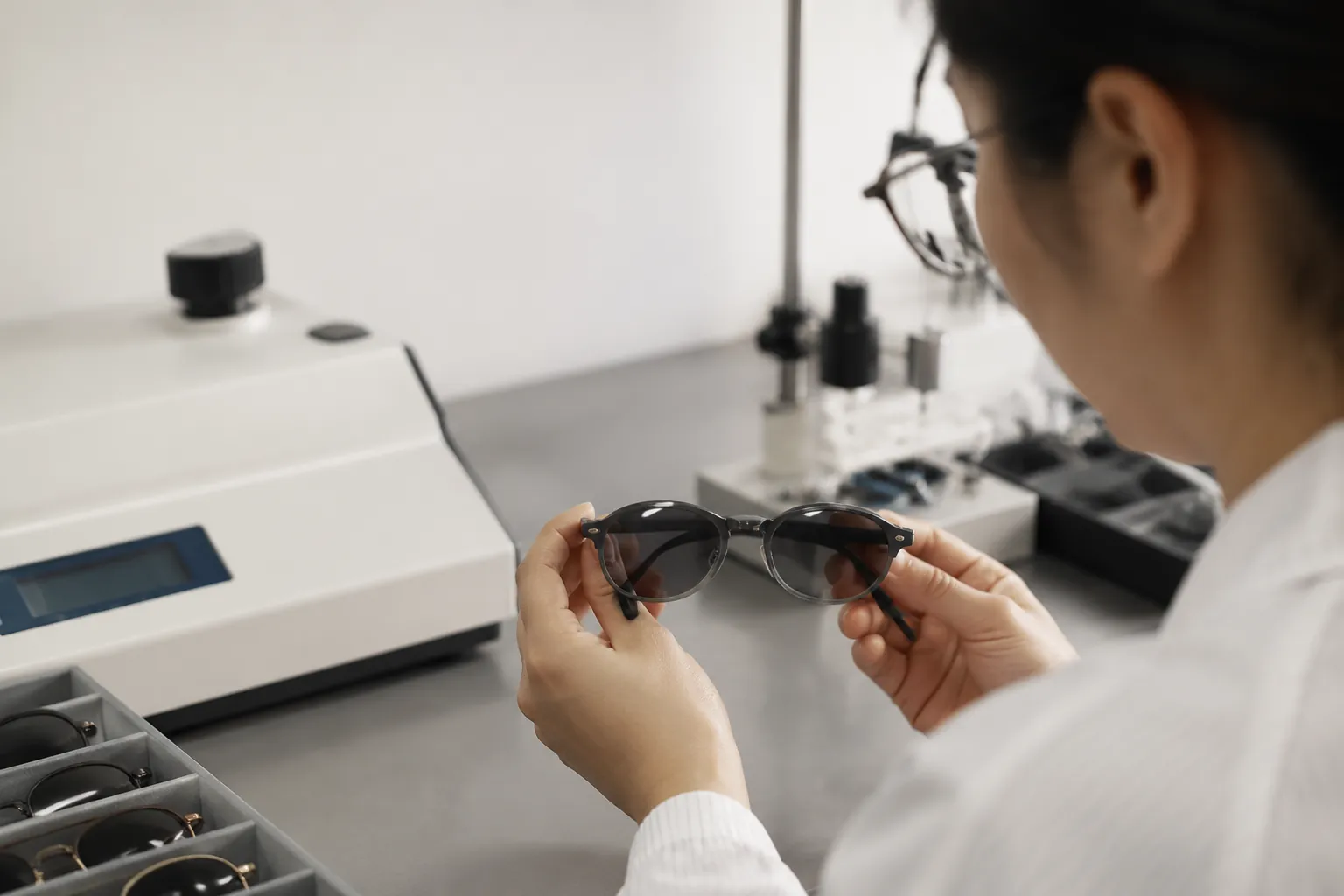
This guide is for importers, distributors, retail buyers, promotional-product companies, and eyewear brands that print UV400 on packaging, product pages, lens stickers, or hang tags. UV400 should not be treated as a loose sales phrase. It should become a purchasing requirement, a test plan, and a document file that a retailer, marketplace, customs broker, or compliance team can check. Lens darkness is not proof of UV protection. Performance depends on the lens material, UV absorber, film structure, tint process, coating stack, and whether the tested sample matches the shipped SKU. If the substrate, tint, coating, supplier, or construction changes, review the UV claim before goods leave the factory.
Define the UV400 Claim on the PO
UV400 is common in sales copy. Treat it as a technical requirement. In sourcing terms, UV400 means the sunglass lenses are intended to block ultraviolet radiation up to 400 nm, covering the UVA and UVB range. The pass criteria should be tied to the destination standard and product category, not to a catalog claim.
Put the requirement in three places: the purchase order, the approved product specification sheet, and the artwork approval file. A clear PO clause is: Final production lenses must provide UV400 protection and meet the ultraviolet transmittance requirements of the applicable sunglass standard for the destination market. Testing must be conducted on the final lens material, color, coating, and construction intended for shipment.
That last sentence matters. A black PC lens, brown TAC polarized lens, blue mirror lens, and clear fashion lens with UV treatment are not automatically equivalent. Same frame. Different compliance item.
For a custom LumiShades order, freeze the approved lens material, color code, UV additive or film source, visible light transmission category, coating stack, logo method, and packaging claim before bulk production starts. Identify the approved sample by SKU, lens code, artwork version, and destination market. Everyone should work from the same reference.
Use the Right Standard for the Market
Different markets expect different compliance references. The standards overlap, but the paperwork is not interchangeable. A European buyer may ask for CE documentation supported by EN ISO 12312-1. A U.S. distributor may ask for ANSI Z80.3 evidence. Australia and New Zealand commonly expect AS/NZS 1067. REACH is different. It is not a UV performance test. It addresses restricted substances in materials, coatings, inks, nose pads, metal components, and other relevant parts for the EU market.
| Market or buyer request | Document or standard to specify | Main compliance focus | Buyer action |
|---|---|---|---|
| European Union | EN ISO 12312-1, CE Declaration of Conformity, REACH as required | UV transmittance, visible light category, optical quality, labeling, restricted substances | Match the Declaration of Conformity to the model, lens category, and supporting test report. |
| United States | ANSI Z80.3 and FDA registration where applicable | Non-prescription sunglass optical and transmission requirements | Do not describe sunglasses as "FDA approved." Registration is not product approval. |
| Australia/New Zealand | AS/NZS 1067 | Lens category, UV transmission, visible light transmission, warnings, labeling | Ensure the printed category and warnings match the tested lens. |
| EU chemical compliance | REACH documentation or restricted-substance test data | Substances in acetate, PC, TR90, coatings, inks, metal trims, nose pads, and other relevant materials | Request material-level support when using plated logos, colored inks, soft nose pads, or coated parts. |
LumiShades can support recognized compliance documentation such as CE EN ISO 12312-1, ANSI Z80.3, AS/NZS 1067, REACH, FDA registration, ISO 9001, and BSCI where applicable to the product, order, and buyer requirement. Buyers should still confirm what their retailer, marketplace, importer of record, or local compliance adviser requires. Extra certificates can create problems if model numbers, lens categories, or report scopes do not match the shipment.
Write Lens Specs the Factory Can Build
A strong UV400 specification does more than say "UV400 lens." It tells production what to buy, mold, tint, coat, decorate, inspect, and pack. Many problems start when a buyer approves a compliant sample and later receives a bulk lens that looks similar but uses a different material, film, coating, or supplier.
- Lens material: PC, TAC polarized, nylon, CR-39, or another agreed material. Do not allow substitution without written approval.
- Lens construction: injected lens, cut lens, laminated polarized lens, gradient dyed lens, mirror-coated lens, photochromic lens, or clear UV lens.
- Color reference: use a lens color code, approved physical sample, measured visible light transmission range, or another controlled reference.
- Visible light transmission: specify the intended category or target VLT range. The tested result should drive the final label and warnings.
- UV requirement: UV400 performance compliant with the applicable destination standard on the final production lens.
- Coatings: mirror, hard coat, anti-scratch, oil-resistant, hydrophobic, or no coating. List the coating stack if order or structure affects performance.
- Polarization: yes or no, plus any required axis direction and consistency control if the product is sold as polarized.
- Decoration controls: laser mark, pad print, heat transfer, lens sticker, hang tag, pouch, and box wording must not create unsupported claims.
Material behavior matters. PC lenses are widely used for injection-molded sports, fashion, and promotional sunglasses; UV performance depends on the resin formulation, additives, and processing. TAC polarized lenses depend on the polarizing film and lamination structure. Change the film source and the compliance basis may change too. Nylon lenses are often used for curved or performance styles, but tinting and coating still need validation. CR-39 is known for optical clarity, but suitability depends on design, cost target, and processing route.
Dark tint is not proof. A dark gray lens can reduce visible light and still perform poorly in UV if the material lacks proper absorbers. A clear or pale yellow lens can meet a UV400 requirement if the material or coating is engineered correctly. For audits, use measured data. Not visual judgment.
Test the Exact Version You Will Ship
Prove UV claims during sample approval. Do not wait until bulk goods are packed. Third-party lab testing takes time for sample shipment, queueing, testing, and report review. Build it into the schedule.
- Freeze the frame material, lens material, tint, coating, logo method, packaging claim, destination market, and intended standard.
- Request pre-production samples made from the same lens process and supplier route intended for bulk production.
- Test at least one representative lens material and color. Add separate review for mirror, gradient, polarized, photochromic, clear UV, or other materially different lens versions.
- Review the lab report against the required standard, exact SKU description, lens category, and artwork wording.
- Approve bulk production only after the report, artwork, category marking, warnings, and carton labeling match.
Do not test a black lens and automatically apply the result to rose, yellow, blue mirror, smoke gradient, and polarized brown lenses. A grouped test plan may be reasonable when the substrate, UV additive, lens supplier, production method, and coating stack are the same and the variation is technically justified. It is weaker when the mirror coating, lamination film, photochromic treatment, dye process, or lens supplier changes.
Keep a golden sample. Mark it with the approval date, SKU, lens code, report number, artwork version, and packaging version. During production QC, compare bulk goods with that sample for color, lens category marking, coating appearance, lens fit, logo position, and hang tag wording. For larger or repeat orders, retain samples from the production run. If a complaint appears later, you need the shipment history.
Read UV Test Reports Without Guessing
A useful UV report connects the tested item to the product being purchased. A weak report says only "sunglasses lens" with no material, no color, no model number, no lens category, and no clear standard. That may help a sales call. It is poor evidence for a retailer audit or technical file.
Before accepting a report, check these details:
- Applicant and manufacturer: names should match the supplier chain or be explainable in writing.
- Sample description: model number, lens color, material, coating, and category should match the SKU or clearly defined product family.
- Standard cited: EN ISO 12312-1, ANSI Z80.3, or AS/NZS 1067 as required by the market or buyer.
- Measured items: ultraviolet transmittance, visible light transmittance, optical power, prism imbalance, traffic signal recognition, labeling, or other items required by the cited standard and product type.
- Numeric results: pass/fail is useful, but numeric transmission data is stronger for technical files, repeat orders, and future production checks.
- Report date and sample basis: older reports may be useful only if the lens material, supplier, resin, film, tint, coating, and production method have not changed.
For CE programs, the test report should support the Declaration of Conformity and match the model or product family named in that declaration. For U.S. buyers, keep ANSI Z80.3 test evidence separate from FDA registration documents. FDA registration does not prove that a specific sunglass shipment meets optical performance requirements.
If a report covers a product family, ask for the grouping rationale. Acceptable logic may include same lens material, same UV additive or film, same supplier, same production method, same coating stack, and controlled tint variation. "Same frame shape" is not enough. "Same factory" is not enough either.
Control Production Changes Before They Break the Claim
UV performance can become unsupported when procurement substitutes lenses, tinting parameters shift, coating suppliers change, or packaging claims are copied across SKUs. The risk rises when sample approval, purchasing, production, printing, and packing teams use different versions of the specification.
| Control point | What to check | Typical failure | Buyer control |
|---|---|---|---|
| Incoming lens material | Material grade, supplier batch, film source, UV additive package | Substitute lens used after sample approval | Require batch records tied to SKU and PO. |
| Tinting process | Color code, tint bath, time, temperature, gradient position | Color looks close but VLT category changes | Approve measured VLT range and golden sample. |
| Coating process | Mirror layer, hard coat, anti-scratch coating, hydrophobic layer | Coating stack changes UV or visible transmission | Freeze coating stack and review or retest if changed. |
| Decoration | Pad print, laser engraving, lens sticker, heat transfer, metal logo plate | Decoration damages coating or creates unsupported claims | Approve decorated sample, not blank frame only. |
| Final packing | Hang tag, pouch, box, carton marks, category label | UV400, polarized, category, or warning claim applied to wrong SKU | Use SKU-level packing checklist with photos. |
Where LumiShades manages lens sourcing, decoration, packing, and QC for a custom program, buyers should still define the inspection logic in writing. Practical controls include incoming material confirmation, in-process visual checks, AQL final inspection where appropriate, SKU-level packing checks, and retained samples. Retention matters for repeat orders, multiple lens colors, retailer programs, and any shipment where packaging carries a UV400, polarized, category, or performance claim.
Quote MOQ, Price, and Lead Time Against the Spec
UV400 compliance is rarely only a unit-price issue. The costly mistakes usually come from ambiguity: testing the wrong lens, changing materials after approval, applying one report to unrelated SKUs, or discovering after packing that the packaging claim is unsupported.
Minimum order quantity, price, and lead time should be quoted against a locked specification. The quote should state the frame material, lens material, lens type, coating, logo method, packaging, inspection requirement, and compliance documents included. Do not compare a TAC polarized lens, mirror lens, photochromic lens, or category-specific retail hang tag with a plain injected PC lens in generic packing. They are not the same product.
Ask the supplier to separate one-time costs, sample costs, testing costs, decoration setup, packaging costs, and bulk unit price where relevant. This makes quotes easier to compare. It also prevents a low initial price from excluding the documentation or inspection work required for the destination market.
Plan around approval gates, not optimistic ship dates. A safer timeline includes sample production, artwork review, lab testing if required, report review, final specification approval, bulk production, final inspection, document pack review, and shipping. If mold development, custom acetate patterns, special metal trims, complex packaging, or retailer-specific labeling are involved, add time before committing to delivery.
Build the Document Pack Before Shipping
Fix paperwork before cartons leave. Once goods are in transit, missing or mismatched documents can trigger urgent emails, retailer delays, customs-broker questions, storage costs, or relabeling. For every UV400 shipment, the document pack should connect the purchase order, product specification, lab report, production batch, and carton labels.
A practical shipment file includes:
- Approved product specification sheet listing lens material, color, coating, UV400 requirement, intended standard, and destination market.
- Final artwork files showing UV400 wording, category marking, warnings, retailer language, and SKU references.
- Relevant test report: EN ISO 12312-1, ANSI Z80.3, or AS/NZS 1067 depending on the destination market and buyer requirement.
- REACH support for EU programs when restricted-substance evidence is part of the buyer checklist.
- Declaration of Conformity for CE programs, tied to the correct model or justified product family.
- Factory QC report with batch numbers where available, inspection date, inspected quantity, defect summary, and disposition.
- Packing list and carton marks that match SKU, quantity, lens category, destination, and buyer references.
- Golden sample record or retained-sample photos for future complaint handling.
Do not let packaging create a new claim that was never tested or otherwise supported. "UV400," "polarized," "category 3," "blue light blocking," "anti-scratch," and "impact resistant" are separate claims. They may require different evidence depending on the market and buyer. If the approved lens is UV400 but not polarized, the hang tag must not say polarized. If the tested lens is category 2, do not print category 3 because the color looks dark. Keep the rule simple: one SKU, one locked lens spec, one matching evidence file, and one matching packaging claim.
Have a custom sunglasses project in mind?
Send us your styles, target market and quantities and we will return a detailed quote with MOQ, lead time and a sample plan.
Get a QuoteWhy source this from Wenzhou with LumiShades
Wenzhou in Zhejiang Province is widely regarded as China’s eyewear manufacturing capital, producing a large share of the world’s sunglasses. That concentration matters to buyers: a deep local supply chain for acetate sheet, hinges, lens blanks, plating and packaging means shorter component lead times, easier color and material matching, and a workforce with decades of eyewear-specific skill. LumiShades has manufactured in this ecosystem since 2009, and our vertical integration — in-house injection molding, acetate cutting, CNC milling, lens tinting, decoration and quality control — means no part of your order is quietly subcontracted to a workshop you cannot audit.
For international buyers, that vertical control translates into accountability. When a single factory owns every step, defects are traced and fixed at source rather than bounced between vendors, and your specifications survive intact from first sample to bulk. For procurement review, buyers can request process records, approved samples, quality checkpoints and project-specific compliance files before placing a bulk order. Required testing and documentation are confirmed against the destination market and product specification rather than assumed from a generic certificate list. Explore our manufacturing capabilities and quality control process to see how this works in practice.
Frequently asked questions
Can one UV400 test report cover several sunglass colors? Sometimes, but do not assume it. Ask the supplier or lab to explain the grouping basis in writing. A shared report is more defensible when the lenses use the same material, same UV additive or UV-blocking film, same supplier, same production method, same coating stack, and controlled tint variation. Treat mirror, gradient, polarized, photochromic, clear UV, and supplier-changed lenses as separate review items unless a technical justification says otherwise.
Is FDA registration the same as FDA approval for sunglasses? No. FDA registration is not product approval and should not be described as "FDA approved." For U.S. non-prescription sunglasses, keep ANSI Z80.3 test evidence for the specific SKU or a technically justified product family. If a supplier provides FDA registration, file it separately from the product performance report and make sure marketing copy does not imply FDA endorsement.
What should I ask the factory before printing UV400 on packaging? Ask for the lens material, lens color code, coating stack, lens supplier or batch control method, applicable standard, and UV400 test report. Confirm that the tested lens matches the production lens and that the report scope covers the SKU or product family you are ordering. Approve the final packaging artwork only after the UV400 wording, lens category, warnings, and SKU references match the specification and test evidence.
Do dark lenses always provide better UV protection? No. Lens darkness relates mainly to visible light transmission, not UV blocking. A clear or light-colored lens can provide UV400 protection if the material or coating is designed for it. A dark lens can still fail if it lacks proper UV absorbers or if the coating and film structure are not suitable. Use lab data and the applicable standard, not visual darkness, to support the claim.
How early should lab testing be arranged for a custom sunglasses order? Arrange testing during sample approval, before bulk production. Send the lab the final lens material, color, coating, and construction intended for shipment. Do not wait until goods are packed. A failed or mismatched result may require retesting, relabeling, lens replacement, or order delay. Build time into the schedule for sample preparation, shipment to the lab, testing, report review, and corrective action.
Ready to start?
Explore our square sunglasses or request a quote — our sales team replies within 12 hours.
Request a Quote