
UV400 Sunglasses Testing Before Bulk Shipment
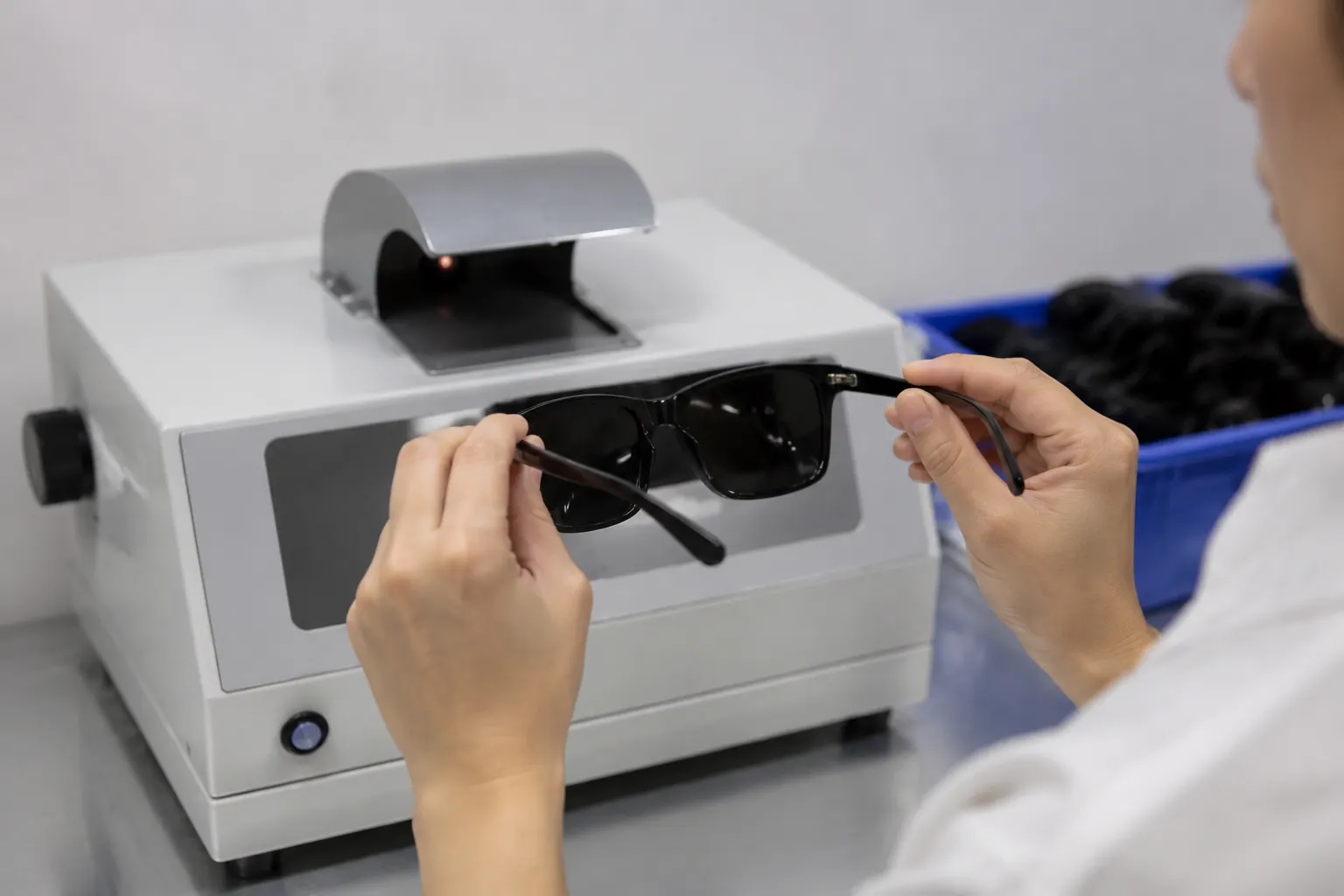
This guide is for brands, importers, distributors, and retailers buying custom sunglasses in volume. It explains how to verify UV400 protection before bulk shipment, not after cartons reach your warehouse. The goal is simple: stronger compliance files, cleaner retail claims, fewer rejected lots, and fewer disputes with suppliers, inspectors, retailers, or marketplace compliance teams.
Start With What UV400 Means
UV400 is a protection claim. It means the lens is intended to block ultraviolet radiation up to 400 nm, covering UVA and UVB wavelengths. For buyers, that claim must match the ultraviolet transmittance limits required by the test method and destination market. Your purchase order should state both UV400 and the relevant standard, such as EN ISO 12312-1, ANSI Z80.3, or AS/NZS 1067.
UV400 is not lens darkness. A dark category 3 lens may look protective and still fail if the lens material, absorber, coating, or film structure is wrong. A light amber, clear fashion, or category 1 lens may pass UV400 if the material and coating system are controlled. Do not approve bulk production based only on a hangtag, website claim, catalog page, or supplier sales sheet. Test the lens.
At factory level, UV performance depends on lens material, absorber additives, tinting process, coating stack, polarization film, adhesive layers, and rework control. PC lenses can provide strong UV blocking when the resin grade and additives are correct. TAC polarized lenses depend on film structure, adhesive layers, and supplier consistency. Nylon can perform well for sports and curved lenses when the grade is properly specified. CR39 can provide good optical quality but usually requires controlled material selection, tinting, and coating. The frame material, whether acetate, TR90, metal, or recycled plastic, does not create UV protection. The lens does.
Buyer rule: treat UV400 as a safety and labeling claim that must be verified by lens type and production batch, not as a decoration claim.
Ask for a Report That Matches the Order
A useful UV400 report is specific. It should identify the lens material, lens color, coating or polarization status, test method, tested wavelength range, test date, sample quantity, and result. For shipment approval, the report should connect to the actual order by SKU, color code, model, product family, production date, supplier batch number, or another traceable reference.
A generic report with no model, no color, and no batch link may help with early supplier screening. It is weak evidence for a finished retail shipment. Ask the supplier or laboratory to provide measured results across the relevant UV range, not only a single word such as "pass." For regulated retail channels, the claimed lens category, UV protection, polarization status, warnings, and compliance mark should match the product packed in cartons.
| Document | What It Should Confirm | Buyer Check |
|---|---|---|
| UV transmission report | Blocking performance up to 400 nm | Match lens color, material, treatment, and batch |
| EN ISO 12312-1 / CE file | EU sunglass performance and labeling basis | Confirm model or product family coverage |
| ANSI Z80.3 | U.S. non-prescription sunglass requirements | Check optical, UV, and traffic-signal sections where relevant |
| AS/NZS 1067 | Australia and New Zealand sunglass requirements | Confirm lens category, warnings, and labeling |
| REACH review | Restricted substance control | Review frame, lens, coating, paint, logo, pouch, and packaging scope |
LumiShades can provide commonly requested sunglasses compliance documents, including CE EN ISO 12312-1, FDA registration where applicable, ANSI Z80.3, AS/NZS 1067, REACH, ISO 9001, and BSCI. The value is not a logo on a PDF. The value is whether the document covers the product, lens construction, labeling claim, and production batch used for your order.
Set Batch Sampling Before Production
Agree on sampling rules before deposit. Do not negotiate them during final inspection. UV400 checks are faster than many full laboratory programs, but they still need to represent the actual bulk lenses. For a small trial order, test finished pairs from each lens color or treatment. For larger programs, build UV checks into incoming lens inspection, first production output, and final random finished-goods QC.
A practical three-stage plan works well. First, test or verify the approved pre-production sample. LumiShades normally prepares samples in 7-10 days, which is the right stage to lock lens material, color, category, logo position, and packaging claim. Second, test lenses or assembled frames from the first mass production run before the full batch is packed. Third, test random finished goods before cartons are sealed and released.
- Record SKU, frame color, lens color, lens material, supplier batch number, and production date.
- Test both left and right lenses after assembly, especially on curved, oversized, or highly wrapped frames.
- Separate polarized, mirror, gradient, photochromic, and clear-lens variants as different test groups.
- Keep at least one retained sample per tested lens batch at the factory or buyer office.
- Photograph the test reading with the product, PO number, and carton or batch reference visible.
For cosmetic defects, many buyers use AQL sampling or their own retailer standard for scratches, frame alignment, hinge function, printing drift, lens fit, and packaging damage. That is useful. It is not a substitute for UV verification. A pair can look perfect and still fail the UV claim.
Match Lens Material, Color, and Category
Check UV400 together with visible light transmission category. Category 3 lenses are common for strong sunlight. Category 0 or 1 fashion lenses may still block UV400, but they should not be marketed as dark sun lenses. Category 4 lenses require specific warnings and are generally not suitable for driving. If the hangtag says UV400, polarized, category 3, and CE, every claim needs support from the specification, test record, and packed product.
Material behavior matters. PC is common for promotional, sports, and children's sunglasses because it is impact resistant and can support UV-blocking performance when the material grade is controlled. TAC polarized lenses are common for lifestyle and driving-oriented polarized orders, but film consistency and lamination quality must be checked. Nylon is useful for premium curved sports lenses because it can support shape stability and optical performance when properly processed. CR39 can provide good optical quality, but it is less impact resistant than PC and requires controlled coating and tinting.
| Lens Type | Typical Use | UV400 Control Point |
|---|---|---|
| PC | Sports, kids, promotional, durable programs | Confirm resin grade, additive consistency, and coating after tinting |
| TAC polarized | Driving, beach, fishing, lifestyle polarized lines | Test UV blocking and polarization efficiency by color and film batch |
| Nylon | Curved sports, premium lightweight styles | Check optical distortion, curve stability, and UV performance after forming |
| CR39 | Fashion and optical-quality sun lenses | Control tint depth, coating adhesion, and UV absorber specification |
Color changes create compliance risk. If a buyer approves smoke gray and later switches to gradient brown, mirror blue, or pink transparent lenses, the old UV report may not cover the new production. For gradient lenses, test the lightest zone, not only the darkest top area. For mirror lenses, confirm UV protection through testing. Reflective appearance proves nothing.
Control Decoration and Label Claims Separately
Custom sunglasses often include laser engraving, pad printing, hot stamping, metal logo plates, temple plaques, lens logos, printed pouches, barcodes, and retail hangtags. These decoration steps usually do not change UV blocking by themselves. They do create claim risk when the wrong tag, pouch, barcode, or sticker is applied to the wrong lens group.
LumiShades handles many custom processes in-house, including injection molding, acetate cutting, CNC milling, lens tinting, laser engraving, pad printing, metal logo plates, assembly, and QC. This can help traceability when production records connect frame production, lens cutting, logo application, and packing. The buyer still needs a locked specification sheet. It should include lens material, thickness, color code, polarization status, UV400 requirement, lens category, logo method, logo position tolerance, approved sample reference, packaging wording, warning text, barcode data, and carton marks.
Use measurable decoration tolerances. For temple printing, define the acceptable position tolerance in writing and compare it with the approved sample. For laser logos on lenses, require the mark to stay outside the wearer's main field of vision and match the approved sample. For metal plates, check adhesion, edge smoothness, corrosion resistance, and whether plating or coating materials are included in the chemical compliance review.
Keep two approvals separate: decoration approval and UV approval. A clean logo does not prove the lens is compliant. A passing UV lens does not excuse inaccurate packaging, missing warnings, or unsupported retail claims.
Watch the Process Points That Break UV Protection
Many UV failures come from substitutions or uncontrolled changes. A lens supplier changes sheet stock. A tint formula is adjusted to hit a color target. A rework batch is mixed with approved lenses. A buyer requests a lower price and the lens grade changes without written approval. These are avoidable risks.
A custom eyewear production line may include injection molding, acetate cutting, CNC milling, hinge fitting, lens cutting, tinting, coating, decoration, assembly, cleaning, and packing. Each step needs traceability. Incoming lens sheets or blanks should be labeled by supplier, material, color, batch, and date. Cut lenses should remain separated by SKU and treatment. Reworked lenses should not be mixed back into approved stock without retesting and written release.
Price pressure needs specification control. LumiShades supports MOQ from 50 pairs per design, with pricing affected by quantity, frame construction, lens material, decoration, packaging, and testing requirements. Cost reductions should come from scale, tooling efficiency, simplified decoration, packaging optimization, or specification alignment. They should not come from unapproved lens substitution.
If the factory proposes a material, lens supplier, tint, coating, or polarization change to meet a target price or delivery date, require written approval and new UV verification before bulk production continues. Apply the same rule to changes from PC to TAC, non-polarized to polarized, solid tint to gradient, standard lens to mirror coating, or one lens color to another.
Inspect the Right Items During Final QC
Final QC should confirm that the product in the carton matches the approved sample, written specification, and compliance claim. This is not only a laboratory issue. Inspectors can catch many problems with a clear checklist and a calibrated or verified portable UV transmission tester. Laboratory testing still matters for formal compliance files, retailer submissions, or disputed results.
| Checkpoint | Method | Fail Signal |
|---|---|---|
| UV400 function | Portable UV tester or lab report review | Any lens reads outside the agreed limit or range |
| Lens category | Visible transmission test or document review | Hangtag category does not match lens darkness |
| Lens mix control | Compare SKU, color, batch, and carton marks | Different lens batches packed under one SKU without traceability |
| Polarization | Polarization test card or instrument check | Weak, uneven, or missing polarization effect |
| Logo and decoration | Visual check against approval sample | Laser, pad print, plate, or temple logo placement drift |
| Retail packaging | Read hangtag, pouch, barcode, and carton label | UV400, CE, ANSI, polarized, or category claim missing or overclaimed |
For retail-ready orders, check packaging language line by line. Do not use one universal hangtag across all lens types unless every product using that tag meets every claim on it. If one SKU is category 3 polarized and another is category 1 fashion tint, they should not share the same claim set unless the wording is accurate for both.
Bulk lead time at LumiShades is typically 25-35 days after sample approval, depending on quantity, material, decoration, packaging, and testing requirements. Build final inspection time into that window. Rushing inspection at the end of production increases the risk of wrong lens mixes, missing warning labels, unsupported UV400 claims, and packaging errors.
Use UV400 as a Shipment Release Condition
The safest workflow is straightforward: lock the approved sample, lock the written specification, verify first production output, inspect finished goods, then release shipment. Document changes before production continues, especially for lens material, lens color, polarization, coating, labeling, or destination market.
Before bulk shipment, ask for a shipment file. It should include the final invoice SKU list, packing list, production photos, QC report, UV test record, applicable compliance documents, and photos of retail packaging. If the order has several lens colors or treatments, the file should separate them. A single mixed report for black, brown, green, clear, gradient, and mirrored lenses is weak unless it clearly identifies and covers each variant.
- Product scope: SKU, frame material, lens material, lens color, polarization, and decoration method.
- UV requirement: UV400 protection tested up to 400 nm with batch traceability.
- Market standard: EN ISO 12312-1, ANSI Z80.3, or AS/NZS 1067 based on destination.
- Chemical file: REACH review where frame, lens, coating, print, pouch, and packaging are relevant.
- Sampling plan: approved sample, first production check, and final finished-goods spot check.
- Label control: approved wording for UV400, polarized, lens category, warnings, and compliance marks.
If you are buying 50 pairs for a test launch, keep the process light but still test the actual lenses. If you are buying higher-volume production, require batch-level records, variant-level traceability, and retained samples. The cost of checking is usually small compared with relabeling, airfreight replacement, chargebacks, or a retailer compliance dispute.
Best practice: make UV400 verification a shipment release condition in the PO, not a request after cartons are packed.
Have a custom sunglasses project in mind?
Send us your styles, target market and quantities and we will return a detailed quote with MOQ, lead time and a sample plan.
Get a QuoteWhy source this from Wenzhou with LumiShades
Wenzhou in Zhejiang Province is widely regarded as China’s eyewear manufacturing capital, producing a large share of the world’s sunglasses. That concentration matters to buyers: a deep local supply chain for acetate sheet, hinges, lens blanks, plating and packaging means shorter component lead times, easier color and material matching, and a workforce with decades of eyewear-specific skill. LumiShades has manufactured in this ecosystem since 2009, and our vertical integration — in-house injection molding, acetate cutting, CNC milling, lens tinting, decoration and quality control — means no part of your order is quietly subcontracted to a workshop you cannot audit.
For international buyers, that vertical control translates into accountability. When a single factory owns every step, defects are traced and fixed at source rather than bounced between vendors, and your specifications survive intact from first sample to bulk. For procurement review, buyers can request process records, approved samples, quality checkpoints and project-specific compliance files before placing a bulk order. Required testing and documentation are confirmed against the destination market and product specification rather than assumed from a generic certificate list. Explore our manufacturing capabilities and quality control process to see how this works in practice.
Frequently asked questions
Is a UV400 sticker enough for customs or retail compliance? No. A sticker is only a product claim. Ask for a UV transmission report tied to the lens material, color, treatment, and production batch, plus the relevant market standard such as EN ISO 12312-1, ANSI Z80.3, or AS/NZS 1067. Also check that the claim appears correctly on the hangtag, packaging, and SKU file.
Do darker sunglasses always give better UV protection? No. Darkness controls visible light transmission, not automatic UV blocking. A light lens can pass UV400 if the material or coating blocks UV properly, while a dark lens can fail if the absorber, coating, film, or material grade is wrong. Test UV performance separately from lens category.
Should every lens color be tested separately? Yes, unless the report clearly covers the exact product family, color range, treatments, and production batch. Treat gradient, mirror, polarized, clear fashion, and photochromic lenses as separate test groups. For gradient lenses, test the lightest area because it may be the highest-risk zone.
When should UV testing happen in a custom sunglasses order? Use three checkpoints: approved sample, first mass production output, and random finished goods before shipment. For LumiShades orders, samples usually take 7-10 days and bulk production usually takes 25-35 days after approval, so the testing plan should be included in the production schedule before deposit.
What should I do if final inspection finds one UV failure? Hold shipment for the affected SKU, lens color, or batch. Retest additional samples, separate suspect lens lots, check whether labels or lens batches were mixed, and compare results with the approved sample and test report. Release cartons only after replacement, verified rework, or documented retesting confirms the claim.
Can low MOQ orders still include UV400 verification? Yes. LumiShades supports MOQ from 50 pairs per design, and small runs should still use tested lenses. The sampling plan can be lighter than a large retail program, but the UV400 claim still needs evidence tied to the actual lens color, material, and treatment shipped.
Ready to start?
Explore our shield & oversized sunglasses or request a quote — our sales team replies within 12 hours.
Request a Quote