
Category 2 vs 3 Sunglasses by Sales Channel
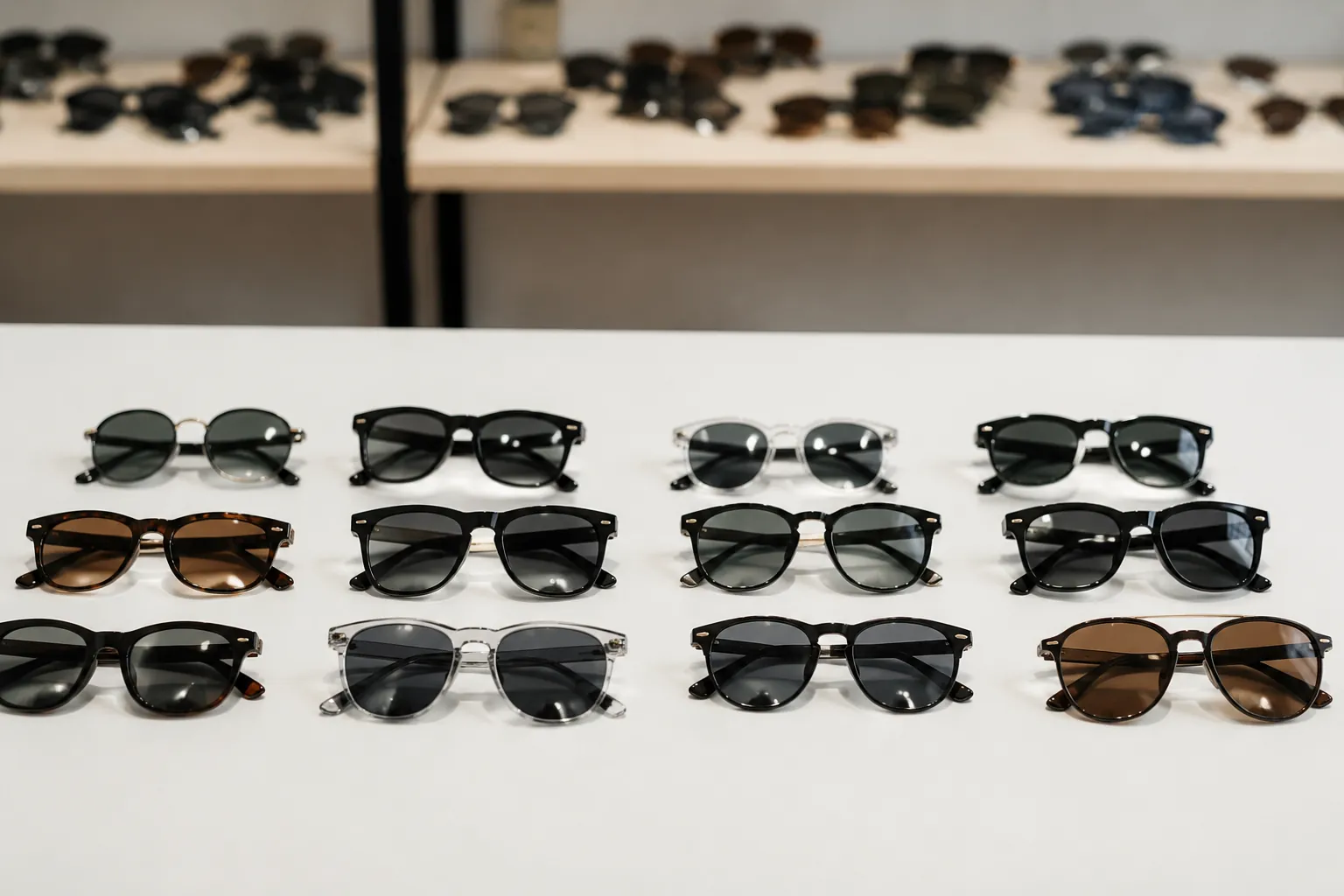
This guide is for brand owners, importers, distributors, and retail buyers placing volume sunglass orders. The real question is not which lens looks better on a sample board. It is which category fits the channel, climate, customer expectation, compliance needs, and return-risk profile of the program. Decide that early. It reduces complaints, protects margin, keeps labeling straight, and makes reorders easier to manage.
What Category 2 and Category 3 actually mean
Start with visible light transmission, not appearance. Under common sunglass standards, Category 2 lenses transmit 18% to 43% of visible light. Category 3 lenses transmit 8% to 18%. That gap matters because it changes how bright conditions feel to the wearer and how the product performs once it leaves the store.
Category 2 is generally suited to medium sun glare and mixed-light use. Category 3 is generally suited to strong sunlight and remains the mainstream choice for general outdoor sunwear. In plain terms, Category 2 often fits fashion-led or city-use programs. Category 3 is more common in outdoor, travel, beach, and summer assortments.
For buyers, lens category is a production specification. Not a vague color preference. Two grey lenses can look similar on a desk and still fall into different categories once tested. The same applies to gradients, flash coatings, and mirror coatings. The shipped lens still has to meet the approved transmission target and carry the correct category labeling.
Compliance has to match both the destination market and the final production spec. EU programs usually require CE conformity supported by testing to EN ISO 12312-1. US buyers often ask about ANSI Z80.3 and manufacturer FDA registration details. Australia and New Zealand buyers may request AS/NZS 1067. Chemical compliance requests may include REACH. If the approved sample and the production lot do not match, the problem is not cosmetic. It can trigger labeling errors, shipment delays, and product-liability exposure.
That is why process control matters. Final transmission can shift with lens material, lens thickness, tint method, and coating sequence. Factories with documented systems such as ISO 9001 and audited social compliance programs such as BSCI may give buyers more confidence, but the key point is simpler: lock the production spec and verify it against the approved sample.
Where Category 2 usually sells better
Category 2 often works better in channels where customers buy fast, try on indoors, and react first to style, comfort, and price. Think fashion boutiques, department-store accessories areas, concept stores, optical side collections, museum or gift retail, and online assortments built around trend and color.
The reason is straightforward. A medium tint is easier to accept under store lighting than a dark tint, especially when the frame is sold as an everyday accessory rather than a sun-performance product. Category 2 can also leave the eyes more visible through the lens, which often suits fashion-led presentations and softer color stories.
Climate matters too. In mixed-weather markets or city-use programs, many customers want one sunglass they can wear across commutes, shop entries, cafés, and intermittent sun. In that setting, Category 2 often feels more versatile than Category 3. It is not better in absolute terms. It is simply better matched to that use case.
- Best-fit channels: fashion retail, concept stores, urban optical side collections, online trend assortments, promotional premium programs.
- Best-fit climates: mixed weather, lower-glare urban use, cloud-variable coastal markets, spring and autumn fashion programs.
- Main selling points: easier indoor try-on, softer fashion look, broader daily-use feel, lower risk of immediate "too dark" rejection.
- Main commercial risk: customers buying for bright beach or holiday use may later decide the lens is not dark enough.
Material and color choices often support this positioning. Category 2 pairs well with crystal acetates, champagne tones, pale translucent injected plastics, tea gradients, rose tints, and slim metal fashion shapes. In those designs, a darker Category 3 lens can push the product toward a more performance-led look, which may not suit the account.
Where Category 3 is the safer default
Category 3 remains the default for a large share of sunglass programs because it matches what many consumers expect a sunglass lens to be: dark, outdoor-ready, and suitable for bright daylight. For coastal retail, travel retail, outdoor lifestyle chains, summer gift programs, marketplace listings, and resort stores, Category 3 is often the safer starting point.
It is especially reliable when the intended use is clearly bright outdoor exposure. If the product is bought for beach wear, summer travel, poolside use, daytime driving, or outdoor gifting, buyers often prefer Category 3 because it lowers the risk that the end user feels underprotected in strong sun. It also reads clearly in product photography, which matters in e-commerce where customers cannot test brightness before buying.
From a returns standpoint, Category 3 is often the lower-risk choice when the use case is obviously outdoor. But there is a catch. If the same frame is sold into both urban fashion stores and bright-sun resort stores, one default lens category may not suit both. In that case, split the assortment by channel instead of forcing one lens spec across every account.
Buyers should also check whether coatings or color effects change final transmission. A mirror lens approved as Category 3 at sample stage still needs the same category confirmed in bulk production. The priority is simple: the shipped product must stay within the approved spec and carry the right labeling for the destination market.
Use channel, climate, and return risk together
Many buying mistakes start with a narrow view. Teams choose by trend, by climate, or by quotation alone. That is where errors creep in. The better decision balances channel, climate, and return risk at the same time. The right category is the one that helps sell-through without creating predictable complaints later.
| Buying situation | Better default | Typical transmission target | Why it sells | Main return risk |
|---|---|---|---|---|
| Fashion boutique in mixed-weather city | Category 2 | 20% to 30% | Easier indoor try-on and broader daily wear | Customer expected a darker holiday lens |
| Beach shop or resort retail | Category 3 | 10% to 15% | Matches strong-sun use and customer expectation | Low, unless target customer prefers a lighter comfort tint |
| Online marketplace general assortment | Category 3 | 12% to 16% | Photos read as clear sun protection | Some city users may find it too dark in variable weather |
| Optical side collection for casual wear | Category 2 | 22% to 35% | Works for city use and multipurpose wear | Lower satisfaction if customer bought mainly for beach or travel use |
| Outdoor lifestyle chain | Category 3 | 9% to 14% | Clear outdoor function and fewer protection doubts | May feel heavy for frequent indoor-outdoor switching |
Discuss return risk before approval, not after launch. Ask a blunt question: which complaint hurts more in this channel, "too dark" or "not dark enough"? In a fashion chain, a dark first impression can cut conversion. In a resort shop, a medium tint may sell at first and disappoint in real sun. Different channels create different risks. The default category should reflect that.
If the answer is unclear, sample both categories in the same frame and the same lens color family, then review them under store lighting and outdoor daylight. That small step usually costs far less than correcting a bulk order specified without reference to the real selling environment.
What changes in manufacturing, cost, and lead time
Shifting between Category 2 and Category 3 usually does not require new frame tooling. It does require control. Lens material, tint method, lens thickness, coating stack, and inspection method all affect the final result. Polycarbonate, CR-39, TAC, and nylon-based materials do not always tint or transmit light the same way, so the target should always be verified on the final construction.
A typical controlled workflow looks like this:
- Lens material is selected based on price, impact needs, optical requirements, and coating compatibility.
- Base tint is set using a target transmission value or approved range tied to the intended category.
- Color and transmission consistency are checked across the lens surface and across the lot.
- Hard coating, anti-reflective back coating, flash coating, or mirror coating is applied only after the base lens specification is stable.
- Finished lenses are assembled and checked again in final QC against the approved production standard.
In most private-label programs, decoration choices affect cost more than the difference between Category 2 and Category 3 on their own. Printed logos, laser engraving, foil logos, metal badges, and custom packaging can have a larger effect on unit cost than lens category. The main price drivers are usually frame material, hinge spec, lens material, coating count, packaging complexity, order volume, and testing requirements.
MOQ and price breaks vary by factory and by construction, so ask for quotation tiers. Do not assume a standard rule. Lead time is also driven more by sample approval, artwork confirmation, packaging readiness, and test scheduling than by lens category alone. If the program uses custom lens colors, mirror finishes, or strict repeat-lot controls, ask whether extra QC steps are required before shipment.
Compliance and labeling errors that get expensive fast
One common B2B mistake is treating the test report as the finish line and ignoring the production file. The report matters. The production match matters more. The approved category, the final bulk transmission, the SKU label, and the packaging language all need to agree. If one part drifts, the buyer carries the risk.
Ask for a control pack that ties the approved sample to the production standard. At minimum, it should identify the frame reference, lens material, lens color, transmission target or approved range, category, decoration method, carton marking, and any required packaging statement. Where relevant, it should also list the requested compliance documents, such as EN ISO 12312-1 support for CE programs, ANSI Z80.3 information, AS/NZS 1067 documentation, REACH declarations, manufacturer FDA registration details, and any factory records the buyer requires, such as ISO 9001 or BSCI status.
- Common mistake: approving a sample by appearance only without locking the tested transmission result.
- Common mistake: changing mirror color, gradient depth, or base tint after approval without checking category impact.
- Common mistake: using one label file across multiple lens categories of the same frame.
- Common mistake: assuming a reorder will match the first lot without a sealed reference sample.
- Better practice: keep one written lens standard and one sealed approval sample per SKU and per category version.
This discipline cuts three costly risks: customer dissatisfaction from lens mismatch, customs or retailer issues caused by paperwork inconsistency, and exposure created by incorrect labeling. Treat lens category as a controlled specification. Because it is one.
How to place the first order if you are unsure
If the line is new and customer preference is still unproven, the safest move is often to split risk instead of forcing one category across the full opening order. Keep the same frame, branding, and packaging architecture where possible, then assign lens category by account type, use case, or geography.
A practical structure is simple: place Category 2 into urban fashion accounts and optical side collections, and place Category 3 into coastal stores, travel retail, summer campaigns, and marketplace listings built around outdoor use. That lets the buyer test channel response without changing the core product identity.
Keep the variables tight. Use the same frame, the same lens color family where possible, the same fit, and the same packaging format. Then review sell-through, returns, and customer feedback by channel. That gives a cleaner basis for reorder decisions than relying on internal preference or sample-room opinion.
If the frame is fashion-first and the market is mixed light, start with Category 2. If the frame is sun-first and the market is bright, start with Category 3.
It is not an absolute rule. It is a good first filter. And it gives you a clearer reorder path based on channel data rather than guesswork.
A simple decision framework buyers can use
Before bulk approval, score the frame against the real selling conditions. Give one point to Category 3 for each of these factors: strong-sun climate, outdoor-led sales channel, customer expects a dark sun lens, e-commerce photography needs obvious darkness, and the channel has low tolerance for "not dark enough" complaints. A score of four or five usually supports Category 3 as the base spec.
Give one point to Category 2 for each of these factors: mixed-weather market, indoor try-on matters, fashion color is the main purchase trigger, urban daily wear is the likely use case, and the channel has low tolerance for "too dark" feedback. A score of four or five usually supports Category 2.
If the score is close, do not decide by taste alone. Ask the supplier for matched samples in both categories, request the transmission results for each sample, and review them in the real selling context. Before bulk approval, confirm five points in writing: the target market standard, the tested category, the transmission result or approved range, the final label wording, and the sealed reference sample for future reorders.
The commercial logic is simple. Choose the category based on where the goods will sell, how customers are likely to use them, what the channel expects a sunglass to look like, and which complaint is most costly if the choice is wrong. That is the decision most likely to support repeat business instead of preventable claims.
Have a custom sunglasses project in mind?
Send us your styles, target market and quantities and we will return a detailed quote with MOQ, lead time and a sample plan.
Get a QuoteWhy source this from Wenzhou with LumiShades
Wenzhou in Zhejiang Province is widely regarded as China’s eyewear manufacturing capital, producing a large share of the world’s sunglasses. That concentration matters to buyers: a deep local supply chain for acetate sheet, hinges, lens blanks, plating and packaging means shorter component lead times, easier color and material matching, and a workforce with decades of eyewear-specific skill. LumiShades has manufactured in this ecosystem since 2009, and our vertical integration — in-house injection molding, acetate cutting, CNC milling, lens tinting, decoration and quality control — means no part of your order is quietly subcontracted to a workshop you cannot audit.
For international buyers, that vertical control translates into accountability. When a single factory owns every step, defects are traced and fixed at source rather than bounced between vendors, and your specifications survive intact from first sample to bulk. For procurement review, buyers can request process records, approved samples, quality checkpoints and project-specific compliance files before placing a bulk order. Required testing and documentation are confirmed against the destination market and product specification rather than assumed from a generic certificate list. Explore our manufacturing capabilities and quality control process to see how this works in practice.
Frequently asked questions
Can I sell the same frame in both Category 2 and Category 3? Yes. In many programs, that is a practical way to test channel fit while keeping the frame platform unchanged. Treat each version as a separate controlled SKU. Each category should have its own approved sample, transmission result, labeling file, packaging details, and compliance record. Before shipment, confirm that carton markings and product labels match the lens category actually packed.
Does Category 3 always reduce returns? No. Category 3 can reduce dissatisfaction when the product is bought for bright outdoor use, but it can also increase "too dark" feedback in city, mixed-light, or indoor try-on channels. To assess return risk, review the expected use case, the channel environment, customer expectation, and product-page presentation. If the channel is mixed, split the assortment rather than assuming one category will work everywhere.
Will Category 2 be cheaper than Category 3? Usually not by a meaningful amount on its own. Ask the supplier to break the quotation out by frame material, lens material, coatings, decoration, packaging, testing, and volume tier. That shows whether any price difference actually comes from lens construction or from other features. In most orders, unit cost is influenced more by material choices and order volume than by moving from Category 2 to Category 3.
How do I control tint consistency across bulk production? Approve a sealed reference sample and require the supplier to link bulk production to that sample. Ask for the measured transmission result for the approval sample, the intended category, the lens material, and the final coating construction. Request final QC records for production lots and confirm whether the factory controls tinting in-house or through an outside processor. If repeatability matters for reorder business, ask how the supplier stores the approved standard and how reorders are matched to it.
What documents should I ask for before shipment? Ask for the production control pack and the market-relevant compliance file. At minimum, request the approved sample reference, lens category, transmission result or approved range, label artwork, carton markings, and packing confirmation. For compliance, request the documents relevant to the destination market, such as CE support with EN ISO 12312-1 for EU programs, ANSI Z80.3 information and manufacturer FDA registration details for US programs, AS/NZS 1067 where required, and REACH declarations if requested. If factory system status matters to your sourcing process, also ask for current ISO 9001 and BSCI records.
Ready to start?
Explore our rimless sunglasses or request a quote — our sales team replies within 12 hours.
Request a Quote