
How to Build a Profitable Lens Tint Assortment
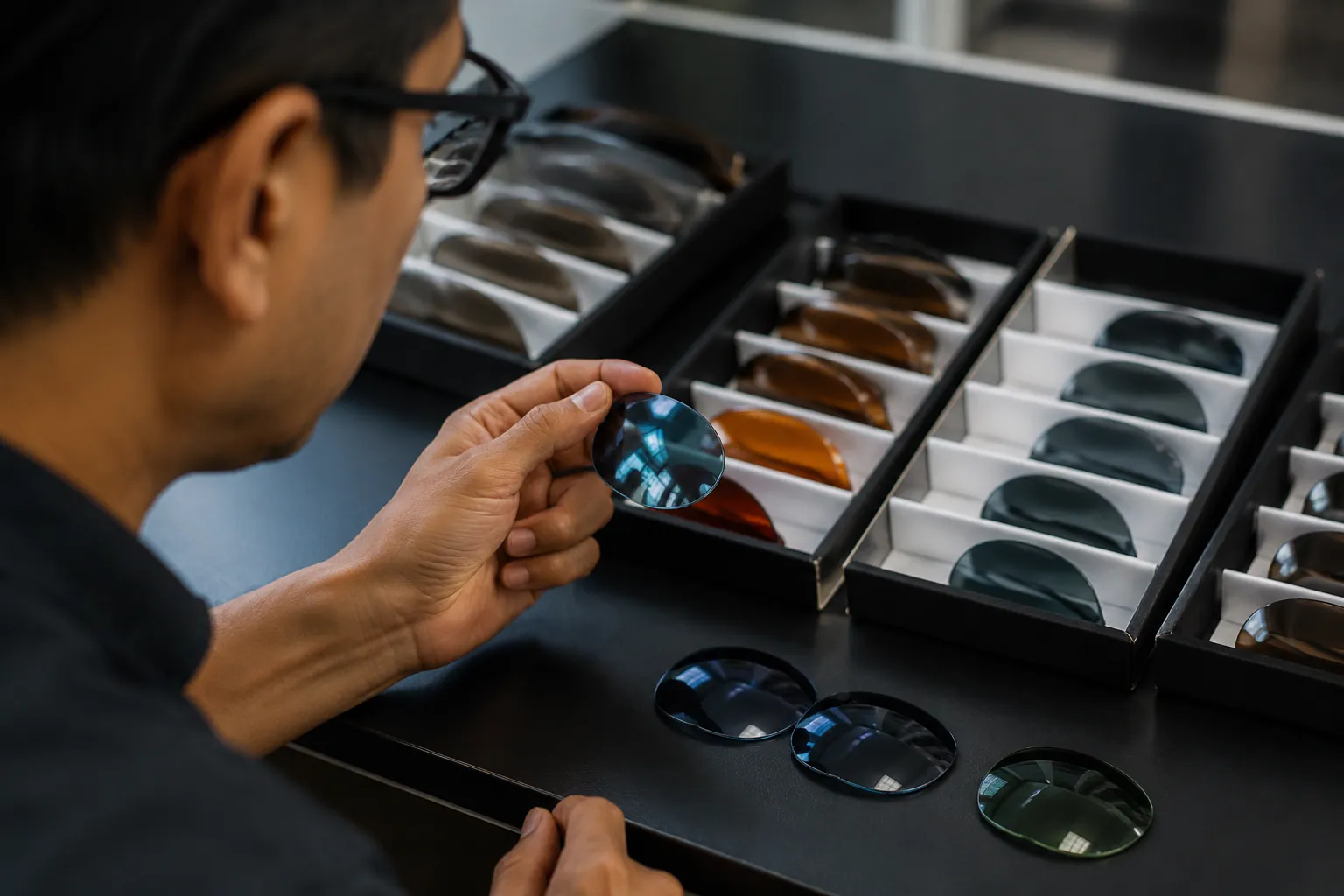
This guide is for brand owners, importers, distributors, and retail buyers who need a commercial lens tint range, not a color lineup based on personal taste. The goal is simple: build a tighter assortment that fits the target customer, sales channel, retail price point, and reorder model. A disciplined tint plan reduces SKU sprawl, improves MOQ efficiency, simplifies sample approval, and makes factory quotations more consistent because frame-lens combinations, lens materials, coatings, and decoration choices are defined earlier.
Start with the buyer, then work backward
Most tint-range problems start before production. A buyer approves too many lens colors, spreads quantity across too many frame-tint combinations, and ends up with shallow depth per SKU. The result is predictable: more complexity, weaker reorder logic, and slower variants that are hard to replenish or clear.
Start with four commercial questions. Who is the end customer? Where do they buy? What price point is the product targeting? Is this a repeat program or a one-time launch? Answer those first. Tint decisions get easier fast.
For a broad online program, the safest starting point is usually a narrow range led by smoke. It is familiar, easy to merchandise, and works across common frame colors such as black, tortoise, crystal, and metal finishes. For driving, outdoor, or heritage-led channels, brown and G15 often deserve more space because they support a warmer or more classic-performance product story. A standard green can also work, but it usually needs a frame design that clearly signals vintage, military, or retro.
Commercial limits matter more than theoretical flexibility. A factory may accept a low MOQ per design. That does not mean every design should launch with several tints. Every added tint creates another SKU, another approval point, and another replenishment decision. In practice, many strong new programs launch with a small number of total tints across the line rather than several tints on every frame.
If the line is meant to reorder, each tint needs a job: volume leader, warm alternative, classic premium option, or selective image builder. No clear role? Cut it before sample approval.
What each core tint does commercially
Buyers do not need a chemistry lesson. They need to know how a tint sells, how it fits frame materials, and where it creates risk. The four common commercial shades are smoke, brown, green, and G15. They are not interchangeable.
| Tint | Best fit | Commercial strength | Main risk |
|---|---|---|---|
| Smoke | Mainstream retail, e-commerce, unisex basics | Reliable default; broad frame compatibility; straightforward to repeat | Can feel generic if the collection needs a stronger brand signature |
| Brown | Driving, outdoor lifestyle, warm-tone acetate and metal programs | Works well with tortoise, tea, honey, gold, and warm translucent frames | May look less convincing on icy crystal colors, silver metal, or stark monochrome stories |
| Green | Vintage, military, heritage, selected fashion channels | Adds distinct character without becoming overly niche in the right frame family | Usually narrower in appeal than smoke as a first-launch volume tint |
| G15 | Aviators, navigators, premium classics, driving-led styles | Recognizable classic-performance look; strong signal on the right metal frames | Loses impact if applied too broadly across unrelated shapes |
Smoke is often the base tint because it is the easiest anchor for replenishment. Brown is a practical second choice if the line leans outdoor, motoring, or warm materials. Green and G15 are usually better used with more control. A general green works best when the brand story leans heritage or retro. G15 is more specific. Buyers often connect it with classic-performance eyewear, especially aviators and metal shapes.
One mistake shows up often: treating green and G15 as the same thing. They are not. Green is a broader visual family. G15 carries a more defined product meaning and usually works best when the frame earns that classic signal. That difference matters in merchandising because it changes how the product is described online, in line sheets, and on the shop floor.
Match tint count to retail tier and MOQ
The lower the retail price, the tighter the tint menu should be. Entry programs need volume concentration because margin is more exposed to small-run inefficiency. Every extra tint increases SKU count, fragments purchasing, and can reduce the buyer's ability to consolidate volume into cleaner production lots.
Factories often quote more efficiently when buyers strip out unnecessary variation within the same style family. Exact MOQ and price-break structures vary by supplier, lens material, coating, and construction, so buyers should confirm the real breakpoints on the quotation instead of guessing. The commercial rule stays the same: one style family concentrated into fewer tints is usually easier to cost, approve, and reorder than the same volume spread thinly across many lens variants.
| Retail tier | Recommended tint count | Typical order logic | Main objective |
|---|---|---|---|
| Entry price | 1-2 tints | Concentrate volume into smoke; add brown only if the channel already supports it | Protect margin and limit slow stock |
| Mid-tier private label | 2-3 tints | Use smoke as the base, brown as a warmer option, and G15 on selected classics | Balance assortment breadth with reorder discipline |
| Higher-ticket fashion or specialist | 3-4 tints | Assign each tint to a frame family instead of offering all tints in all shapes | Support storytelling without losing SKU control |
Use a simple rule for opening ranges: show enough tint variety to define the line, but not so much that each SKU becomes weak. Extra tints also create more photography work, more inventory handling, more sample approvals, more compliance records, and more replenishment complexity. More choice is not always better. Often it is worse.
Channel changes what deserves space
The same tint can perform very differently in e-commerce, wholesale, and physical retail. The reason is not optical theory. It is buying behavior.
In e-commerce, customers rely on familiar visuals and clear product images. Smoke often performs best because it is recognizable and neutral across many frame colors. Less familiar greens and warm browns can still work, but they usually need stronger positioning, better photography, and more deliberate merchandising support.
In physical retail, customers can try products on, compare frame materials, and react to how the lens tone works with the face and frame. Brown often benefits here because it can feel warmer in person than it does in thumbnails. G15 also tends to perform better in store when tied to a clear frame story such as aviators, navigator metals, or heritage silhouettes.
- Online-first DTC: lead with one hero tint and one secondary tint; keep the first image logic consistent across the range.
- Distributor program: keep tint logic simple so dealers can reorder by family without confusion.
- Department store or chain retail: maintain continuity in core tints and add only selective fashion lenses where merchandising support exists.
- Outdoor, travel, or motoring accounts: give brown and G15 more room than a pure fashion account usually would.
Use one blunt test: if a tint needs a long explanation to justify its place, it is probably not the range's main volume driver. That does not make it useless. It just means it should usually be an accent, not the default.
Build repeatable frame-and-tint pairings
Some combinations look exciting in sample review and then fail in repeat business. Strong buyers plan for the second order from day one. They build tint logic around frame families, not around isolated sample wins.
A practical grouping is simple: black injection basics, tortoise or tea acetate, transparent fashion acetates, classic gold or silver metals, and statement shapes. Define those families first. Then assign tints by family and keep the structure consistent. This prevents random assortments and makes replenishment easier for both buyer and factory.
For example, black and dark solid frames often work best with smoke as the first option and G15 as a second option for classic shapes. Tortoise, tea, honey, and warm gold materials often support brown first, then green or G15 depending on whether the frame reads more heritage or more driving-classic. Silver or gunmetal aviators often suit G15 first and smoke second. Transparent fashion acetates usually need smoke first, with selective green only if the collection clearly leans retro.
Material behavior matters. The same target tint can look different in TAC, PC, nylon, or other substrates because lens thickness, surface finish, polarization build, and coating stack affect visual appearance. If a buyer approves a color on one lens material and later switches to another for cost or performance reasons, the lens should be re-approved visually. Small construction changes can change how the tint reads in bulk production.
Decoration choices also affect the picture. A laser logo on a metal temple creates a different impression from foil on acetate or a printed mark on the lens. If the frame already carries a strong decoration story, the lens palette should usually stay tighter. Too many design signals weaken the product. They do not strengthen it.
Use compliance and material control to cut bad ideas early
Tint planning is tied to compliance approval. Lens color, target category, material, and construction all affect how smoothly a program moves through testing and bulk production. Buyers should define the destination market before final approval because EU, US, and Australia/New Zealand programs may follow different standards, including CE EN ISO 12312-1, ANSI Z80.3, and AS/NZS 1067.
Compliance is broader than the lens standard alone. Depending on the product and sales model, buyers may also need to confirm chemical compliance such as REACH, factory quality-management controls such as ISO 9001, social compliance status such as BSCI, and, for relevant US programs, whether FDA registration requirements apply to the supplier or product category being sourced. These checks do not replace lens testing. They are part of supplier qualification and risk control.
This does not mean each tint needs a completely different factory setup. It does mean approval has to be controlled properly. A retained reference sample, approved swatch, or signed-off gold sample should be kept for each confirmed shade. Photos are not enough. Screens and camera settings shift color too easily.
At pre-production stage, buyers should confirm:
- Tint reference: approved physical swatch or retained sample for each confirmed shade.
- Lens material: TAC, PC, nylon, or another substrate, because tint depth and surface appearance can shift by material.
- Lens thickness: especially if the style changes from a thinner fashion lens to a thicker sport or wrap construction.
- Coating stack: polarized build, mirror, hard coat, or back-side anti-reflective treatment, because these can affect final appearance.
- Destination market: EU, US, Australia/New Zealand, or mixed shipments, so testing and documentation stay aligned.
Buyers should also agree practical production tolerances with the supplier. Exact tolerances depend on the product specification and the applicable standard, but the commercial requirement is simple: bulk lenses should match the approved sample within an agreed visual tolerance under controlled lighting, and left-right appearance should stay consistent within the same pair. If one style uses polarized TAC and another uses non-polarized PC, buyers should not expect identical appearance even if both are called smoke or brown. Construction consistency is part of color consistency.
The rule is simple. Once the color is approved, do not change lens material, thickness, coating, or source late in development and expect the bulk result to look the same. Lock the construction before bulk approval.
Plan samples, lead times, and reorders before launch
A good tint assortment is one that can be reordered without friction. Sampling should test more than appearance. It should also test whether the SKU structure makes commercial sense. Actual sample and bulk lead times vary by factory capacity, season, material availability, and order complexity, so buyers should confirm the timeline in writing before launch planning. Then use that timeline to simplify the assortment, not expand it forever.
During sampling, decide which tint is the stock leader, which is the secondary commercial option, and whether there is a third tint used mainly for brand image. If a tint has no defined role, remove it before the first production purchase order. Low MOQ should be used to test one or two commercial hypotheses. Not every possible lens variation.
| Order stage | Buyer decision | Why it matters | Common mistake |
|---|---|---|---|
| Sampling | Approve a limited number of tints | Prevents SKU sprawl before launch and keeps line presentation clear | Sampling more tint options than the opening order can realistically support |
| Initial order | Push volume into the strongest frame-tint combinations | Improves cost control and simplifies replenishment | Splitting quantity evenly across weak variants without channel evidence |
| Bulk production | Use retained tint reference and fixed lens construction | Controls color consistency across the run | Approving by photo only or changing material late |
| Reorder | Repeat proven tints first and expand only after sell-through review | Protects margin, stock turn, and forecast accuracy | Adding new tints before core sellers stabilize |
If the factory offers a low MOQ per design, use that flexibility carefully. It can help test a secondary tint on a proven frame family, but it does not justify a fragmented launch. A cleaner approach is to put most opening quantity into the safest tint, give a smaller share to the second tint, and reserve any third tint for frames and channels with a clear merchandising case.
A practical formula for most B2B buyers
Most commercial programs do not need a blank-page approach every season. A repeatable formula usually works better. For many private label or wholesale lines, a four-part structure is enough: one lead smoke tint across the highest-volume shapes, one warm option such as brown across selected acetate or outdoor-led styles, one classic option such as G15 for aviators and heritage metals, and one limited fashion tint only if margin, channel support, and reorder logic are clear.
This structure fits how factories quote, schedule, and control production. Fewer tint variables mean simpler purchasing, fewer approval disputes, cleaner QC control points, and easier reorders. It also gives the sales team a clearer line story. Instead of offering every lens color in every frame, the buyer can explain why each tint belongs where it does.
The best tint lineup is rarely the widest. It is the one that gives each frame a clear role, keeps quantity healthy per SKU, and makes the second order easier than the first.
If the program sells across multiple countries, keep the core assortment common wherever possible. Localize only when there is a clear market reason. In most cases, it is better to adjust the mix of smoke, brown, and G15 by market demand than to create completely different tint structures by country. That preserves scale, reduces operational complexity, and supports a cleaner replenishment model over time.
Have a custom sunglasses project in mind?
Send us your styles, target market and quantities and we will return a detailed quote with MOQ, lead time and a sample plan.
Get a QuoteWhy source this from Wenzhou with LumiShades
Wenzhou in Zhejiang Province is widely regarded as China’s eyewear manufacturing capital, producing a large share of the world’s sunglasses. That concentration matters to buyers: a deep local supply chain for acetate sheet, hinges, lens blanks, plating and packaging means shorter component lead times, easier color and material matching, and a workforce with decades of eyewear-specific skill. LumiShades has manufactured in this ecosystem since 2009, and our vertical integration — in-house injection molding, acetate cutting, CNC milling, lens tinting, decoration and quality control — means no part of your order is quietly subcontracted to a workshop you cannot audit.
For international buyers, that vertical control translates into accountability. When a single factory owns every step, defects are traced and fixed at source rather than bounced between vendors, and your specifications survive intact from first sample to bulk. For procurement review, buyers can request process records, approved samples, quality checkpoints and project-specific compliance files before placing a bulk order. Required testing and documentation are confirmed against the destination market and product specification rather than assumed from a generic certificate list. Explore our manufacturing capabilities and quality control process to see how this works in practice.
Frequently asked questions
How many lens tints should I launch in a new private label sunglasses range? For most new ranges, start with 2 to 4 tints total across the collection, not 2 to 4 tints per frame. Build the opening range around one core tint, usually smoke, then add brown, green, or G15 only where the frame family and channel support them. Before approving each tint, ask three operational questions: does it have a clear role, can it carry enough order depth to justify its SKU, and can you reorder it confidently if it sells well? If the answer is no to any of those, cut it from the launch.
Is G15 necessary if I already offer a standard green lens? Not always. A standard green may be enough for a fashion-led or heritage-inspired range. Add G15 when you have classic metal shapes, aviators, navigator styles, or a driving-led product story where that specific classic-performance look adds merchandising value. Ask your supplier to show approved physical references for both shades on the actual lens material you plan to use, because the visual difference can narrow or widen depending on substrate, thickness, and coatings.
What is the safest tint for online sales? Smoke is usually the safest online because customers recognize it immediately, it photographs predictably, and it works across more frame colors than most alternatives. To use it well, keep the lead image consistent across the range, avoid mixing too many niche tints into the opening assortment, and approve the production standard against a retained sample rather than product photos alone. If you add a second tint, choose one that clearly supports the frame story instead of adding variety for its own sake.
How should I use a low MOQ without overcomplicating the line? Use low MOQ to test one focused commercial question, such as whether a secondary tint can sell on one proven frame family. Do not use it to launch every possible lens shade. A practical process is to assign one lead tint to most opening volume, add one secondary tint only on selected frames, review sell-through by frame-tint combination, and expand only after repeat demand is proven. Ask the factory to quote the MOQ, price effect, and lead-time effect of each added tint before you confirm the assortment.
Do different target markets affect tint planning? Yes. Destination market should be defined before final approval because lens testing and documentation may follow CE EN ISO 12312-1, ANSI Z80.3, or AS/NZS 1067 depending on where the product will be sold. Buyers should also confirm any related compliance requirements relevant to the project, such as REACH, and verify supplier controls such as ISO 9001 or BSCI where these matter to the sourcing program. In practice, keep a retained approved tint sample, lock the lens material and coating stack, and make sure the factory knows which market standard applies to each shipment before bulk production starts.
Ready to start?
Explore our sport wrap sunglasses or request a quote — our sales team replies within 12 hours.
Request a Quote