
PC vs TAC vs Nylon Polarized: Which Fits the Price?
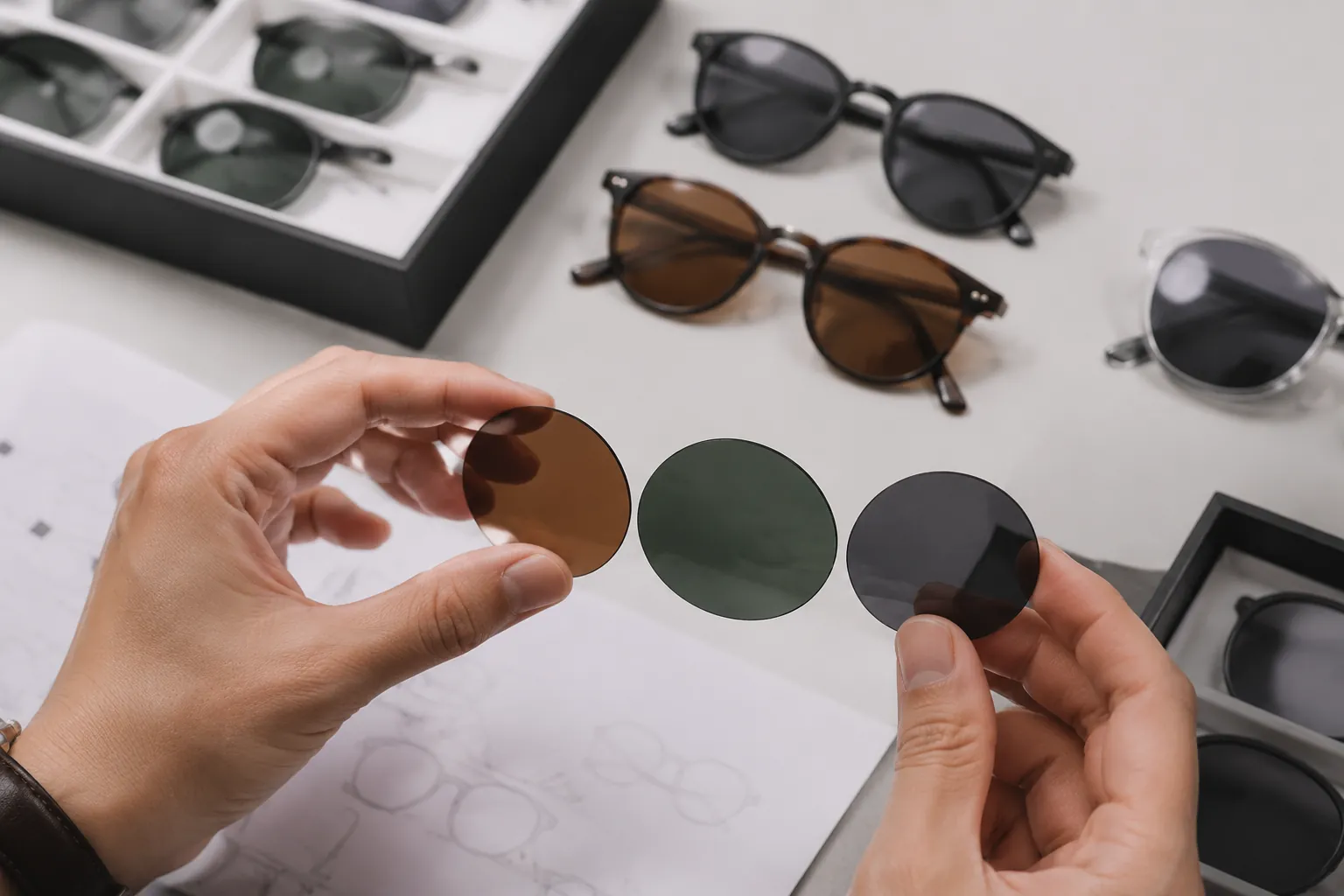
This guide is for buyers sourcing custom polarized sunglasses at volume, including private-label brands, importers, distributors, retail chains, and outdoor programs. The goal is simple: choose the lens construction that fits the sales channel, use case, compliance target, and cost ceiling before you approve samples. PC, TAC, and nylon can each be the right call. They differ in impact behavior, surface durability, optical performance, lamination risk, and process demands. Match the lens build to the channel early. You get fewer sample revisions, more accurate quotes, and lower claim risk after shipment.
Start with the channel, not the material
Buyers often start by asking for the "best" polarized lens. That is the wrong question. Start with where the product will be sold, how it will be used, which claims must hold up, and what total cost has to work after packaging, freight, duty, and margin.
An entry-price fashion sunglass, a mid-market polarized lifestyle style, and a fishing or cycling product should not default to the same lens build. In fashion-led channels, appearance, color, and branding often drive sell-through more than technical upgrades. In driving, marine, cycling, and other active-use channels, complaint risk shifts fast toward scratching, distortion, lens retention, and heat stability.
Channel fit also decides how much process complexity makes sense. Lower-volume programs usually do better with standard curves, standard tint families, and simple decoration. Every extra variable adds approval risk. Higher-volume programs can support tighter specs, more advanced coating stacks, and more validation because the business case is there.
- Promo and entry fashion: cost-sensitive, appearance-led, and usually best served by proven constructions with limited customization.
- Mid-market retail and DTC: balanced need for appearance, repeat-order consistency, acceptable durability, and controlled cost.
- Outdoor, driving, marine, and sport: higher exposure to heat, wiping, sweat, and rough handling, so durability and optical control matter more.
- Kids and youth active: low weight, impact behavior, and secure lens retention usually matter more than premium optics alone.
The practical rule is blunt: define the failure you can live with first. Then choose the material.
What buyers are actually choosing between
PC, TAC, and nylon polarized are not interchangeable labels. They are different lens constructions with different manufacturing routes, risk points, and cost drivers.
PC polarized uses a polycarbonate lens construction and is often chosen where impact resistance and low weight matter most. It is common in active use, youth styles, and wrapped sport shapes. Its weak point is surface scratching if the hard coat is poor or inconsistent. That matters. A PC lens can perform well, but coating quality largely determines how quickly it shows wear from wiping and daily handling.
TAC polarized uses a laminated structure, typically with polarized film bonded between protective layers. It is widely used because it offers a straightforward polarized build and is often commercially attractive for casual programs. The main risk is not the polarized effect. It is the lamination system. Weak materials, poor adhesive control, rough edge finishing, or loose process conditions can lead to haze, bubbles, edge issues, or delamination after heat or humidity exposure.
Nylon polarized is often selected when buyers want low weight, good toughness, and better optical stability on higher-wrap curves. It is usually positioned for premium sport and outdoor products. It also demands tighter control in shaping, coating, and inspection. That is one reason it appears more often in products with a stronger technical or premium retail brief.
One more point matters: lens performance depends on both material and process. Two suppliers can quote the same material name and deliver very different results because their coating, lamination, edging, or inspection control is not the same.
Use this table to match build to channel and cost target
| Lens build | Typical cost position | Main strength | Main risk | Best channel fit |
|---|---|---|---|---|
| PC polarized | Usually mid-range relative to common polarized options, depending on coating, curve, and finish | High impact resistance, low weight, and strong suitability for active use and wrapped shapes | Scratch complaints increase if hard-coat quality is weak or inconsistent | Sport retail, outdoor programs, driving, youth active, and active DTC lines |
| TAC polarized | Often the most cost-efficient entry point for polarized programs, especially on standard curves | Commercially accessible polarized construction with broad tint and mirror flexibility | Lamination quality can fail under heat, humidity, or insertion stress if the build is weak | Mid-price online, chain retail, distributor programs, and casual lifestyle sun |
| Nylon polarized | Usually premium because of material and process demands | Good optical stability, low weight, and strong visual comfort on higher-wrap products | Higher cost and tighter process-control requirements | Performance brands, marine, cycling, fishing, and premium outdoor programs |
These positions are directional, not fixed. Actual cost depends on base curve, thickness, tint, mirror treatment, logo application, frame construction, packaging, and required testing.
The pattern is still clear: TAC is often the easiest commercial entry point for casual polarized offers. PC becomes more attractive when impact behavior and rough handling matter. Nylon is easier to justify when wrapped geometry and premium optics sit at the center of the brief.
Do not judge cost by ex-factory price alone. Include fallout, rework, and field claims. A cheaper lens can become the more expensive sourcing choice.
Where each material fails in real use
Ask how a lens fails over time, not how it looks on a fresh approval sample. Most field problems follow familiar material and process patterns.
- PC polarized: scratching, coating inconsistency, haze, or cosmetic defects if molding and hard-coat control are weak.
- TAC polarized: edge lifting, bubbles, adhesive haze, warpage, or delamination if the lamination stack is unstable or heat exposure is severe.
- Nylon polarized: inconsistency in color or finish, or avoidable quality variation if shaping and coating control are not stable.
Heat is one of the most useful real-world stress checks. Sunglasses get left in cars, exposed to direct sun, or shipped through hot conditions. Laminated constructions often show weakness first in those situations, especially near the lens edge or as visible haze. PC generally offers better impact behavior in active use. Nylon often proves its value on higher-wrap products where distortion control and visual comfort matter more.
Frame geometry changes the risk as well. A flatter fashion frame usually creates less insertion stress than a high-base wrap. Edge a lens too tightly and the stress can cause visible distortion, whitening near the groove, or later cracking. For wrapped products, ask which lens construction has already been validated on similar geometry. Do not choose on price alone.
Compliance and test points for the sample checklist
Polarization alone does not make a sunglass market-ready. The finished product has to meet the requirements for its destination market and intended use. Depending on the market and program, buyers may need to consider controls or standards such as CE EN ISO 12312-1, ANSI Z80.3, AS/NZS 1067, REACH, FDA registration, ISO 9001, and BSCI. Define the applicable requirement before sampling starts. Not after.
For practical sourcing, the sample checklist should cover both compliance and process control:
- Visible light transmission category: confirm that the lens category is appropriate for the intended use and target market.
- Polarization consistency: verify that left and right lenses match and show no visible contamination, mismatch, or unwanted rainbow effect.
- Optical quality: inspect for distortion, especially on mirrored lenses and wrapped shapes where edging stress is more likely to show.
- Impact and retention: confirm that the lens remains secure in the frame and that the finished sunglass is developed to the applicable market requirement.
- Heat and humidity stability: ask what internal checks are used for laminated structures and coated lenses before bulk release.
- Chemical compliance: confirm REACH-related control or any other destination-market material requirement relevant to the program.
Request the test basis and target standard in writing. A vague request such as "need CE" does not guide development well. A clear brief does.
How factory process affects lens quality and repeatability
Raw material does not determine lens quality by itself. Process control does. This is where reliable sourcing programs separate from attractive but inconsistent quotes.
For polarized lenses, the main control points usually include incoming lens inspection, polarization alignment, tint or mirror consistency, hard-coat curing, curvature tolerance, edging accuracy, insertion stress, and final cosmetic inspection under defined lighting. Strong factories do not rely on final inspection alone. They control defects where they start.
Ask direct process questions. How is coating consistency checked? How is mirror color matched on repeat orders? What cosmetic standards apply to dust, pin marks, edge chips, haze, or color variation? What lens-fit tolerance is allowed before insertion stress is considered too high? Those answers tell you more than broad sales claims.
Decoration and finishing choices also affect repeatability. Mirror effects, gradient tints, laser marks, and complex branding can add variation and approval risk if they are not tightly controlled. That does not mean you should avoid them. It means you should specify realistic tolerances and check them on the final assembled frame, not on loose lenses only.
A practical spec path for lower- and higher-volume programs
Order size changes what is commercially sensible. Setup allocation, rejection handling, component planning, and packaging complexity do not scale the same way.
- Lower-volume programs: keep the build simple with proven frame shapes, standard polarized options, and low-risk decoration so approval stays manageable.
- Medium-volume programs: use the volume to make a clearer channel-specific lens choice, such as TAC for casual retail or PC for more abuse-prone active use.
- Higher-volume programs: optimize the full package, including lens coating, decoration, packaging, and compliance documentation, instead of focusing only on material choice.
- Large repeat programs: work backward from margin target, complaint tolerance, and replenishment consistency, because small quality differences become commercially significant at scale.
A sensible buying path is to identify which complaint is most expensive in the target channel. If scratching is the main issue, weak coating control can wipe out any material cost savings. If heat stability is the concern, laminated construction quality needs close review. If wrapped optics are central to the value proposition, nylon may justify the higher cost.
A common sourcing mistake is simple: too much focus on frame appearance, not enough on the lens construction the end user deals with every time the product is worn.
Short buying rules that prevent expensive mistakes
If you need a fast starting rule, use this one: start with TAC for cost-driven casual programs, start with PC for active and abuse-prone programs, and start with nylon for premium performance programs where wrap and optical comfort are central to the brief.
Then test that choice against four buying questions:
- What is the target retail price and what is the maximum acceptable landed cost per pair?
- Which complaint is most damaging in this channel: scratches, breakage, haze, delamination, or visible distortion?
- Will the product be worn casually, used for driving, or exposed to marine or sport conditions with higher heat and handling stress?
- Does the frame geometry increase the risk of insertion stress, distortion, or edge-related failure?
Finally, assess the sample under realistic conditions. Check it after repeated cleaning, after heat exposure, under strong light, and on the final assembled frame, not as a loose lens only. A polished quote sheet proves very little. A controlled sample and a clear test basis do.
Have a custom sunglasses project in mind?
Send us your styles, target market and quantities and we will return a detailed quote with MOQ, lead time and a sample plan.
Get a QuoteWhy source this from Wenzhou with LumiShades
Wenzhou in Zhejiang Province is widely regarded as China’s eyewear manufacturing capital, producing a large share of the world’s sunglasses. That concentration matters to buyers: a deep local supply chain for acetate sheet, hinges, lens blanks, plating and packaging means shorter component lead times, easier color and material matching, and a workforce with decades of eyewear-specific skill. LumiShades has manufactured in this ecosystem since 2009, and our vertical integration — in-house injection molding, acetate cutting, CNC milling, lens tinting, decoration and quality control — means no part of your order is quietly subcontracted to a workshop you cannot audit.
For international buyers, that vertical control translates into accountability. When a single factory owns every step, defects are traced and fixed at source rather than bounced between vendors, and your specifications survive intact from first sample to bulk. For procurement review, buyers can request process records, approved samples, quality checkpoints and project-specific compliance files before placing a bulk order. Required testing and documentation are confirmed against the destination market and product specification rather than assumed from a generic certificate list. Explore our manufacturing capabilities and quality control process to see how this works in practice.
Frequently asked questions
For an entry-price polarized fashion line, should I start with TAC or PC? Start with TAC on standard fashion shapes because it is often the most practical polarized option for casual use. Then ask for a side-by-side PC option only if the style is likely to face rough handling, youth use, or sport positioning. During sampling, compare three points on the assembled frame: scratch appearance after wiping, lens-fit stress after insertion, and any change after basic heat exposure. That gives you a sourcing decision based on use, not just a material label.
Is nylon worth the extra cost for non-sport sunglasses? Usually only if the brief calls for a technical benefit the customer will notice or the channel expects. Nylon is easier to justify on higher-wrap designs, premium lightweight products, or programs where optical comfort is part of the value proposition. For standard low-wrap fashion frames, ask the supplier to show the actual gain versus PC or TAC on distortion, weight, and finish consistency before you accept the cost increase.
What should I ask for during sample approval besides polarization? Ask for a written sample record covering lens material, visible light transmission category, target market standard, optical inspection result, retention on the final frame, cosmetic standard, and the heat- or humidity-stability check used internally. If the product is being developed for a defined market, state the applicable basis clearly, such as CE EN ISO 12312-1, ANSI Z80.3, or AS/NZS 1067, and confirm any relevant REACH-related requirement at the same time. That prevents the supplier from optimizing only for appearance while leaving compliance and durability vague.
How do lead times change with custom lens decoration or color? Ask the supplier to break lead time into three parts: sample preparation, color or decoration approval, and bulk production after approval. Custom mirrors, special tints, laser marks, or non-standard packaging usually add time because they require color matching, process confirmation, or extra QC checkpoints. The practical step is to request a critical-path list before approval so you know which items can delay bulk release and which are still flexible.
Can I hit a low landed cost and still reduce return risk? Yes, if you control the right risk. Start by identifying the most expensive likely complaint in the channel, then specify the lens build around that issue instead of chasing the lowest unit price. A stable TAC construction may be enough for casual fashion, while an active-use program may justify better-coated PC or nylon if scratching, distortion, or handling damage would drive returns. Ask the supplier to quote at least two lens options on the same frame and compare them on compliance basis, likely failure mode, and inspection criteria, not just material name.
Ready to start?
Explore our square sunglasses or request a quote — our sales team replies within 12 hours.
Request a Quote