
Stock vs Custom Sunglass Lenses: Cost, MOQ, Lead Time
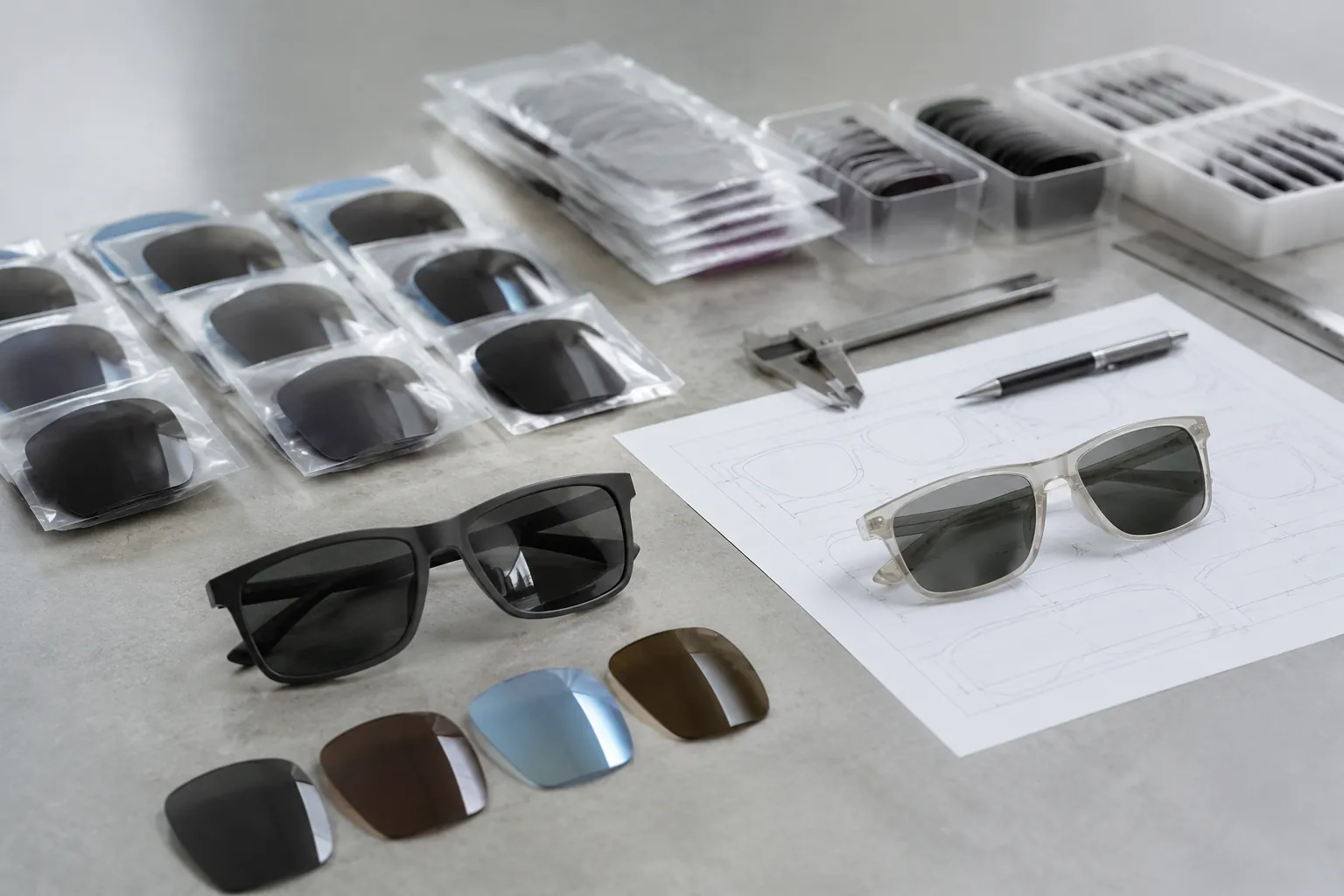
This guide is for brand owners, importers, distributors, and retailers buying sunglasses in volume. It compares stock lenses with custom lens development using the factors that actually affect the order: MOQ, unit cost, development cost, lead time, fit, and compliance. The goal is simple. Pick the lens route that matches your target price, expected volume, retail channel, and need for consistency. If you need to decide between moving fast with existing lens options or investing in a custom lens program, this article gives you a practical way to make that call.
Choose the lens route first
Lens choice affects far more than color. It can change frame engineering, groove compatibility, assembly method, testing needs, packaging claims, and the amount of development work required before bulk production. Many buyers start with the frame and treat the lens as a finish option. That is a mistake.
Stock lenses are existing options a supplier already makes or sources in standard materials, base curves, dimensions, and colors. Common stock choices include smoke, brown, and green, along with some standard gradients or mirror finishes. Because the process already exists, stock lenses usually reduce work at both the sample stage and the first bulk order.
Custom lenses are developed or specified for one project. That can mean a custom shape, a non-standard base curve, a defined thickness target, a brand-specific tint, a mirror coating with a controlled look, or a logo placed in a fixed area. Every added variable needs confirmation.
For most private-label programs, this is a commercial decision, not a creative one. If you need a faster sample cycle, lower minimums, and fewer approval risks, stock lenses are often the right move. If the product depends on repeatable lens appearance, non-standard geometry, or tighter visual control across reorders, custom development may be worth it.
Do not choose custom because it sounds more premium. Choose it only if the added work supports the order volume, retail strategy, and product claim in a clear way.
Where stock lenses work best
Stock lenses work well when the main selling point is the finished sunglass, not a proprietary lens story. They are common in fashion programs, promotional products, seasonal launches, tourism retail, and first-run projects where speed and cost control matter most.
- Lower upfront development cost: if the frame can use an existing lens specification, added lens-development charges may be low or not needed at all.
- Faster sampling: standard colors and established process routes usually shorten sample timing.
- Lower MOQ pressure: stock lenses are easier to use on smaller runs because they do not require the same level of dedicated setup.
- Simpler approval flow: fewer custom variables mean fewer failure points during color, fit, and cosmetic review.
- Better budget flexibility: more spend can go to frame decoration, packaging, or other visible brand elements.
Stock does not mean low quality. It means standardized. A capable supplier should still define material, cosmetic grade, color reference, and assembly requirements clearly. That is the real advantage of stock programs: predictability.
Material choice still matters. Polycarbonate is widely used because it is light and impact resistant. TAC polarized lenses are also common in commercial programs where polarization is required. Other materials may be available, but buyers should confirm intended use, durability, and compliance impact before approval.
The limit is differentiation. If several suppliers can offer a similar standard tint, the lens itself is less likely to create a distinct brand signature. That may be fine for entry-price and mid-market programs. It is less useful for carryover styles where lens appearance is part of recognition.
When custom lenses justify the extra cost
Custom lens production makes sense when the lens is part of the product promise. In practice, that usually means a repeatable signature tint, a custom shape, a non-standard base curve, a tightly controlled mirror appearance, or a more exact specification for future reorders.
Custom work usually requires several technical checkpoints before mass production:
- Confirm eye wire dimensions, groove width, groove depth, lens shape, thickness target, and base curve compatibility.
- Make trial lenses or fitting samples and check assembly fit, rim coverage, stress marks, and stability in the frame.
- Approve tint or mirror appearance against a retained physical reference sample under controlled viewing conditions.
- Confirm visible light transmittance and review the intended compliance path before bulk production.
- Approve a final reference sample for color, fit, logo placement, and cosmetic standard.
This costs more for a reason. More variables need control. A lens that does not match the frame groove can cause assembly stress, cosmetic defects, or poor retention. A lens color that looks fine by eye can still create compliance problems in the target market.
Fit control matters most. Acceptable tolerances depend on lens material, frame construction, groove design, and assembly method. Do not rely on generic tolerance claims. Ask the supplier how lens dimensions are controlled after edging and what finished-fit standard is accepted for gap, stress, and retention.
Color control also needs discipline. Phone photos are not enough for a custom tint or mirror finish. Buyers should require a retained master sample and a written lens specification so repeat orders can be checked against the same reference.
Custom lenses are easier to justify when the style is likely to reorder, when the lens look is central to the collection, or when volume is high enough to spread development cost across more units. If not, stock is usually the safer choice.
Cost, MOQ, and lead time in plain terms
There is no universal lens price. Material, polarization, coatings, geometry, quality requirements, and rejection risk all affect cost. But the buying pattern is consistent. Lower MOQs usually fit stock options. More customization usually means more development time, more approvals, and more risk on the first run.
| Lens route | Typical MOQ fit | Added development cost | Sample timing | Bulk timing impact | Commercial logic |
|---|---|---|---|---|---|
| Stock standard tint | Best suited to lower-volume orders | Minimal or none | Usually the fastest option | Normally the lowest disruption to standard production timing | Best for fast launch, market testing, and tight budget control |
| Stock lens with logo, mirror, or coating option | Often more suitable once volume is established | Low to moderate | May require additional sample review | Can add approval time depending on finish and branding method | Useful for private-label programs that need visible differentiation without a fully custom lens |
| Custom tint or custom lens shape | Generally better suited to reorder-driven or larger-volume programs | Moderate | Usually slower than stock due to development and approval steps | Often extends the first bulk run because fit and color must be confirmed | Suitable when the lens contributes directly to brand identity or product specification |
| Full custom lens program with strict visual target | Typically justified by scale or long-term continuity | Highest | May require multiple approval rounds | Best managed as an ongoing program rather than a one-off launch | Used when lens appearance and repeatability are core to the collection |
Think in unit-cost terms, not just total order value. A development charge that looks manageable can push cost per pair up sharply on a small order. On a larger reorder program, the same charge may be easier to absorb if the lens supports stronger perceived value or better consistency.
Lead time should be broken down the same way. Do not rely on one total estimate. Ask for separate timing for sample development, approval rounds, and bulk production. Then ask which step sits on the critical path if the lens is custom.
Compliance can change the lens decision
For sunglasses, compliance is closely tied to the lens. Buyers selling into different markets should confirm both product-performance requirements and documentation needs before approving material, tint, and transmittance targets. This matters even more when the lens is customized for a fashion effect.
Standards and registrations often mentioned in eyewear programs include CE EN ISO 12312-1, ANSI Z80.3, AS/NZS 1067, REACH, FDA registration, ISO 9001, and BSCI. They do not mean the same thing. CE EN ISO 12312-1, ANSI Z80.3, and AS/NZS 1067 are product-related references for sunglasses in specific markets. REACH covers chemical compliance. FDA registration may matter in an importer or facility context in the United States, but it does not replace sunglass performance testing. ISO 9001 and BSCI relate to management systems or social compliance, not lens optical performance.
That distinction matters. A custom tint or mirror finish can affect final appearance and visible light transmittance. A buyer who approves color only on appearance may face problems later if the product is meant for regulated retail channels or broad market distribution.
Before approving a lens, ask for a written specification sheet covering material, lens construction, nominal thickness, base curve, color reference, visible light transmittance target where applicable, coating details, and the intended market standard. If those points are vague, the sourcing risk is higher than the quotation suggests.
Even with stock lenses, buyers should confirm that the final product configuration matches the documentation path they plan to use. Stock only helps if it also fits the market where the finished sunglasses will be sold.
Questions to ask before approving lenses
A reliable supplier should explain lens production step by step, not in vague sales language. For stock lenses, that may include material selection, color confirmation, coating where needed, edging or finishing, frame assembly, cosmetic inspection, and final QC. For custom lenses, expect added steps such as drawing confirmation, fitting trials, appearance approval, and transmittance review.
Ask specific process questions:
- Fit tolerance: how is lens size controlled after edging, and what finished-fit criteria are accepted for movement, gap, stress, or poor retention?
- Groove match: what groove width, groove depth, and edge profile are required for the selected frame construction?
- Tint approval: is color approved against a retained reference sample, or only by description or image?
- Coating build: which coatings are standard, which are optional, and how do they affect process steps and lead time?
- Cosmetic grading: what counts as a reject for scratches, pits, chips, coating defects, edge damage, or other visible flaws?
- QC checkpoints: are lenses checked before assembly, after assembly, or both, and what records are kept for approval reference?
Decoration choices also affect the buying decision. On a low-volume launch, a buyer may get more visible value from frame branding, packaging, or accessory upgrades than from custom lens development. That does not make the lens unimportant. It just puts spending in order.
Process control drives repeatability. A good sample matters less if the supplier cannot explain how the same lens specification will be held in bulk production and on the next reorder.
Match the lens route to the brand goal
Not every brand needs a custom lens. Many should avoid it on the first order. If customers mainly buy on frame shape, visible branding, packaging, and price point, stock lenses are often the stronger commercial choice. In that case, the budget may work harder on frame finish, temple branding, color assortment, pouch design, cleaning cloth, or carton presentation.
Custom lenses make more sense when the lens look itself supports brand recognition. That may be a repeatable tone, a defined mirror appearance, a specific polarized offer, or a lens specification that must stay consistent across campaign imagery and reorders. The value is not novelty. It is control.
A practical sourcing rule is simple:
- Use stock lenses for short runs, promotional programs, market testing, and price-sensitive retail.
- Use custom lenses for carryover styles, reorder-driven SKUs, premium collections, and programs that require tighter appearance control.
- Stage the investment by launching with stock lenses first, then moving to a custom lens specification once demand is proven.
That staged approach often leads to better decisions. It shortens the first launch, reduces the risk of overinvesting in an unproven style, and gives the buyer real sell-through data before committing to a more complex lens program.
Buyer checklist for the right lens route
Before requesting samples, buyers should answer a few internal questions. Clear answers help suppliers quote more accurately, reduce unnecessary revisions, and improve the odds that the first sample is commercially useful.
- What is the realistic first-order quantity?
- Is speed to market more important than lens uniqueness for this launch?
- Is the style expected to reorder, or is it a short-term test?
- Do you need a standard tint, a custom tint, a custom shape, polarization, or a specific mirror appearance?
- Which markets will the product enter, and which compliance path applies?
- What cosmetic and fit standard will your retail channel accept?
- Should the branding budget go first into lens development or into more visible frame and packaging elements?
If the answers are still unclear, start with a stock-lens version and measure market response before building a custom specification. That reduces development waste while keeping a path open for a later upgrade. The best lens decision is usually the honest one. Fit the first order first.
Have a custom sunglasses project in mind?
Send us your styles, target market and quantities and we will return a detailed quote with MOQ, lead time and a sample plan.
Get a QuoteWhy source this from Wenzhou with LumiShades
Wenzhou in Zhejiang Province is widely regarded as China’s eyewear manufacturing capital, producing a large share of the world’s sunglasses. That concentration matters to buyers: a deep local supply chain for acetate sheet, hinges, lens blanks, plating and packaging means shorter component lead times, easier color and material matching, and a workforce with decades of eyewear-specific skill. LumiShades has manufactured in this ecosystem since 2009, and our vertical integration — in-house injection molding, acetate cutting, CNC milling, lens tinting, decoration and quality control — means no part of your order is quietly subcontracted to a workshop you cannot audit.
For international buyers, that vertical control translates into accountability. When a single factory owns every step, defects are traced and fixed at source rather than bounced between vendors, and your specifications survive intact from first sample to bulk. For procurement review, buyers can request process records, approved samples, quality checkpoints and project-specific compliance files before placing a bulk order. Required testing and documentation are confirmed against the destination market and product specification rather than assumed from a generic certificate list. Explore our manufacturing capabilities and quality control process to see how this works in practice.
Frequently asked questions
Can I get a custom lens color with only 50 pairs? It may be technically possible, but it is often not commercially efficient. At that volume, ask two direct questions first: can the color be matched from an existing stock option, and what added charges or approval steps apply if it cannot? If the supplier cannot provide a clear color reference, sample-approval method, and cost breakdown, a stock color is usually the lower-risk option. Many buyers at this volume get a better result by keeping the lens standard and using the budget on frame branding or packaging.
Will custom lenses always delay bulk production? Not always, but they usually add approval steps on the first order. The issue is not the word custom. It is whether the lens needs new fit checks, color confirmation, coating approval, or transmittance review. Ask the supplier to separate lead time into three parts: sample development, approval cycle, and bulk production. Then ask which step could delay shipment if revisions are needed. That gives you a schedule you can actually use.
What documents should I ask for before confirming the lens? Ask for a written lens specification sheet and the approval reference sample. The specification should state material, lens construction, nominal thickness, base curve, shape or size reference, color reference, visible light transmittance target where applicable, coating details, logo method if used, and the intended compliance path such as CE EN ISO 12312-1, ANSI Z80.3, or AS/NZS 1067 where relevant. If the program also needs chemical or factory-level documentation, confirm REACH status and any relevant FDA registration, ISO 9001, or BSCI records separately so they are not confused with product-performance testing.
Are stock lenses acceptable for private-label sunglasses? Yes, as long as they fit the product specification and market requirements. Stock lenses are widely used in private-label programs because they simplify sourcing and reduce development risk. The key checks are practical: confirm lens material, color reference, frame-fit compatibility, cosmetic standard, and the intended compliance path for the finished sunglasses. Do not assume a stock lens is suitable for every market or every frame design without that review.
At what volume does custom lens development usually start to make sense? There is no fixed breakpoint because the answer depends on how much the lens contributes to the product concept and whether the style is likely to reorder. A better question is this: will the custom lens improve sell-through, brand recognition, or repeatability enough to justify the added development work? If the style is a one-season test or the lens is not central to the product story, stock is often the safer route. If the style is meant to be a carryover SKU and the lens look is part of the brand identity, custom development becomes easier to justify. Ask the supplier to show the extra development cost separately so you can calculate its effect on unit cost at your actual order quantity.
Ready to start?
Explore our rimless sunglasses or request a quote — our sales team replies within 12 hours.
Request a Quote