
Polarized Lens QC: Prevent Claims Before Bulk Production
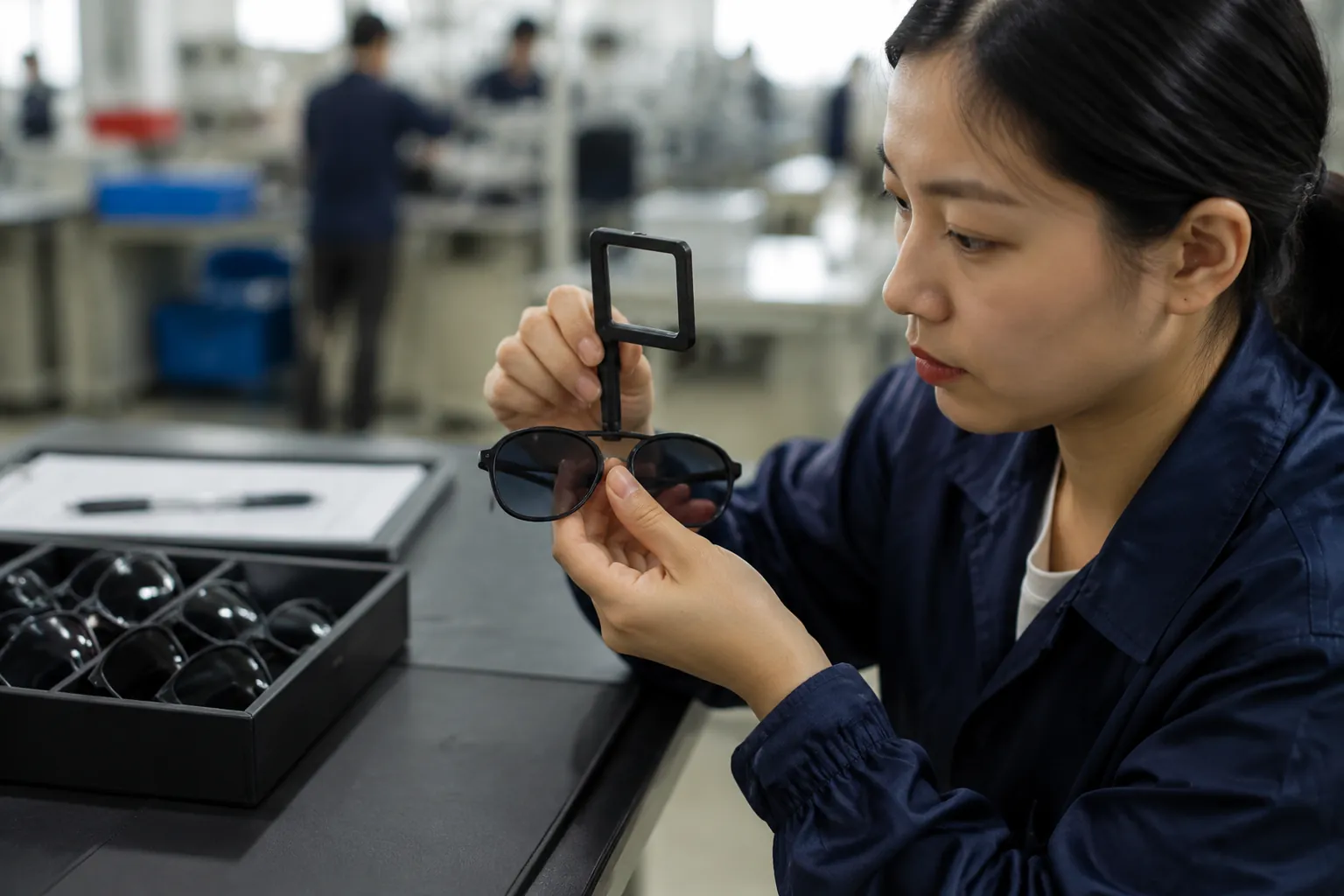
This article is for brand owners, importers, distributors, and retail buyers sourcing polarized sunglasses in volume. The goal is simple: reduce returns, chargebacks, and post-sale complaints before bulk production starts. Polarized lens programs carry more risk than non-polarized ones because the construction is more complex and more sensitive to lamination quality, heat, edging, and assembly stress. The fix is not complicated. Define the lens construction before sample approval closes. Check optical performance before and after lens insertion. Tie compliance documents to the exact SKU, or to a clearly equivalent lens construction, instead of relying on a generic catalog style.
Why polarized programs create more claim risk
Polarized sunglasses usually carry more claim risk than standard tinted lenses because the lens stack is more complex and less forgiving. A non-polarized sunglass lens may involve a substrate, tint, and coating. A polarized lens adds a polarizing film or laminated structure. That creates more opportunities for optical distortion, bond failure, haze, edge defects, and coating mismatch.
Most buyer complaints fall into three groups. First, distortion: the wearer sees waves, bent lines, eye strain, or a swimming effect, especially on wrapped sport frames or on lenses under assembly stress. Second, delamination: the lens edge starts to separate, haze develops, or bubbles appear after heat, humidity, storage, or transit exposure. Third, inconsistency: one lot differs from the approved sample in color, visible light transmission, polarization performance, mirror appearance, or surface quality.
These defects rarely start at final packing. They usually begin earlier during material selection, film lamination, cooling, curve forming, edging, coating, assembly, or storage. If you inspect only finished goods, you may catch defects. You are less likely to catch root cause in time to stop them from repeating. For B2B buyers, control should start at sample approval, continue through pre-production, and be checked again during inline and final inspection.
Small custom orders are not exempt. A short run can carry the same process weakness that later shows up in a larger reorder. Build claim prevention into approval and production. Do not bolt it on after packing.
Set the lens specification before you approve the frame
Many sourcing teams lock frame color, logo placement, hinge details, and packaging before they fully lock the lens specification. That creates avoidable risk. The lens specification affects claim exposure, compliance, production feasibility, and final cost. It also decides whether a style can realistically hit a target price without a change in construction or performance.
At minimum, the purchase specification should define lens material, base curve, center or edge thickness target, color, visible light transmission range, polarization requirement, coating stack, and cosmetic acceptance standard. It should also state the destination-market requirement, such as CE EN ISO 12312-1, ANSI Z80.3, or AS/NZS 1067. If chemical restrictions apply, add REACH requirements. For US programs, buyers may also request the supplier's FDA registration information together with relevant test documentation.
- Lens material: TAC polarized lenses are common in fashion programs; PC polarized lenses are often chosen when lower weight or higher impact resistance is required.
- Thickness target: Write the target on the specification sheet and review it against lens size, frame groove design, and intended use.
- Base curve matching: A 4-base, 6-base, or 8-base lens must match the frame design and approved sample. Mismatch raises insertion stress and optical failure risk.
- Color tolerance: Define how lot-to-lot color acceptance will be judged under agreed viewing conditions instead of relying on "same as sample."
- Coating structure: Hard coat, mirror, hydrophobic, anti-fog, or other surface treatments can affect adhesion, appearance, yield, and claim risk.
If these points stay vague, the supplier will fill in the gaps. Sometimes that works. Sometimes it produces a lens that meets the target cost but not the buyer's quality standard or risk threshold.
Know where distortion starts on the factory floor
Distortion is not one defect. Treating it that way hides the cause. It can come from warped substrate, uneven lamination pressure, polarizing film misalignment, poor cooling control, excessive curvature, edging stress, or frame groove pressure after insertion. On wrapped sunglasses, the same lens may look acceptable before fitting and then fail after assembly because the frame applies uneven stress.
Buyers should ask how the factory processes the polarized lens and how it checks optical quality at each stage. If a wrapped sport style shows optical strain, the supplier should be able to trace whether the issue comes from the laminated lens, the edging profile, the groove dimensions, or the assembly method. That matters only if the process is documented and the standard is held lot by lot.
- Confirm the raw lens or laminated lens source and material grade before sampling.
- Approve the exact lens color and polarization sample under both daylight and indoor lighting.
- Check visual distortion on flat and wrapped styles before mass production, not only on loose lenses.
- Verify edging parameters so the lens is retained securely without excessive groove stress or micro-chipping.
- Repeat optical checks after assembly because insertion can create the final defect.
Ask direct questions. Does the factory inspect incoming lens lots? Are rejected lots physically segregated? Are curve-specific jigs or process settings used for different base curves? Is there a defined post-assembly optical check? If the answer is vague, the risk is already in the program.
Delamination control is mostly about heat, moisture, and edge handling
Delamination claims often appear after the goods leave the factory. A pair may pass final inspection, then show haze, bubbling, or edge separation after container transit, warehouse heat, store display, or consumer use. That is why buyers need preventive controls, not just appearance checks at packing.
The lens edge is a common weak point in many polarized constructions. Rough edging, micro-chips, or poor edge finish make it easier for heat and moisture to attack the bond line. Excessive heat during processing can do the same. Storage matters too. Semi-finished or finished lenses kept in high heat before assembly may lose bond stability later, even if they looked fine when packed.
| Risk point | Typical cause | Buyer control | Likely complaint if missed |
|---|---|---|---|
| Lens edge | Rough cutting, chipped edge, weak finish | Approve edge finish standard and inspect cut samples before assembly | Bubbles or edge separation after wear |
| Lamination bond | Material incompatibility or unstable lamination process | Request lot-based QC records and review heat-exposure controls | Haze, peeling, reduced lens life |
| Assembly stress | Lens forced into a tight groove or twisted during fitting | Confirm fitting method and review pilot-run retain samples | Cracks, stress marks, later delamination |
| Transit heat | Hot container or warehouse storage | Review packing method and shipment heat-risk plan before dispatch | Bulk claims shortly after arrival |
Buyers should also understand material behavior. TAC polarized lenses are widely used because they can offer good appearance and cost control, but they may tolerate severe heat less well than some sport-focused constructions. PC polarized lenses are often chosen for active eyewear because of impact performance, but they still need proper coating adhesion and assembly control. The point is practical: material choice, frame geometry, and use case must match.
Do not wait for a warranty claim to discover that the lens edge was finished badly. Ask for cut-lens inspection photos, pilot-run retain samples, and post-assembly checks from the actual production lot.
Use a pre-production approval package, not one salesman sample
One hand-made sample is not enough to control a polarized program. A buyer should approve a package of reference points before bulk starts. That package should include the final frame, final lens construction, cosmetic standard, and a sample made with production-representative settings rather than bench-made shortcuts.
Approval speed matters only if the approved sample reflects the real production process. If the sample does not represent the actual lens construction, edging method, or assembly condition, a fast approval cycle still leads to the wrong result at scale.
- Golden sample: Signed reference pair for lens color, logo position, assembly fit, and cosmetic standard.
- Lens-only approval: Loose lens or cut lens sample confirming tint, polarization effect, mirror appearance, and coating appearance.
- Pilot-run sample: Short run made under actual production conditions, especially important for new molds, wrapped frames, or new lens constructions.
- Packaging reference: Pouch, polybag, tissue, and carton method because abrasive or high-pressure packing can mark lenses in transit.
Decoration details belong in the approval package too. A one-color pad print has different durability and placement tolerance than hot stamping, screen printing, heat transfer, or laser marking. If the frame looks premium but the packaging rubs the lenses or sheds fibers, the buyer still gets a quality claim. Good approvals cover the full sellable unit, not just the frame front.
Attach a defect agreement to the PO or quality appendix. Define what counts as critical, major, and minor defects for lenses, coatings, logos, and assembly. Without that document, every claim is harder to resolve after shipment.
Match inspection intensity to order size and risk level
QC should reflect commercial reality. A 50-pair trial order does not need the same inspection budget as a 5,000-pair program, but the control points should still exist. Order size changes how much sampling, traceability, and documentation you require. It should not change whether the lens is fit for sale.
Style risk matters too. A simple flat fashion frame with a basic polarized lens presents a different control challenge from a highly wrapped sport frame with mirror coating and tighter fit tolerances. Buyers should adjust inspection intensity to technical risk, not just order quantity.
| Order level | Typical buyer goal | Recommended QC focus | Commercial note |
|---|---|---|---|
| 50 pairs | Market test or sales sample run | Golden sample control, 100% appearance check, lens function confirmation | Best used to validate the written spec before scaling |
| 300 pairs | Small launch | Pre-production approval, inline checks, final AQL or agreed sampling | Useful stage to confirm repeatability before larger reorders |
| 1,000 pairs | Core seasonal order | Lot traceability, pilot-run review, stronger final inspection | One recurring defect can affect multiple cartons quickly |
| 5,000+ pairs | Program business | Documented process control across lots, dates, and operators | Low defect rates still create meaningful claim cost at scale |
Put simply: if you negotiate hard on price, negotiate just as hard on the written lens specification and inspection plan. Many disputes come from bad assumptions, not bad intent.
Check compliance documents against the actual lens
Compliance mistakes create a different kind of claim risk. A factory may hold valid certifications and testing capability, but buyers still need to confirm that the documents match the actual product configuration being ordered. A report for one lens category, color, or construction does not automatically cover another.
For sunglasses, buyers commonly ask suppliers to support programs with CE EN ISO 12312-1, ANSI Z80.3, AS/NZS 1067, REACH, FDA registration information, ISO 9001 quality management, and BSCI social compliance records where relevant. Those documents matter. The key question is narrower: does the approved frame-and-lens combination for this SKU meet the requirement for the destination market?
Request a document pack tied to the SKU or the closest matching construction, then verify the following points carefully:
- Lens category and transmission: The report should match the intended sunglass use and tint level, not just a similar lens color name.
- Material and construction: The test basis should reflect the actual polarized lens type being sold.
- Chemical compliance: REACH or related declarations should cover relevant components, not only one raw material line.
- Factory identity: The documents should connect clearly to the supplier producing the shipped goods.
Do not accept generic paperwork without cross-checking the bill of materials and approved sample. That is how customs issues, retailer compliance disputes, and private-label recalls start.
Build a claim-prevention checklist into the purchase order
The most reliable way to reduce post-sale complaints is to convert QC expectations into a purchase order attachment or quality agreement. Keep it short. Keep it testable. A concise document you can enforce is more useful than a long one full of vague language.
A workable polarized lens checklist should include approved sample references, lens construction details, color standard, visible light transmission requirement, defect definitions, inspection timing, carton marking, and retain-sample rules. It should also state what happens if any production material changes after approval. No substitution without written sign-off is a practical rule. It prevents many avoidable disputes.
For most serious buyers, three checkpoints are the minimum: pre-production sample approval, inline inspection during lens fitting and assembly, and final inspection on packed goods. If the style is new, highly wrapped, mirrored, or uses a new polarized construction, add a pilot-run confirmation before the full bulk run starts.
Practical rule: If the supplier cannot show how distortion and delamination are controlled during process, do not assume final inspection will catch everything.
That is the core lesson for B2B sourcing teams. Claims are cheaper to prevent than to negotiate. Polarized sunglasses become a stronger category when the lens standard is written, checked, and repeated lot after lot. The best suppliers are not the ones who say "no problem." They are the ones who can show where the risk sits, how they inspect it, and what records they keep when the order ships.
Have a custom sunglasses project in mind?
Send us your styles, target market and quantities and we will return a detailed quote with MOQ, lead time and a sample plan.
Get a QuoteWhy source this from Wenzhou with LumiShades
Wenzhou in Zhejiang Province is widely regarded as China’s eyewear manufacturing capital, producing a large share of the world’s sunglasses. That concentration matters to buyers: a deep local supply chain for acetate sheet, hinges, lens blanks, plating and packaging means shorter component lead times, easier color and material matching, and a workforce with decades of eyewear-specific skill. LumiShades has manufactured in this ecosystem since 2009, and our vertical integration — in-house injection molding, acetate cutting, CNC milling, lens tinting, decoration and quality control — means no part of your order is quietly subcontracted to a workshop you cannot audit.
For international buyers, that vertical control translates into accountability. When a single factory owns every step, defects are traced and fixed at source rather than bounced between vendors, and your specifications survive intact from first sample to bulk. For procurement review, buyers can request process records, approved samples, quality checkpoints and project-specific compliance files before placing a bulk order. Required testing and documentation are confirmed against the destination market and product specification rather than assumed from a generic certificate list. Explore our manufacturing capabilities and quality control process to see how this works in practice.
Frequently asked questions
What is the most common cause of polarized lens complaints after shipment? A common pattern is weak edge or bond-line performance that is not obvious at final packing but appears after heat or humidity exposure in transit or storage. To reduce this risk, ask for evidence of edge-finish control, review how the factory handles lamination and post-assembly checks, and keep retain samples from the shipped lot so later complaints can be compared to production references.
Should I approve only a finished sunglass sample or also a loose lens sample? Approve both. The finished pair confirms assembly fit, appearance, and whether frame stress affects visual quality. The loose or cut lens sample helps you lock tint, polarization effect, mirror appearance, and coating appearance before bulk cutting and fitting. Put both approvals in writing and reference them in the PO or quality appendix.
How do I reduce risk on a low-MOQ 50-pair custom order? Use the same written lens specification you would use for a larger order, require a signed golden sample, and request a 100% finished-goods appearance check. Also ask the supplier to confirm the exact lens material, color, and construction used for the short run, because that small order may become the benchmark for a later reorder.
Can one compliance report cover every polarized lens color in my collection? Not automatically. Lens transmission, category, mirror finish, and construction can change by color and coating stack. Review whether each SKU matches the tested configuration or a clearly equivalent one, and ask the supplier to identify any colorways that need separate confirmation under CE EN ISO 12312-1, ANSI Z80.3, or AS/NZS 1067 for your destination market.
At what order size should I require a pilot run? Require a pilot run whenever the technical risk justifies it, especially for new styles, wrapped frames, new mirror colors, or new polarized constructions. Even below 1,000 pairs, a pilot run is useful if assembly stress or lens consistency is uncertain. Ask for pilot-run samples from actual production conditions and approve them before full bulk assembly starts.
Ready to start?
Explore our sport wrap sunglasses or request a quote — our sales team replies within 12 hours.
Request a Quote