
TAC vs. PC Polarized Lenses: Best Fit by Price Tier
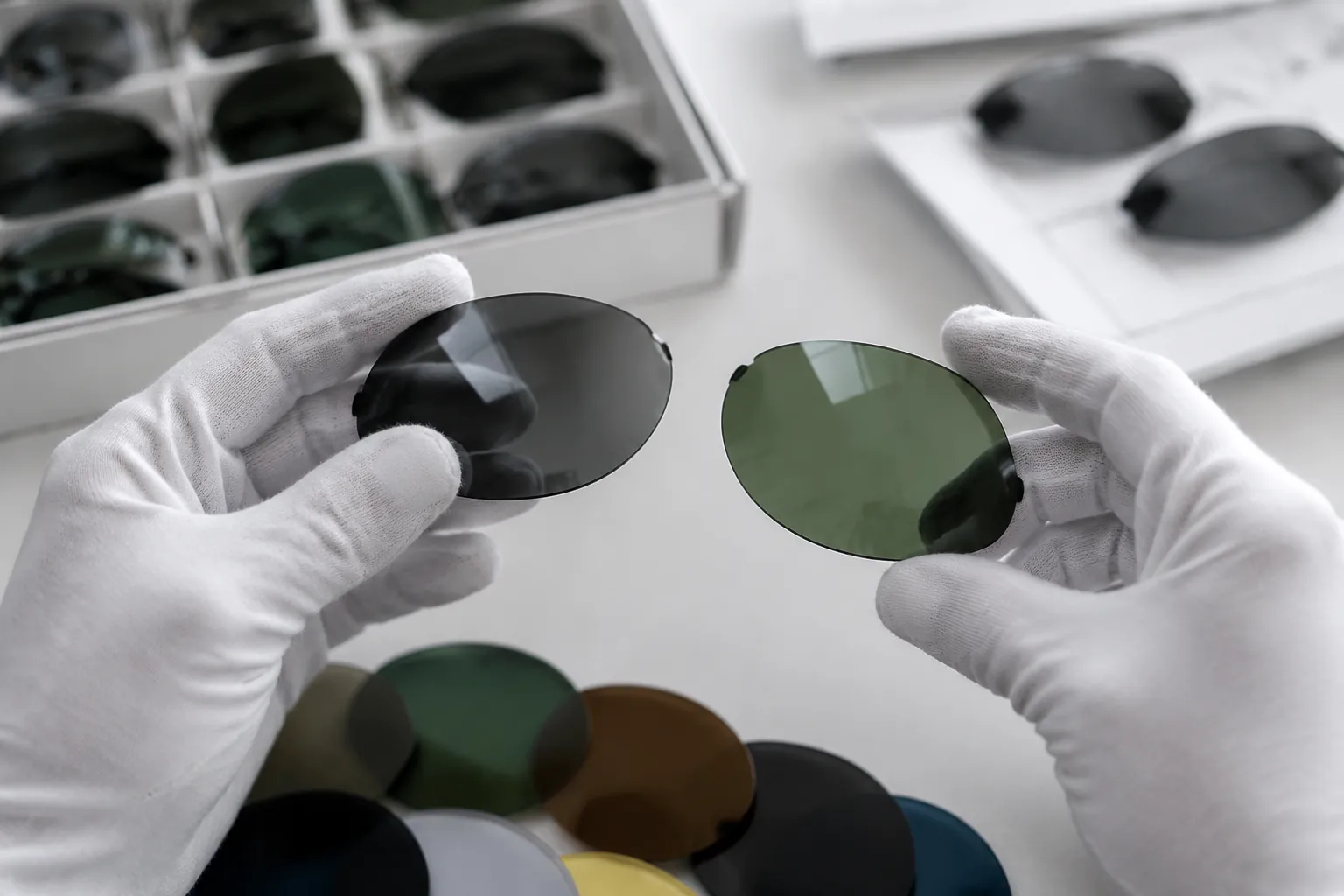
This guide is for brand owners, importers, distributors, and retail buyers comparing two common polarized lens constructions: TAC and PC. The choice is not cosmetic. It affects unit cost, assembly tolerance, breakage risk, compliance workflow, and how reliably a style moves from sample approval into repeat production. A lower-cost lens can be the right call, but only if the frame design, use case, and QC controls support it. Match the lens to the job. That helps protect margin, shipment timing, and retail consistency.
Start with lens construction, not just the word "polarized"
Buyers often ask for polarized lenses as if polarization were a single material specification. It is not. TAC and PC polarized lenses are built differently, behave differently in production, and fit different commercial needs.
TAC usually refers to a laminated polarized lens construction. It typically combines several bonded layers, including a polarizing film and protective outer layers. The exact stack-up can vary by supplier, so buyers should confirm the actual construction instead of assuming all TAC lenses are the same.
PC refers to polycarbonate as the lens substrate. A PC polarized lens uses polycarbonate as the base material, with polarization added through the supplier's process. In practice, buyers usually choose polycarbonate where higher impact resistance and greater toughness matter.
The difference goes beyond glare reduction. It affects edging, frame insertion, transport heat, and day-to-day wear. A laminated TAC lens may be less tolerant of high assembly stress or rough handling than a polycarbonate-based lens. A PC lens often suits harder use. Simple point: a giveaway sunglass, a fashion retail style, and a sport wrap should not all use the same default polarized lens.
The commercial differences that matter most
| Factor | TAC Polarized | PC Polarized | Buyer Impact |
|---|---|---|---|
| Typical cost position | Often lower, depending on construction and order requirements | Often higher, especially when durability is prioritized | Important when balancing target FOB against expected use conditions |
| Impact resistance | Varies by construction, but generally lower than polycarbonate | Generally higher | Relevant for kids, sport, and active outdoor programs |
| Edge and fitting tolerance | Can be less forgiving in high-stress frame designs | Often more tolerant during shaping and insertion | Important for wraps, sharp corners, and tighter frame fit |
| Heat and process sensitivity | Laminated construction requires controlled processing and handling | Still requires process control, but is often selected for tougher use | Relevant for assembly, transport, and storage conditions |
| Common program fit | Promo, souvenir, casual fashion, opening-price retail | Sport, kids, driving, outdoor utility, higher-durability retail | Use case should drive lens choice |
The headline is simple. TAC often works where price pressure is high. PC becomes more attractive where breakage risk, rough handling, or harder use is part of the program.
For sourcing teams, the comparison is not just raw lens cost. It is total risk: returns, inspection consistency, assembly yield, and whether the lens spec matches how the product will actually be used.
Where TAC polarized makes sense
TAC polarized lenses are often the practical choice when the product needs a polarized feature but the program must stay within a controlled cost structure. Common applications include souvenir shops, promotional merchandise, event programs, opening-price fashion sunglasses, and value-oriented retail assortments.
- Best price band: promo to value or lower-mid retail
- Best frame types: standard curves, simpler eye shapes, lower-stress assembly
- Main advantage: supports a polarized product story at a more accessible cost in many programs
- Main caution: should be validated carefully for hard-use environments, kids, or aggressive wrap frames
TAC is usually strongest when frame design is straightforward and end use is normal casual wear, not repeated drops or impact exposure. It also makes sense when the buyer's priority is adding polarization at a fixed entry price rather than paying for a tougher technical spec.
This does not make TAC a low-quality default. It means fit matters. Buyers should confirm lens construction, test the lens in the intended frame, and agree on inspection criteria before approving bulk production.
Where PC polarized earns the extra cost
PC polarized lenses usually justify higher cost in channels where durability matters more than hitting the lowest possible FOB. Polycarbonate is commonly used for sunglasses that may be dropped, flexed, packed loosely, or worn during active use. That makes it a common choice for sport-influenced styles, fishing and driving programs, kids' sunglasses, and outdoor utility products.
PC can also provide more process tolerance in some constructions. When a frame has stronger curvature, tighter lens seating, or sharper corners, insertion stress increases. In those conditions, a laminated TAC lens may be more vulnerable to edge stress or fit-related damage, while a polycarbonate lens may leave a wider margin during assembly. Still, the result depends on frame design, lens thickness, edging quality, and factory process control.
This matters in repeat production. A lens that works in an early sample can still create problems in volume if frame fit is tight or the process window is narrow. So buyers should evaluate the finished frame-and-lens combination, not just the lens label on a quote sheet.
Do not specify PC just because a style looks more premium. Ask a harder question: does the end market, use case, and return environment justify the added cost? If not, a well-controlled TAC specification may be the better sourcing decision.
Compliance is mandatory, and lens choice changes risk
Check lens selection against the destination market before sample approval, not after materials are ordered. Buyers often work against standards and systems such as CE EN ISO 12312-1, ANSI Z80.3, AS/NZS 1067, REACH, FDA registration, ISO 9001, and BSCI. Which ones matter depends on the product category, target market, and buyer requirement.
Polarization does not make a sunglass compliant by itself. The finished product still needs to meet relevant requirements for UV protection, visible light transmittance category, optical performance, labeling, and, where applicable, other physical or chemical criteria. In many programs, the buyer or lab tests the complete finished product, not just raw material declarations.
- Confirm the destination market and required standard before approving samples.
- Lock lens color, transmittance category, and polarization orientation before production release.
- Decide early whether the customer requires finished-product testing, material documentation, or both.
- Verify REACH or other chemical compliance requirements for coatings, plastics, inks, and metal components where relevant.
TAC and PC can both be used in compliant sunglasses, but the risk points differ. TAC needs close control of lamination quality, handling, and assembly stress. PC reduces some mechanical concerns, but it still needs correct tint control, optical inspection, and disciplined processing. Most compliance failures come from inconsistent execution or incomplete documentation, not from the lens label alone.
Factory process decides the real outcome
On a quote sheet, lens sourcing can look simple. On the factory floor, results depend on execution. The same nominal lens specification can perform very differently based on edging quality, curve consistency, insertion method, and final inspection standards.
That is why buyers should review factory process as well as lens type. A suitable lens can still fail in production if the edge finish is poor, the frame fit is too tight, or handling controls are weak.
- Lens cutting and edging: rough or inconsistent edges can increase chip risk and insertion stress
- Curve control: stronger base curves require tighter consistency to reduce distortion and fit issues
- Tint consistency: visible variation can create problems in retail assortments and repeat orders
- Decoration sequence: printing, engraving, or trim installation should be managed to avoid lens surface damage
- Final QC: inspect polarization orientation, cosmetic defects, fit, alignment, and packing accuracy before shipment
Ask where defects are checked: before lens insertion, after assembly, and before packing. A supplier that can explain those control points clearly is easier to assess than one that answers only in general terms.
Lead time, MOQ, and price-break logic buyers should use
Lens choice should track the order stage, not follow a fixed rule. At sample stage, the goal is usually to validate appearance, fit, and specification. In production, the goal expands to repeatability, compliance, and acceptable defect control. Late changes to lens type, color, category, or coating can disrupt both scheduling and test planning.
MOQ and price-break logic matter too. Small trial runs can help test a new account or market, but they do not always reflect the economics of a repeat program. Buyers should compare the same style across likely reorder volumes instead of assuming the lowest-volume setup is the right long-term choice.
| Order Stage | Typical Goal | Lens Logic | Commercial Priority |
|---|---|---|---|
| Low-volume trial | Test look, fit, and market response | Avoid over-specifying unless the channel or standard requires it | Validation and speed |
| Mid-volume reorder | Improve consistency and refine packaging | Compare TAC and PC against likely return exposure and assembly performance | Balanced cost and quality |
| Scaled repeat business | Protect consistency across larger production runs | Choose the lens based on total landed cost, process stability, and risk control | Yield, repeatability, and claims management |
Many buyers start with the lens that fits the opening price target, then reassess after they have real feedback on sell-through, damage, or returns. That is a disciplined sourcing approach. It ties specification changes to evidence, not assumption.
A practical decision framework by program type
If you need one fast rule, use a three-part filter: price band, expected abuse level, and retailer tolerance for returns or defects.
| Program Type | Recommended Lens Direction | Why | Watch-Out |
|---|---|---|---|
| Promo or giveaway | TAC polarized | Often better for controlling cost at entry-level price points | Do not assume it is suitable for rough-use expectations |
| Mid-market fashion retail | TAC or PC | Depends on target retail price, frame stress, and return policy | Validate fit and finished-product performance before approval |
| Sport, kids, outdoor utility | PC polarized | Generally better aligned with durability-focused use cases | Confirm finished-product compliance and lens category early |
| High-volume proven SKU | Compare both using actual field feedback | At scale, consistency and return exposure matter as much as unit cost | Do not decide from showroom samples alone |
Short version: TAC often fits aggressive price tiers. PC often fits harder use. If the program sits in the middle, do not compare lens price alone. Review frame geometry, assembly tolerance, shipping conditions, testing needs, and the retailer's tolerance for claims or returns. That is how disciplined buyers choose the right polarized lens construction.
Have a custom sunglasses project in mind?
Send us your styles, target market and quantities and we will return a detailed quote with MOQ, lead time and a sample plan.
Get a QuoteWhy source this from Wenzhou with LumiShades
Wenzhou in Zhejiang Province is widely regarded as China’s eyewear manufacturing capital, producing a large share of the world’s sunglasses. That concentration matters to buyers: a deep local supply chain for acetate sheet, hinges, lens blanks, plating and packaging means shorter component lead times, easier color and material matching, and a workforce with decades of eyewear-specific skill. LumiShades has manufactured in this ecosystem since 2009, and our vertical integration — in-house injection molding, acetate cutting, CNC milling, lens tinting, decoration and quality control — means no part of your order is quietly subcontracted to a workshop you cannot audit.
For international buyers, that vertical control translates into accountability. When a single factory owns every step, defects are traced and fixed at source rather than bounced between vendors, and your specifications survive intact from first sample to bulk. For procurement review, buyers can request process records, approved samples, quality checkpoints and project-specific compliance files before placing a bulk order. Required testing and documentation are confirmed against the destination market and product specification rather than assumed from a generic certificate list. Explore our manufacturing capabilities and quality control process to see how this works in practice.
Frequently asked questions
Is TAC polarized always cheaper than PC polarized? Usually, TAC polarized lenses are quoted below PC polarized lenses, but buyers should not assume that is automatic. The price gap depends on construction, thickness, coatings, color, frame design, and order volume. For a real comparison, ask the supplier to quote the complete finished sunglass in both versions, confirm whether the lens specification changes any testing requirement, and review the likely effect on assembly yield and return risk.
Which lens is better for kids' sunglasses? PC polarized is usually the better starting point for kids' sunglasses because polycarbonate is widely used where higher impact resistance is needed. Buyers should still verify the complete finished product against destination-market requirements, confirm that the lens category suits the intended use, and check that the frame design does not create unnecessary assembly stress or sharp edges.
Can TAC polarized lenses meet CE EN ISO 12312-1 or ANSI Z80.3? Yes. TAC polarized lenses can be used in sunglasses that meet CE EN ISO 12312-1 or ANSI Z80.3 if the complete finished product is designed, manufactured, and tested correctly. Do not rely on the word TAC alone. Ask for relevant test evidence for the finished style or confirm what additional testing will be required before shipment.
When should I switch from TAC to PC in a repeat order? Consider switching when one of three things happens: the product moves into a harder-use channel, the frame design creates recurring assembly or breakage issues, or field feedback shows the TAC version is creating too much risk. The practical step is to review return reasons, defect patterns, and any compliance or fit issues from the first run, then re-cost the style in PC before the next purchase order.
Does PC polarized slow down production? Not by default. Production timing depends more on specification clarity, sample approval, testing requirements, and change control than on the lens label alone. To keep lead times predictable, lock the lens type, color, transmittance category, and coating before bulk approval, and confirm whether any market-specific compliance testing must be completed before shipment.
Ready to start?
Explore our rimless sunglasses or request a quote — our sales team replies within 12 hours.
Request a Quote