
Tinted vs Polarized vs Mirror: Build a Profitable Range
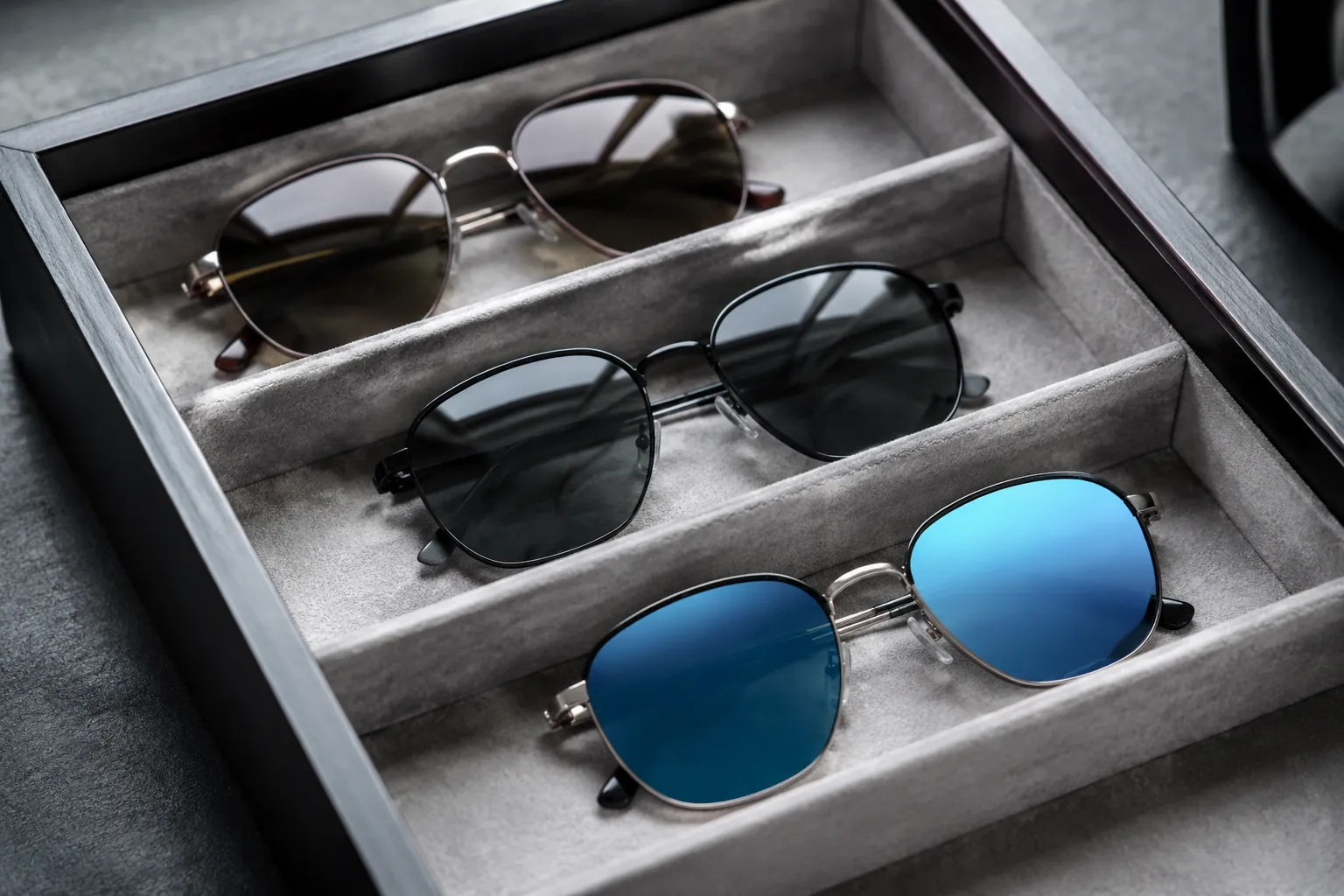
This guide is for brand owners, importers, distributors, and retail buyers building a sunglasses range that has to sell through, not just look good on a line sheet. The core decision is not which lens looks best on its own. It is which lens mix fits the channel, can be produced consistently, supports the right compliance file, and still leaves margin after freight, returns, and markdowns. Start there. Then choose between tinted, polarized, and mirror with a clear commercial plan.
Start with channel economics, not lens taste
Most lens assortment mistakes start too early in the design conversation. One person likes blue mirror. Another prefers green tint. The range ends up built around opinion instead of channel logic. That usually means too many SKUs and weak replenishment.
A profitable lens mix starts with how the shopper buys, how fast the product must communicate value, and how much explanation the sales environment can support.
In ecommerce, shoppers usually see a thumbnail, a price, and a short feature list before they decide to click. That favors a tight offer: standard tinted lenses as the volume base, then a smaller polarized upgrade on proven shapes. Too many lens options complicate photography, create uneven product pages, and increase return risk when the delivered lens does not match the screen image. Mirror can work online, but only if photography is tightly controlled for lighting, white balance, and color naming.
Optical and other staff-assisted channels work differently. A trained salesperson can explain glare reduction, lens category, use-case fit, and why polarized costs more. That support makes polarized easier to justify. Fashion chains are different again. They usually sell on shape, color, and timing, not on technical lens education. Resort stores depend on display impact and fast conversion. Promotional programs are stricter still: low unit cost, broad compliance coverage, easy replenishment, and low complaint risk usually matter more than lens complexity.
Before choosing colors or finishes, buying teams should lock four decisions:
- Will the product be self-selected, digitally sold, or staff-assisted?
- Is the purchase driven mainly by function, fashion, gifting, or event branding?
- How much retail price headroom exists between a base lens and an upgraded lens?
- How many active SKUs can the channel realistically support without slowing sell-through?
Use a simple rule. Every added lens finish has to earn its place through conversion, higher ticket, or stronger display impact. If it does not, it is probably adding sample cost, split MOQ pressure, and inventory risk.
Know what each lens type changes
Tinted, polarized, and mirror are not interchangeable. They solve different commercial problems, and they do not travel through the factory the same way.
Tinted lenses are the base commercial lens in most sunglasses programs. They reduce visible light through solid coloration, gradient tinting, or dyed lens material, depending on the construction. Carryover colors such as smoke, brown, and green are usually easier to match on repeat orders than novelty fashion tints. In production, standard tinted lenses usually offer the best repeatability and the simplest process route. That is why they work well in replenishment programs.
Polarized lenses add a filtering layer that reduces reflected glare from roads, water, windshields, and other flat surfaces. The commercial upside is clear: stronger technical value and a more credible premium story. The trade-off is just as clear. Quality control has to be tighter. The factory must control film alignment, lamination quality where applicable, haze, edge integrity after shaping, and stress after lens mounting. If those controls slip, the product may show distortion, stress marks, or uneven polarization performance.
Mirror lenses add a reflective surface coating, usually to increase visual impact and trend appeal. That makes them strong in resort, travel, and fashion-led channels. But mirror is more appearance-sensitive than a standard tint. Small coating inconsistencies, batch color drift, pin marks, and fine scratches show up fast under store lighting and sunlight. Buyers often underestimate how much approval attention mirror needs.
| Lens type | Main selling point | Typical factory route | Best-fit channels | Main trade-off |
|---|---|---|---|---|
| Tinted | Lower cost, easy assortment, simple story | Base lens plus tinting or dyed material | Ecommerce, promotional, entry fashion | Lower technical value perception |
| Polarized | Glare reduction, premium positioning | Polarizing layer within an approved lens construction | Optical, outdoor retail, premium ecommerce | Higher cost and stricter QC requirements |
| Mirror | Strong visual impact, impulse appeal | Base tinted lens plus flash or mirror coating | Resort, fashion retail, seasonal capsules | Coating consistency and scratch visibility |
| Polarized mirror | Function plus display appeal | Polarized construction plus mirror coating | Premium sport and resort programs | Highest complexity and the most appearance-sensitive route |
That is the sourcing reality. These are not just cosmetic options. They come with different cost structures, defect modes, reorder stability, and sales stories.
Build the assortment by channel
A good range does not give every channel the same lens menu. It gives each channel a disciplined mix that matches how the product is sold.
Ecommerce: Keep the range narrow. Use standard tinted lenses as the base and add polarized only on proven frame shapes or stronger price tiers. Keep mirror selective. Use plain naming such as smoke polarized, brown tint, or silver mirror rather than internal trade names. Product photography must be controlled so lens appearance stays consistent across PDP images.
Optical: Give polarized more room because staff can explain the use case and support the price step. Keep technical information ready for buyers who ask about lens category, visible light transmission, and market-specific test alignment.
Fashion retail: Lead with visual coherence. Tinted and mirror usually do most of the work. Polarized should be selective and attached only to shapes where the retail uplift still fits the shelf architecture. Too many technical variants in this channel often create markdown risk, not extra margin.
Resort and travel retail: Mirror often performs well because the product has to attract attention quickly from display. Blue, silver, rose gold, and warm flash mirrors can read strongly in bright ambient light. Still, keep a lower-price tinted fallback so the range does not open only at a premium price point.
Promotional programs: Be blunt about budget and risk. Standard tinted lenses are usually the safest core because they are easier to approve, easier to repeat, and less complaint-prone. Polarized works only when the client has a clear premium brief and enough unit value to carry it. Mirror can work for event-driven campaigns, but it usually tightens cosmetic tolerance and slows approvals.
- Use tinted as the volume base across most channels.
- Use polarized where the sales environment can explain the value.
- Use mirror where display impact directly affects conversion.
- Avoid equal weighting of all three lens types in the same launch.
The best assortments are usually simple. A small number of repeatable lens choices tied to the right channels will beat a broad menu spread thinly across low-volume SKUs.
Margin logic: where the upgrade works
Lens upgrades make sense only when the channel can recover the extra cost through retail price, higher conversion, or lower markdown dependency.
At factory level, pricing usually improves with volume, but only when the program is consolidated. A supplier may allow low starting MOQs for sampling or pilot runs, then improve pricing at higher quantities. So buyers should evaluate lens upgrades against the actual order structure, not against an attractive bulk quote taken from a different program.
As a broad sourcing rule, polarized usually adds a meaningful premium over a comparable standard tinted lens because of added material and tighter quality control. Mirror usually adds a smaller but still real upcharge because of coating, yield, and cosmetic inspection sensitivity. Polarized mirror adds both. The real question is not whether the lens costs more. It is whether the price step creates more gross margin dollars or simply slows sell-through and leaves stock behind.
| Channel | Base lens recommendation | Upgrade strategy | Commercial logic |
|---|---|---|---|
| Ecommerce | Tinted | Add polarized on top sellers | Protects entry price while creating a clear upsell path |
| Optical | Tinted and polarized split | Mirror only on selected fashion styles | Staff support helps justify premium lens pricing |
| Fashion retail | Tinted | Mirror on trend frames | Appearance usually sells faster than technical storytelling |
| Resort | Tinted plus mirror | Polarized mirror on premium subset | Display impact comes first, function second |
| Promotional | Tinted | Very limited premium options | Budget control and delivery reliability matter most |
Order size matters. A small buy split across too many lens combinations weakens unit economics, complicates approvals, and raises the risk of slow-moving residual stock. In most private-label programs, fewer lens routes with deeper quantities win.
Production realities to factor in early
Lens choice affects more than cost. It changes the process route, approval workload, defect risk, and delivery reliability. Treat it as critical-path planning.
A factory with stronger in-house control over molding, acetate processing, CNC work, lens tinting, decoration, and final QC will usually manage consistency better than a supply chain that outsources each step. Even then, lens types do not behave the same way. Standard tinted lenses are generally the most stable route because there are fewer variables. Polarized lenses need extra checks on polarization performance, lamination quality where relevant, and edge condition after shape cutting. Mirror needs coating uniformity checks, adhesion review, and stricter cosmetic inspection because defects are easier to see on reflective surfaces.
Development timing depends on the starting point. Straightforward samples can move quickly when the frame tooling already exists and the lens route is standard. Bulk timing is more predictable when lens colors, coatings, and decoration methods all sit on approved, repeatable specifications. Custom lens colors, non-stock mirror shades, mixed decoration methods, or multiple logo placements add approval cycles and scheduling risk. No surprise there.
Buyers should confirm at least these points before PO release:
- Lens base color, target visible light transmission, and the tolerance band used for approval
- Polarized construction type, and whether the approved sample matches the intended bulk build
- Mirror coating standard, including expected color tolerance, reflectivity appearance, and batch-match expectation
- Scratch, adhesion, and cosmetic inspection method, including the agreed inspection level
- Decoration route, such as pad printing, laser marking, hot stamping, or metal logo plate, because each affects scheduling and reject risk differently
- Carton pack-out by SKU and barcode logic to reduce receiving and warehouse errors on arrival
Short version: simple lens menus are easier to ship consistently. Complex menus can work, but only with disciplined approvals, clear tolerances, and calendar buffer.
Compliance is part of the product
For overseas buyers, compliance is not an afterthought. It is part of product definition. Sunglasses sold into different markets may require testing or technical files aligned to standards such as CE EN ISO 12312-1, ANSI Z80.3, or AS/NZS 1067, depending on destination and product category. Material controls such as REACH also need active management, especially when coatings, inks, nose pads, or decorative components are involved. Some buyer workflows also request FDA registration records from the supplier where relevant to the supplier setup and the customer's own import process.
Lens choice matters because it changes what must be controlled. If a product is sold as polarized, the production lens has to match the approved polarized construction in both the test file and the approved sample. If the supplier switches to a different build after approval, the paperwork may no longer represent the bulk goods. Mirror creates a different risk. Visible light transmission and cosmetic appearance can shift if the coating recipe changes, even if the frame stays the same.
A disciplined supplier should be able to support manufacturing under systems such as ISO 9001 and social compliance frameworks such as BSCI, while also providing product-specific test support from the approved product family. Buyers still need to verify that the documents match the SKU family being ordered, not a generic report from another style.
- Ask for the test basis for the exact lens family or the nearest technically equivalent approved family.
- Confirm that coatings, decoration, and material substitutions do not change approved performance.
- Keep a sealed or clearly identified golden sample for each lens variant and approved colorway.
- Block unapproved substitute lenses from repeat orders, even if they look similar.
This sounds administrative. It is really commercial risk control.
Reduce returns and dead stock
The wrong lens mix does not always fail at launch. More often, it shows up later as returns, complaint credits, and aging inventory. The fix is not complex. It just requires discipline.
First, reduce option count at launch. If you are testing a new frame family, start with one dependable tinted lens and one premium version, not several speculative finishes. Second, match lens choice to the message the channel can actually communicate. A promotional buyer rarely needs multiple technical lens stories. Third, standardize carryover colors. Smoke, brown, and green are usually easier to replenish across seasons than novelty mirror shades that are harder to match and harder to repeat.
For ecommerce, photograph mirror honestly. Over-saturated images create avoidable returns because the delivered product often looks softer, darker, or less reflective than the marketing image. For optical and distribution channels, train sales teams on the difference between light comfort, glare reduction, and cosmetic finish. They are not the same thing.
A practical stock model is:
- Keep one to two core tinted colors across most carryover frames.
- Add polarized only to proven shapes, outdoor-led styles, or channels that can explain the premium.
- Use mirror in limited seasonal, resort, or capsule quantities rather than as a full-range default.
- Review sell-through by lens feature as well as by frame shape, because weak lens variants often hide inside otherwise good frame performers.
Most dead stock is not caused by one bad frame. It comes from too many weak lens variants attached to otherwise viable frames, with quantities too shallow to support clean reorders or orderly markdowns.
A practical buying formula for the next order
If you need a simple decision model, start with the channel and build a three-layer lens structure. Choose one base lens that covers most of the volume. Add one premium upgrade only where the sales environment can support the higher price. Add one visual statement option only if display impact materially affects conversion.
For many buyers, the formula is stable: tinted for volume, polarized for premium positioning, mirror for attention. The ratio changes by channel, but the logic stays the same. A self-service ecommerce assortment may lean heavily toward tinted with a narrow polarized upsell. An optical assortment may support a stronger polarized mix. A resort assortment may need mirror-led presentation with a smaller polarized or polarized-mirror subset behind it.
If you are sourcing from a manufacturer with in-house lens tinting, molding, acetate work, CNC processing, decoration, and QC, use that capability carefully. Consolidate frame families, keep lens specifications literal, and avoid unnecessary SKU fragmentation. MOQ flexibility helps with testing, but the real advantage appears when the range is concentrated enough to improve pricing, simplify quality control, and support clean replenishment.
Good buying is not about offering every possible lens finish. It is about choosing the few lens routes that fit the channel, comply cleanly, repeat consistently, and leave enough margin after claims, discounts, and operational friction. That is what scales.
Have a custom sunglasses project in mind?
Send us your styles, target market and quantities and we will return a detailed quote with MOQ, lead time and a sample plan.
Get a QuoteWhy source this from Wenzhou with LumiShades
Wenzhou in Zhejiang Province is widely regarded as China’s eyewear manufacturing capital, producing a large share of the world’s sunglasses. That concentration matters to buyers: a deep local supply chain for acetate sheet, hinges, lens blanks, plating and packaging means shorter component lead times, easier color and material matching, and a workforce with decades of eyewear-specific skill. LumiShades has manufactured in this ecosystem since 2009, and our vertical integration — in-house injection molding, acetate cutting, CNC milling, lens tinting, decoration and quality control — means no part of your order is quietly subcontracted to a workshop you cannot audit.
For international buyers, that vertical control translates into accountability. When a single factory owns every step, defects are traced and fixed at source rather than bounced between vendors, and your specifications survive intact from first sample to bulk. For procurement review, buyers can request process records, approved samples, quality checkpoints and project-specific compliance files before placing a bulk order. Required testing and documentation are confirmed against the destination market and product specification rather than assumed from a generic certificate list. Explore our manufacturing capabilities and quality control process to see how this works in practice.
Frequently asked questions
Should I launch polarized on every frame in a new collection? Usually not. Start polarized on proven frame shapes, outdoor-led styles, or channels where staff can explain glare reduction and justify the higher retail. For a new collection, a practical structure is one core tinted version and one selective polarized upgrade. Before approval, confirm that the factory can provide a matching sample, the intended polarized construction for bulk, and test support aligned to the destination market standard.
How much more lead time should I allow for polarized or mirror lenses? Do not use a fixed extra-day rule across all programs. Lead time depends on whether the lens route is already approved, whether the color or coating is standard, and whether decoration is also changing. Ask the supplier to break timing into sample development, approval revisions, raw-material readiness, and bulk production. If the program uses a new polarized construction, a non-stock mirror color, or multiple cosmetic approvals, add buffer before the ship window and require written confirmation of the approval sequence.
Which lens type is safest for promotional programs? Standard tinted lenses are usually the safest choice for promotional programs because they keep unit cost lower, simplify approvals, and reduce cosmetic complaint risk. If a client wants a premium version, ask whether the campaign objective is functional value or visual impact. Choose polarized only when the budget, target retail value, or gifting level can support it. Choose mirror only when appearance is central to the campaign and the client accepts tighter cosmetic approval standards.
What documents should I ask for before placing a bulk order? Ask for documents tied to the actual product family and destination market: test support aligned to CE EN ISO 12312-1, ANSI Z80.3, or AS/NZS 1067 as applicable; REACH support for relevant materials and components; FDA registration records where relevant to the supplier setup and your import workflow; and factory system documents such as ISO 9001 and BSCI if required by your customer. Also request confirmation that the approved sample, lens construction, lens color, and any coating used for bulk match the basis of the compliance file.
Is mirror better than polarized for resort stores? Not automatically. Mirror usually gives stronger first visual impact, which matters in resort retail where shoppers often decide from display. Polarized gives the stronger functional story because it reduces reflected glare. Many resort assortments work best when mirror is used on display-led styles and polarized or polarized-mirror is reserved for a smaller premium subset. To choose between them, review your opening price target, the store's ability to explain function, and whether the range needs fast impulse conversion or a stronger premium story.
Ready to start?
Explore our cat-eye sunglasses or request a quote — our sales team replies within 12 hours.
Request a Quote