
Hard Coating and Retail Sunglass Returns
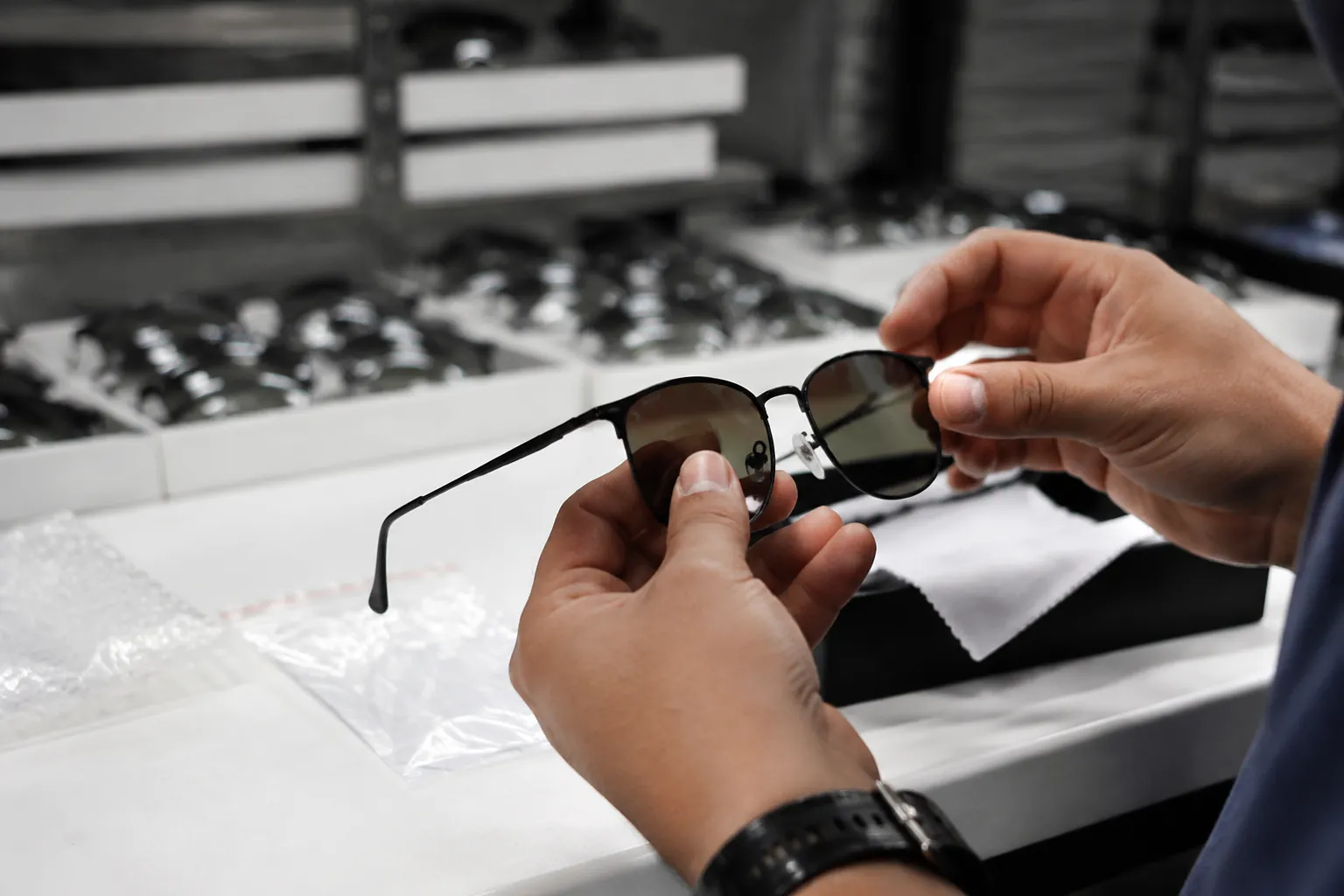
This article is for brand owners, importers, distributors, and retail buyers deciding whether lens hard coating is worth the added cost in a bulk sunglasses program. In many retail-facing programs, it is. Hard coating does not make a plastic lens scratch-proof. It does improve resistance to everyday abrasion, which can reduce the cosmetic damage that leads to returns, replacements, and customer complaints. In wholesale sunglasses, even a small per-pair upcharge can be easier to justify than one avoidable quality issue. The real question is not only, "What does the coating cost?" It is, "Will it lower total cost after handling, packing, retail display, e-commerce returns, and repeat orders are counted?"
What hard coating changes
A hard coat is a clear protective layer applied to the lens surface to improve abrasion resistance on plastic lenses. In sunglasses, it is commonly used on polycarbonate (PC), acrylic, TAC polarized constructions, and some nylon lenses. These materials are light and common in production. They are also easier to mark than glass.
The coating is thin. The effect is not. Buyers often treat it as a small unit-cost choice, but the damage shows up later in packing, transit, retail handling, and consumer cleaning. A lens can pass factory inspection and still pick up visible wipe marks or fine scuffs before it reaches the customer if it is uncoated or poorly protected.
Hard coating does not make a lens scratch-proof. It improves resistance to routine abrasion. That is enough to matter. Many returns are not caused by structural failure or compliance failure. They come from cosmetic complaints such as "arrived scratched," "looks used," "marks too easily," or "poor finish for the price."
- Uncoated PC and acrylic lenses are more likely to show cosmetic rub marks during packing and handling
- Hard-coated lenses usually hold first-use appearance better, especially on dark tints and mirror finishes
- Retail buyers often judge lens quality in seconds, before they assess the frame
So the coating is usually a sourcing and margin decision, not just a technical one.
Where no-coating programs fail
Uncoated lenses are not always wrong. They can work for ultra-low-cost giveaways, short promotions, or campaigns where the product is not expected to see repeated use. The problem starts when a buyer approves an uncoated sample under controlled conditions and then ships it into a less controlled channel.
The failure points are ordinary. Dust trapped in pouching. Lens-to-lens contact in bulk inner packs. Vibration during transit. Rough cleaning at retail counters. Consumers wiping lenses with shirt hems, tissue, or paper products. On softer surfaces, those actions can leave visible hairline marks.
Some lens and finish combinations are more complaint-prone than others. Dark smoke, black, and deep green lenses can show fine wipe marks more clearly under indoor light. Mirror coatings make cosmetic defects easier to notice because the reflective surface reveals every rub line. TAC polarized lenses add another variable: even when the outer coating is acceptable, poor lamination control can create haze, edge stress, or appearance inconsistency that buyers may simply call "bad lenses."
Programs most exposed to these complaints include:
- E-commerce orders, where customers inspect lenses closely under bright indoor light
- Gift-box and influencer kits, where presentation matters as much as function
- Department store and chain retail displays, where many shoppers handle the same pair
- Children's, sports, and festival styles, where repeated cleaning and rough storage are common
- Distributor programs with multiple warehouse transfers before final delivery
The return note may say "hazy lens," "used-looking," "poor finish," or "scratched on arrival." Different wording. Same issue.
How buyers should compare options
The useful comparison is not coated price versus uncoated price in isolation. It is total landed quality cost. If a hard coat adds a small amount per pair, the factory cost may look minor. But replacement freight, service time, reseller deductions, and rating damage can wipe out that savings fast if cosmetic complaints rise.
| Lens option | Typical use case | Typical cost effect | Scratch resistance | Return-risk profile |
|---|---|---|---|---|
| Uncoated acrylic or PC lens | Promo giveaways, event merchandise | Lowest unit cost | Low | Higher if sold through retail or online |
| Hard-coated standard tint PC lens | Fashion retail, chain stores, private label | Usually a modest upcharge at volume | Moderate to good | Lower for first-use cosmetic complaints |
| Hard-coated TAC polarized lens | Outdoor, driving, mid-range retail | Usually a modest upcharge depending on construction | Moderate to good | Lower if lamination and coating QC are stable |
| Hard-coated premium lens with tighter QC and protective packing | E-commerce, repeat SKUs, brand programs | Higher process and inspection cost | Best among standard production options | Lowest for cosmetic surface issues |
Order size changes the math. At 50 to 100 pairs per color or style, some buyers test both versions because the risk is manageable. At 300 pairs and above, the logic shifts. Once a style shows reorder potential, a small reduction in complaints matters more than saving a few cents on materials. By 1,000 to 5,000 pairs, the expected cost of replacements can outweigh the coating upcharge unless the program is purely promotional.
Lead time matters too. A custom sunglasses program may need about 7 to 10 days for sampling and 25 to 35 days for bulk production after artwork and materials are approved. If the buyer waits to revisit coating after complaint data appears, the correction usually comes one purchase order too late.
What happens on the factory floor
Hard coating is only as good as the process behind it. Buyers should not treat "hard-coated" as a guarantee. Execution matters at every stage: substrate quality, cleaning, application method, cure stability, inspection, assembly protection, and packing discipline.
A typical lens route looks like this:
- Lens molding, cutting, or incoming lens preparation
- Ultrasonic or controlled surface cleaning to remove dust, oil, and static contamination
- Hard-coat application by dip, spin, or flow method depending on lens geometry and setup
- Curing under controlled temperature and time conditions until the coating stabilizes
- Post-cure adhesion and appearance inspection under defined lighting
- Edge fitting and insertion into the frame with controlled pressure
- Final cleaning, pouching, and carton packing with abrasion prevention controls
Each stage has failure modes. If dust reaches coating, the defect may cure into the surface. If the cure window is too short, the coating can underperform in wipe resistance. If the frame groove is too tight, the operator can mark the lens during insertion even when the coating is fine. Injection-molded frames with inconsistent groove dimensions, acetate frames with tight manual fitting, and CNC-milled fronts with edge variation can all create that risk.
Buyers should ask for specifics: inspection distance, light source, and packing controls. A serious supplier should be able to explain whether coated lenses are handled with gloves, separated by interleaving tissue or film when needed, inserted only after cure stabilization, and stored in low-dust assembly areas. They should also explain how they handle decoration near the lens area. Pad printing near the eye rim, laser marking on metal trims, or hot-stamped logo parts all add handling steps and raise cosmetic risk if the process is loose.
Coating quality is not one station. It is the result of process control before, during, and after application.
How coating affects claims and margin
Returns hurt in layers. The refund is only the first cost. Then come outbound replacement shipping, reverse logistics, warehouse reinspection, customer service time, reseller credits, and lower review scores. In marketplace channels, even a small rise in defect complaints can affect listing conversion.
A simple way to evaluate the decision is to compare coating cost against the cost of avoidable claims. If a style sells 2,000 pairs and uncoated lenses generate more cosmetic complaints than a coated version, the extra service and replacement expense can quickly exceed the coating upcharge. The exact numbers depend on channel, freight terms, and internal labor rates, but the logic holds: surface durability is often cheaper than complaint handling.
Hard coating pays back fastest in channels where first impression drives perceived quality:
- Direct-to-consumer brands relying on close-up photography and review scores
- Department store and chain programs with frequent in-store try-ons
- Private label collections priced above basic promo tiers
- Distributor inventory that may sit, move, and be rehandled several times before final sale
It also supports pricing power. A customer may not notice hinge gauge or temple core design, but they notice lens marks immediately. When the lens looks clean out of the pouch, the whole pair feels better built. That can help on reorder, especially for repeat SKUs.
Compliance is not durability
One common sourcing mistake is confusing market-entry compliance with real-world cosmetic durability. They are related, but they are not the same. A pair of sunglasses can meet required standards and still create avoidable scratch complaints in retail use.
Depending on the market, buyers may need support for CE EN ISO 12312-1, ANSI Z80.3, AS/NZS 1067, REACH, and relevant U.S. paperwork such as FDA registration. Factory systems such as ISO 9001 and BSCI can also matter when buyers want documented quality and social compliance. Useful, yes. But those do not answer whether the lens will still look acceptable after pouch rubbing, retail cleaning, or routine consumer use.
That is why practical durability checks belong beside formal compliance files. Buyers should ask for:
- Cross-hatch adhesion checks on coated samples after curing
- Defined visual inspection under consistent lighting and distance conditions
- Pouch-rub and vibration comparisons between coated and uncoated samples from the same lens lot
- Incoming and final AQL cosmetic screening with clear accept/reject criteria
- Retained reference samples signed off before bulk production
The goal is simple: separate legal eligibility to sell from the cosmetic durability needed to keep return rates down.
How to write the PO
If the PO says only "sunglasses with tinted lenses," the buyer leaves too much room for interpretation. Lens material, coating, finish, packing, and cosmetic limits should all be written into the approved sample and order documents. That matters even more on private label programs where the same frame may be produced across multiple batches or colorways.
A workable lens specification usually includes:
- Lens substrate: PC, TAC polarized, acrylic, nylon, or another agreed material
- Hard coat: yes or no, and whether it applies to one side or both sides if relevant
- Tint, mirror, flash, or gradient details, including target visual appearance
- Polarization requirement and a matching reference sample if applicable
- Cosmetic standard: no visible scratches under defined light at the agreed inspection distance
- Packing standard: individual pouch, protective film if needed, divider method, and master carton approach
- Test requirement: approved pre-production sample plus retained counter-sample
Lead time should match the process. Many custom sunglasses programs can sample in roughly 7 to 10 days and run bulk in 25 to 35 days after artwork, materials, and packaging are locked. Laser engraving, pad printing, foil stamping, metal logo plates, mirror lens effects, or lens remakes for tighter cosmetic standards can extend the schedule. That is another reason to decide coating at quotation stage, not after pilot complaints.
The practical move is simple: ask for two prices at the start, uncoated and hard-coated. Then weigh the difference against channel risk, reorder potential, and complaint cost.
A simple rule for wholesale programs
For most retail programs, hard coating should be the default starting point. Buyers can remove it later if the item is truly promotional and the complaint risk is acceptable. Starting without it often creates a false economy, especially on dark lenses, mirrored finishes, polarized styles, or e-commerce launches where customers inspect every detail.
A useful rule of thumb looks like this:
- Use no coating for the lowest-cost event giveaways, campaign merchandise, and short-life promo programs where resale quality is not the priority
- Use hard coating for e-commerce, chain retail, department store, private label, and repeat core styles
- Use hard coating plus tighter QC and protective packing for darker tints, mirrored lenses, TAC polarized constructions, and channels with higher return sensitivity
That rule works because returns rarely happen in the language of lab specs. They happen when customers receive a pair that already looks worn, or when normal wiping leaves visible damage too quickly. Hard coating is not a cure-all. It does not replace good packing or assembly control. But in wholesale sunglasses, it is often one of the cheapest ways to reduce avoidable cosmetic complaints and protect margin.
Have a custom sunglasses project in mind?
Send us your styles, target market and quantities and we will return a detailed quote with MOQ, lead time and a sample plan.
Get a QuoteWhy source this from Wenzhou with LumiShades
Wenzhou in Zhejiang Province is widely regarded as China’s eyewear manufacturing capital, producing a large share of the world’s sunglasses. That concentration matters to buyers: a deep local supply chain for acetate sheet, hinges, lens blanks, plating and packaging means shorter component lead times, easier color and material matching, and a workforce with decades of eyewear-specific skill. LumiShades has manufactured in this ecosystem since 2009, and our vertical integration — in-house injection molding, acetate cutting, CNC milling, lens tinting, decoration and quality control — means no part of your order is quietly subcontracted to a workshop you cannot audit.
For international buyers, that vertical control translates into accountability. When a single factory owns every step, defects are traced and fixed at source rather than bounced between vendors, and your specifications survive intact from first sample to bulk. For procurement review, buyers can request process records, approved samples, quality checkpoints and project-specific compliance files before placing a bulk order. Required testing and documentation are confirmed against the destination market and product specification rather than assumed from a generic certificate list. Explore our manufacturing capabilities and quality control process to see how this works in practice.
Frequently asked questions
Does hard coating make sunglasses scratch-proof? No. It improves scratch resistance, but it does not stop all damage. Coated lenses can still be scratched by abrasive dust, sand, rough cloth, hard contact in storage, or aggressive cleaning. The gain is better resistance to routine wear, not immunity.
Is hard coating worth it on low-cost wholesale sunglasses? Usually yes if the product will be sold at retail or online. If the sunglasses are only for short-term promotions, giveaways, or very low-expectation use, uncoated lenses can be acceptable. For any program where returns, reviews, or repeat orders matter, compare the coating upcharge with likely complaint handling costs.
Can an uncoated lens still meet CE EN ISO 12312-1 or ANSI Z80.3? Yes, potentially. Those standards address safety and performance requirements, but they do not guarantee cosmetic durability in daily use. A lens can meet a standard and still show surface marks too easily for retail expectations, so treat compliance and scratch resistance as separate checks.
What should I ask a factory besides whether the lens is hard-coated? Ask for the coating method, cleaning steps before coating, cure control, post-cure inspection conditions, lens handling during frame assembly, pouch material, any interleaving or protective film, and the final packing method used to prevent lens rubbing in transit. Also ask for approved sample references and the inspection criteria used at final QC.
At what order size should I switch to hard-coated lenses? There is no fixed cutoff. The better trigger is channel risk. If the style is going into e-commerce, chain retail, department store, private label, or any program that will be reordered, hard coating is usually easier to justify. Even at smaller quantities, it can be the safer choice when the lens finish is dark, mirrored, or polarized.
Ready to start?
Explore our rimless sunglasses or request a quote — our sales team replies within 12 hours.
Request a Quote