
Choosing Sunglass Lenses: Impact, Clarity, Scratch Tradeoffs
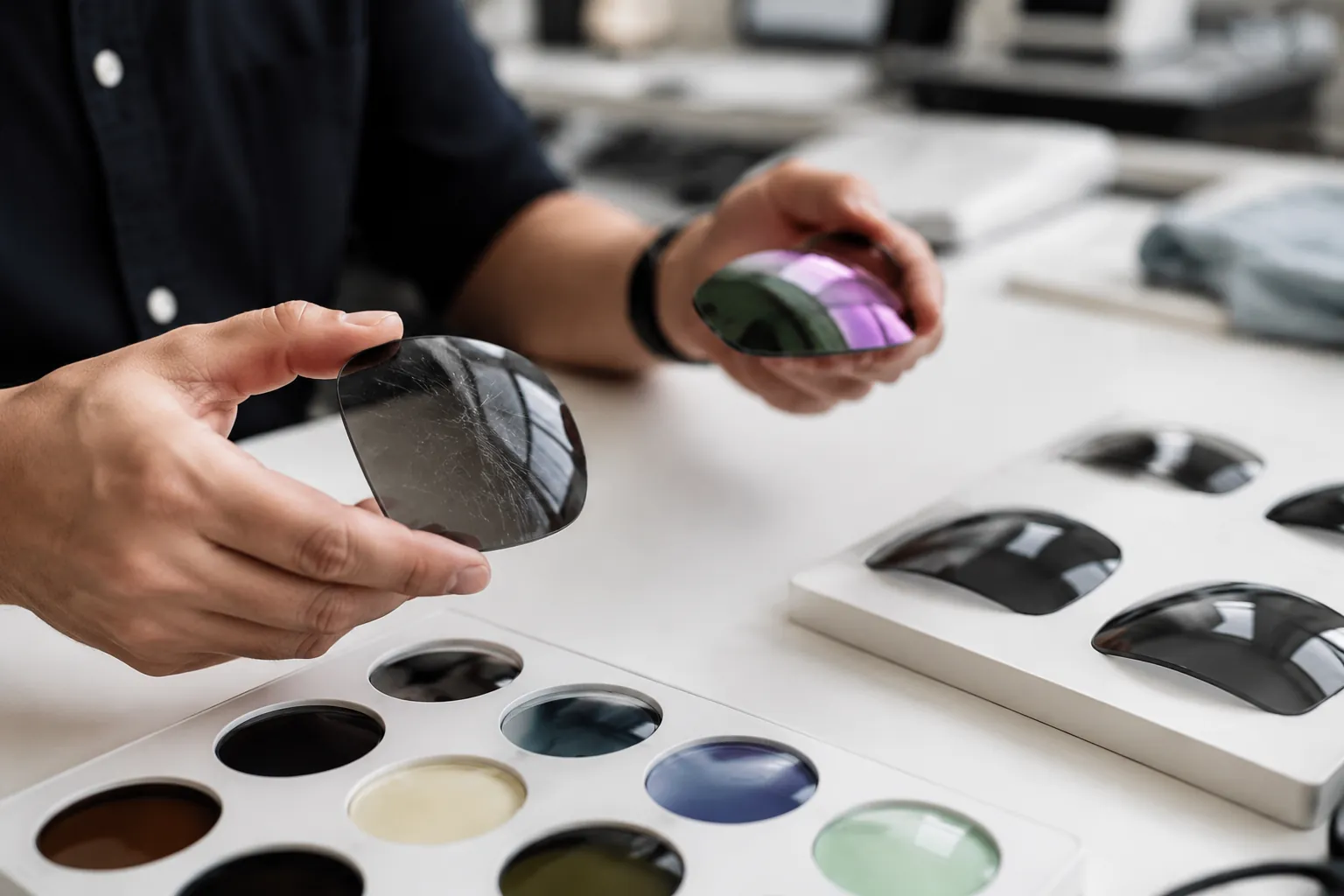
This guide is for brand owners, importers, distributors, and retail buyers sourcing custom sunglasses in volume. It focuses on the lens tradeoffs that affect claims, returns, compliance risk, and sell-through: impact resistance, optical clarity, scratch performance, process stability, and unit cost. The goal is simple: help you compare factory specs with less guesswork. Material names alone are not enough. A lens that looks fine in a sample can still create problems in bulk if coating, tinting, edging, or inspection control is weak. Use this as a practical checklist before approving samples or placing a PO.
Start with the use case, not the material name
Buyers often ask for TAC, PC, nylon, or CR-39 as if the material alone decides performance. It does not. Two polycarbonate lenses can perform very differently if one has tighter mold control, better hard-coat adhesion, cleaner edge finishing, and more stable tinting. Material sets the baseline. Process decides whether that baseline holds in production.
In most private label sunglass programs, three priorities shape the lens spec. First is impact resistance. This matters in sports, kids, cycling, work-near-hazard categories, and any line where drops or strikes are likely. Second is optical clarity. This matters in premium fashion, driving, and lifestyle products where distortion complaints hurt perceived quality. Third is scratch resistance. This matters in everyday retail because customers toss sunglasses into bags, glove boxes, pockets, and cup holders.
These priorities do not usually peak at the same price point. A buyer building a $9.99 to $14.99 retail program will often choose a commercially reliable coated PC lens over a costlier lens system with tighter optical tolerances. A premium fashion label may accept less impact margin to gain better visual comfort and a cleaner look. A cycling or wrap-sport line usually shifts toward PC or nylon. Field failure is less forgiving there.
Separate category fit from material preference. A lens that works in a fashion frame may be the wrong choice for a high-wrap sport frame, even if both use the same base resin. The right sequence is straightforward: intended use, destination market requirements, target price, then lens specification.
What the priorities mean on the factory floor
Impact resistance is not just a resin property. Thickness, edge geometry, base curve, and mounting method all matter. A 1.0 mm to 1.2 mm cosmetic fashion lens behaves differently from a 1.8 mm to 2.2 mm active-use lens, even if both are polycarbonate. Rimless drilling, tight groove insertion, and aggressive wrap curves add stress. Polycarbonate is common because it combines low weight with toughness. Nylon is also used in active-use frames because it handles wrap shapes and flex well, but it usually costs more and needs tighter process control.
Optical clarity means more than transparency. Buyers should look at haze, waviness, edge distortion, birefringence risk, surface consistency, and tint uniformity across the field of view. CR-39 is often used in non-sport sunglasses because it can deliver a cleaner visual feel, especially in flatter fashion shapes. But poor edging, heat warp, or uneven coating can erase that advantage. On curved sport frames, optical quality depends heavily on mold precision and curve control.
Scratch resistance usually depends more on coating quality than base material alone. Hard-coat chemistry, coating thickness, cure temperature, cure time, pre-coat cleanliness, and post-cure handling all affect the result. A lens described as scratch resistant without a defined coating process is a weak spec. Ask whether lenses are dip-coated or flow-coated, how cure conditions are controlled, what defect standards are used, and how lenses are protected during packing and assembly.
These priorities interact. A harder coating may improve surface durability but raise cost, extend cure time, or reduce yield if adhesion is unstable. A thinner lens may look better in a fashion frame but cut impact margin. A dark gradient may look more premium but create more pair-matching rejects than a standard smoke tint. Good suppliers explain these tradeoffs early. They do not hide behind material labels.
Common lens options and where they fit
The table below reflects how buyers compare lens families in real sourcing programs, not just in lab terms.
| Lens option | Typical thickness range | Main strength | Main weakness | Typical fit | Buyer note |
|---|---|---|---|---|---|
| Polycarbonate | 1.0-2.2 mm | High impact resistance, low weight, broad commercial versatility | Needs a good hard coat for scratch performance; optical quality depends heavily on molding control | Sports, kids, promotional, mid-market fashion | Often the best all-round choice when cost, safety, and production flexibility all matter |
| CR-39 | 1.4-2.0 mm | Good optical clarity and comfortable visual feel | Lower impact resistance than PC; less ideal for rough-handling categories | Premium fashion, driving-oriented styles, adult lifestyle lines | Useful where visual comfort matters more than drop resistance |
| Nylon | 1.5-2.2 mm | Good toughness, flexibility, and performance in wrap shapes | Higher raw material cost and tighter process requirements | Performance sport, wrap frames, active outdoor lines | Useful when frame curve and active wear demand better flex behavior |
| TAC polarized lens assembly | Usually 1.0-1.3 mm finished assembly | Polarization at accessible cost, broad retail appeal | Quality depends on lamination stability, edge sealing, and long-term delamination resistance | Fashion polarized, chain retail, resort channels | Check edge stability, adhesive quality, and pair-to-pair consistency before approval |
There is no universal winner. A value retail program may choose hard-coated PC because it balances impact resistance and cost. A premium fashion label may prefer CR-39 because customers notice visual comfort and color cleanliness first. A cycling line usually leans toward PC or nylon because a chipped or failed lens carries more use risk than it does in casual fashion.
How end market changes the answer
End market should drive lens specification. Buyer habit should not. The same frame can use different lens builds for different channels, and that is often the right commercial decision.
- Mass retail and promotional: Price discipline is tight, so coated PC and entry-level polarized constructions are common. Scratch resistance still matters because early-use marking can increase returns.
- Fashion retail: Optical appearance, tint repeatability, and cosmetic cleanliness usually matter more than maximum impact margin. Customers inspect lens color, mirror finish, and surface defects under store lighting.
- Sports and outdoor: Impact resistance and secure lens retention come first. Higher base curves, wrap shapes, and active use make molding accuracy, edge finishing, and groove fit more critical.
- Kids: Toughness is the priority. Frames get twisted, dropped, sat on, and stepped on. Polycarbonate is often the most practical choice.
- Driving and premium lifestyle: Distortion complaints matter. Buyers should pay closer attention to optical uniformity, polarization quality, and transmittance consistency across production lots.
This is also where MOQ and price logic matter. Small orders are useful for pilots, capsule drops, and market testing, but low quantities usually carry more setup cost per unit. At larger volumes, unit economics improve because setup, color matching, and inspection work are spread across more pairs. Higher volume can improve price efficiency. It does not automatically justify a premium lens spec for every SKU.
Ask a harder question: what does the full lens spec do to yield, inspection time, and repeatability? That is where margin moves. A simple lens in a stable color is usually easier to scale than a highly customized lens with tight cosmetic requirements.
Where factories win or lose
Lens performance is often decided after the raw lens is molded or cut. Four production stages deserve a close look.
- Hard coating: Ask whether the coating is dip-coated or flow-coated, what curing cycle is used, and how dust is controlled before cure. A weak hard coat can pass a sample inspection and still fail quickly in real handling.
- Tinting and polarization handling: Uneven tint density, weak pair matching, and poor TAC lamination create visible defects fast. Check several pairs from the same run, not just the approved sample pair.
- Edging and assembly: Lenses can chip at the edge, stress in the groove, or show insertion marks if edging tolerances are loose or operators rush assembly. CNC milling accuracy and groove cleanliness matter, especially on shield and wrap styles.
- Decoration compatibility: Mirror coatings, revo finishes, laser logos, pad-printed marks, and gradient effects all add complexity. Every extra decorative step adds handling risk and can raise the reject rate.
Ask to see the control points. Useful checkpoints include incoming lens inspection, hard-coat visual review, color comparison against the signed master sample, polarization direction check, assembly fit check, and final QC under controlled lighting. On premium programs, it is reasonable to ask how pair matching is defined and whether AQL or an internal defect grading system is used for cosmetic inspection.
The point is simple. Make the factory show its process, not just its catalog. If a supplier cannot explain where defects are controlled, you are carrying more risk than the sample suggests.
Match compliance to the sales market
Separate material claims from market-entry requirements. If sunglasses will be sold in the EU, US, Australia, or New Zealand, the lens and finished product need to follow the right testing and documentation path. That affects performance claims, transmittance category, labeling, packaging language, and chemical declarations.
The documents you request should match the destination market and product category. For sunglass sourcing, commonly referenced standards and frameworks include CE EN ISO 12312-1, FDA registration, ANSI Z80.3, AS/NZS 1067, REACH, ISO 9001, and BSCI. Do not ask for a generic certificate bundle. Ask for what your market actually needs.
- CE EN ISO 12312-1: Relevant for sunglasses sold into the EU and important for lens category, UV protection, and labeling alignment.
- ANSI Z80.3: A common US reference point for non-prescription sunglasses and a frequent retail documentation requirement.
- AS/NZS 1067: Relevant for Australia and New Zealand programs, especially where market-entry requirements are reviewed closely.
- REACH: Important for coatings, plastics, inks, and decorative materials entering the EU.
- FDA registration: Often discussed in US import documentation, but buyers should still confirm their own legal and category-specific obligations.
- ISO 9001: Indicates a quality management system, but it does not by itself prove product compliance.
- BSCI: A social compliance framework used by some buyers as part of vendor qualification.
Do not leave compliance until the end. Lens tint category, visible light transmission, mirror density, and labeling details can affect what can be shipped and how it can be sold. If one SKU is meant for multiple markets, raise that point before sample approval, not after bulk production starts.
How lens choice affects MOQ, price, and lead time
Lens specification has a direct commercial effect. Buyers often underestimate it. A lens that is harder to coat, match, or edge can raise reject rates and slow throughput even when the raw material cost change looks minor on paper.
Sample development and bulk production timelines vary by lens type, decoration complexity, and order size. Standard tinted PC lenses are usually easier to schedule than polarized programs with strict color matching, laser lens logos, or multi-step packaging. Confirm lead time for the exact build. Not just the frame.
| Program factor | Lower complexity option | Higher complexity option | Likely commercial effect |
|---|---|---|---|
| Lens type | Standard tinted PC | Polarized TAC or nylon sport lens | Higher reject risk, more inspection time, and higher unit cost |
| Scratch-performance target | Basic hard coat | Higher durability expectation with tighter cosmetic control | More process control needed and stronger sample approval discipline |
| Color requirement | Black, smoke, standard brown | Custom gradient, mirrored finish, or tight brand color match | Longer development cycle and more pair-matching checks |
| Order volume | Small pilot order | Larger repeat order | Higher volume usually improves unit price, yield absorption, and process stability |
Price breaks matter because setup cost is spread across quantity. If the target market expects stronger scratch performance or tighter optical consistency, forcing that standard into a very small test order can be expensive. In some cases, the better move is to launch the pilot with a simpler lens spec, validate demand, then upgrade coating or polarization options on the reorder.
Also ask which part of the build drives time: lens sourcing, coating, tinting, edging, decoration, or final assembly. That question often shows where a factory is efficient and where it is likely to miss schedule.
A practical lens brief to send before ordering
If you want fewer surprises, write a tighter lens brief. Do not send only "PC polarized lens" and expect the factory to infer your quality level. Good sourcing means defining the likely failure points for the market, then paying for the level of control needed to hold the spec in bulk production.
- State the priority: rank impact resistance, optical clarity, and scratch resistance instead of listing all three equally.
- Define the market: specify EU, US, Australia/New Zealand, or multi-market so the documentation path is clear from the start.
- Specify lens construction: material, polarized or non-polarized, solid or gradient tint, mirror or no mirror, and target visual effect.
- Set cosmetic expectations: define acceptable minor marks, color tolerance, pair matching, and mirror consistency under inspection lighting.
- Confirm process requirements: ask about hard-coat method, curing control, tint inspection, edging method, and final QC checkpoints.
- Confirm commercial limits: share target price, expected reorder volume, launch date, and whether the first order is a pilot or a scale run.
That level of detail protects margin. It reduces the chance that a supplier quotes one quality level, samples another, and delivers a third. The best lens choice is not the one with the strongest claim. It is the one that fits the market, survives the intended use, meets the target cost, and can be repeated at scale.
Have a custom sunglasses project in mind?
Send us your styles, target market and quantities and we will return a detailed quote with MOQ, lead time and a sample plan.
Get a QuoteWhy source this from Wenzhou with LumiShades
Wenzhou in Zhejiang Province is widely regarded as China’s eyewear manufacturing capital, producing a large share of the world’s sunglasses. That concentration matters to buyers: a deep local supply chain for acetate sheet, hinges, lens blanks, plating and packaging means shorter component lead times, easier color and material matching, and a workforce with decades of eyewear-specific skill. LumiShades has manufactured in this ecosystem since 2009, and our vertical integration — in-house injection molding, acetate cutting, CNC milling, lens tinting, decoration and quality control — means no part of your order is quietly subcontracted to a workshop you cannot audit.
For international buyers, that vertical control translates into accountability. When a single factory owns every step, defects are traced and fixed at source rather than bounced between vendors, and your specifications survive intact from first sample to bulk. For procurement review, buyers can request process records, approved samples, quality checkpoints and project-specific compliance files before placing a bulk order. Required testing and documentation are confirmed against the destination market and product specification rather than assumed from a generic certificate list. Explore our manufacturing capabilities and quality control process to see how this works in practice.
Frequently asked questions
Is polycarbonate always the best choice for sunglasses? No. Polycarbonate is widely used because it is light and impact resistant, but it is not the best option for every program. If your priority is visual comfort, flatter fashion styling, or a premium driving feel, CR-39 may be a better fit. If you choose polycarbonate, ask the factory to define the hard-coat system, edge finish, and optical tolerance so you know what level of performance you are actually buying.
What should I ask a factory besides lens material? Ask about the hard-coat method, cure conditions, tint consistency control, polarization lamination quality, edging process, assembly handling, cosmetic inspection standard, and final QC checkpoints. Also ask which compliance documents they can provide for your destination market, such as CE EN ISO 12312-1, ANSI Z80.3, AS/NZS 1067, REACH, FDA registration, ISO 9001, or BSCI where relevant.
How do I reduce scratch-related returns on a mid-price program? Specify a defined hard-coated lens, not just a material name. Approve production samples under realistic handling conditions, set clear cosmetic limits, and confirm how lenses are packed before assembly and shipment. If scratch complaints are a serious risk, ask for the coating process, cure control, and post-cure handling steps in writing.
Can I start with a small custom order to test a lens concept? Yes. A small pilot order is a practical way to test fit, appearance, and sell-through before committing to a larger run. The tradeoff is cost efficiency: small quantities usually carry more setup cost per pair, so custom coatings, mirrored finishes, or strict color matching may be harder to justify on the first order. Use the pilot to validate the spec, then refine the build on the reorder if needed.
How long do lens samples and bulk orders usually take? Lead time depends on lens type, decoration, and order size, so confirm timing for the exact build. Standard tinted lenses are usually faster to schedule than polarized or highly customized programs. Ask the supplier for separate sample and bulk timelines for the specific material, tint, coating, and packaging you want.
Ready to start?
Explore our square sunglasses or request a quote — our sales team replies within 12 hours.
Request a Quote