
Best Sunglass Lens Colors by Market and Use Case
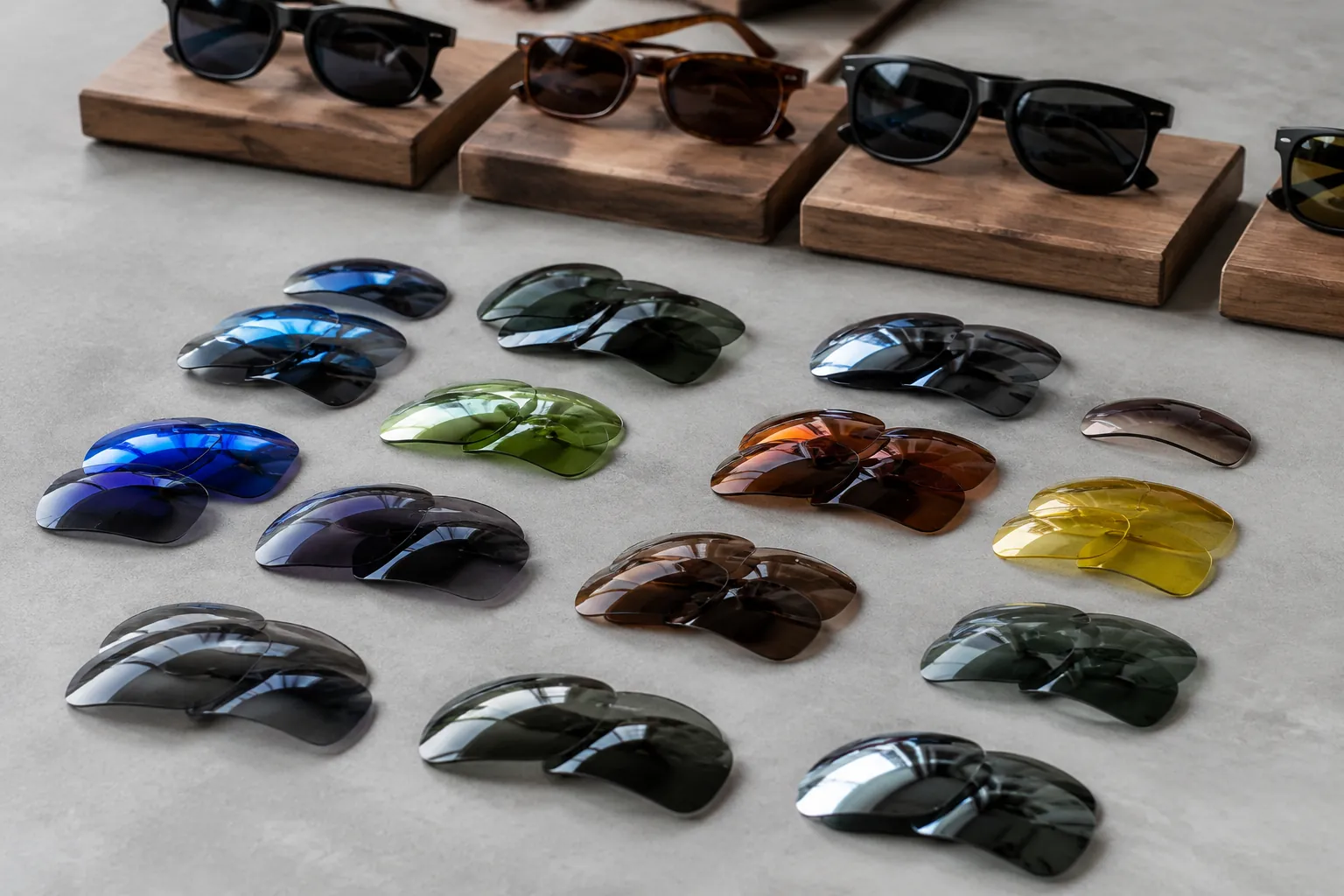
This guide is for brand owners, importers, distributors, and retailers buying custom sunglasses in volume. Lens color is not a minor styling detail. It affects perceived value, shopper confidence, assortment clarity, and how efficiently a factory can standardize production and quality control. This article explains where smoke, brown, green, and G15 usually fit by market and use case, how they shape customer perception, and how to plan assortments without creating needless SKU complexity. It also covers the sourcing points that matter during development, including MOQ planning, tint consistency, lead-time impact, decoration compatibility, and compliance checks.
Lens color is a merchandising decision first
Many buyers lock in frame shape, material, hinge, and target FOB before they settle lens tint. That often leads to avoidable sample revisions later. Lens color influences three commercial variables at once: how the product looks in the assortment, how the wearer experiences brightness and contrast, and how easily retail staff can explain it at the shelf.
Smoke, brown, green, and G15 all work in general sunglass programs. They do not say the same thing. Smoke reads neutral and direct. Brown feels warmer and more outdoor-led. Green reads classic. G15 usually signals a specific classic or aviator look, not just a generic green-lens story.
Most shoppers do not describe these differences in optical terms. They use buying language: clean, comfortable, sharp, classic, premium, too dark. That matters. Lens color should be assigned to the channel strategy and product story, not left as a late styling choice.
For sourcing teams, tint choice also affects production planning. Standard tints are usually easier to batch, approve, inspect, and repeat. Fragment the tint plan too much, and the checkpoints multiply during sampling, bulk production, and final inspection.
What smoke, brown, green, and G15 say to customers
| Lens color | Typical VLT range | Customer perception | Best-fit use cases | Common risks |
|---|---|---|---|---|
| Smoke | Approx. 12% to 20% | Neutral, clean, easy to understand | Fashion sunglasses, general driving, entry to mid-price collections | Can feel basic if frame design and branding are weak |
| Brown | Approx. 12% to 18% | Warm, contrast-oriented, outdoor-friendly | Driving, beach, lifestyle outdoor, sports-inspired styles | Can shift a fashion style toward a more functional look |
| Green | Approx. 13% to 20% | Classic, balanced, slightly more traditional | Unisex classics, metal frames, heritage styling | May move more slowly in markets that strongly prefer gray-based lenses |
| G15 | Approx. 12% to 18% | Recognizable, technical-classic, premium-coded | Aviators, navigators, military-inspired and driving styles | Needs clearer product storytelling because many consumers do not know the term |
Smoke is often the safest commercial base. It works across men's, women's, and unisex programs and usually keeps the product visually neutral. For launches with limited sell-through history, smoke is the easiest anchor color.
Brown is common when the product story includes driving, bright outdoor use, or a warmer visual tone. Buyers often choose it for beach programs, road-use positioning, and active-lifestyle assortments.
Green is broader than many buyers expect. It pairs well with black acetate, tortoise patterns, brushed gunmetal, and gold-tone metals. G15 is not simply another label for green. In commercial use, it usually refers to a specific dark green family tied to classic aviator styling and heritage eyewear.
Put simply: smoke is broad, brown is function-led, green is classic, and G15 is classic with a more defined identity.
Regional demand should shape the tint mix
Regional planning is shaped by more than sunlight. Fashion norms, channel positioning, and customer familiarity with classic sunglass cues all affect which lens colors are easiest to sell.
- North America: Smoke is widely used in mass and mid-market programs because it is easy to merchandise and easy for consumers to understand. Brown is common in driving and outdoor categories. G15 matters most where aviators, men's classics, or heritage styling already sell well.
- Western Europe: Fashion accounts often accept more lens variation when the frame design supports it. Green and brown can work well on metal and acetate styles that need a more refined or classic presentation. Smoke still remains the broadest commercial base.
- Australia and New Zealand: Driving, outdoor use, and sun-protection positioning are often more central to the selling story. Smoke and brown are common core choices, with G15 used more selectively. Buyers should confirm AS/NZS 1067 requirements early when the destination market is Australia or New Zealand.
- Middle East: Strong cosmetic appeal, darker visual presentation, and premium-looking frame-and-lens combinations are often important. Smoke and green can both work, but the final aesthetic needs to feel deliberate and polished.
- Latin America: Bold products can perform well, but a disciplined base assortment is still the safer starting point. Smoke and brown are common opening choices, with gradients or mirrors added only after core demand is proven.
These are patterns, not rules. A distributor selling to airports, optical chains, department stores, and resort retail may need different tint ratios by channel or by account. Buy for the retail setting you are targeting, not for whatever looked best in the sample room.
Build assortments by frame family
One costly sourcing mistake is giving every launch SKU its own lens story. A better method is to assign lens strategy by frame family and repeat it where it makes sense. This improves shelf clarity for the retailer and simplifies production planning for the factory.
- Choose 1 core tint for each high-volume frame family.
- Add 1 secondary tint only when the family has clear channel support or reorder potential.
- Reserve green and G15 for shapes that naturally support a classic, metal, or aviator-led story.
- Use brown where the proposition includes driving, outdoor comfort, beach use, or a warmer visual tone.
- Keep smoke as the lowest-risk replenishment tint in broad commercial programs.
Example: a 12-style launch does not need 12 different lens stories. A fashion acetate family may center on smoke, while an outdoor-led family may center on brown. An aviator family may justify G15 as the primary lens color. This lets the buyer test frame families instead of scattering volume across too many isolated variants.
Discuss MOQ logic early with the supplier. Lens color fragmentation can hurt batch efficiency even when the nominal MOQ is technically achievable. A low pilot MOQ may work for sampling or market testing, but unit economics usually improve when more units share the same lens specification, branding setup, and packaging configuration.
Split one program across too many frame colors, lens tints, and branding treatments at the same time, and the order becomes harder to run. Setup time rises. Approval points increase. Sell-through analysis gets messier after launch.
How tint choice affects cost and lead time
| Order setup | Factory impact | Commercial effect | Typical fit |
|---|---|---|---|
| 1 frame, 1 lens color | Simplest tint batching, fastest QC, lowest mismatch risk | Easiest path to stable costing and repeatability | Opening orders and core repeat styles |
| 1 frame, 2 lens colors | Extra approval and more segregation during assembly | Useful when one tint is core and one is a controlled test | Mid-volume launches and seasonal trials |
| Several frames, shared lens tint | More efficient lens production across SKUs and simpler control standards | Supports assortment breadth without unnecessary complexity | Retail collections and distributor programs |
| Several frames, many custom tints | Higher setup time, more inspection points, greater shade-variation risk | Harder to repeat cleanly and harder to manage inventory | Best reserved for proven premium lines |
Lead time is shaped by the number of approval gates the lens plan creates. Standard lens colors are usually easier to sample and approve than custom-developed tints, gradients, or mirrored finishes. Add multiple lens colors, packaging formats, and destination markets with different documentation requirements, and the process usually slows. More variables need sign-off.
Decoration method also affects the final look. Pad printing is common for straightforward temple logos. Laser marking can suit technical or understated styles. Metal logo plates can add perceived value, but they also add assembly steps and should be reviewed against the selected lens color so the product does not look visually crowded.
Gradient lenses and mirrored coatings add control points because color fade and reflectivity must be checked on finished goods, not only on loose lenses. For buyers focused on opening-price competitiveness, consolidating lens tint across several frame references often creates more operational value than over-customizing the color mix at launch.
Compliance is not optional
A dark-looking lens is not automatically a compliant lens. Appearance alone does not confirm that a sunglass lens meets the relevant visible light transmission category, UV-protection requirement, labeling rule, or market-specific documentation standard. Tint selection, destination market, and test planning should be aligned before final sample approval. No shortcuts here.
For buyers sourcing sunglasses internationally, the standards and systems most often referenced in this context include CE EN ISO 12312-1, ANSI Z80.3, AS/NZS 1067, REACH, FDA registration, ISO 9001, and BSCI. Not all of these are product-performance standards. Some relate to quality management, social compliance, chemical compliance, or importer documentation. Buyers should verify which documents are relevant to the product and destination market instead of treating every item on the list as interchangeable.
- CE EN ISO 12312-1: Relevant for sunglasses placed on applicable markets using this product standard. The declared lens category and labeling should match the tested finished product.
- ANSI Z80.3: Commonly referenced in the US market for non-prescription sunglasses. Buyers should confirm that testing reflects the finished lens configuration, including coatings or gradients where applicable.
- AS/NZS 1067: Important for Australia and New Zealand. It is best to confirm this path early if the product is intended for those markets.
- REACH: Relevant where chemical compliance is required for lens treatments, coatings, and frame materials supplied into applicable markets.
- FDA registration: Often reviewed in the US import context. Buyers should confirm with their compliance team what documentation is required for the specific product category and shipment.
In practice, buyers should approve three things together: the visual standard, the destination market, and the required test and documentation path. Approving appearance alone can create delays later if the formal compliance route has not been defined.
How factories control tint consistency in bulk
A good sample does not guarantee consistent bulk output. Tint consistency depends on lens material, process controls, reference standards, and final inspection discipline. Polycarbonate, TAC polarized constructions, and CR-39-type lenses do not always behave the same way during tinting, coating, or post-processing.
In a controlled production flow, the process usually includes the following steps:
- Confirm an approved reference sample or master standard before bulk production starts.
- Separate lens lots by material, order code, and target tint to avoid mixed-batch variation.
- Run tinting or coating by controlled batch rather than by informal top-up decisions.
- Check color against the approved standard visually and, where applicable, with transmission testing or measurement records.
- Verify left-right lens matching before assembly.
- Inspect again after assembly because frame color and frame thickness can change how the lens appears to the eye.
That last step matters. The same lens can appear darker in a thick black acetate frame than in a thin gold metal frame because the surrounding frame changes the visual impression. A factory that only reviews loose lenses may miss a mismatch that becomes obvious once the product is assembled.
Buyers should also ask how the factory defines acceptance for shade consistency, left-right matching, and lot-to-lot stability. Exact tolerances can differ by lens construction and by program requirements, but a reliable supplier should be able to explain its method for batch separation, reference comparison, in-process control, and final inspection.
Decoration adds another checkpoint. A lens may meet performance requirements and still look commercially wrong if the branding weight, frame finish, and lens color do not work together. Final QC should assess both technical conformity and finished-product presentation.
A practical buying formula for first and repeat orders
For first orders in a new market, keep the lens plan conservative. For repeat orders, widen selectively based on actual sell-through, customer feedback, and return patterns.
A practical first-order formula is simple: use smoke as the volume base, use brown for function-led or driving-led styles, and assign green or G15 only to frames with a clear classic or aviator story. Keep the number of lens tints low enough that each tint reaches meaningful volume and can be evaluated properly after launch.
For repeat orders, review more than unit sales. Check store feedback, return reasons, conversion by frame family, and whether the lens color supported the intended product story. Comments such as too dark, too warm, too plain, or not premium enough can point to a lens-positioning problem rather than a frame-design problem.
A practical rule for buyers: expand tint variety only after one tint has already proven demand in that frame family.
This reduces dead stock and keeps sourcing and replenishment manageable. Test a controlled assortment first. Identify the tint-frame combinations that move consistently. Then scale those combinations with clearer forecasting and cleaner production planning.
Have a custom sunglasses project in mind?
Send us your styles, target market and quantities and we will return a detailed quote with MOQ, lead time and a sample plan.
Get a QuoteWhy source this from Wenzhou with LumiShades
Wenzhou in Zhejiang Province is widely regarded as China’s eyewear manufacturing capital, producing a large share of the world’s sunglasses. That concentration matters to buyers: a deep local supply chain for acetate sheet, hinges, lens blanks, plating and packaging means shorter component lead times, easier color and material matching, and a workforce with decades of eyewear-specific skill. LumiShades has manufactured in this ecosystem since 2009, and our vertical integration — in-house injection molding, acetate cutting, CNC milling, lens tinting, decoration and quality control — means no part of your order is quietly subcontracted to a workshop you cannot audit.
For international buyers, that vertical control translates into accountability. When a single factory owns every step, defects are traced and fixed at source rather than bounced between vendors, and your specifications survive intact from first sample to bulk. For procurement review, buyers can request process records, approved samples, quality checkpoints and project-specific compliance files before placing a bulk order. Required testing and documentation are confirmed against the destination market and product specification rather than assumed from a generic certificate list. Explore our manufacturing capabilities and quality control process to see how this works in practice.
Frequently asked questions
Which lens color is safest for a new private label launch? Smoke is usually the lowest-risk starting point for a new private label launch because it is easy for consumers to understand, works across a wide range of frame shapes, and is generally the simplest color to use as the core tint in a mixed assortment. A practical step is to make smoke the default lens for your highest-volume frame family, then test only one secondary tint in categories with a clear use case, such as brown for driving or G15 for aviators.
When should I choose G15 instead of standard green? Choose G15 when the frame has a clear aviator, navigator, or heritage-classic identity and you want the lens to reinforce that story. Choose standard green when you want a classic look but do not need the more specific narrative associated with G15. Before approval, ask the supplier to show both options in the actual frame so you can compare the final assembled look, not just the loose lens, and confirm the labeling or test path required for the destination market.
Does adding more lens colors always improve sell-through? No. More lens colors can improve consumer choice in some programs, but they can also weaken sell-through if volume is split too thin across too many variants, if store presentation becomes confusing, or if low-volume colors are hard to replenish. A practical rule is to launch one core tint per frame family, review sales and feedback by SKU, and add a second tint only when the first tint has already shown reliable demand.
How do lens colors affect lead time? Lens colors affect lead time because every additional tint can add sampling, approval, segregation, and inspection steps. Standard tints are usually easier to repeat than custom tints, gradients, or mirrored combinations. When requesting a production schedule, ask the supplier to separate timing for sample approval, lab or third-party testing where needed, and bulk production so you can see whether the tint plan itself is creating avoidable delay.
What compliance documents should I confirm before approving tinted lenses? Start by confirming the destination market, because the required compliance path depends on where the product will be sold. Then ask the supplier for the specific documents or test reports relevant to that market, which may include CE EN ISO 12312-1, ANSI Z80.3, AS/NZS 1067, REACH, and any FDA registration-related import documentation that applies. Also confirm that the documents relate to the finished product configuration you are buying, including the actual lens tint, coatings, gradients, and packaging labels, rather than only to a base material or a similar past style.
Ready to start?
Explore our wayfarer sunglasses or request a quote — our sales team replies within 12 hours.
Request a Quote