
CR-39 vs Polycarbonate vs Nylon Sunglass Lenses
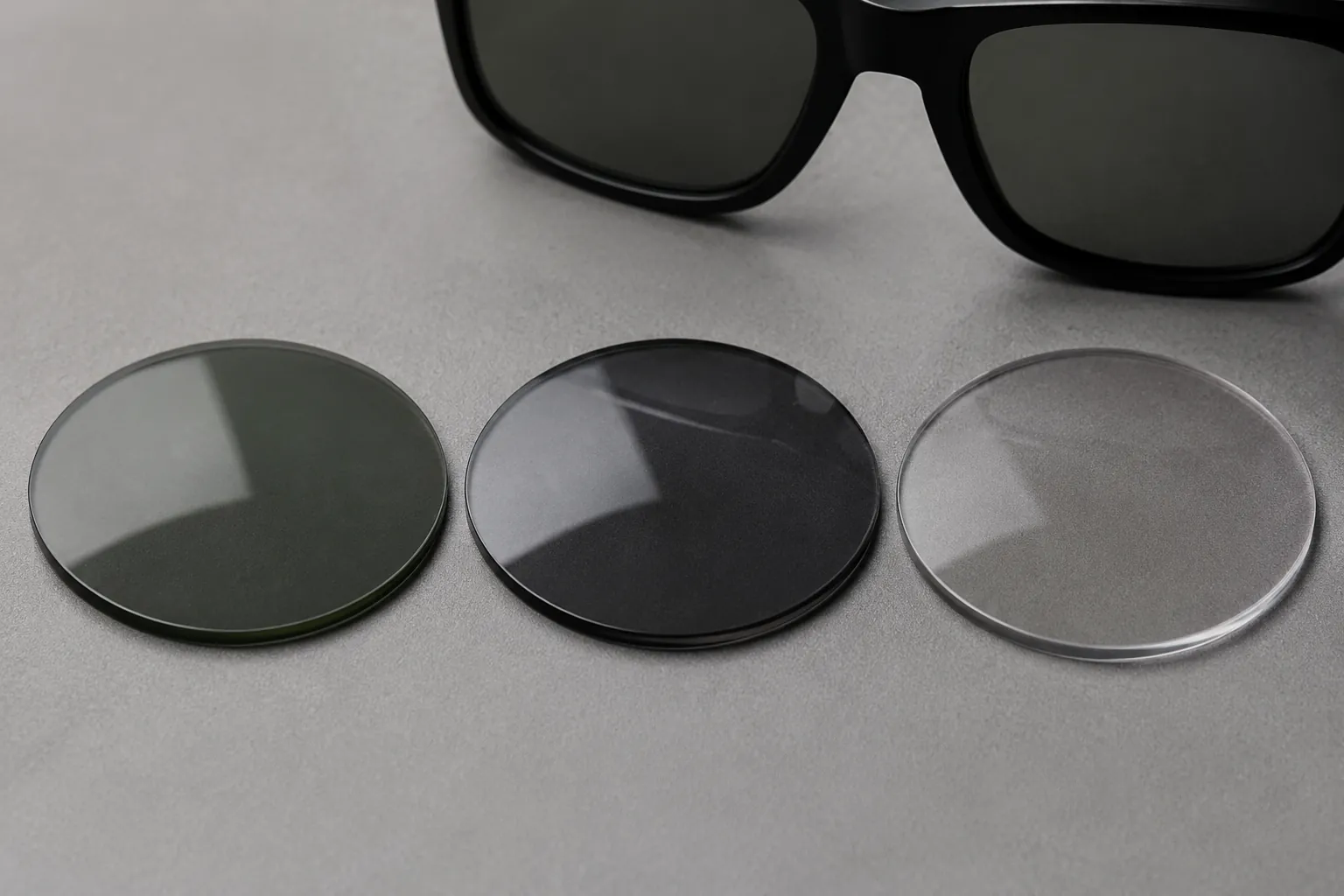
This guide is for brand owners, importers, distributors, and retail buyers building private-label sunglasses lines. Lens material is not a minor spec. It affects unit cost, optics, weight, durability, and how much QC is needed before shipment. A poor choice adds cost without adding a retail benefit strong enough to justify it. A good choice helps you build a clear good-better-best range, cut complaint risk, and match product performance to the channel, from entry fashion to active-use collections.
Why lens material matters in private-label sourcing
Frames usually get the first attention in development: shape, hinge construction, logo placement, plating, and color. That makes sense. Those details are easy to spot in a sample room. But lens material often decides whether a style performs like a basic fashion item, a mid-market polarized product, or a sport model built for wrap and active use.
In most private-label sunglass programs, three materials cover most demand: CR-39, polycarbonate, and nylon. Each affects more than optics. It changes lens blank cost, coating performance, edging behavior, stress risk during assembly, and the level of inspection needed before shipment. On a small run, a bad material match may be tolerable. On repeat orders, it turns into a margin problem.
For overseas buyers, the right comparison is not lens price alone. It is total program fit. Look at coating quality, scratch risk, destination-market compliance, retail price band, and whether the factory can repeat tint and curvature from batch to batch. Lens choice also affects tinting, hard coating, edging, assembly checks, and final inspection. That means it affects lead time and reorder consistency too.
- CR-39 usually gives better visual clarity and suits style-led programs.
- Polycarbonate is often the practical choice for volume, impact resistance, and low weight.
- Nylon is usually reserved for wrap shapes, technical designs, and sport positioning that can justify the higher cost.
Specify lens material early. Not at the end.
The commercial baseline: cost, optics, weight, and durability
If you strip the topic down to buying basics, each material has a clear role. The table below is a planning tool, not a lab ranking.
| Lens material | Density / weight feel | Relative cost at volume | Optical clarity | Impact behavior | Typical process notes | Best market fit |
|---|---|---|---|---|---|---|
| CR-39 | Light, but slightly heavier than polycarbonate | Low to mid | Very good | Moderate | Good tint acceptance, stable for standard shapes, hard coat recommended | Fashion, lifestyle, value-premium |
| Polycarbonate | Very light | Low to mid, depending on volume and coating spec | Good | High | Scales well in standard programs; scratch performance depends on coating control | Mass market, kids, active casual, chain programs |
| Nylon | Very light | Mid to high | Good to very good | High | Handles wrap and technical shapes well; tighter process control needed | Sport, wrap frames, premium performance |
CR-39 is often the logical step up from basic commodity lenses because distortion is usually low and tint presentation is clean. Polycarbonate is the volume workhorse. It is light, commercially efficient, and widely used where cost control matters. Nylon is the upgrade for more demanding geometry and a higher retail position.
Volume changes the math. Small development runs magnify setup cost. Large production runs magnify material efficiency. So a lens choice that looks only slightly different on a sample quote can create a wider cost gap once polarization, mirror coating, logo application, and packaging are added.
No material is always best. The right one depends on target retail band, frame geometry, and how much complaint risk your channel can absorb.
CR-39: strong optics for fashion and mid-market programs
CR-39 is still one of the most useful sunglass lens materials for fashion and lifestyle collections. Its main advantage is visual quality at a sensible cost. Buyers usually notice this during development when comparing dark tints, gradients, and polarized lenses side by side. The view often looks cleaner. Low-level distortion is less likely to trigger complaints in daily wear.
For private-label ranges, CR-39 works especially well in acetate and metal frames where the product story is style-led rather than sport-led. It also performs well in classic base curves and standard lens shapes. That helps keep edging predictable and reduces avoidable assembly issues. Tint acceptance is another practical advantage. Brown, green, grey, smoke gradient, and fashion-color programs are usually easier to control with consistent production samples and retained approvals.
From a production standpoint, CR-39 makes sense when buyers want mid-range perceived quality without moving into technical sport construction. It fits boutique retail, department-store lifestyle capsules, and premium-looking polarized upgrades. If a buyer wants a stronger lens story than low-end polycarbonate but does not need aggressive wrap performance, CR-39 is often the cleanest answer.
The trade-off is impact durability and rough handling. It is usually not the first choice for kids' programs, cycling-inspired shields, or products likely to face heavy open-display abuse. Hard coating matters. If coating coverage is inconsistent or curing is weak, scratch complaints rise fast. That is where factory discipline shows up in the return rate.
- Best fit: fashion sunglasses, boutique retail, mid-market polarized programs.
- Main advantage: better optical clarity and stronger perceived quality for the cost.
- Main caution: lower impact resistance than polycarbonate or nylon.
- Commercial logic: useful as the "better" tier in a good-better-best collection.
Polycarbonate: the practical volume choice
Polycarbonate is the material many buyers choose when they need a solid balance of margin, weight, durability, and scale. It is light, impact resistant, widely available, and common in chain-store programs, youth styles, active-casual designs, and broad commercial assortments.
Its main strength is operating efficiency. Once order quantities move from a small MOQ into repeat production, polycarbonate often becomes attractive because standard lens blanks, standard tints, and standard coating routes scale well. For buyers trying to keep complete sunglass pricing inside a strict target, that matters. In simple, high-volume constructions with standard packaging and no special decoration, the material can support aggressive factory pricing. Add polarization, mirror treatment, custom packaging, or extra decoration, and the total cost climbs.
The weak point is surface hardness. Polycarbonate scratches more easily if hard-coat application is inconsistent or if packaging allows lens-to-lens rub during transit. So do not judge the material in isolation. Judge the process: coating control, drying and curing discipline, packing method, and final inspection for rub marks and fine scratches.
For buyers sourcing from China, ask direct questions:
- What hard-coat process is used, and is it done in-house or by a subcontractor?
- How are scratch defects classified during final QC?
- Are lens tints controlled against retained approval samples?
- What packaging prevents lens contact during bulk transit?
If the answers are vague, polycarbonate can become expensive after shipment even if the quoted unit cost looked good.
Nylon: where performance starts to justify the cost
Nylon enters the sourcing discussion when the product shifts from fashion toward sport, outdoor, or premium active use. The material earns its place when lens curvature is higher, frame wrap is more aggressive, or the buyer needs a tougher performance story without dropping into low-end commodity positioning.
Its value comes from how it behaves in more technical constructions. Wrap frames and shield styles can expose the limits of lower-tier materials through assembly stress, visual inconsistency, or unstable finishing on demanding curves. Nylon is often the safer choice in these cases because it handles technical geometry better and supports a stronger active-use story at retail.
This matters for performance and for positioning. If the frame is clearly sport-led, a cheaper lens that struggles with curve stability can weaken the whole product. Buyers may save on the quote sheet and lose on warranty, remakes, or retailer confidence.
The cost is higher, so specify it for a reason. Nylon belongs where the end use or price architecture can support it. It is usually the wrong move for low-ticket fashion product where customers will not notice or pay for the extra performance.
- Use nylon when the frame wrap is more aggressive or the lens geometry is technically demanding.
- Use nylon when impact performance matters and the collection needs a premium active position.
- Skip nylon for entry fashion lines that need tight cost control more than technical lens performance.
For many brands, the smartest approach is selective use. Put nylon in the "best" tier or sport capsule, not across the whole line.
How lens choice affects MOQ, costing, lead time, and decoration
Lens material changes more than the bill of materials. It changes how efficiently the factory can source blanks, tint lenses, apply coatings, edge to shape, fit lenses into frames, and pack the order without damage. Sample and bulk timelines vary by factory and program complexity, so buyers should confirm lead time case by case.
At a small MOQ per design, keep lens variation under control. One material, one or two tint options, and standard decoration usually give the cleanest economics. Too many options at low volume create setup waste and slow approvals. Once order size moves above a few hundred pairs, a more structured lens ladder is easier to support. At larger volumes, buyers can justify polarized upgrades, mirror options, or higher-value packaging.
| Buyer scenario | Recommended lens path | MOQ / volume logic | Lead-time and cost note |
|---|---|---|---|
| New brand testing 2-3 SKUs | CR-39 or polycarbonate | Start with one material and limited tint options | Keeps approvals simple and reduces setup waste |
| Importer building chain-store line | Polycarbonate | Best economics usually appear at repeat volume | Cost control is strong, but packaging and hard-coat quality are critical |
| Boutique brand building a better-tier story | CR-39 | Works well when retail can support a noticeable optics upgrade | Good for style-led lines where perceived quality matters more than impact use |
| Sport retailer adding a premium range | Nylon | Use selectively on technical shapes and wrap frames | Higher lens cost is justified only when retail positioning supports it |
Decoration choices matter too. If the program includes laser logo marking, screen printing, hot stamping on temples, or premium packaging, evaluate the full build together. A lens upgrade can make sense in a simple product. It may be hard to recover once several decorative costs stack on top.
A disciplined factory should say when the spec is becoming commercially inefficient. If not, the buyer pays for complexity the customer does not value.
Compliance and QC: what buyers should verify before approval
Lens material selection has to sit inside a real compliance and quality-control process. For sunglasses, buyers should verify testing and document routes tied to the actual destination market and the actual finished product. Relevant certifications and registrations to request or verify, where applicable, include CE EN ISO 12312-1, ANSI Z80.3, AS/NZS 1067, FDA registration, REACH, ISO 9001, and BSCI. The point is simple: ask for documents that match the product and market, not generic paperwork that does not match the shipment.
Material alone does not guarantee compliance. Lens tint category, UV protection, visible light transmission, optical quality, impact behavior, and labeling all matter. A lens can look good in a showroom and still fail in market if the tint category does not match the label or if optical quality falls outside the required standard.
On the factory side, buyers should verify that the QC route is concrete, not verbal. Useful checkpoints include:
- Incoming material verification with batch traceability for lens blanks and coatings.
- Tint control against approved retained samples for color consistency across reorders.
- Visual inspection for scratches, pits, flow marks, bubbles, and color mismatch.
- Assembly inspection for lens fit, stress marks, curve mismatch, and edge quality.
- Final AQL-based inspection before packing and shipment.
A factory with in-house molding, cutting, decoration, and QC can reduce handoff risk between subcontractors, but that does not remove the buyer's job. Acceptance standards still need to be defined in advance. Clear targets get better results.
A practical upgrade path for private-label collections
Most buyers do not need one lens material across the full range. They need a price and performance structure that makes sense to retailers and end customers. The cleanest approach is to match lens material to channel, use case, and target retail band instead of forcing one spec everywhere.
A practical architecture often looks like this:
- Entry range: polycarbonate for low landed cost, low weight, and solid durability.
- Mid range: CR-39 for better optics, stronger perceived quality, and cleaner lifestyle positioning.
- Performance range: nylon for sport, wrap, shield, and premium active styles.
This structure helps the sales story and the sourcing plan. Retail partners can explain why one style costs more than another, and sourcing teams can align component cost with expected margin. The upgrade is not arbitrary. It is tied to visible product behavior and actual use case.
Buyers who force one lens material across all categories usually create a mismatch somewhere: too expensive for opening-price fashion, too weak for active use, or too ordinary to support premium pricing. Start with the target shelf price. Work backward to landed cost. Then choose the lens material that fits the job.
If your collection needs a clear price ladder, lens material is one of the few specification changes customers can feel, retailers can explain, and factories can scale with predictable cost logic.
That is why lens strategy belongs in the first sourcing conversation, not the last.
Have a custom sunglasses project in mind?
Send us your styles, target market and quantities and we will return a detailed quote with MOQ, lead time and a sample plan.
Get a QuoteWhy source this from Wenzhou with LumiShades
Wenzhou in Zhejiang Province is widely regarded as China’s eyewear manufacturing capital, producing a large share of the world’s sunglasses. That concentration matters to buyers: a deep local supply chain for acetate sheet, hinges, lens blanks, plating and packaging means shorter component lead times, easier color and material matching, and a workforce with decades of eyewear-specific skill. LumiShades has manufactured in this ecosystem since 2009, and our vertical integration — in-house injection molding, acetate cutting, CNC milling, lens tinting, decoration and quality control — means no part of your order is quietly subcontracted to a workshop you cannot audit.
For international buyers, that vertical control translates into accountability. When a single factory owns every step, defects are traced and fixed at source rather than bounced between vendors, and your specifications survive intact from first sample to bulk. For procurement review, buyers can request process records, approved samples, quality checkpoints and project-specific compliance files before placing a bulk order. Required testing and documentation are confirmed against the destination market and product specification rather than assumed from a generic certificate list. Explore our manufacturing capabilities and quality control process to see how this works in practice.
Frequently asked questions
Which lens material gives the best value for a mid-market private-label sunglass line? Usually CR-39 or polycarbonate. Choose CR-39 if optical clarity, tint appearance, and perceived quality matter most. Choose polycarbonate if impact resistance, low weight, and tighter cost control matter more. The better option depends on your target retail price, frame type, and expected use.
Is nylon worth the extra cost for fashion sunglasses? Usually not. Nylon makes the most sense for sport, wrap, shield, or active-use styles where curve performance and impact behavior justify the higher cost. For low-ticket fashion programs, it often adds cost without creating a strong enough retail benefit to protect margin.
How should I use a 50-pair MOQ per design without creating too much complexity? Keep the build simple: one lens material, one or two tint options, standard packaging, and limited decoration. At this volume, too many lens variants usually create setup waste, slower approvals, and weaker price efficiency. Ask the factory to quote a single specification first, then add options only if the margin supports them.
What compliance documents should I ask for on sunglass lenses? Request documents that match your destination market and finished product, such as CE EN ISO 12312-1, ANSI Z80.3, AS/NZS 1067, FDA registration, and REACH where applicable. Also confirm factory system controls such as ISO 9001 and BSCI if those matter to your sourcing requirements. Do not rely on certificates unrelated to the market you are shipping into.
How much can lens material affect final sunglass pricing? It can change the total package a lot, especially once polarization, hard coating, mirror treatment, frame construction, and packaging are added. The biggest cost impact usually comes from the full specification stack, not the lens material alone. For a useful quote, compare complete build specs side by side instead of asking for lens price in isolation.
Ready to start?
Explore our square sunglasses or request a quote — our sales team replies within 12 hours.
Request a Quote