
Choosing Lens Tints by Market Demand
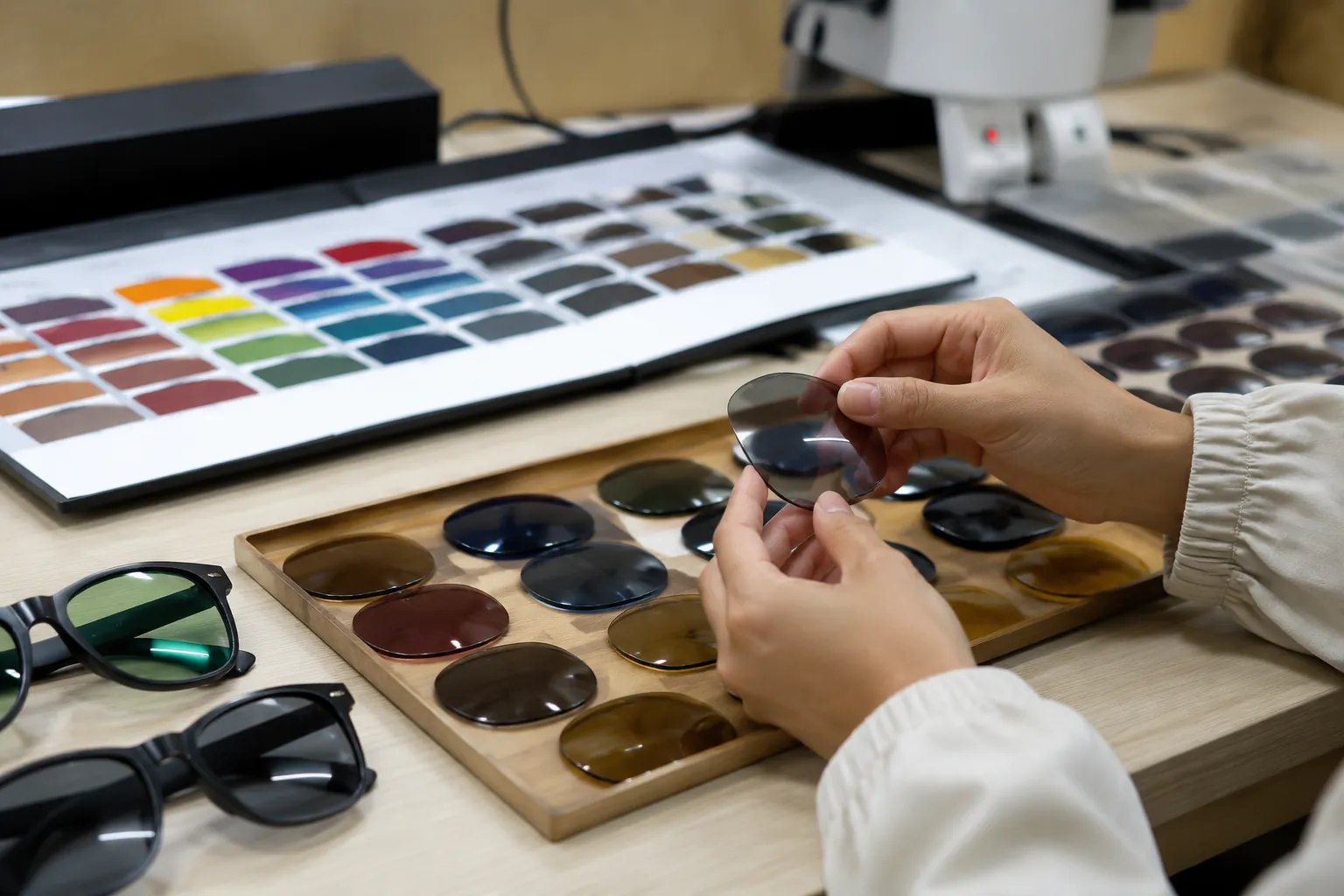
This guide is for brand owners, importers, distributors, and retailers buying sunglasses in volume. It shows how to choose smoke, brown, green, and fashion lens tints based on where the product will sell, how it will be used, what price point the program must hit, and how much SKU complexity the channel can absorb. The goal is simple: build a tint assortment that fits the market instead of repeating one familiar lens color across every style. Done well, that usually improves line clarity, supports cleaner replenishment decisions, and reduces the risk of carrying low-rotation color variants that are hard to reorder with confidence.
Start with the selling environment before samples are locked
Many buyers choose lens color too late. They finalize frame shape, material, logo placement, and packaging first, then default to smoke because it feels safe. Smoke is often a solid choice. But that sequence can rule out better options before the brief is fully aligned.
Set the lens plan early. Not after the frame is basically finished. Discuss tint direction while the buyer is still confirming frame material, hardware finish, decoration method, and target price. Lens tint is not just styling. It affects wearer perception, compliance review, production repeatability, and how clearly the assortment is positioned.
Ask four questions at the start:
- Which channel will sell the product: optical retail, fashion chain, online-first DTC, resort, promotional, travel retail, or sport-adjacent lifestyle?
- What light conditions matter most: high-glare beach, mixed city use, driving, hiking, overcast climate, or bright tropical daylight?
- Where does the program sit on price: entry promotional, mid-market private label, or premium capsule?
- How many active SKUs can the customer realistically stock, explain, and replenish?
Those answers narrow the tint plan fast. A broad online assortment may need a simple lens offer because subtle differences are harder to explain on screen. A resort program can support darker green, warm brown, or selected fashion tints because the retail setting gives the product more room to tell its story. An opening-price wholesale line may need only one or two lens colors because each added tint increases planning, matching, and inventory load.
Do not treat tint as decoration added at the end. It is part of the lens specification. The earlier it is defined, the easier it is to align samples, testing, and reorder expectations.
What the core tint families do in real use
Basic tint families are not interchangeable. Each one solves a different commercial and visual problem. Each one also reacts differently to material and process variation.
| Tint family | Best commercial fit | User effect | Material/process note | Main risk |
|---|---|---|---|---|
| Smoke / Gray | Mass retail, online, unisex carryover, promotional programs | Neutral color perception and broad acceptance | Usually the easiest core tint to standardize across common sunglass builds | Can make the range look undifferentiated if used on every style |
| Brown / Amber | Driving, outdoor lifestyle, warm acetate stories | Warmer view and stronger perceived contrast for many users | Tone control matters because warmth shifts are easier to notice than buyers often expect | Lot variation can make the assortment look inconsistent |
| Green | Classic metal frames, heritage-inspired assortments, bright daylight use | Balanced visual tone with a more classic sunglass look | Shade matching usually needs closer review because small hue shifts are visible | Mismatch between sample and bulk can stand out quickly |
| Fashion custom tints | Trend capsules, influencer drops, festival, resort | Strong identity and stronger visual differentiation | Often needs more sample review and tighter approval control | Lower reorder confidence if the color is too trend-specific |
Smoke remains the default for a reason. It works across men's, women's, and unisex styles, and it pairs easily with black, crystal, tortoise, gunmetal, and painted injection frames. If a buyer needs one lens color for a broad commercial assortment, smoke is still usually the lowest-risk starting point.
Brown is stronger than many buyers expect, especially once the product is worn rather than judged on a display board. In driving and outdoor-lifestyle programs, users often respond well to the warmer visual tone. Brown also helps warm-toned frame stories feel more intentional, particularly on honey, tea, champagne, and tortoise acetates.
Green is underused in lower-price programs because buyers sometimes assume it is harder to sell. That can be true if the retailer cannot explain the difference. But in aviators, classic metal shapes, and premium-looking acetate styles, green often makes the line feel more considered and less generic.
Use custom fashion tints selectively. They work best when the channel can explain them, photograph them accurately, and reorder them with confidence. A pink, blue, tea gradient, or lavender lens may create a strong launch statement. If reorder demand is unclear, that tint becomes just another SKU.
Build assortments by channel, climate, and price tier
Different channels need different tint logic. A buyer's personal preference is not a strategy. Neither is a sample wall.
- Online-first programs: Keep the offer easy to read. Too many subtle tint differences can increase hesitation and returns because customers interpret lens color differently on screens.
- Optical and specialty retail: More nuance is possible because staff can explain lens benefits and help customers compare options in person.
- Resort and travel retail: Darker lenses, warm gradients, and selective fashion tints can perform well because the purchase context is more aspirational and sun use is immediate.
- Promotional and entry-price wholesale: Minimize complexity. One or two lens colors usually simplify forecasting, matching, and replenishment.
- Sport-adjacent lifestyle: Brown, smoke, and mirrored options can work, but only when the product claim and final lens specification are aligned.
Climate changes the ratio. High-sun markets often support darker smoke and green because glare reduction and a clear sunglass look matter. Mixed-weather urban markets often need medium smoke and brown because wearability across variable light matters more. Driving-heavy programs may justify a higher share of brown because many users prefer the warmer visual tone.
A practical first-order planning model:
- General lifestyle line: smoke as the primary tint, with brown and green used as secondary options on selected frames
- Classic fashion line: smoke and green as the core pairing, with brown added where the frame story is warm or heritage-led
- Driving and outdoor lifestyle line: smoke and brown as the main lens families, with green used more selectively
- Trend capsule: smoke as the commercial anchor, then a limited number of brown, green, and custom fashion tints on clearly chosen hero SKUs
These are planning structures, not fixed formulas. Historical sell-through should always override a generic model. But for a new program, structure helps prevent the assortment from drifting into all-gray sameness or too many low-volume color variants.
Price tier matters too. Entry-level lines usually cannot support many low-rotation lens colors because the margin structure is tight. Mid-market private label can usually support two or three core tints if the forecast is disciplined. Premium capsules can justify narrower color stories because perceived value comes from curation as well as volume.
Material behavior and frame finishing affect tint decisions
Lens color does not sit alone. The base lens material, coating route, and frame finish all influence how the tint reads in the final product.
For many commercial sunglasses, the lens base is polycarbonate. Buyers should still confirm how the supplier produces the final color, because color depth and visual feel can change with lens thickness, tinting method, and coating stack. TAC polarized constructions add another layer because the final visual tone comes from a laminated build rather than a simple dyed monolens. CR-39 and nylon may appear in higher-spec programs, but they change the cost structure and should be confirmed early.
Frame material also affects the best lens choice. Injection-molded frames often support broad commercial tint use because they are commonly built for volume and repeatability. Acetate frames usually benefit from more deliberate lens pairing because the visual richness of the frame raises expectations for the lens tone. CNC details, plated hinges, metal inserts, and polished bevels can all push the product toward a more judged look, where green or a warmer brown may outperform default smoke.
Decoration method matters too. If the buyer is adding screen print logos, hot foil, laser marks, or metal plaques, the lens should support the intended positioning. A very standard smoke lens in a highly styled capsule may weaken the premium story, while a well-matched green or brown lens can make the product feel more coherent.
In practical assortment planning:
- Warm acetates: brown, tea, and selective gradients often pair naturally
- Black or crystal acetate: smoke and green are usually the easiest core fits
- Gold metal: green often supports a more classic look than dark gray
- Matte sport-injection: smoke and brown usually communicate function most clearly
Good buyers review lens color and frame finish together, not as separate approval steps. That is often where the product starts to look intentional instead of assembled.
Production realities: tolerances, MOQ logic, cost, and lead time
Custom tints are easy to request and harder to repeat. Problems often show up on the reorder, when the buyer expects the same color and the production route has shifted.
Lens tint consistency depends on the base material, target darkness, dye or coating control, process timing, drying conditions, and QC method. The pass-fail standard should be defined before bulk starts. At minimum, buyers should ask for a physical master sample, a signed approval sample, and a written acceptance method for shade approval and left-right lens matching.
In practice, smoke usually tolerates small visual variation better than green or custom fashion colors because hue shifts are less obvious. Green, gradients, and fashion tints usually need tighter review because even minor movement can show clearly under store lighting or in side-by-side comparison. Gradient lenses add another control point because both the top density and fade transition must stay close to the approved sample.
| Program type | MOQ logic | Typical FOB effect | Lead-time effect | Control requirement |
|---|---|---|---|---|
| One standard tint on one design | Often the simplest structure for lower-volume trial orders | Usually the lowest setup complexity | Typically the easiest approval and repeat process | Master sample and visual QC may be sufficient if the lens build is standard |
| Two to three core tints across a style family | Better suited to programs with enough volume to support multiple active SKUs | Usually adds sorting, matching, and planning cost | Can still fit normal production timing if standards are locked early | Stronger lot control and pair matching are needed |
| Multiple custom fashion tints or gradients | Best used when the buyer expects repeat demand or is managing a limited capsule intentionally | Usually increases sampling, control, and waste risk | Extra sample rounds can extend pre-production timing | Signed color standard and stricter matching control are recommended |
| High-volume carryover program | Works best when the tint standard is stable and replenishment is planned | Can improve sourcing efficiency if specifications stay unchanged | Usually becomes more stable once materials and standards are fixed | Documented retention of the approved standard is essential for reorders |
MOQ and lead time vary by supplier, material route, packaging requirement, and whether the lens is standard, polarized, mirrored, or gradient. Buyers should ask for those numbers against the exact build they want rather than relying on a broad quote sheet. Late tint changes are one of the fastest ways to lose time because they can trigger a fresh approval round, a new QC reference, or an updated compliance review.
The practical sourcing lesson is blunt. A tint that looks good on a sample card is not automatically a good bulk decision. The real question is whether the supplier can reproduce it consistently at the intended order size and on the intended reorder cycle.
Compliance and testing must follow the exact lens specification
Lens color is a commercial decision, but it sits inside a compliance framework. Buyers selling across multiple markets should confirm that the final lens construction matches both destination requirements and intended product claims.
Relevant checkpoints may include CE EN ISO 12312-1, ANSI Z80.3, AS/NZS 1067, REACH, and FDA registration where relevant. At supplier level, buyers may also ask about ISO 9001 and BSCI. Those are verifiable checkpoints. Nothing beyond them should be assumed without documentation.
The main risk is specification drift. A sample may be tested in one lens material, one tint depth, and one coating structure. If the buyer later changes darkness, adds mirror, switches to polarized TAC, or changes the material after the test basis is set, the original paperwork may no longer describe the actual bulk product. That is why the exact tested construction matters.
Heavily colored, mirrored, gradient, or very light fashion lenses need extra caution because visual appeal does not confirm suitability for every market or use claim. Buyers should ask:
- Which exact lens material was tested?
- What tint depth or category was approved?
- Was the tested lens mirrored, polarized, gradient, or plain?
- Does the test basis still apply if the buyer changes the coating, material, or lens construction?
Compliance review should happen in parallel with tint approval, not after it. That is the most reliable way to avoid an attractive sample turning into a documentation problem later.
A practical first-order SKU plan and supplier checklist
Many new sunglass programs launch with too many weak color variants. A tighter opening range is usually better for margin control, replenishment, and sell-through visibility.
For a first order, many B2B buyers do well with this structure:
- Choose 2 to 4 frame winners only. Do not spread volume across too many shapes at launch.
- Assign one default tint to every frame, often smoke, to anchor the line.
- Add one secondary tint only where the frame and channel clearly justify it, often brown for warm acetate or green for classic metal.
- Keep custom fashion tints to one hero SKU instead of forcing them across the whole collection.
- Set reorder rules before launch, including what sales result is required to keep, expand, or cut a secondary tint.
This structure keeps purchasing disciplined. Once a style proves itself, the buyer can widen the tint offer with better evidence instead of guessing at launch.
Before approval, serious buyers should ask process questions rather than stopping at a visual sample:
- How is the master tint standard defined? Ask for a physical counter sample and a written acceptance method.
- Is tinting done in-house or through an outside processor? This affects correction speed, traceability, and repeat control.
- How are left and right lenses matched? Pair matching matters most for green, gradients, and fashion colors.
- What is retained for reorder reference? Confirm how approved samples and production records are stored.
- Which tests apply to this exact lens build? Tie the answer to destination market and final lens construction.
The best tint program is not the one with the most options. It is the one that fits the channel, climate, price point, material route, and reorder reality. Buyers who plan tint that way usually build cleaner assortments and make better repeat-order decisions.
Have a custom sunglasses project in mind?
Send us your styles, target market and quantities and we will return a detailed quote with MOQ, lead time and a sample plan.
Get a QuoteWhy source this from Wenzhou with LumiShades
Wenzhou in Zhejiang Province is widely regarded as China’s eyewear manufacturing capital, producing a large share of the world’s sunglasses. That concentration matters to buyers: a deep local supply chain for acetate sheet, hinges, lens blanks, plating and packaging means shorter component lead times, easier color and material matching, and a workforce with decades of eyewear-specific skill. LumiShades has manufactured in this ecosystem since 2009, and our vertical integration — in-house injection molding, acetate cutting, CNC milling, lens tinting, decoration and quality control — means no part of your order is quietly subcontracted to a workshop you cannot audit.
For international buyers, that vertical control translates into accountability. When a single factory owns every step, defects are traced and fixed at source rather than bounced between vendors, and your specifications survive intact from first sample to bulk. For procurement review, buyers can request process records, approved samples, quality checkpoints and project-specific compliance files before placing a bulk order. Required testing and documentation are confirmed against the destination market and product specification rather than assumed from a generic certificate list. Explore our manufacturing capabilities and quality control process to see how this works in practice.
Frequently asked questions
Should I launch with one tint or three? If the program is new, start with one default tint across the range and add one secondary tint only where the frame, channel, and forecast clearly support it. Use three tints only when each one has a clear commercial role, such as smoke for broad appeal, brown for driving or warm frame stories, and green for classic premium-looking styles. Before approving three tints, check three things: minimum order by tint, whether each tint needs a separate compliance review, and whether your customer can explain the difference at point of sale.
Is smoke always the safest commercial choice? Usually, smoke is the safest starting point for broad lifestyle, wholesale, and online programs because it is neutral, familiar, and easy to merchandise. It is not automatically the best choice for every style. Brown may suit driving-focused or warm-color collections better, and green may improve the perceived quality of aviators, metal frames, and heritage-inspired styles. The practical test is to compare the same frame in smoke and one alternative tint, then review which version better fits the retail channel, frame finish, and intended use.
How do custom tints affect MOQ, cost, and approval risk? Custom tints usually increase complexity even when the supplier is willing to produce small quantities. They can require more sample rounds, tighter color approval, closer left-right lens matching, and more careful reorder control. Ask the supplier for MOQ, sample lead time, and bulk lead time against the exact lens build, including whether it is plain, polarized, mirrored, or gradient. Also ask what physical standard will be retained for reorders. If the tint is trend-led and reorder demand is uncertain, limit it to one hero SKU instead of spreading it across the full range.
What certifications should I ask for on sunglass programs? Ask according to the destination market and the exact lens specification being ordered. Common checkpoints include CE EN ISO 12312-1, ANSI Z80.3, AS/NZS 1067, REACH, and FDA registration where relevant. At supplier level, ISO 9001 and BSCI may also be requested. The key action is to verify that the documents match the actual bulk product, including lens material, tint depth, and whether the lens is mirrored, polarized, gradient, or plain. If any of those change after testing, ask whether new testing or updated documentation is required.
How long do tint samples and bulk production usually take? There is no universal timing because lead time depends on frame material, lens construction, logo process, packaging, and whether the tint is standard or custom. Buyers should request a timeline for sampling, approval revision, and bulk production based on the final specification, not a generic estimate. The best way to protect delivery is to freeze lens color early, avoid late changes to tint depth or lens type, and confirm whether any compliance review depends on the final approved lens build.
Ready to start?
Explore our aviator sunglasses or request a quote — our sales team replies within 12 hours.
Request a Quote