
TAC Polarized Lens Checks Before Bulk Orders
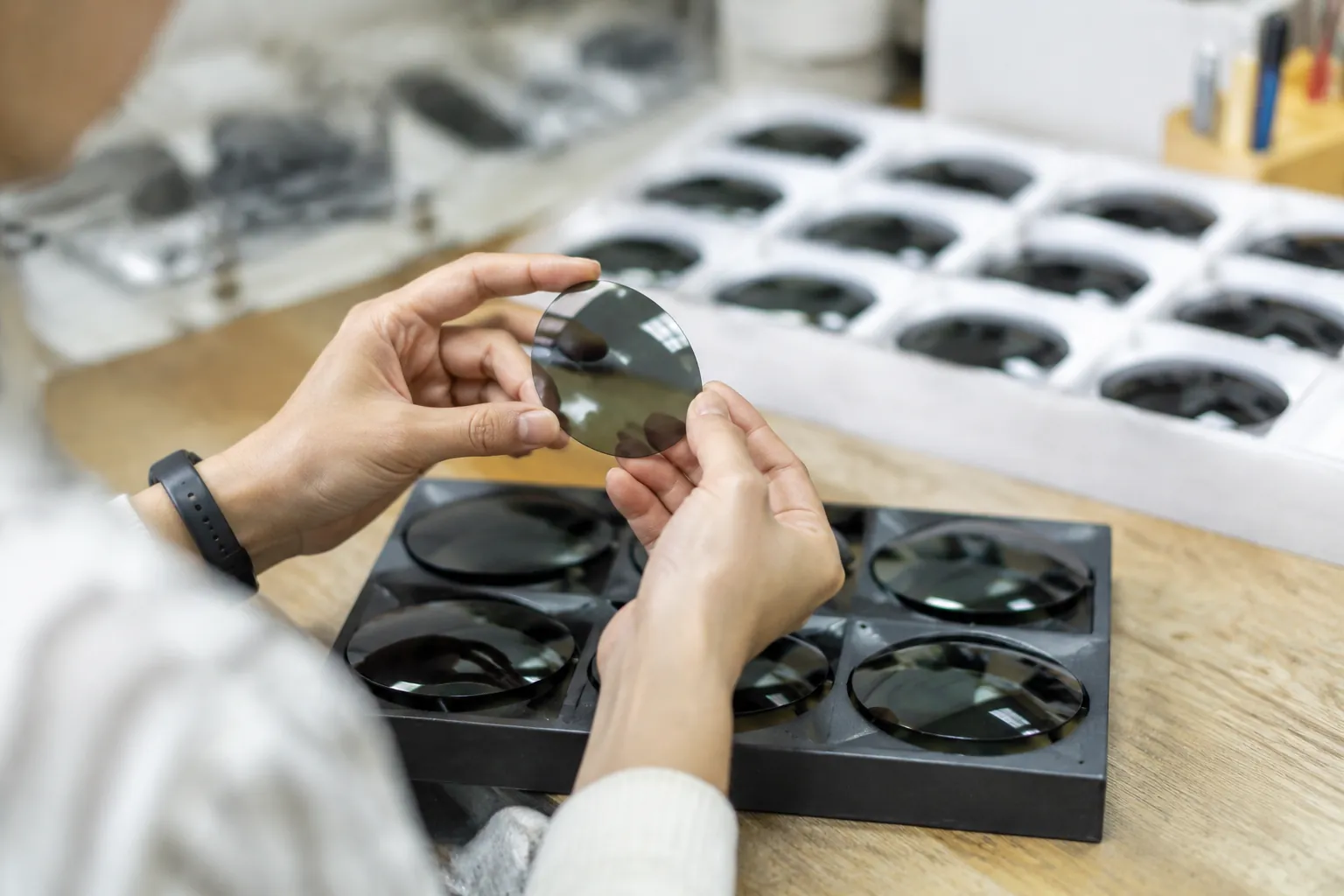
This guide is for brand owners, importers, distributors, and retail buyers sourcing polarized sunglasses at volume. It covers the lens checks that matter before you approve samples or release a bulk order: polarization consistency, lamination stability, optical distortion, cosmetic defects, compliance paperwork, and process control. TAC polarized lenses can perform well in commercial programs. But only if lamination, coating, edging, and mounting are controlled. Set the checkpoints early. You cut returns, shipment delays, and avoidable rework.
Why TAC lens quality breaks down in bulk orders
TAC usually refers to a laminated polarized lens structure built from triacetate cellulose-based layers and a polarized film. For sourcing, the key point is simple: TAC is not one solid material block. It is a layered lens, and performance depends on lamination quality, adhesive stability, coating sequence, edging quality, and frame fit.
That is why a prototype can look fine while a production lot shows left-right tint mismatch, uneven polarization, edge whitening, wave distortion, coating marks, or early delamination. The cause is often process variation during cutting, forming, coating, edging, or assembly. Not one dramatic mistake. Just inconsistency.
For B2B buyers, the lesson is clear. You are not only buying a material description on a quotation. You are buying a manufacturing process. Small changes in lens thickness, base curve, adhesive curing, bevel pressure, or frame fit can change the finished result.
Lens quality also has to be reviewed with frame design. Tight grooves, heavy wrap, drilled details, or too much mounting pressure can stress a lens that looked acceptable before assembly. Check those interactions early. Fixing them later costs more.
Check polarization consistency, not just polarization itself
Many buyers ask one question: is the sample polarized? That is not enough. The better question is whether polarization stays consistent across the batch and whether left and right lenses remain correctly aligned after edging and mounting.
If polarization axis alignment varies too much, the wearer may notice uneven glare reduction or left-right visual imbalance on water, windscreens, polished metal, or glass. That is a functional problem. Not a cosmetic one.
- Request batch-level checks. Ask the supplier to inspect multiple finished pairs from the lot instead of relying on one approval sample.
- Define an alignment requirement. If your company uses an internal tolerance for polarization axis alignment, put it into the specification and confirm the supplier can measure it.
- Inspect after edging and mounting. Polarization should be checked on finished sunglasses, not only on loose lenses.
- Use a polarized viewer or LCD screen. Compare several pairs from different cartons and rotate them to confirm blackout behavior is uniform and matched left to right.
Ask for pre-production samples made with production-intended materials and processes. If the order includes mirror, flash, gradient, or logo decoration, the approval sample should use the same coating and decoration route planned for mass production.
For repeat orders, keep one signed reference pair and one backup pair. A retained physical standard makes future lot comparison much faster and disputes much easier to settle.
Lamination stability is the main hidden TAC risk
The costliest TAC failures often come from unstable lamination. The polarized film and outer layers rely on an adhesive bond that has to stay stable through edging, assembly, transport, storage, and normal wear. If that bond is weak or inconsistent, the first signs may be haze, bubbles, rainbow marks, edge opening, or internal separation.
This matters because sunglasses may face high temperatures during container transport, warehouse storage, retail display, or daily use. A lens can pass final visual inspection and still fail later if the lamination process is weak.
Ask process questions that should have clear answers:
- What lens stack and nominal thickness are specified for this model?
- What base curve is used for sample approval, and will production follow the same curve?
- How is edge quality controlled after cutting and beveling?
- What internal heat, humidity, or aging checks are applied to finished lenses or finished sunglasses?
- At what stage are hard coating, mirror coating, flash coating, hydrophobic topcoat, or logo decoration applied?
A capable supplier does not need to reveal proprietary formulations. It should still be able to explain the process sequence and the control points. If the process cannot be described clearly, be cautious.
Lamination defects often appear first at the lens edge, especially on wrapped shapes, tight grooves, or high-pressure mounting points. So frame fit and lens fit need to be reviewed as one system, not two separate sourcing decisions.
How to catch optical distortion before customers do
Polarization does not guarantee visual comfort. A lens can cut glare and still create a poor viewing experience if lamination, curvature forming, thickness distribution, or mounting stress is not controlled. Distortion may show up as bent straight lines, local blur, swim effect, or general visual discomfort.
Cosmetic appearance is easy to check at receiving. Wear comfort is what drives many returns. If the wearer feels imbalance or distortion, the product comes back even if the lens surface looks clean.
- Check against a grid or straight-line pattern. Move the lens slowly and look for bending, waving, or uneven image movement.
- Check left-right matching. Compare both lenses as a pair to confirm similar tint density, clarity, and visual feel.
- Check mounted stress. Repeat the distortion check after the lens is inserted into the frame.
- Check every lens version. Different colors, mirror finishes, and gradients should be inspected separately because one version may perform differently from another.
If the frame uses a strong wrap or fashion-driven curve, increase the review level. A factory may produce one attractive sample, then lose consistency when production speed rises. That is why post-assembly inspection is usually more useful than checking loose lenses alone.
Compliance documents such as CE EN ISO 12312-1, ANSI Z80.3, or AS/NZS 1067 matter. They still do not replace a practical optical inspection of the actual approved construction.
Defect checkpoints to write into the PO
If your purchase order says only "good quality lenses," it leaves too much room for argument. Write the visible defects, inspection conditions, and action rules before sample approval and before bulk production starts. This is even more important when the lens includes mirror, flash, gradient, hard coating, or printed logos. Every added process adds another defect risk.
| Checkpoint | What to inspect | Why it matters | Typical action |
|---|---|---|---|
| Polarization | Uniform glare reduction, left-right axis alignment, no visible mismatch between lenses | Helps prevent visual imbalance and user complaints | Hold the lot for review if repeated inconsistency appears across sampled finished pairs |
| Lamination integrity | No bubbles, haze, rainbow marks, edge opening, or internal separation | Reduces the risk of delayed failures after transport, storage, or wear | Hold shipment and trace the issue to the relevant lens lot or process stage |
| Optical distortion | No wave, blur, swim effect, or bent-line appearance | Protects wear comfort and helps reduce returns | Recheck on mounted lenses and compare with the approved reference standard |
| Cosmetic finish | No scratches, pits, coating marks, logo defects, or color mismatch | Helps prevent receiving rejects and retail complaints | Define viewing distance, lighting, and acceptance criteria before production |
| Edge quality | Clean cut, no chipping, no stress whitening, no rough bevel | Important for acetate, metal, wrapped, and tight-groove frames | Inspect loose lenses and finished assemblies separately |
Add practical inspection conditions beside each checkpoint: light source, viewing distance for cosmetic review, and whether the check applies to loose lenses, mounted lenses, or both. If you use AQL, state the exact standard in the PO rather than assuming the factory uses the same threshold.
Even on smaller custom orders, documenting these checkpoints pays off. Low quantities can hide process variation until the program scales.
Compliance, documentation, and traceability
Lens quality is not only visual. Buyers also need the right compliance basis for the target market, and the paperwork has to match the actual product being supplied. Be careful with vague claims such as "same as previous report" if the lens color, visible light category, coating, or construction has changed.
For commercial sunglasses programs, requested documents often include CE EN ISO 12312-1, ANSI Z80.3, AS/NZS 1067, REACH-related material compliance where relevant, FDA registration context for the US when applicable, and factory-level system documents such as ISO 9001 and BSCI. Factory certificates help with supplier assessment. They do not replace product-specific testing or specification review.
- Match documents to the SKU. Confirm that the lens category, color, coating, and construction match the product being ordered.
- Check identification details. Reports and declarations should identify the model or specification clearly enough to reduce substitution risk.
- Review documents early. If compliance affects launch timing, ask for the document set before deposit or material commitment.
- Reconfirm on repeat orders. Existing reports may not cover a revised lens color, mirror finish, or construction change.
Traceability matters too. At minimum, a supplier should be able to identify the production date, lens lot, and assembly lot for the shipped goods. If a problem appears after delivery, that shortens root-cause review.
How MOQ, price breaks, and lead time change lens risk
Commercial pressure changes lens risk. If a custom polarized program is pushed to a lower target cost without changing the specification, inspection scope, or timeline, the pressure often shows up first in lens processing, coating consistency, or final QC. Ask the right question: not only whether price can drop, but which controls change with it.
Small pilot orders are useful for market testing, but they do not always show the same process behavior as larger lots. Higher-volume orders can improve efficiency, but they also make lot control and consistency more important. Quantity decisions should match the approval and inspection routine.
| Order size | Typical commercial effect | Lens quality implication | Buyer advice |
|---|---|---|---|
| 50 pairs | Higher unit cost, useful for trial launch | Useful for design validation but limited for evaluating production consistency | Treat it as a pilot and review every approval checkpoint carefully |
| 300 pairs | Better cost control and more stable planning | Large enough to reveal variation in tint, polarization, or coating appearance | Request production-level QC records and sample photos from the lot |
| 1,000 pairs | Stronger price break and better material efficiency | More reliable if the lens specification and decoration route are locked early | Freeze the approved sample, defect limits, and packaging before bulk starts |
| 5,000+ pairs | Better unit economics for established programs | Consistency depends on discipline across lots, shifts, and material batches | Use pre-shipment inspection by lot, not only by style |
Lead time has the same effect. Short schedules can work when lens color, logo method, frame choice, and packaging are already fixed. Late changes to mirror color, gradient density, printing, metal logo details, or packaging compress the schedule and raise the risk of coating defects, color mismatch, or assembly stress marks. If timing is aggressive, simplify the specification or confirm material readiness before release.
A practical approval routine for first and repeat orders
Buyers who handle TAC polarized lenses well usually follow a simple approval routine from first sample to final shipment. It does not need to be complicated. It does need to be documented and repeatable.
- Write the lens specification clearly. Define lens color, visible light category, polarization requirement, coating stack, mirror or flash finish, logo method, and target compliance market.
- Approve a real physical standard. Keep one signed reference pair and, if possible, one approved loose lens.
- Review pre-production output from production-intended materials. This matters most when changing lens color, coating, or decoration on an existing style.
- Inspect mounted lenses, not only loose lenses. Many stress, distortion, and edge issues appear only after assembly.
- Check by lot before shipment. Do not assume all cartons are identical because one sample carton passed.
- Track defect history by style. If a style has shown edge haze, coating marks, or fit-related stress before, note it on the next PO and inspect it more closely.
This routine gets easier on repeat orders because the acceptance points are already defined. That is where a reliable manufacturer proves value: by reproducing the approved result across multiple orders instead of relying on one strong prototype.
The safest TAC program is usually not the one with the lowest sample cost. It is the one with a defined lens specification, controlled lamination process, suitable frame fit, realistic lead time, and written defect checkpoints agreed before bulk production starts.
Have a custom sunglasses project in mind?
Send us your styles, target market and quantities and we will return a detailed quote with MOQ, lead time and a sample plan.
Get a QuoteWhy source this from Wenzhou with LumiShades
Wenzhou in Zhejiang Province is widely regarded as China’s eyewear manufacturing capital, producing a large share of the world’s sunglasses. That concentration matters to buyers: a deep local supply chain for acetate sheet, hinges, lens blanks, plating and packaging means shorter component lead times, easier color and material matching, and a workforce with decades of eyewear-specific skill. LumiShades has manufactured in this ecosystem since 2009, and our vertical integration — in-house injection molding, acetate cutting, CNC milling, lens tinting, decoration and quality control — means no part of your order is quietly subcontracted to a workshop you cannot audit.
For international buyers, that vertical control translates into accountability. When a single factory owns every step, defects are traced and fixed at source rather than bounced between vendors, and your specifications survive intact from first sample to bulk. For procurement review, buyers can request process records, approved samples, quality checkpoints and project-specific compliance files before placing a bulk order. Required testing and documentation are confirmed against the destination market and product specification rather than assumed from a generic certificate list. Explore our manufacturing capabilities and quality control process to see how this works in practice.
Frequently asked questions
How can I verify that a polarized sample is consistent enough for bulk production? Do not approve a single showroom sample and move on. Ask the supplier for several finished pairs made with production-intended materials, then compare them under a polarized viewer or LCD screen. Check that blackout behavior is uniform, that left and right lenses match, and that inspection was done after edging and mounting. In the PO, require batch-level polarization checks on finished goods and keep one signed reference pair for repeat-order comparison.
What is the most common hidden failure in TAC polarized lenses? Lamination instability is one of the most common hidden risks. It may not show at final packing, then appear later as haze, bubbles, rainbow marks, edge opening, or internal separation after transport, storage, heat exposure, or wear. To reduce the risk, ask how the lens stack is built, what internal heat or aging checks are used, and whether edge quality is inspected after cutting and mounting.
Should I inspect lenses loose or only after they are mounted? Inspect both, but treat mounted inspection as essential. Loose lenses help you review surface condition, tint consistency, and obvious lamination defects. Mounted inspection shows what happens in the finished product, including frame-induced stress, optical distortion, edge pressure, and left-right visual imbalance. If inspection time is limited, spend more of it on finished-pair checks.
Which compliance documents should I request for sunglasses programs? Request documents that match your market and the actual product configuration. Depending on destination and product type, that may include CE EN ISO 12312-1, ANSI Z80.3, AS/NZS 1067, REACH-related material compliance where relevant, and FDA registration context for the US when applicable. You can also ask for ISO 9001 and BSCI for factory background, but those are not substitutes for product-specific documentation. Before shipment approval, confirm the reports or declarations match the lens color, visible light category, coating, and model being ordered.
Does a lower MOQ mean lower lens quality? Not automatically. But a lower MOQ can limit process efficiency and reduce how much production variation you can observe. A small order is useful for testing design and market response, but it should be treated as a pilot, not proof that bulk production will be identical. If you start at 50 pairs, tighten the specification, keep a signed reference sample, and add more lot-based checks before scaling to 300 pairs or more.
Ready to start?
Explore our aviator sunglasses or request a quote — our sales team replies within 12 hours.
Request a Quote