
How to Choose Core Lens Colors by Retail Channel
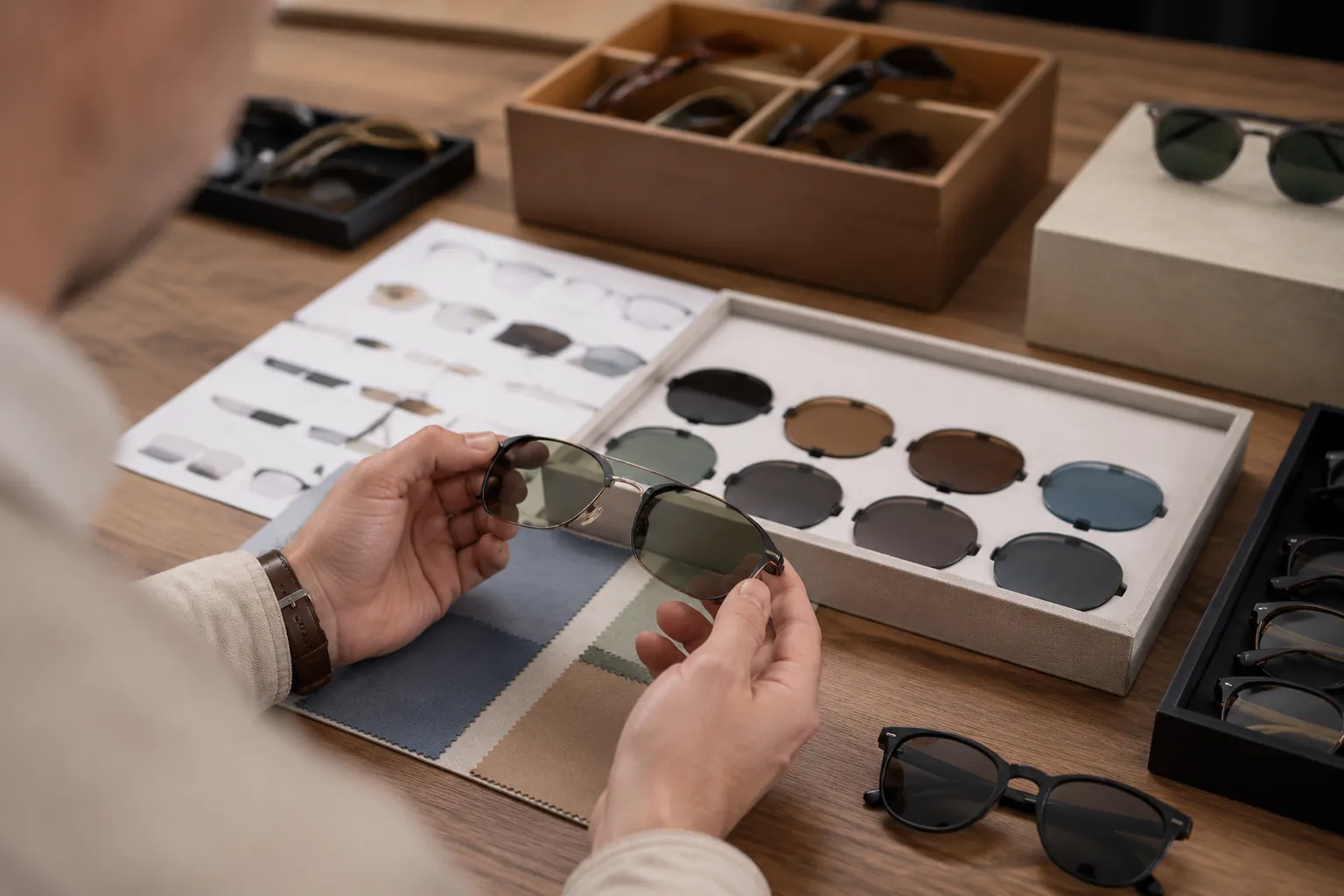
This guide is for brand owners, importers, distributors, and retail buyers building sunglass assortments at scale. The goal is not to offer every tint. It is to build a tight lens color program that fits the retail channel, supports compliance, works within MOQ limits, and stays repeatable in production. In many commercial assortments, the core program comes down to smoke, brown, green, and G15, with each color playing a specific role. Buyers who standardize lens families by use case, price band, frame material, and approval method usually make replenishment easier and cut avoidable complexity in sourcing and QC.
Start with channel economics, not trend boards
Most lens color mistakes start before sampling. A buyer approves too many tints from mood boards, then tries to spread them across a small number of frame styles. The result is predictable: fragmented inventory, smaller production lots, and harder replenishment.
Start with the retail channel instead. That is the practical way to set a core lens program. Each channel has a different tolerance for SKU complexity:
- Value retail: usually works best with a narrow lens-color offer because shoppers want simple choices and buyers need easy replenishment.
- Mid-market fashion: can often support core colors plus one recognizable signature option if the brand has a clear style position and repeat-order potential.
- Optical chains: typically prioritize neutral daily-wear colors, repeatable QC, and complete documentation over novelty.
- Outdoor or specialty accounts: often require a tighter technical brief, especially for visible light transmission, polarization, mirror coatings, and lens category labeling.
For many commercial sunglass lines, four lens families cover most routine demand: smoke or grey, brown, green, and G15. If the program is still small, adding more than a few lens colors usually increases sourcing risk and stock risk faster than it improves sell-through. Repeating the right core tint across proven frame shapes may look less exciting in a line review. It usually produces cleaner reorders and better inventory control.
Before adding another tint, ask three questions. Which channel is it for? What does it do better than smoke or brown? Can it repeat at meaningful volume in the next order? If the answers are weak, keep the opening program tight.
What each core lens color does at shelf and on face
Lens color is not a minor styling detail. It affects shelf appeal, perceived comfort, color distortion, return risk, and how easily store staff can explain the product. Buyers should judge each color by two tests: its commercial role and its wearer effect.
| Lens color | Typical VLT target | Commercial role | Wearer effect | Best channel fit |
|---|---|---|---|---|
| Smoke/Grey | Typically Category 3 range, often around 12% to 18% depending on program | Safest high-volume core | Neutral color perception, broad everyday appeal | Value chains, department stores, general retail |
| Brown | Typically Category 3 range, often around 12% to 20% depending on program | Warm fashion-function bridge | Warmer tone, often perceived as improving contrast in bright light | Lifestyle retail, driving-focused styles, resort |
| Green | Typically Category 3 range, often around 12% to 18% depending on program | Alternative core with heritage feel | Balanced tone, less warm than brown, more selective appeal | Fashion chains, classic-inspired assortments |
| G15 | Typically Category 3 range, often around 13% to 16% depending on program | Recognizable premium classic | Grey-green view, natural contrast, legacy positioning | Mid-market, optical, specialty sunglass accounts |
Smoke is usually the most efficient core. It creates few objections and works with black, crystal, navy, gunmetal, and many standard frame colors. Brown is often the next most useful because it pairs naturally with tortoise, gold, champagne, honey, and warmer translucent acetates. Green can work well, but it needs discipline. Several slightly different greens in one collection create confusion in approvals and repeat orders. G15 is useful when the line needs a classic premium-coded option without expanding into a wider technical lens assortment.
Simple rule: smoke is usually the anchor, brown is the second workhorse, and green or G15 should be added only when they have a clear channel role and a real reorder path.
Build the lineup by price point and MOQ
Price architecture matters. Lens color affects lot control, approval complexity, and whether components can be shared across styles. Buyers should match color ambition to actual order size. Not wishful order size.
At opening price points, simplification usually matters most. One smoke density and one brown density shared across multiple frames are often easier to control than a wider tint spread. In male or unisex programs, smoke often carries more volume. In fashion-lifestyle assortments with warmer frame colors, brown may take a larger share. Even then, the opening range is usually easier to manage when limited to two core colors.
At mid-market, a buyer can often support two core colors plus one signature color such as G15. That adds differentiation without turning every SKU into a separate tint-development project.
At higher price points, a brand may want a stronger lens story. That only works if the volume supports consistent production and repeat purchasing. Exact MOQ depends on the factory, lens construction, and whether the tint is shared across styles. In general:
- Small test orders: best used for fit checks, sales samples, or channel testing; avoid splitting the volume across too many lens colors.
- Moderate production runs: can support a two-color program more efficiently when the same lens family is repeated across several frame styles.
- Larger consolidated runs: usually make a third core color more practical because tinting, coating, and QC can be standardized across more units.
- Very large programs: are better suited to custom tint development, tighter visual matching, and stronger cost leverage.
Standardize lens families across several designs instead of asking for a unique tint for each SKU. That makes the program easier to cost, easier to replenish, and easier to control from batch to batch.
Match lens color to customer segment and frame material
The same lens family can look very different depending on the end wearer and the frame material around it. Approve the full frame-lens combination, not the lens by itself.
For injection-molded sunglasses, smoke is often the safest option. It sits cleanly with matte black, gloss black, crystal, navy, and standard tortoise, and it suits sharper opening price points. Brown works well when the collection needs a softer or warmer look, especially in women's, resort, and driving-oriented assortments. Green is usually more selective in molded programs unless the frame shape has a strong heritage cue such as a navigator or classic keyhole style.
For acetate, the frame front often has more pattern depth and more visible light around the rim. That gives brown and G15 more room to look intentional. Tortoise acetate with brown or G15 remains a dependable commercial combination because it stays balanced across seasons and usually needs little consumer explanation.
For metal frames, plating tone matters. Gold, rose gold, and bronze often pair naturally with brown. Silver, gunmetal, and black metal usually support smoke or G15 more cleanly. A warm brown lens inside a cool silver metal can work. It should be deliberate, not default.
Material choice also affects how the lens reads in production. Polycarbonate is common in value-to-mid programs and needs controlled color approval for repeatability. TAC polarized lenses can work well in polarized programs, but they add construction and edge-finish considerations. If the product includes mirror or flash coatings, the base tint matters even more because the coating changes how the color reads from different angles.
Control the technical variables behind the color
Buyers often specify lens color too loosely. Saying brown or green is not enough for bulk production. Two lenses with the same color name can behave very differently if visible light transmission, base material, coating stack, or gradient depth changes.
For a commercial tech pack, define at least these points:
- Lens material: for example PC, TAC polarized, or another approved construction.
- Target color family: smoke, brown, green, or G15.
- Visible light transmission range: a controlled target window suitable for the intended category and market.
- Finish: solid, gradient, flash mirror, full mirror, or polarized.
- Decoration method: laser logo, silk screen, pad print, or no decoration.
- Reference approval: signed master sample, approved swatch, or both.
For repeat programs, approve a control sample and require QC comparison under standardized lighting such as D65 or equivalent daylight conditions. This matters most for smoke and G15 because small shifts in density or hue become obvious when cartons from different runs are compared side by side. A seasonal fashion tint may tolerate some movement. A replenishment core should not.
Process detail matters. Solid tints are generally easier to stabilize in commercial production. Gradients need tighter control because top and bottom density can drift. Mirror and flash coatings add another variable because reflectivity can hide or exaggerate differences in the base tint. If logos are added to the lens, define the placement standard in the approval file so visual consistency can be checked during bulk QC.
Treat compliance as part of the color brief
Lens color selection cannot be separated from compliance. A lens may look right and still fail for the intended market if visible light transmission, category, or labeling does not match the target standard.
For overseas buyers, the practical checklist often includes CE EN ISO 12312-1 for applicable markets, ANSI Z80.3 for the United States, AS/NZS 1067 for Australia and New Zealand, REACH where restricted substance control is relevant, and FDA registration or related file requirements where applicable for the US market. Factory credentials such as ISO 9001 and BSCI can support supplier review, but they do not replace product testing against the relevant sunglass standard.
A common sourcing mistake is approving a dark or fashion-led lens on appearance first, then finding out that the intended category or labeling needs revision. That can delay bulk production, especially if the lens must be retinted or the packaging must be updated. Better approach: lock the intended market, test method, lens category, and target visible light transmission during development, then approve the production sample against those same conditions.
Buyers should ask the supplier to confirm:
- Target market standard before sample approval.
- Lens category and VLT window before bulk tinting starts.
- Labeling language and warning requirements before packaging print is released.
- Whether coatings or polarization change the test profile on the selected lens construction.
This is basic. It still gets missed. Most delays happen when lens color is treated only as a style choice instead of a technical and regulatory specification.
Use sampling and bulk planning to reduce color risk
A disciplined sample process protects margin later. Speed is not the main issue. Sequence is.
The most reliable approval order is:
- Approve the frame first if material color, plating tone, or acetate pattern is still changing.
- Approve the lens family second: smoke, brown, green, or G15.
- Approve tint density, visible light transmission range, and finish third.
- Approve mirror, polarization, gradient, or decoration details last.
That order matters because logos, trims, and mirror effects can distract teams from more expensive errors in lens tone and transmission. A printed logo can often be revised without remaking the lens. A lens that misses the approved color or VLT target may require more serious rework.
For bulk planning, standardize one smoke and one brown across as many styles as possible. Then decide whether green or G15 deserves a permanent slot, a channel-exclusive role, or only a seasonal test. This improves purchasing efficiency, simplifies QC, and reduces dead-stock risk. If several frame designs share one core lens program, the factory can usually manage material planning and visual control more effectively.
Good lens programs are narrow, repeated, and controlled. Wide lens programs often look strong in a line review and become difficult to replenish later.
A practical opening structure for many buyers is simple: start with one dominant smoke, one commercial brown, and one optional third color only if the channel, order size, and reorder plan clearly support it.
A practical core program most buyers can start with
If you are building or resetting a sunglass assortment, start with a simple planning model. Make every extra color justify itself with a clear channel role, MOQ path, and compliance plan.
- Value retail: usually starts best with smoke first and brown second.
- Mid-market fashion: often supports smoke and brown plus one selective option such as G15 or green.
- Optical and specialty: may justify a larger role for G15 when the account can explain the offer and the technical brief is clear.
- Resort or warm-climate lifestyle: usually starts with smoke and brown, with green added only where the frame styling clearly supports it.
These are planning principles, not fixed formulas. The key point is simple: each color must have a job. Smoke covers broad utility and low-objection wear. Brown supports warmth, driving, and lifestyle positioning. Green is more selective and should not be added casually. G15 works best as a deliberate classic or premium-coded option.
If a lens color does not have a clear channel function, repeat-order path, and technical specification, it usually does not belong in the first bulk order. Keep the program tight. Replenish what sells. Add complexity only after the data supports it.
Have a custom sunglasses project in mind?
Send us your styles, target market and quantities and we will return a detailed quote with MOQ, lead time and a sample plan.
Get a QuoteWhy source this from Wenzhou with LumiShades
Wenzhou in Zhejiang Province is widely regarded as China’s eyewear manufacturing capital, producing a large share of the world’s sunglasses. That concentration matters to buyers: a deep local supply chain for acetate sheet, hinges, lens blanks, plating and packaging means shorter component lead times, easier color and material matching, and a workforce with decades of eyewear-specific skill. LumiShades has manufactured in this ecosystem since 2009, and our vertical integration — in-house injection molding, acetate cutting, CNC milling, lens tinting, decoration and quality control — means no part of your order is quietly subcontracted to a workshop you cannot audit.
For international buyers, that vertical control translates into accountability. When a single factory owns every step, defects are traced and fixed at source rather than bounced between vendors, and your specifications survive intact from first sample to bulk. For procurement review, buyers can request process records, approved samples, quality checkpoints and project-specific compliance files before placing a bulk order. Required testing and documentation are confirmed against the destination market and product specification rather than assumed from a generic certificate list. Explore our manufacturing capabilities and quality control process to see how this works in practice.
Frequently asked questions
Should I carry both green and G15 in the same opening order? Usually not unless the total program is large enough to give both colors meaningful volume and a clear role. If the opening order is still in test mode, choose one. Use G15 when you want a classic, premium-coded lens with a recognizable market position. Use green only when it clearly fits the frame story, retail channel, and reorder plan. Before approving either option, ask the supplier for side-by-side lab dips or production references under standardized lighting, and confirm the target VLT and lens category in writing.
What is the safest core lens color for a mixed-gender retail program? Smoke or neutral grey is usually the safest starting point because it has broad consumer acceptance, looks clean on shelf, and works across many frame colors and metal finishes. It also gives buyers a straightforward baseline for compliance testing and repeat approvals. Practical step: approve one smoke reference with a defined VLT range, one signed control sample, and one approved packaging label linked to the intended market standard.
How do I keep lens color consistent across repeat orders? Use a formal repeat-order control method. Approve a signed master sample, record the lens material, target color family, finish, and VLT range in the tech pack, and require QC comparison under D65 or equivalent daylight conditions. Ask the supplier to compare each bulk lot against the approved control sample before shipment. If the program is a replenishment core, do not rely on color names alone. Require the purchase order and approval file to reference the exact approved sample code or internal standard.
Does lens color affect compliance testing? Yes. Lens color directly affects visible light transmission and therefore influences category, labeling, and suitability for the target market. A dark, mirrored, or polarized lens may perform differently from a solid non-mirror lens even when the base color name is similar. Practical step: confirm the target market standard first—such as CE EN ISO 12312-1, ANSI Z80.3, or AS/NZS 1067—then align the lens color, VLT target, and packaging language to that requirement before bulk approval.
At what quantity does it make sense to expand beyond smoke and brown? Expand only when the third color can be repeated across enough styles or enough reorder volume to justify separate approval, production control, and stock management. There is no universal number because MOQ depends on the supplier, lens construction, and whether the color is shared across multiple SKUs. As a buying rule, do not add a third color just to widen the line visually. Add it when the channel has a clear need, the supplier can repeat it consistently, and the order plan supports replenishment without leaving fragmented inventory.
Ready to start?
Explore our cat-eye sunglasses or request a quote — our sales team replies within 12 hours.
Request a Quote