
UV400 Sunglasses Claims: How Buyers Verify Them
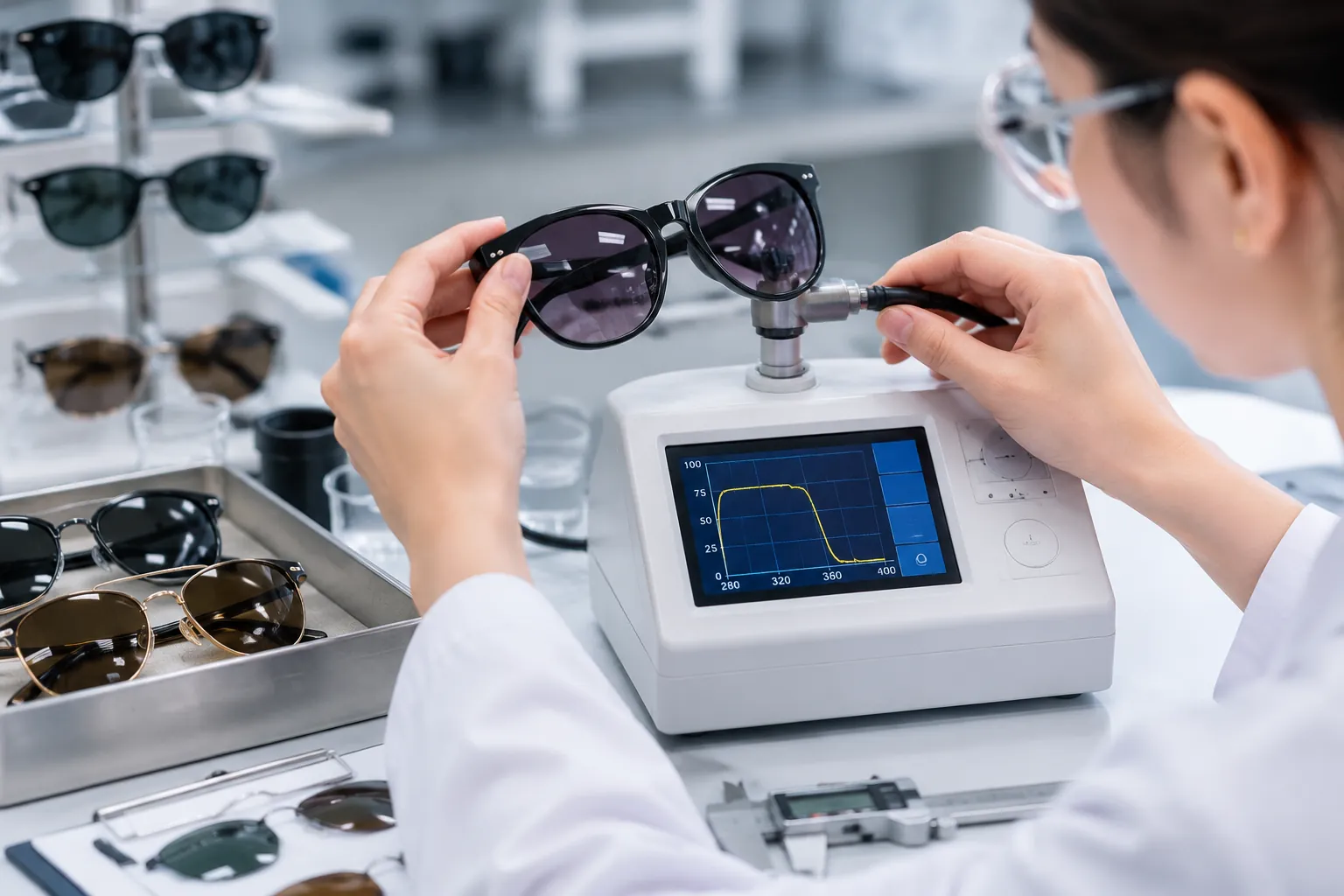
This guide is for brands, importers, distributors, promotional buyers, and retail teams that need proof before selling sunglasses with UV protection claims. It explains what UV400 means, how it differs from lens category, which documents to request, what numbers to check, and how to control production batches. Do not rely on a line in a quotation. Use this checklist before you approve packaging, place a bulk order, or publish a marketplace listing.
Start with the claim: UV400 is not lens darkness
UV400 is a UV protection claim. In practice, it means the lens is intended to protect across the ultraviolet range up to 400 nm, including UVA and UVB wavelengths. It is not a darkness claim. Dark lenses can fail UV requirements if the material, absorber, or coating is wrong. A pale fashion tint can meet UV400 expectations if the lens construction is correct and verified.
Keep three items separate: UV400, lens category, and visible light transmission. UV400 concerns ultraviolet transmittance. Lens category concerns how much visible light reaches the eye. Visible light transmission, often shown as VLT, is the measured percentage of visible light passing through the lens. Color is not a test. A gray lens and a brown lens may look similar in a showroom but fall into different category ranges after measurement.
For regulated markets, the claim should be supported by a report or technical file that identifies the model, lens material, lens color or coating, test standard, sample date, and measured result or pass criteria. The report must connect the tested sample to the product you will ship. If a supplier sends a generic report for another SKU, another lens color, or a report that only says "pass" without identifying the tested construction, do not use it as shipment release evidence.
Buyer rule: approve a UV400 claim only when the evidence matches the lens you will sell, including material, tint, mirror coating, gradient, polarization, and any functional coating that could affect transmittance.
Know the standard for your sales market
Sunglasses are not governed by one global rule. The same frame and lens may need different evidence, labels, warnings, and technical-file content by market. Define the destination market before sample approval. Also define the exact claim language. "UV400," "100% UV protection," "Category 3," and "not suitable for driving" are compliance statements. Treat them that way.
| Market | Common standard or requirement | What buyers should verify | Common mistake |
|---|---|---|---|
| European Union | CE marking under the applicable EU PPE framework, with EN ISO 12312-1 commonly used for plano sunglasses | UV protection, visible transmittance category, optical quality, user information, importer or responsible economic operator details, and declaration of conformity | Using the CE mark without a technical file and declaration that cover the exact model and lens construction |
| United States | FDA registration/listing obligations may apply; ANSI Z80.3 is commonly used as a performance reference for non-prescription sunglasses | Product-specific performance documentation, impact-related requirements, labeling claims, and supplier records | Assuming FDA registration proves UV performance. It does not. |
| Australia/New Zealand | AS/NZS 1067 series requirements for sunglasses and fashion spectacles | Lens category, UV requirements, traffic signal recognition where relevant, and required warning labels | Selling fashion tint lenses without correct category labeling and use warnings |
| Chemical restricted markets | REACH and retailer chemical protocols where applicable | Restricted substances in frames, coatings, inks, nose pads, screws, plated logos, and parts in prolonged skin contact | Testing only lenses and ignoring frame or decoration materials that touch the skin |
Supplier documents may mention CE EN ISO 12312-1, FDA registration-related records, ANSI Z80.3, AS/NZS 1067, REACH, ISO 9001, or BSCI. Read each one for what it is. ISO 9001 is a quality management system certificate. BSCI is a social compliance audit reference. Neither replaces product-specific lens testing or market-specific compliance review.
Read the lab report like a buyer
A lab report should answer one commercial question: does this exact product support the claim you plan to print, list, and sell? If it does not answer that question, it may be useful background. It is not enough for final release.
- Applicant and manufacturer: Check whether the applicant is the factory, trading company, lens supplier, or another brand. If the name is unfamiliar, ask for the relationship in writing.
- Sample description: The report should identify sunglasses or lenses, model number where applicable, lens material, lens color, lens type, and sometimes frame material. Match it to your purchase order and approved sample.
- Test standard: Look for the standard relevant to the sales market, such as EN ISO 12312-1, ANSI Z80.3, or AS/NZS 1067. REACH reports address chemical restrictions, not optical performance.
- Test date and product revision: Report age matters, but sample match matters more. An older report for the exact unchanged lens construction may be more relevant than a new report for a different tint or coating.
- Measured values: Request UV transmittance and visible light transmission where available. For lens category control, a few percentage points can matter near a category boundary.
- Report integrity: Check report number, page count, lab name, sample photos, amendments, and whether the lab provides report verification by website, QR code, or email.
For custom sunglasses, a stock black-lens report does not automatically cover smoke gradient, brown polarized, blue mirror, clear yellow, green TAC, or PC shield lenses. Lens recipes matter. Coating thickness matters. A mirror layer can reduce visible transmission and move a lens into a darker category. A pale gradient lens may meet UV expectations but still belong in category 1 or 2, which changes the product language.
Lens category: the label buyers often miss
Lens category is usually based on visible light transmission, not UV protection. It tells the user how dark the lens is and where it is suitable. It affects packaging, hangtags, user leaflets, marketplace listings, and retailer onboarding forms. Do not estimate it by eye.
| Lens category | Common visible light transmission range | Common use | Buyer warning |
|---|---|---|---|
| Category 0 | 80% to 100% | Fashion, indoor, or very low sunlight use | Do not present as strong sun-glare protection just because it has UV protection |
| Category 1 | 43% to 80% | Low sunlight or fashion tint | Transparent yellow, pink, or light gradient lenses often fall here |
| Category 2 | 18% to 43% | Average daylight | Small tint variation can change retail positioning and category marking |
| Category 3 | 8% to 18% | Bright sunlight and typical outdoor sunglass use | Common for sunglasses; still needs separate UV performance evidence |
| Category 4 | 3% to 8% | Very high glare environments | Usually not suitable for driving; warning language must be checked against the target market |
These are common category ranges. Confirm the exact wording and boundary treatment required by the applicable standard and market. If your packaging says category 3 but the production lot measures as category 2, you have a labeling problem even if the lens meets UV requirements.
Specify a target VLT range, not just a category. "Category 3 gray lens" is too loose for production control. Define the approved target range, allowable tolerance, and the rule that production must remain within the labeled category.
Verify before bulk production
The best time to catch a UV400 or category problem is before tooling, packaging print, and bulk lens tinting are locked. Build sample development and testing time into the launch calendar. Confirm lead times in the quotation. Do not approve packaging until the UV claim, lens category, warning text, and market documents have been checked.
- Freeze the lens specification. Record material, color code, lens thickness, coating, polarization, mirror layer, gradient direction, and target category.
- Request matching documentation. Ask for EN ISO 12312-1, ANSI Z80.3, AS/NZS 1067, REACH, or FDA registration-related records according to the destination market.
- Test pre-production samples when the lens is new or customized. Custom colors, mirrors, gradients, shield lenses, and polarized constructions should be checked before packaging artwork is finalized.
- Check the marking plan. Confirm UV claims, lens category, driving warnings, importer or responsible party details, batch code, user information, and required language versions.
- Set acceptance criteria. Define what happens if UV transmittance, visible light transmission, lens color, coating adhesion, or polarization alignment differs from the approved sample.
- Retain samples. Keep one signed pre-production sample and one production sample from each batch, labeled by purchase order, SKU, and date.
For small orders, buyers sometimes skip independent testing to save cost. That is a risk decision, not a compliance plan. Even a limited promotional run can trigger marketplace document requests, retailer questions, or customs review if the product carries UV or category claims.
Control the production variables
UV protection and lens category depend on material control, tinting control, coating control, and batch records. A certificate issued for one construction does not validate a later construction if the material, tint, coating, lens supplier, or process has changed. Small changes count.
Material behavior matters. PC lenses can have UV-blocking performance through the base resin and additives, but the actual construction still needs verification. TAC lenses are common for polarized sunglasses and depend on lamination quality as well as the polarizing film. CR-39 can offer good optical clarity but must use the correct UV treatment or absorber system. Nylon lenses are often used for sports styles because of flexibility and impact resistance. For all materials, ask whether UV blocking comes from the substrate, additive, coating, or a combination.
Tinting is variable. Dye concentration, dipping time, bath temperature, cleaning quality, and curing conditions can change visible transmission. A practical tinting control plan may include a master color chip, approved lens sample, first-piece check, in-process checks at defined intervals, and final batch comparison under controlled light. Mirror coating can lower visible transmission. Uneven coating can create left-right mismatch. Polarized lenses add alignment risk; check that the polarizing axis is consistent and that delamination, bubbles, or stress marks are not visible.
Decoration can affect durability and chemical compliance. Pad printing, laser engraving, heat transfer, metal temple logos, foil stamping, rubberized coatings, and painted tips should be checked for adhesion, abrasion, and restricted substances where applicable. A buyer-side QC plan should include incoming lens batch checks, frame color comparison, hinge torque, screw security, logo adhesion, lens fitting, packaging accuracy, carton condition, and final inspection against the approved sample and specification. Keep batch records. If a retailer asks months later, memory is not evidence.
Match testing logic to order size
Compliance cost feels different on a small trial order than on a large retail program. The logic is the same: plan the test budget before you promise UV400, "100% UV protection," or a specific category on packaging. Confirm project MOQ, unit price, tooling cost, packaging cost, inspection requirements, and testing responsibility in the written quotation. Do not rely on old pricing or a catalog claim when the lens construction is customized.
| Order scale | Typical buyer goal | Verification approach | Risk if skipped |
|---|---|---|---|
| Small trial order | Market test, influencer drop, event order | Use existing matching reports only if the lens and frame materials are truly covered; avoid aggressive claims if not tested | Small batches can still trigger marketplace, retailer, or customs document requests |
| Retail trial order | Distributor sample order or first store placement | Confirm category, packaging text, and lens color; consider lab testing for custom tints or coatings | Wrong category or warning may be printed across all retail units |
| Seasonal launch | Planned retail or e-commerce release | Test pre-production samples for new lens constructions and retain production samples | Rework cost, launch delay, or retailer rejection if failure is found late |
| Volume program | Repeat or multi-SKU retail program | Set batch QC, document control, shipment inspection, and periodic retesting where risk justifies it | Recall exposure, chargebacks, shipment holds, and brand damage |
Do not wait until final inspection to ask for compliance papers. Reports, artwork, and sample approval should move together. If third-party testing is required, add that time before bulk production approval, not after goods are packed.
Keep a technical file by SKU
A buyer-side technical file does not need to be complex. It needs to be complete, current, and easy to retrieve by SKU. Store documents by model and revision, not in a long supplier email thread. When a lens color, coating, frame material, logo method, or warning text changes, create a new revision and decide whether new testing or document review is needed.
- Purchase order, final specification sheet, and approved quotation
- Approved pre-production sample photos and signed sample record
- Lens material, thickness, color, coating, polarization, category, and target VLT statement
- Relevant EN ISO 12312-1, ANSI Z80.3, AS/NZS 1067, REACH, or FDA registration-related documentation for the sales market
- Packaging artwork showing UV claims, category, warnings, importer or responsible party details, language versions, and batch code
- QC inspection report, AQL or agreed inspection result, production batch records, and carton list
- Retained production sample reference with purchase order, SKU, and production date
- Any lab retest reports for custom colors, mirror coatings, gradient lenses, polarized lenses, or material changes
This file supports customs review, retailer onboarding, online marketplace document requests, insurance review, and internal claims approval. It also protects repeat orders. If you reorder the same sunglasses but change from smoke lenses to green mirror lenses, treat it as a new compliance check, not a simple color swap.
Have a custom sunglasses project in mind?
Send us your styles, target market and quantities and we will return a detailed quote with MOQ, lead time and a sample plan.
Get a QuoteWhy source this from Wenzhou with LumiShades
Wenzhou in Zhejiang Province is widely regarded as China’s eyewear manufacturing capital, producing a large share of the world’s sunglasses. That concentration matters to buyers: a deep local supply chain for acetate sheet, hinges, lens blanks, plating and packaging means shorter component lead times, easier color and material matching, and a workforce with decades of eyewear-specific skill. LumiShades has manufactured in this ecosystem since 2009, and our vertical integration — in-house injection molding, acetate cutting, CNC milling, lens tinting, decoration and quality control — means no part of your order is quietly subcontracted to a workshop you cannot audit.
For international buyers, that vertical control translates into accountability. When a single factory owns every step, defects are traced and fixed at source rather than bounced between vendors, and your specifications survive intact from first sample to bulk. We back this with 15+ years of experience, shipments to 60+ countries, more than 5 million pairs produced per year and a 98.5% on-time delivery rate. Our certifications — CE EN ISO 12312-1, FDA registration, ANSI Z80.3, AS/NZS 1067, REACH, ISO 9001 and BSCI audit — mean the compliance documentation your market requires already exists. Explore our manufacturing capabilities and quality control process to see how this works in practice.
Frequently asked questions
Can I print UV400 on packaging if the supplier says the lenses are UV400? Do not rely on a verbal claim or quotation line. Ask for documentation that matches the actual lens you will sell, including material, color, coating, polarization, and model reference. Check that the report or technical file supports the target market standard and the exact claim you plan to print. If the lens is customized or not clearly covered, test pre-production samples before approving packaging.
Does FDA registration prove UV protection for sunglasses sold in the US? No. FDA registration or listing is not a UV400 performance test and does not prove that a lens meets UV transmittance requirements. For US sales, keep product-specific performance records, review ANSI Z80.3-related data where applicable, and make sure labeling claims can be supported by test evidence for the actual product.
Do mirrored or gradient lenses need separate verification? Often, yes. Mirror coating and gradient tint can change visible light transmission, category, appearance, and packaging language. If the mirror, gradient, base tint, material, or polarizing construction differs from the tested sample, request matching data or send pre-production samples for testing before bulk approval.
Is CE EN ISO 12312-1 enough for Australia or New Zealand? Not by itself. EN ISO 12312-1 evidence may be useful technical background, but Australia and New Zealand use AS/NZS 1067 requirements. If you sell there, verify the applicable AS/NZS performance requirements, category labeling, warnings, and user information for the exact SKU.
What should I do if my bulk order tests as a different lens category than approved? Stop shipment and quarantine the affected goods. Compare the result with the retained pre-production sample, approved specification, and production batch records. Then decide whether to relabel, retest, sort affected units, replace lenses, or remake the batch. Do not ship products with category labeling or warnings that conflict with the measured result.
How early should I arrange UV or category testing for custom sunglasses? Arrange testing at the pre-production sample stage, before packaging print and bulk lens production. Build testing time into the development schedule and make shipment approval conditional on matching documentation, correct category labeling, and retained samples. Late testing can cause relabeling, rework, or launch delays.
Ready to start?
Explore our wayfarer sunglasses or request a quote — our sales team replies within 12 hours.
Request a Quote