
Children's Sunglasses Sourcing Guide for Buyers
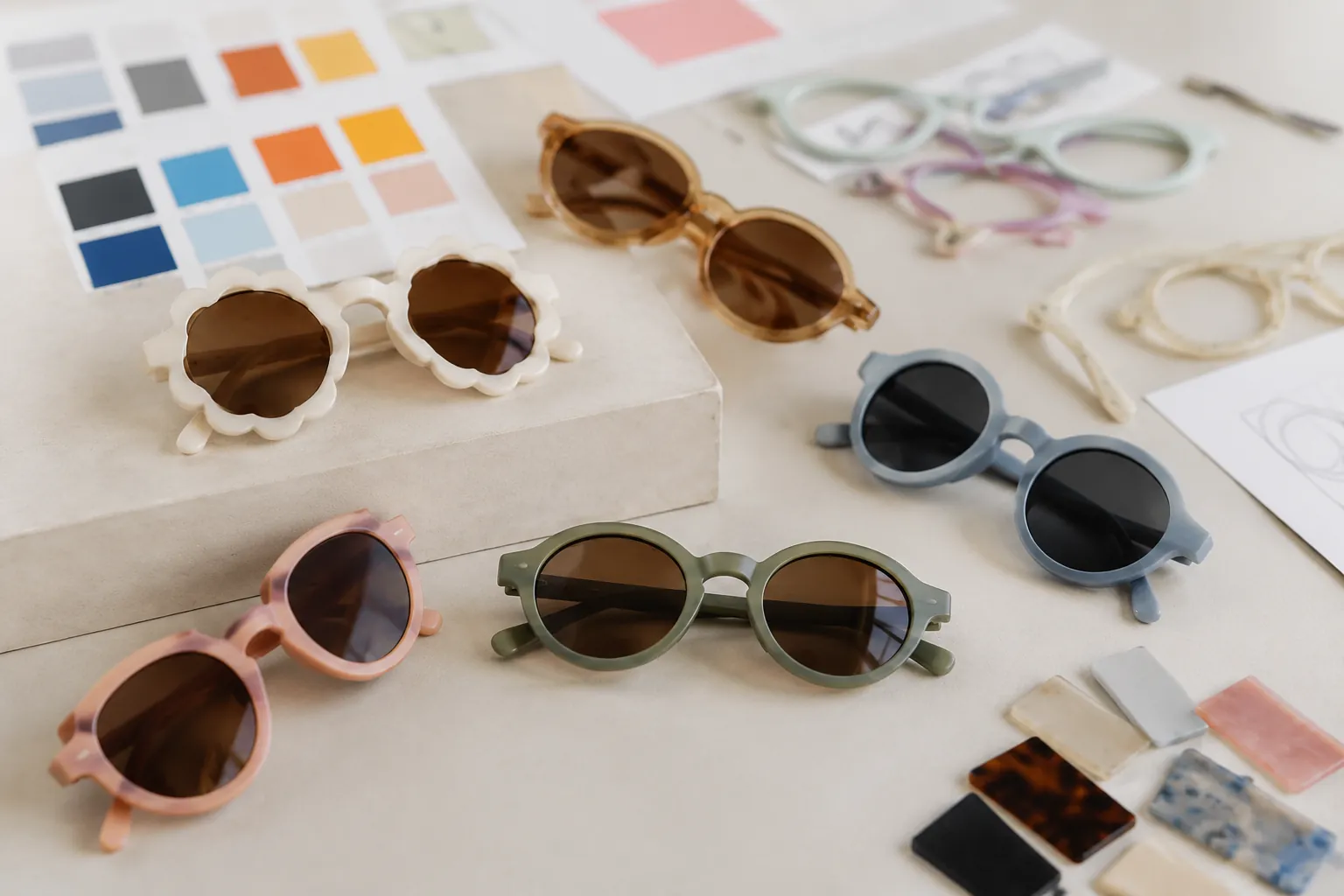
This guide is for importers, retailers, distributors, and private-label brands buying children's sunglasses in volume. Kids' eyewear has little margin for error. Bad fit, weak hinges, unsafe coatings, loose trim, vague UV claims, or wrong labels can cause returns, compliance delays, and product-safety risk. Use this framework to specify age fit, materials, lens performance, labeling, testing, MOQ, pricing, and factory QC before you place a bulk order.
Start with age band and fit tolerance
Do not ask a factory to shrink an adult sunglasses style and call it a children's frame. Kids' frames need their own fit logic. Bridge width, temple length, front curvature, hinge feel, lens retention, and total weight all matter. Children move more, pull harder, and often wear sunglasses during active outdoor use.
Set the age bands before choosing colors, logos, or packaging. A toddler and an older child should not share the same bridge, temple length, or front width. If one frame is forced to cover too wide an age range, it usually fits no group well.
| Age band | Typical frame target | Weight guide | Main sourcing risk |
|---|---|---|---|
| 0–2 years | Small bridge, short temples, strap option where suitable, rounded edges | Keep as light as the design allows | Loose small parts, pressure marks, lens pop-out |
| 3–5 years | Flexible temples, stable bridge, soft contact points | Lightweight construction preferred | Hinge breakage, chewing, coating transfer |
| 6–9 years | Stronger hinge, more style detail, accurate lens category | Balance durability and comfort | Loose screws, weak UV-claim control |
| 10–12 years | Near-youth sizing, more fashion colors, optional metal trim | Comparable to small youth frames | Nickel release, sharp trim, temple discomfort |
Ask the supplier for a size chart covering lens width, bridge, temple length, front width, lens height, base curve, and finished frame weight. Put tolerances in the specification. For most children's programs, fit-critical points such as bridge, temple length, and front width need tighter control than outer cosmetic dimensions. Agree the final tolerance with the factory based on material, tooling, and production method.
Do not approve fit from photos. Use physical samples, a suitable pediatric head form, and, if your product-safety process permits it, supervised fit feedback from the intended age group.
Specify material performance, not just appearance
Children twist temples, drop frames, chew temple tips, and throw sunglasses into bags without a case. Material selection must cover impact behavior, flexibility, chemical control, edge safety, and skin contact. Looks are not enough.
Injection-molded plastics are common because they offer repeatable shape, efficient production, and strong color options. Acetate can look more premium, but it is usually heavier and needs more hand finishing. Metal frames can work for older children, but plating, nickel release, screw ends, and sharp edges need close control.
- Injection plastic: good for repeatable molded frames. Specify the resin or approved material family, and check brittleness, flashing, and dimensional stability.
- Flexible plastic or TR-style material: useful where bend resistance matters. Confirm lens retention, hinge function, and decoration security after flexing.
- Acetate: strong color depth and a higher-end look. Check finished weight, edge rounding, polishing residue, hinge installation, and warpage after finishing.
- Rubberized or soft-touch coating: comfortable and grippy, but risky if poorly controlled. Test the actual production coating for rub resistance, adhesion, color transfer, and chemical compliance.
- Metal parts: use with caution on children's frames. Inspect plating, screw ends, nose-pad arms, rivets, decorative plates, and skin-contact areas. For EU programs, manage nickel-release risk under applicable REACH requirements.
Manage REACH compliance at material and component level. Do not ask for a certificate at the last minute and assume the job is done. Identify all skin-contact or possible mouth-contact areas: frame front, temples, temple tips, nose pads, coatings, decorative plates, printing ink, straps, pouches, and relevant packaging components.
Write restricted-substance requirements into the purchase order. Require material consistency between approved samples and bulk goods. A test report only helps if the tested material, color, coating, lens, and decoration match the production item.
Make UV and lens category claims measurable
A hangtag that says "UV400" is not enough. UV400 is a claim. Buyers need to connect it to a recognized standard, a test report, a lens category, a SKU, and the final label.
Common references include EN ISO 12312-1 for general-purpose sunglasses in Europe, ANSI Z80.3 for nonprescription sunglasses in the United States, and AS/NZS 1067 for sunglasses and fashion spectacles in Australia and New Zealand. Requirements vary by product type, claim, and market. Confirm the applicable standard for the destination country before production.
Lens darkness is not UV protection. A dark lens with poor UV filtration can be unsafe because the pupil may dilate while UV exposure remains insufficiently controlled. For children's outdoor sunglasses, the visible light transmission category must match the intended use and the label. Very dark lenses with use restrictions should not be sold casually or mislabeled.
- Define the lens material, such as PC, AC, or TAC polarized, and confirm it fits the price point and performance target.
- State the applicable standard and UV-performance requirement instead of relying only on "UV400."
- Confirm visible light transmission category and exact label wording for the destination market.
- For polarized lenses, define polarization requirement, axis direction, and acceptable visual distortion limits.
- Approve tint color with a physical master sample under controlled lighting. A phone photo is not approval.
Require pre-production lens samples, a retained golden sample, and batch checks during production. Reject clear left/right lens mismatch, visible waves, stress marks that affect vision, wrong category marking, or any lens that does not match the approved SKU-linked test report.
Control small parts, hinges, and decoration
Kids' eyewear carries more mechanical risk than adult promotional sunglasses. The problem is not only breakage. It is what comes loose: screws, logo plates, charms, snap-in ornaments, nose pads, temple caps, and other small parts.
Choose decoration by risk level. Laser engraving usually has low detachment risk because it adds no separate part. Pad printing is economical, but it needs adhesion testing on the actual production surface. Metal logo plates can look better, but they need edge checks, plating review, and pull testing. Glued charms or stickers are poor choices for children's retail eyewear unless the age grade, warnings, and market rules clearly support the design.
| Decoration method | Best use | Process control | Buyer decision |
|---|---|---|---|
| Laser engraving | Small logo on temple or approved lens area | Depth, placement, no sharp groove | Low peel risk; good for clean branding |
| Pad printing | Color logo, pattern, character artwork | Ink adhesion, tape test, rub test after curing | Test on the final material and coating, not only on a flat plaque |
| Hot stamping | Metallic logo effect without a separate plate | Foil adhesion, heat-mark control | Useful for older children's fashion styles if adhesion is proven |
| Metal logo plate | Premium styles for older children | Pull force, smooth edges, plating quality | Avoid on toddler frames unless a safety review supports it |
| Glued charm or sticker | Limited promotional use only where suitable | Bond strength and small-part risk review | Generally not preferred for children's retail sunglasses |
Hinges should open smoothly and close without wobble. Include inspection checks for screw tightness, screw-tip exposure, hinge alignment, temple symmetry, and opening angle. For molded frames, confirm whether the hinge is pinned, screwed, spring-loaded, or part of a flexible one-piece design. For acetate frames, inspect hinge alignment after polishing. Finishing can shift the front or temples.
Build the compliance file before packing
Labeling errors can stop goods at receiving, force relabeling, or create regulatory exposure. Build the compliance file before mass production. Not after cartons are sealed.
The file should connect the SKU, lens type, frame material, age grade, test report, user information, packaging artwork, barcode, and carton mark.
For Europe, buyers commonly reference CE marking and EN ISO 12312-1 for general-use sunglasses. For the United States, buyers may request ANSI Z80.3 documentation and relevant FDA registration details where applicable to the supplier or product. For Australia and New Zealand, AS/NZS 1067 is the key reference. REACH supports EU chemical compliance for skin-contact parts, coatings, and decorations. ISO 9001 and BSCI are factory or social-compliance references. They do not replace product testing.
- Product code, lens type, and style name must match the test report, packaging, and carton label.
- Lens category and usage warnings must match the destination market and the tested lens.
- User warnings may need to state limits such as not for direct observation of the sun and not for protection against artificial light sources.
- Age grading must be consistent across packaging artwork, hangtag, online listing, and master carton.
- Country-of-origin marking must follow importer, retailer, and destination-market requirements.
- If the product includes a strap, pouch, case, cleaning cloth, or other accessory, include those items in the compliance review where relevant.
A supplier can help collect documents, but the importer or brand owner remains responsible for market compliance. Ask for current, SKU-relevant files only: CE/EN ISO 12312-1 where applicable, ANSI Z80.3 where applicable, AS/NZS 1067 where applicable, REACH documentation for relevant materials, FDA registration details where applicable, and factory-level ISO 9001 or BSCI documents if required by your retailer. Reject expired, unrelated, or style-mismatched certificates.
Plan sampling, MOQ, pricing, and lead time
Sample new children's sunglasses in at least two stages. The first sample should confirm shape, size, comfort, material, hinge concept, and lens retention. The second should confirm final lens, tint, logo, packaging, warnings, barcode, and compliance-linked artwork. Trying to approve everything in one round usually creates late corrections.
MOQ and pricing depend on tooling, material, lens type, decoration, packaging, testing, and factory workload. Existing molds and standard colors usually support lower MOQs than custom tooling, custom acetate colors, metal trims, or custom packaging. Polarized lenses, special coatings, cases, retail-ready packaging, and third-party testing should be priced as separate line items. Otherwise, cost drivers get hidden.
| Order level | Best fit | Price logic | Planning note |
|---|---|---|---|
| Low-volume trial | Market test, small retailer, buyer presentation | Higher unit cost because setup, color change, and QC time are spread over fewer units | Use existing molds, standard materials, and simple decoration where possible |
| Small retail drop | Initial seasonal launch or distributor sample stock | Better absorption of setup and packaging costs | Validate cartons, labels, barcodes, and warnings before scaling |
| Seasonal wholesale order | Multi-store or distributor program | More efficient material, lens, and packaging purchasing | Lock color, lens category, artwork, and test requirements before deposit |
| Large chain-retail order | National retailer or high-volume distributor | Lowest unit cost potential, but higher documentation and inspection discipline required | Use in-line inspection plus final AQL inspection |
Ask the supplier to quote sample lead time, tooling lead time if any, bulk production lead time, third-party testing time, packaging approval time, and shipment booking time separately. Do not build the schedule around production days only. Compliance testing, warning review, barcode approval, and retailer packaging checks can take longer than frame production.
Inspect the failures that actually happen
QC for children's sunglasses should target predictable failures, not just appearance. A carton can look neat while lenses pop out, temples wobble, lens category is wrong, logo ink rubs off, or a screw tip is exposed.
Put inspection points in the purchase order and approve a golden sample before bulk production. If a requirement is not written, measured, or linked to an approved sample, it is hard to enforce.
- Dimensional checks: measure lens width, bridge, temple length, front width, lens height, base curve, and weight against the approved specification and agreed tolerances.
- Lens retention: flex the frame and apply an agreed test method to confirm lenses do not pop out during foreseeable handling.
- Hinge function: check screw tightness, opening angle, temple symmetry, wobble, and sharp or exposed screw ends.
- Surface safety: inspect burrs, flashing, rough acetate edges, sharp metal plates, nose-contact points, coating defects, and poor polishing.
- Lens performance: verify SKU-linked test reports and spot-check tint shade, category consistency, polarization where specified, and left/right matching.
- Decoration durability: run rub, tape, scratch, and adhesion checks on pad print, coating, hot stamp, or plates after curing.
- Packing accuracy: match SKU, age band, lens category, barcode, warnings, country of origin, pouch or case, instruction sheet, and carton mark.
For larger orders, use an in-line inspection before final packing. It catches hinge, lens, decoration, and labeling issues while rework is still possible. Final random inspection is the last gate, not the only gate. For chain-retail or distributor programs, define AQL levels and classify critical defects separately. Sharp edges, wrong lens category, missing warnings, loose small parts, and incorrect compliance labeling should not be treated as minor defects.
Use a disciplined approval sequence
The lower-risk path is simple. First, define the destination market: EU, United States, Australia/New Zealand, or mixed markets. Second, define the age band and target fit measurements. Third, select the frame material, lens material, lens category, and decoration method. Fourth, confirm labeling, testing, and document requirements. Lock artwork and packaging only after those decisions are stable.
Use a written specification sheet with measurable language. "Safe material" is not a specification. A stronger version is: "Frame front: matte injection-molded plastic, rounded edges, no detachable charms, REACH-controlled skin-contact parts, PC lenses, Category 3 under applicable sunglass standard, pad-print logo with tape and rub test, bridge 15 mm with agreed tolerance, temple 115 mm with agreed tolerance." That gives the factory something to quote, sample, inspect, and repeat.
Blunt rule: if the sunglasses are for children, do not approve bulk production from photos. Hold a physical sample. Flex it. Inspect the edges. Check hinge feel. Verify the lens claim. Read the label like a customs or retailer compliance reviewer would.
On-time shipment depends on complete approvals. Late packaging files, changed lens claims, revised warnings, new testing requests, or decoration changes after production starts can move the schedule. Treat children's sunglasses as a controlled consumer product, not a throwaway accessory. That mindset prevents many avoidable sourcing failures.
Have a custom sunglasses project in mind?
Send us your styles, target market and quantities and we will return a detailed quote with MOQ, lead time and a sample plan.
Get a QuoteWhy source this from Wenzhou with LumiShades
Wenzhou in Zhejiang Province is widely regarded as China’s eyewear manufacturing capital, producing a large share of the world’s sunglasses. That concentration matters to buyers: a deep local supply chain for acetate sheet, hinges, lens blanks, plating and packaging means shorter component lead times, easier color and material matching, and a workforce with decades of eyewear-specific skill. LumiShades has manufactured in this ecosystem since 2009, and our vertical integration — in-house injection molding, acetate cutting, CNC milling, lens tinting, decoration and quality control — means no part of your order is quietly subcontracted to a workshop you cannot audit.
For international buyers, that vertical control translates into accountability. When a single factory owns every step, defects are traced and fixed at source rather than bounced between vendors, and your specifications survive intact from first sample to bulk. We back this with 15+ years of experience, shipments to 60+ countries, more than 5 million pairs produced per year and a 98.5% on-time delivery rate. Our certifications — CE EN ISO 12312-1, FDA registration, ANSI Z80.3, AS/NZS 1067, REACH, ISO 9001 and BSCI audit — mean the compliance documentation your market requires already exists. Explore our manufacturing capabilities and quality control process to see how this works in practice.
Frequently asked questions
What certifications or documents should I ask for when importing children's sunglasses? Ask for documents that match the destination market and the exact SKU. For Europe, request CE documentation and EN ISO 12312-1 test evidence where applicable. For the United States, request ANSI Z80.3 documentation where relevant and FDA registration details if applicable to the supplier or product. For Australia and New Zealand, request AS/NZS 1067 documentation. For EU chemical compliance, request REACH documentation for relevant frame, lens, coating, ink, and decoration materials. ISO 9001 and BSCI can support supplier evaluation, but they do not replace product testing.
Is UV400 enough to print on children's sunglasses packaging? No. UV400 is not a standalone approval. The claim must be supported by a test report linked to the correct SKU, lens material, lens color, and lens category. Packaging and user instructions should match the applicable standard and destination-market wording. Before bulk shipment, compare the test report, packaging artwork, carton label, and approved sample to make sure the claim is consistent everywhere.
What should a buyer include in a children's sunglasses specification sheet? Include age band, target dimensions, dimensional tolerances, frame material, lens material, lens category, UV requirement, applicable standard, decoration method, restricted-substance requirement, labeling language, packaging components, barcode, country of origin, inspection criteria, and approved golden sample reference. Avoid vague terms such as "safe," "good quality," or "UV protection" unless they are tied to a measurable requirement or standard.
What is a reasonable MOQ for a children's sunglasses trial order? MOQ depends on the supplier's tooling, material, color, lens, decoration, and packaging requirements. For trial orders, ask the supplier to quote the lowest MOQ using existing molds and standard materials, then request separate pricing for higher quantities. Compare unit price, setup charges, packaging cost, testing cost, and inspection cost. A very low MOQ may help with market testing, but it usually means a higher unit price and fewer customization options.
Which frame material is safest for younger children? There is no single safest material. Lightweight injection-molded plastic or flexible plastic designs are often practical for younger children because they can reduce weight and breakage risk. The controls matter more than the material name: rounded edges, secure lenses, no detachable small parts, compliant skin-contact materials, stable hinges, and verified labeling.
How long should I plan from sample request to bulk shipment? Ask the supplier to separate the schedule into sample production, sample review, revisions, third-party testing if required, packaging approval, bulk production, inspection, and freight booking. Existing molds and standard materials are faster than new tooling, custom colors, custom packaging, or special testing. For children's sunglasses, build in buffer time for compliance review and labeling approval instead of planning only around production days.
Should I use metal logo plates on children's sunglasses? Use metal logo plates carefully, mainly for older children's styles. Require smooth edges, secure attachment, plating review, and pull testing. For toddler or preschool frames, lower-risk branding methods such as laser engraving, hot stamping, or pad printing are often easier to control because they do not add a detachable metal part.
What defects should be treated as critical during inspection? Critical defects should include sharp edges, exposed screw tips, loose small parts, lenses that pop out, incorrect lens category, missing or incorrect warnings, mismatched test-report information, and any material or decoration that differs from the approved tested sample. Define these defects in the purchase order before production so the factory and inspector apply the same standard.
Ready to start?
Explore our sport wrap sunglasses or request a quote — our sales team replies within 12 hours.
Request a Quote