
Kids' Sunglasses Wholesale: Safety, Fit, Compliance
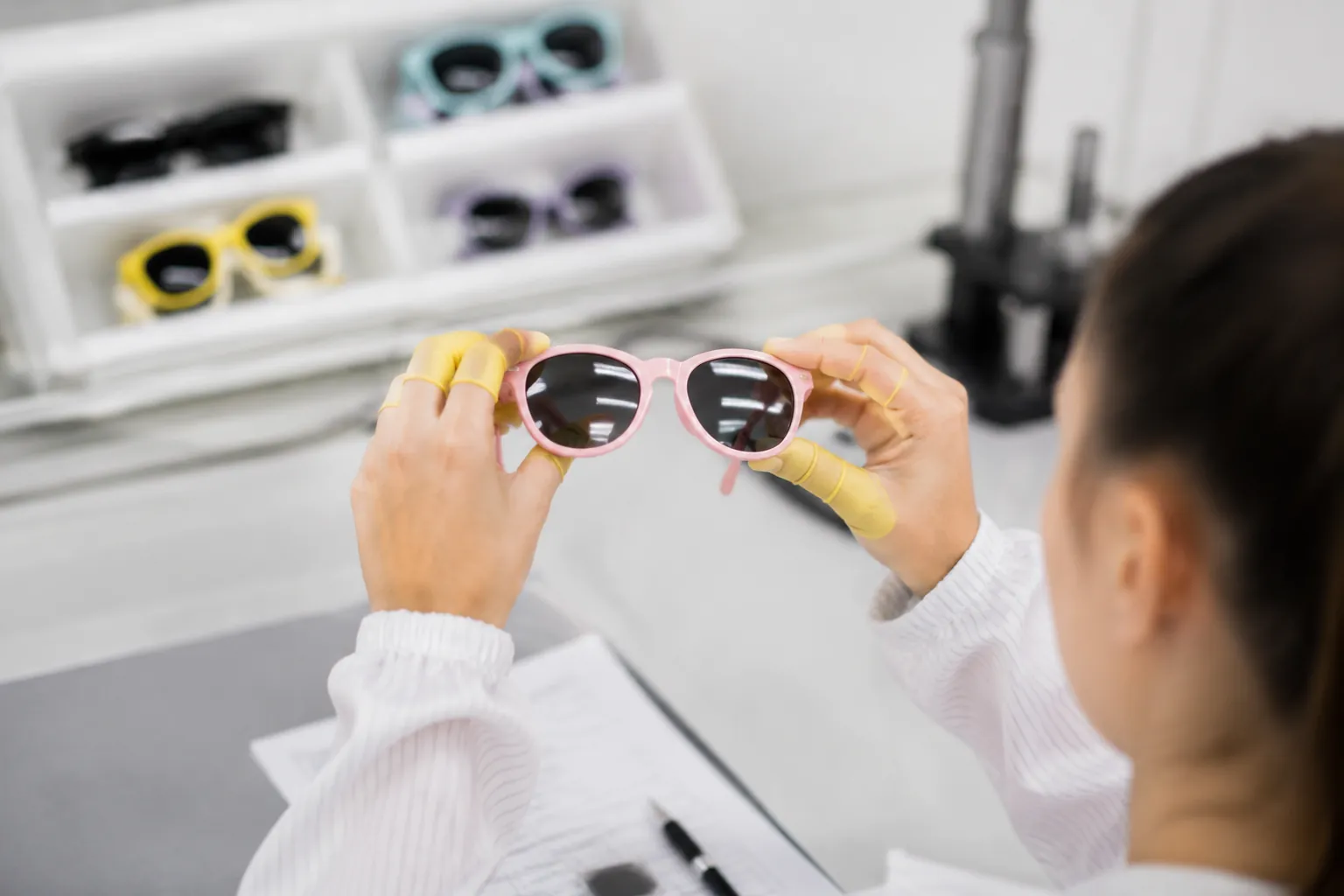
This guide is for buyers sourcing children's sunglasses for retail, distribution, or private-label programs. Start with safety, fit, and compliance. Style matters, but it comes after the product is right for the age band, destination market, label claim, and quality target. Use this framework to check lens protection, sizing, frame materials, documents, labeling, MOQ, pricing, factory controls, and final inspection before bulk production starts.
Start with failure points, not colors
Kids' sunglasses fail in predictable ways. Most problems can be caught before sampling if the inquiry is specific enough. Common issues include poor facial coverage, unstable fit on low bridges, brittle frame parts, weak hinges, inaccurate labels, and compliance documents that do not match the materials used in production.
Start every inquiry with five facts: target age band, lens category or intended use, frame material, hinge construction, and destination market. If a supplier cannot define these clearly, the style is not ready for a controlled wholesale program. Do not guess. Do not approve vague specs.
- Coverage failure: the lens may meet a UV specification, but the frame can still leave large side gaps if the front curve or temple geometry does not suit the age group.
- Fit failure: adult bridge geometry is scaled down without changing the nose contact points, so the frame slides during wear.
- Material failure: weak plastics or poor molding control can cause cracks at the temple screw boss, hinge seat, or front corner.
- Labeling failure: required lens category, warnings, importer details, country-of-origin information, or market-specific information may be missing or inconsistent.
- Production failure: the approved sample uses one resin, lens, hinge, coating, or logo process, but bulk production changes without written approval.
Ask the factory to connect the approved sample to the production bill of materials, color reference, incoming material records, in-process QC records, and final packing file. Traceability matters in children's eyewear. Small changes in bridge width, front width, temple length, material stiffness, or lens seating can affect fit and return rates.
Lock lens protection and standards before sampling
For children's sunglasses, specify verified UV protection and a visible light transmission category that fits the intended use. A dark tint is not proof of UV protection. Lens performance should be backed by a relevant test report or documented specification tied to the exact lens material, tint, and coating used in production.
Common reference standards include EN ISO 12312-1 for sunglasses in the EU and UK context, ANSI Z80.3 for non-prescription sunglasses in the United States, and AS/NZS 1067 for Australia and New Zealand. For EU sales, sunglasses generally require CE marking under the applicable regulatory framework, and EN ISO 12312-1 is commonly used to support conformity. Exact obligations vary by product type and market. Confirm requirements with your compliance team or testing partner before approving packaging copy.
Confirm the lens material and finishing method early. Polycarbonate is common in children's programs because it is lightweight and has good impact resistance. Acrylic usually costs less, but it may be less suitable for rough handling depending on grade and design. TAC polarized lenses can support a premium tier when glare reduction is part of the claim, but they add cost. They also need extra checks for lamination, axis alignment, and cosmetic defects.
| Lens option | Typical use | Buyer notes | Main risk if chosen badly |
|---|---|---|---|
| Grey or smoke tint | General outdoor retail | Neutral color perception; common for broad assortments | Too-dark tint may be unsuitable for the intended use category or young wearers |
| Brown or tea tint | Lifestyle and classic shapes | Warm view; often used in fashion assortments | Color perception changes may not suit every channel or product claim |
| Polarized TAC lens | Premium outdoor or travel styles | Reduces glare; can support a higher retail position | Higher cost; poor lamination or alignment can create quality complaints |
| Mirror-coated lens | Sport-inspired collections | Visual upgrade; coating durability must be specified and checked | Scratching, peeling, or inconsistent color if coating control is weak |
Before approval, request the lens base material, tint method, UV specification, lens category or intended use classification, coating details, and the standard used for testing. The report or declaration must match the same lens construction used in bulk. Close enough is not enough.
Fit by age band: use measurements, not labels
Children are not one size group. Most retail programs should separate toddler, young-child, and older-child fits instead of using one frame across a wide age span. Age helps merchandising. It is not a technical specification.
The technical file should include eye size, bridge, temple length, front width, lens height, front curve, and temple tip shape. These numbers decide whether the frame stays in place.
| Age band | Typical eye size | Typical bridge | Typical temple length | Typical front width | Fit priority |
|---|---|---|---|---|---|
| 2-4 years | 40-44 mm | 14-16 mm | 115-125 mm | 108-118 mm | Low-bridge stability and gentle temple contact |
| 5-8 years | 44-48 mm | 15-17 mm | 125-130 mm | 118-125 mm | Coverage without excessive side pressure |
| 9-12 years | 46-50 mm | 16-18 mm | 130-135 mm | 122-130 mm | Adult-inspired appearance with child-appropriate weight and fit |
These are sourcing reference ranges, not medical fitting rules or universal size standards. Validate them against your target consumer, local market, and sample fitting review. In children's eyewear, a small change in bridge width, front width, or temple angle can decide whether the frame sits securely or slides. Temple tip curvature also matters. A straight temple copied from adult fashion styles may not work for active children.
During sampling, ask for dimensional tolerances linked to the approved sample. Production control points should include front width, bridge, temple length, lens opening, hinge alignment, and temple spread. If your target age band sits between two ranges, request two sample sizes or a clear size split. Do not force one compromise frame to cover too much of the market.
Choose frame materials for use, not just appearance
Frame material affects comfort, appearance, durability, and compliance documentation. For kids' sunglasses, common choices include injected plastic, flexible injected constructions, and acetate for older-child fashion programs.
Injected frames are widely used for volume children's ranges because they offer repeatability, lower weight, efficient production, and competitive unit cost. The key questions are practical: resin grade, wall thickness, hinge design, screw boss strength, edge finishing, and behavior under opening, twisting, and normal handling.
| Material | Strengths | Trade-offs | Best use |
|---|---|---|---|
| Standard injected plastic | Cost-effective, consistent color, efficient for volume | Performance depends heavily on resin grade, molding control, and hinge design | Mass retail and value programs |
| Flexible or soft-touch injected build | Improved comfort and twist tolerance when designed well | Higher cost; surface finish, coating, and chemical compliance need attention | Younger age groups and active styles |
| Acetate | Richer finish, strong color depth, premium appearance | Heavier; polishing, hinge setting, and warpage control require tighter process control | Older-child premium fashion lines |
| Metal logo plate or insert decoration | Stronger brand presentation | Must be smooth, secure, and free from sharp-edge or detachment risk | Mid- to premium-brand programs |
Decoration method matters too. Pad printing is flexible and cost-effective for logos, but abrasion resistance should be checked. Laser engraving can be more durable when the substrate allows a clean mark. Embedded metal plates can improve perceived value, but fixation strength, edge smoothness, and corrosion resistance need review for children's products.
Discuss material compliance early, especially for coatings, soft-touch finishes, inks, adhesives, metal parts, and decorative hardware. For EU programs, buyers commonly request REACH-related documentation for applicable restricted substances. Retailers may also set restricted-substance rules that go beyond legal minimums.
Build compliance and labeling files before production
Do not leave documentation until freight booking. Build the paperwork set into the purchase order, sample approval process, and packaging artwork review. For kids' sunglasses, buyers should request product compliance evidence for the destination market, material documentation where applicable, and pre-approved label and packaging files.
- Confirm the destination market. EU, UK, US, Australia, and New Zealand programs may require different standards, wording, warnings, and importer details.
- Reference the applicable sunglass standard. Common standards include EN ISO 12312-1, ANSI Z80.3, and AS/NZS 1067.
- For EU sales, confirm CE requirements. Ask how CE conformity is supported, which standard was used, and whether the declaration and technical file match the actual product.
- Review chemical or material records. REACH-related documentation is commonly requested for EU programs, especially for plastics, coatings, inks, adhesives, soft-touch surfaces, and metal components.
- Check factory system documents separately. ISO 9001 and BSCI can support supplier evaluation, but they do not prove that a specific pair of sunglasses complies with product performance requirements.
- Approve labels and packaging copy. Review lens category or use information where required, warnings, country of origin, barcode placement, importer or responsible-party details, and SKU/color references.
US buyers may also ask about FDA registration or device listing status for non-prescription sunglasses, depending on the supplier role and distribution model. Treat this as a separate check. It is not a substitute for performance testing to ANSI Z80.3 or for correct product labeling.
Finally, check document consistency. The approved sample code, bill of materials, test report, label file, carton marks, inspection report, commercial invoice, and packing list should identify the same SKU, color code, lens type, and destination market.
Check the factory process after sample approval
Many wholesale problems start after sample approval, when buyers stop asking process questions. For children's sunglasses, useful controls sit between the approved sample and the sealed export carton. Watch that stage closely.
For injected frames, key checkpoints are resin verification, color master matching, molded-part dimensions, hinge installation, opening-and-closing feel, lens fitting tension, decoration adhesion, edge smoothness, and final cosmetic sorting. For acetate, add sheet selection, CNC accuracy, tumbling and polishing consistency, hinge insertion, temple alignment, and warpage control after assembly.
- Incoming materials: verify resin grade, acetate sheet color, lens material, screws, hinges, logo hardware, inks, coatings, and packaging against the bill of materials.
- In-process molding or machining: monitor front width, bridge, lens opening, temple symmetry, surface defects, and flash or sharp edges.
- Assembly: check screw fit, hinge feel, lens seating, temple alignment, logo placement, and any detachable decorative parts.
- Finishing: test print adhesion, mirror-coat appearance, edge smoothness, polishing consistency, and surface cleanliness.
- Final QC: verify assortment, quantity, labeling, barcode, carton marks, protective packing, and appearance against the approved sample and signed artwork.
Lead times are supplier- and project-specific. Confirm timing in writing after the final sample, bill of materials, packaging artwork, and compliance requirements are locked. Custom tooling, acetate construction, polarized lenses, mirror coatings, gift-box packaging, or repeated fit revisions can extend sampling and bulk production schedules.
Clarify MOQ before comparing quotes. Low MOQs help test a new shape, color, or age-band split, but unit cost is usually higher because setup, color matching, labor, inspection, packaging preparation, and administration are spread over fewer units. Ask suppliers to quote clear price breaks. Then compare trial orders and scale orders on the same specification.
Know where cost can be cut—and where it cannot
Children's sunglasses are often bought under price pressure. Still, the lowest quote may carry the highest risk. Cutting lens performance, hinge construction, material quality, or labeling control can lead to returns, rejected shipments, compliance rework, and retailer chargebacks.
The main cost drivers are frame material, lens type, lens coating, hinge construction, decoration method, packaging format, colorway count, order volume, testing requirements, and inspection scope. Polarized lenses, acetate construction, mirror coatings, metal logos, custom packaging, and multiple small color runs usually increase cost.
Ask for a quotation broken into at least these lines: frame, lens, lens upgrade or coating, logo or decoration method, packaging, testing or documentation charges where applicable, and inspection or special handling fees. This makes cost engineering clearer. If savings are needed, review packaging complexity, color assortment, or non-essential decoration before reducing hinge quality, lens specification, or required compliance work.
Compare price breaks only when the specification is the same. Do not compare a low-volume private-label quote with a high-volume blank-stock quote unless material, lens, coating, hinge, packaging, inspection level, and compliance documents are identical. If one quote is far below the others, ask what changed: resin grade, lens material, UV specification, coating, hinge type, screw quality, logo process, packaging count, inspection standard, or documentation scope.
Practical rule: simplify packaging or reduce unnecessary colorways before cutting lens performance, hinge construction, or compliance documentation.
Use a release checklist before bulk production
Use a formal release checklist before bulk starts. It prevents avoidable errors and gives buyer and supplier the same reference if a production issue appears later.
- Approved sample signed off against the exact item code, color code, age band, and destination market.
- Frame measurements confirmed, including eye size, bridge, temple length, front width, lens height, and temple spread.
- Lens specification confirmed: material, tint, UV performance, lens category or intended use, coating, and polarization if applicable.
- Applicable market standard confirmed and listed in the technical file, such as EN ISO 12312-1, ANSI Z80.3, or AS/NZS 1067.
- CE conformity approach confirmed for EU programs where applicable.
- Requested material or chemical compliance records collected, including REACH-related documentation where applicable.
- Label copy, warning text, barcode layout, country of origin, importer or responsible-party details, and packaging artwork approved.
- Decoration method approved: pad print, laser engraving, embedded plate, or other process, with adhesion and safety checks where relevant.
- Final inspection plan agreed before packing starts, including measurements, function, appearance, labeling, and assortment checks.
- Carton marks, assortment ratio, shipping pack-out, and document references confirmed.
- Bulk lead time confirmed in writing after approvals, deposit, materials, and packaging are ready.
Children's sunglasses have to satisfy parents, retailers, and compliance reviewers at the same time. Lock fit, material, lens performance, documents, labels, and pack-out before bulk production. That is how you remove the problems that usually appear after shipment.
Have a custom sunglasses project in mind?
Send us your styles, target market and quantities and we will return a detailed quote with MOQ, lead time and a sample plan.
Get a QuoteWhy source this from Wenzhou with LumiShades
Wenzhou in Zhejiang Province is widely regarded as China’s eyewear manufacturing capital, producing a large share of the world’s sunglasses. That concentration matters to buyers: a deep local supply chain for acetate sheet, hinges, lens blanks, plating and packaging means shorter component lead times, easier color and material matching, and a workforce with decades of eyewear-specific skill. LumiShades has manufactured in this ecosystem since 2009, and our vertical integration — in-house injection molding, acetate cutting, CNC milling, lens tinting, decoration and quality control — means no part of your order is quietly subcontracted to a workshop you cannot audit.
For international buyers, that vertical control translates into accountability. When a single factory owns every step, defects are traced and fixed at source rather than bounced between vendors, and your specifications survive intact from first sample to bulk. We back this with 15+ years of experience, shipments to 60+ countries, more than 5 million pairs produced per year and a 98.5% on-time delivery rate. Our certifications — CE EN ISO 12312-1, FDA registration, ANSI Z80.3, AS/NZS 1067, REACH, ISO 9001 and BSCI audit — mean the compliance documentation your market requires already exists. Explore our manufacturing capabilities and quality control process to see how this works in practice.
Frequently asked questions
What is the safest lens choice for a mass retail kids' program? Specify a general-purpose sunglass lens with verified UV protection and a lens category or visible light transmission level suitable for the intended use and destination market. Ask for the lens material, tint method, UV specification, applicable standard, and test report or declaration tied to the exact lens used in bulk production. Grey and brown tints are common commercial choices, but performance documentation should come before color selection.
Is a polarized lens necessary for children's sunglasses? No. Polarization is useful when glare reduction is part of the product promise, such as outdoor, travel, beach, or sport-inspired use. It can support a higher retail price, but it adds cost and requires checks for lamination quality, axis alignment, surface defects, and consistent labeling. For value or impulse retail, a non-polarized lens with verified UV protection and correct labeling may be the better commercial choice.
What MOQ should I use to test a new kids' style? Use the lowest MOQ that still lets you test the real retail proposition: age fit, color sell-through, packaging, and price point. Ask the supplier for price breaks at several quantities using the same specification, not different materials or lenses. For trial orders, keep the assortment narrow and avoid too many colorways. Small runs spread setup, color matching, inspection, and packaging costs over fewer units.
How long should samples and bulk take for custom kids' sunglasses? There is no universal lead time. Ask the supplier to confirm timing after the bill of materials, lens specification, decoration, packaging artwork, compliance documents, and approved sample are locked. Sampling and production can take longer when the project includes acetate, polarized lenses, mirror coatings, custom packaging, new tooling, or repeated fit corrections. Put the confirmed timeline in the purchase order or production calendar.
Do ISO 9001 or BSCI prove the sunglasses are compliant for sale? No. ISO 9001 relates to quality management systems, and BSCI relates to social-audit expectations. They can help evaluate a supplier, but they do not prove that a specific sunglasses SKU meets EN ISO 12312-1, ANSI Z80.3, AS/NZS 1067, CE-related obligations, REACH-related restrictions, or market-specific labeling requirements. Product compliance must be checked at the SKU, material, lens, and packaging level.
Ready to start?
Explore our sport wrap sunglasses or request a quote — our sales team replies within 12 hours.
Request a Quote