
UV400 Sunglass Testing: Pre-Shipment Checklist
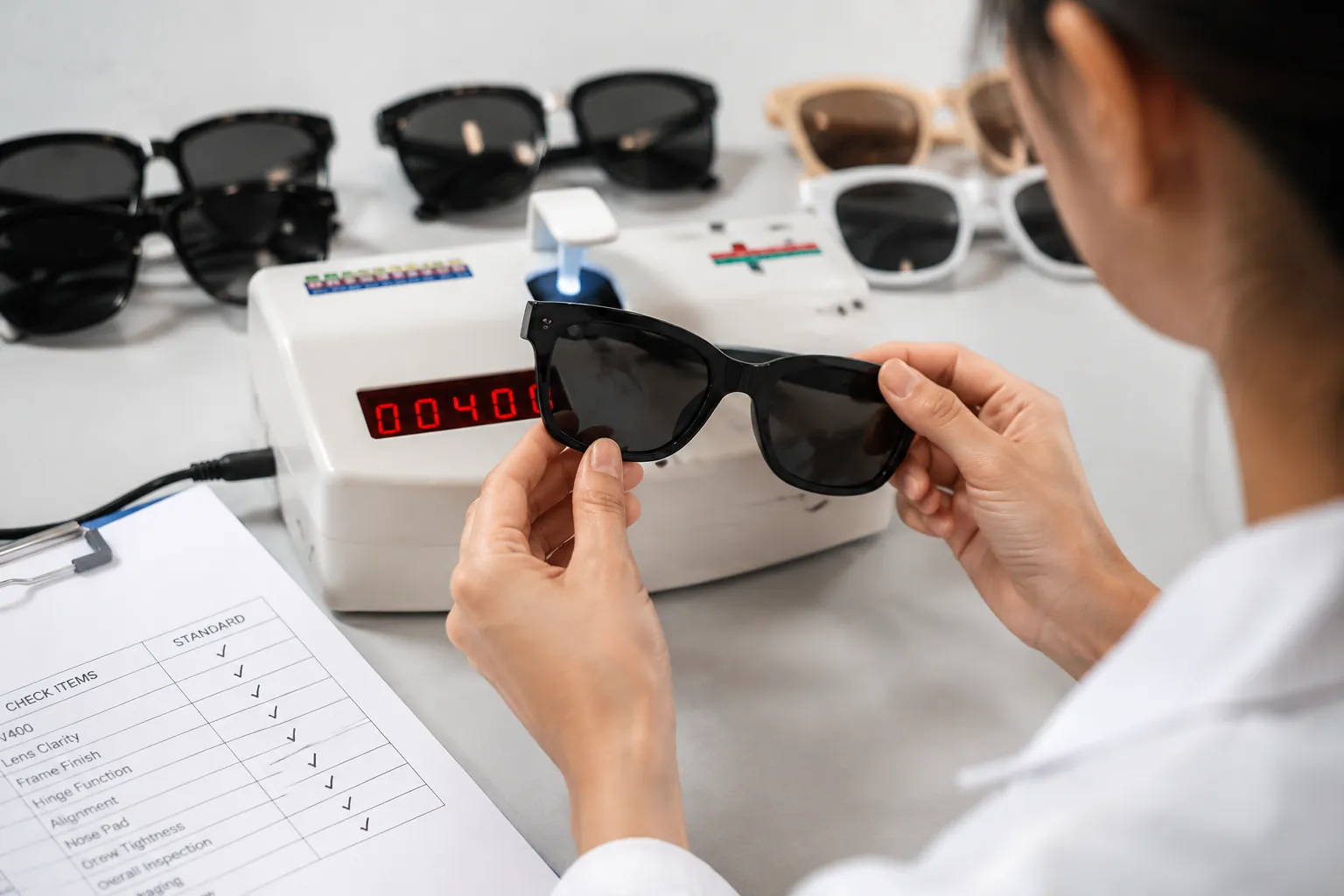
This guide is for importers, private-label brands, distributors, and retailers buying sunglasses in volume. The goal is not to collect a generic certificate. It is to prove that the UV400 claim, lens category, labeling, and construction match the exact model and production lot about to ship. Before final payment, connect four items: the target market requirement, the approved sample, the bulk bill of materials, and the packed batch records. Miss one, and the file is weak. Get it right, and you reduce customs questions, retailer nonconformances, marketplace disputes, and avoidable returns.
Start with the right question: what must UV400 prove?
Many buyers ask for a generic "UV400 certificate." That is too loose. UV400 is a claim that the lens blocks ultraviolet radiation up to 400 nm. Shipment approval should be based on evidence tied to the exact sunglass model, lens material, tint, coating, and production lot.
Start with the destination market. For non-prescription sunglasses, common references include CE marking supported by EN ISO 12312-1 for Europe, ANSI Z80.3 as a common US performance reference, and AS/NZS 1067 for Australia and New Zealand. Confirm the current version, product scope, and legal route with your compliance team or test lab before shipment. Do not guess.
These standards and requirements are not only about UV transmission. They may also cover visible light transmission, filter category, optical quality, robustness, driving suitability, labeling, and consumer information. One report rarely covers every sunglass. A smoke PC lens and a blue mirrored TAC lens are different constructions. Even if both look dark, performance may differ because of:
- Base resin: PC, TAC, nylon, CR-39, and other substrates can have different UV-absorption behavior.
- Tint depth: tint affects visible light transmission and the assigned filter category.
- Surface treatments: mirror coating, hard coating, anti-scratch coating, hydrophobic treatment, or polarized film can affect transmission, appearance, and optical quality.
- Supplier source: a change in raw lens vendor or coating supplier can make an older report no longer representative.
Ask one direct question: does this report represent the exact production construction now being packed? If the answer is not clearly yes, the report is only background evidence. It is not shipment proof.
Request a document pack before final payment
One PDF test report is not enough. A stronger file ties approved samples to mass production and then to packed cartons.
- Product compliance report for the applicable market route, such as CE EN ISO 12312-1 support for Europe, ANSI Z80.3 support for the US, or AS/NZS 1067 support for Australia and New Zealand.
- Material declaration covering lens and frame materials, plus chemical compliance information such as REACH where applicable.
- Golden sample approval record formally approved by buyer and supplier, with style code, frame color, lens color, lens category target, decoration method, and packaging version.
- Production batch record showing lens lot number, frame lot number, tint batch if tinted, coating batch if applicable, assembly date, and output quantity.
- Internal QC report with checked quantity and defect counts for appearance, assembly, hinge function, logo position, lens fitting, markings, and packaging.
- Pre-shipment inspection report from factory QC, buyer staff, or an independent inspection provider.
Details matter. If goods were made from multiple lens lots or frame lots, the record should show it. If finished goods were rejected for lens scratches, poor coating, loose hinges, wrong logo placement, or packaging errors, the QC data should say so. "All goods passed" is not enough when a retailer later asks which lens lot went into which carton range.
Use the sample stage hard. The cheapest time to freeze the lens specification is before bulk production begins. If you want third-party lab testing or a PSI hold point, write it into the purchase order, production timeline, and payment terms before production starts. Waiting until cartons are ready usually leads to rushed decisions.
Treat golden samples as the control point
Many shipment disputes start with weak sample control. The approved sample exists, but the specification behind it is vague. Then bulk production drifts.
A practical golden sample system uses at least two retained pieces: one held by the buyer and one sealed by factory QC. For higher-risk programs, a third retained sample can be held by the inspection company or test lab. Each retained sample should be labeled with PO number, style code, frame material, lens material, lens color, filter category target, decoration method, packaging version, and approval date.
At golden sample stage, lock these points in writing:
- Lens material: PC, TAC, nylon, CR-39, or other agreed construction
- Lens finish: solid tint, gradient, mirror, polarized, hard coat, anti-scratch, or other treatment
- Target visible light transmission category or filter category, where relevant
- Frame material and color code
- Decoration method: pad print, laser engraving, hot stamping, metal logo plate, or other method
- Temple markings, warning text, user information, barcode, and retail packaging SKU
Small visual changes can signal a technical change. If the bulk lens looks much lighter or darker than the approved sample, tint may have drifted. That can affect visible light transmission and category classification. If the supplier changes the lens source, the lens may still fit the frame but no longer be covered by earlier test evidence.
Decoration control also matters. A metal logo plate may need a recess and a controlled adhesive process. Pad printing needs curing and adhesion checks. Laser engraving can change the surface appearance of coated or matte materials. These are not UV issues, but they often cause retailer rejection. Keep technical and cosmetic approval in one golden sample record, not scattered across email threads.
Know where UV and compliance failures happen
Importers often assume UV performance stays stable after one style passes testing. It can, but only if the bill of materials and process stay controlled. The main risks are unapproved substitutions, process drift, and poor lot discipline.
| Failure mode | Typical cause | Buyer risk | What to request |
|---|---|---|---|
| Lens material substitution | Supplier changes PC, TAC, nylon, CR-39, or other lens source without approval | Previous report may no longer represent production | Lens lot record, incoming material ID, retained sample per lot |
| Tint drift | Tinting varies by time, temperature, dye concentration, or process control | Visible light transmission shifts; filter category or appearance may no longer match approval | Tint batch log, in-process checks, side-by-side comparison to golden sample |
| Coating inconsistency | Mirror, hard coating, or other coating thickness or curing varies | Haze, cosmetic defects, optical complaints, or changed transmission profile | Coating specification, coating batch record, visual QC record, adhesion or surface review if relevant |
| Mixed production lots | Approved and unapproved lenses or frames are packed together during assembly | Intermittent market failures that are difficult to trace | Batch segregation, carton trace code, packed-range record |
| Wrong labeling or unsupported claim | Temple marking, packaging, or user information uses incorrect category, warning, or UV claim | Customs questions, retailer nonconformance, relabeling cost, marketplace complaint | Artwork approval, final packaging inspection, destination-market checklist |
Lens tinting needs extra attention. Process variables can include dye concentration, bath temperature, immersion time, rinsing, and drying. You do not need the supplier's full formula. You do need to know whether UV blocking comes mainly from the substrate, a coating, a treatment, or a combination. That distinction matters.
Be blunt about this: a darker lens is not automatically safer. Visible light reduction and ultraviolet blocking are different properties. Use standard-based test evidence and production traceability. Do not approve by appearance alone.
Match the verification level to the order risk
Not every order needs the same proof. The right approach depends on order size, whether the lens construction is new, whether claims or labels changed, and how much exposure the buyer has to retailer or regulatory action.
| Order scenario | Recommended proof before shipment | Typical timing impact | Typical cost logic |
|---|---|---|---|
| Small repeat order, unchanged lens construction | Existing valid report, golden sample match, lot record, factory QC report | Low if documents are reviewed early | Lowest-cost control for a stable repeat program |
| Repeat construction with new colorway, packaging, or decoration | Existing report if construction is still covered, updated golden sample, batch record, PSI from packed cartons | Usually limited to inspection scheduling and document review | Moderate control focused on drift, labeling, and retail presentation |
| New lens material, new tint process, new coating, or new lens source | Third-party lab confirmation on a production-representative sample plus PSI and lot traceability | Depends on courier time, lab queue, and test scope | Justified because previous evidence may not apply |
| Large retail launch, regulated channel, or high-visibility marketplace program | Destination-market report on production-representative samples, batch traceability, PSI, sealed retains, and complete document archive | Moderate if built into the production schedule | Higher upfront cost, but proportionate to recall, return, delisting, or chargeback exposure |
The cost logic is simple. As order exposure rises, the cost of failure rises too: freight, rework, replacement stock, retailer deductions, marketplace takedowns, customer complaints, and brand damage. A low unit cost does not protect you from an unsupported UV400 claim or a mislabeled lens category.
First orders deserve stronger proof. So do orders with a new lens source, new coating, new tint process, or changed market claim. If the goods are for a chain retailer, marketplace program, or regulated channel, test a production-pulled sample unless you have a clear reason not to.
Use a simple pre-shipment workflow
The most reliable system is short and repeatable: approve, freeze, trace, inspect, archive.
- At quotation stage: confirm destination market, applicable standard or requirement, planned labeling language, UV claim, filter category target, and lens construction.
- At sample stage: approve one golden sample with full lens, frame, decoration, marking, and packaging specification. For a new construction, decide at once whether the sample should go to a third-party lab.
- Before bulk starts: freeze the bill of materials. No change to lens substrate, lens source, tint process, coating, frame material, decoration process, claim, or labeling without written buyer approval.
- During production: request in-line photos and a lot record. For tinted or coated lenses, ask for lens lot number and process batch number. For decorated temples, ask which process is used and what visual or adhesion checks are recorded.
- At 80 to 100 percent packed: run PSI on finished cartons, not loose assemblies. Mixed-lot packing, wrong labels, wrong warnings, and carton-range problems are found only when inspection covers packed goods.
- Before balance payment: collect the full document pack and check that style code, PO number, lens description, quantities, carton markings, and destination-market documents match exactly.
- After shipment: retain one production sample from the lot with the final paperwork archive and carton trace information.
This workflow puts control before payment release and before goods leave the factory. It also creates an evidence trail if a retailer, customs broker, marketplace, or internal compliance team asks why the UV400 claim was accepted.
If the supplier handles decoration, tinting, coating, or packaging in-house, check those items in the same inspection event. Verify logo position, print quality, metal plate alignment, laser depth, lens consistency, markings, warnings, and retail packaging together. Otherwise, you can end up with a product that is technically supported but commercially rejected because branding or labeling is wrong.
Make the PSI report traceable
Many inspection reports are too visual and not traceable enough. For sunglasses, a strong PSI should show whether the packed goods match the tested and approved construction.
- PO number, style number, color code, lens description, and total packed quantity
- Carton count, sampling plan, and carton ranges opened
- Photos of outer cartons, inner packs, labels, warnings, user information, and product
- Comparison to golden sample for frame shape, frame color, lens color, lens finish, and decoration position
- Basic functional checks such as hinge movement, screw tightness, lens seating, symmetry, and sharp-edge review
- Verification of destination-market markings, category information, warning text, and unsupported claim text
- Reference to the applicable test report and confirmation that production documents describe the same construction
- Batch or lot IDs taken from factory documents and linked to packed goods or carton ranges
State the limit clearly: a visual PSI does not prove UV transmission by itself. It confirms that the goods appear to match an approved and previously tested construction, and that the paperwork is internally consistent. If the order uses a new lens source, new material, new coating, changed tint process, or changed claim, visual inspection alone is not enough. Add lab verification on production samples pulled from bulk.
A useful PSI report lets another person reconstruct what was inspected, which cartons were opened, what documents were reviewed, and whether the inspected goods matched the approved sample and report. If the report cannot show that chain, it is weaker than it looks.
Organize paperwork by destination market
Different markets ask different questions. Organize the shipment file by document type. Do not mix factory audits, chemical declarations, and product performance evidence into one vague compliance folder.
For Europe, buyers commonly need support for CE marking and the applicable sunglass standard, typically EN ISO 12312-1 for non-prescription sunglasses. In the US, ANSI Z80.3 is a common product-performance reference for non-prescription sunglasses. FDA registration or listing may appear in supplier qualification files for relevant eyewear categories, but it is not proof of UV performance by itself. Australia and New Zealand buyers commonly request AS/NZS 1067 support. Across markets, REACH may apply to materials, coatings, and finishes, while factory credentials such as ISO 9001 or BSCI belong to supplier qualification, not product-performance proof.
Keep the file in three buckets:
- Product performance: UV transmission, visible light transmission, filter category, optical quality, robustness where applicable, and sunglass-standard test reports
- Chemical compliance: material and finish declarations, including REACH where applicable
- Factory system: ISO 9001, BSCI, audit records, FDA registration where relevant, and manufacturing capability information
Do not let one bucket stand in for another. A factory can have ISO 9001 and still pack the wrong lens lot. A product can pass UV testing and still have a labeling problem. A REACH declaration does not prove optical performance. FDA registration does not prove that a specific sunglass model blocks UV to 400 nm. The shipment file needs each category covered for the actual order.
Buyer rule: If the lens material, lens source, tint, coating, labeling claim, filter category, or target market changes, stop and ask whether the old report still applies. If the answer is unclear, get updated test evidence before shipment.
Have a custom sunglasses project in mind?
Send us your styles, target market and quantities and we will return a detailed quote with MOQ, lead time and a sample plan.
Get a QuoteWhy source this from Wenzhou with LumiShades
Wenzhou in Zhejiang Province is widely regarded as China’s eyewear manufacturing capital, producing a large share of the world’s sunglasses. That concentration matters to buyers: a deep local supply chain for acetate sheet, hinges, lens blanks, plating and packaging means shorter component lead times, easier color and material matching, and a workforce with decades of eyewear-specific skill. LumiShades has manufactured in this ecosystem since 2009, and our vertical integration — in-house injection molding, acetate cutting, CNC milling, lens tinting, decoration and quality control — means no part of your order is quietly subcontracted to a workshop you cannot audit.
For international buyers, that vertical control translates into accountability. When a single factory owns every step, defects are traced and fixed at source rather than bounced between vendors, and your specifications survive intact from first sample to bulk. We back this with 15+ years of experience, shipments to 60+ countries, more than 5 million pairs produced per year and a 98.5% on-time delivery rate. Our certifications — CE EN ISO 12312-1, FDA registration, ANSI Z80.3, AS/NZS 1067, REACH, ISO 9001 and BSCI audit — mean the compliance documentation your market requires already exists. Explore our manufacturing capabilities and quality control process to see how this works in practice.
Frequently asked questions
Is a supplier's old UV400 report enough for a repeat order? Only if it still represents the current production. Check that the style, lens material, lens source, tint, coating, polarization, filter category, UV claim, and target market are unchanged. Then ask for current batch records showing which lens lot and frame lot were used. If any construction or claim changed, or if the supplier cannot link the report to the current lot, request updated testing or a lab review before shipment.
Does a dark lens automatically mean better UV protection? No. Visible darkness and UV blocking are different properties. A dark lens may reduce visible light but still fail UV requirements if the substrate, coating, or treatment does not block ultraviolet radiation adequately. Treat lens darkness as an appearance and filter-category issue, not as UV proof. For UV400 claims, rely on a relevant standard-based test report and production traceability.
Should I use third-party testing on every order? Not always. For a stable repeat order using the same frozen bill of materials, a valid existing report, lot records, golden sample comparison, and PSI may be enough. Use third-party testing when the lens material, lens source, coating, tint process, polarization, UV claim, labeling, or target market changes. Also use it for first orders, high-volume launches, chain retail programs, and any shipment where failure could lead to recall, delisting, or retailer chargebacks.
What sample should go to the lab: development sample or production sample? A production-representative sample is stronger for shipment release. Development sample testing is useful early because it can find problems before bulk production. But if bulk production uses a different lens lot, tint batch, coating setup, or supplier source, the development sample may not represent the shipment. For higher-risk orders, pull the lab sample from actual production or finished packed goods and record the lot number.
What is the difference between FDA registration and UV performance proof? FDA registration or listing is a regulatory file item for relevant eyewear suppliers or products in the US context. It does not prove that a specific sunglass model blocks UV to 400 nm or meets optical performance requirements. UV and sunglass performance evidence comes from a product test report, such as ANSI Z80.3 for the US performance reference, tied to the actual lens construction and production lot.
Ready to start?
Explore our aviator sunglasses or request a quote — our sales team replies within 12 hours.
Request a Quote