
UV400 Sunglasses: Buyer Verification Guide
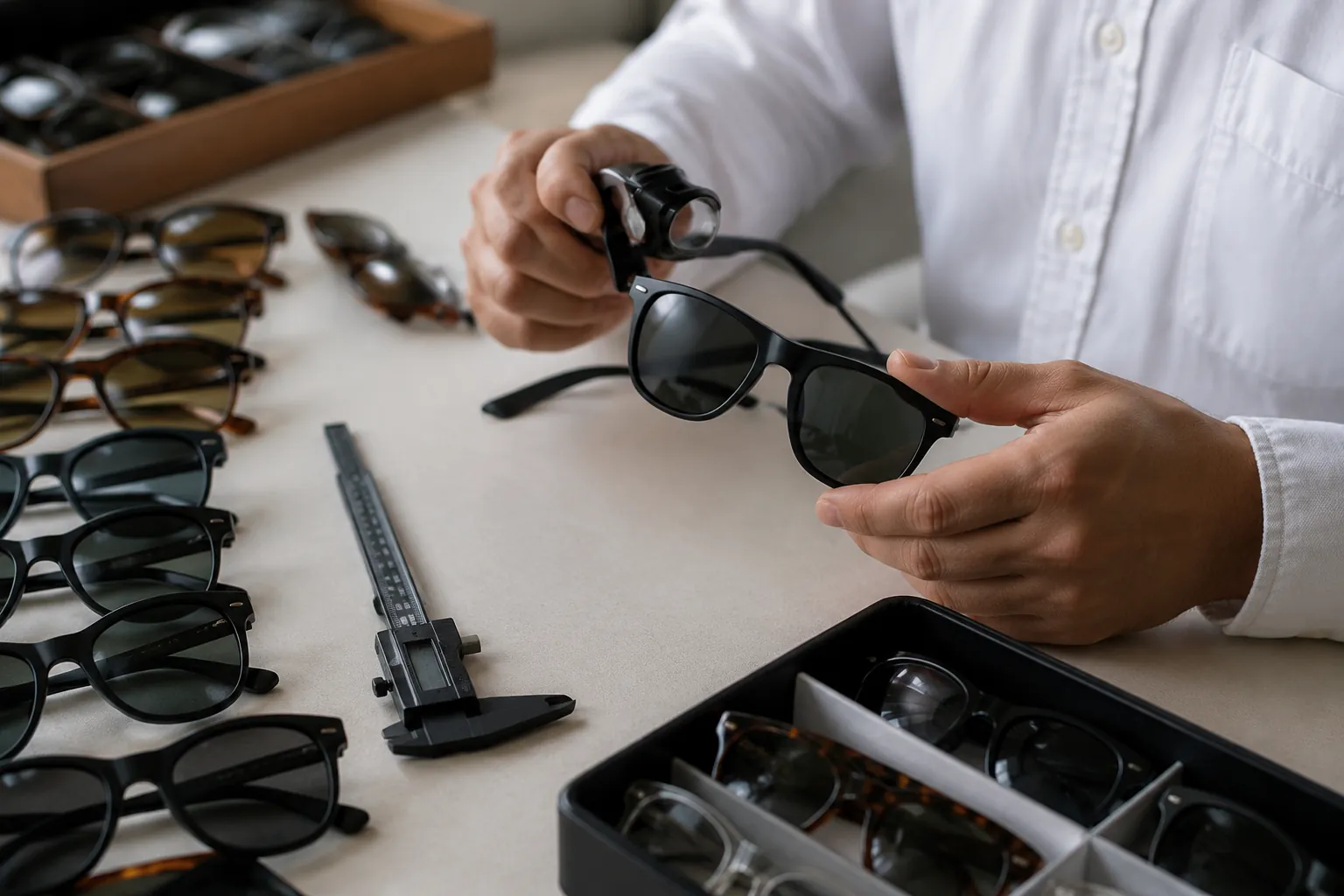
This guide is for brands, importers, distributors, and retailers buying custom sunglasses in volume. It explains what a UV400 claim should mean, what proof to request, and how to connect test reports, approved samples, packaging claims, and production lots before placing a bulk order. The aim is simple: fewer documentation gaps, fewer relabeling problems, fewer retailer rejections, and lower risk from unsupported UV-protection claims.
Start with the claim: UV400 must be proven
UV400 means the sunglass lens is intended to provide ultraviolet protection up to 400 nm. A sticker does not prove it. Neither does a hangtag, product photo, or supplier promise.
Treat UV400 as a measurable optical claim. It must be tied to lens transmission data, an applicable test method, and the exact lens construction that will ship.
For sunglasses, UV performance is normally checked as part of a broader sunglass standard. In the European Union, buyers usually need evidence of conformity with EN ISO 12312-1 and the related CE documentation for the product placed on the market. In the United States, buyers commonly request ANSI Z80.3 test evidence and applicable FDA registration information from the relevant establishment or supplier. Australia and New Zealand use AS/NZS 1067 for sunglasses and fashion spectacles. REACH matters for chemical substances in frames, coatings, inks, nose pads, metal trims, and some packaging-contact materials. It does not prove that a lens blocks UV.
Ask one specific question first: does the report cover the same lens material, tint, coating, polarization, base curve, and filter category as the shipment? A smoke grey TAC polarized category 3 report does not automatically cover a gradient brown PC lens with a blue mirror coating. UV and visible light transmission can change after dyeing, lamination, hard coating, mirror coating, curing, and final edging.
Buyer rule: A UV400 claim is useful only when it is linked to a defined lens build, a recognized test method, and traceable production records for the shipped SKU.
Match the destination market before sampling
Do not wait until production is finished to decide which market standard applies. Markings, user instructions, lens category statements, warnings, and test items vary by destination. Decide early.
If one order will be split between the EU, US, and Australia/New Zealand, confirm the performance and labeling requirements for each destination before approving samples and packaging artwork.
| Market | Common buyer requirement | What to verify | Common mistake |
|---|---|---|---|
| European Union | CE with EN ISO 12312-1 evidence | UV transmittance, luminous transmittance, filter category, traffic signal recognition where applicable, CE marking, user information, importer details, and technical documentation | Printing CE on the product or hangtag without a technical file and report scope that match the SKU |
| United States | ANSI Z80.3 test evidence plus applicable FDA registration information | UV and visible transmission, applicable impact-related requirements, product description, supplier identity, and SKU traceability | Assuming FDA registration by itself proves that the lens passed UV testing |
| Australia/New Zealand | AS/NZS 1067 evidence | Lens category, UV protection, luminous transmittance, required warning statements, and restrictions for fashion or very dark lenses | Selling low-protection fashion lenses as general-purpose sunglasses |
| Multi-market order | Applicable standards for each destination | Product-family test logic, separate artwork versions, country-specific labels, carton control, and SKU separation | Using one universal hangtag that is incomplete or inaccurate for one destination |
LumiShades can provide documentation for buyer review, including CE EN ISO 12312-1, ANSI Z80.3, AS/NZS 1067, REACH, FDA registration, ISO 9001, and BSCI materials where applicable to the product and order. But a document list is not enough. The report scope, product description, sample reference, and artwork must match the frame, lens, and packaging program being purchased.
Read the test report like a buyer
A UV test report can look official and still be weak evidence for your shipment. Read the details. Check the issuing laboratory, report date, standard version, sample description, lens material, lens color, coating, polarization status, filter category, and numerical results. Then compare those details with the approved sample, purchase specification, bill of materials, and packaging artwork.
- Confirm the product description. It should identify sunglasses, finished sunglass lenses, or the relevant finished product family. A report for generic plastic sheets or unrelated eyewear parts may not support the shipped SKU.
- Check the standard and version. Confirm whether the test was performed to EN ISO 12312-1, ANSI Z80.3, AS/NZS 1067, or another agreed method. Make sure it is acceptable for the destination market and retailer.
- Check lens material. PC, TAC, nylon, CR39, and glass may differ in tinting, lamination, edging, coating performance, and impact behavior.
- Check color and treatment. Smoke, brown, green, gradient, polarized, photochromic, and mirror-coated lenses should not be grouped under one vague description unless the report or technical file clearly supports that grouping.
- Check luminous transmittance. This determines the filter category. A darker lens is not automatically safer. Category 3 is common for many general-purpose sunglasses. Category 4 lenses are generally not suitable for driving.
- Check UV data. The transmission results should support the UV400 claim across the relevant ultraviolet range, not only at one selected wavelength.
- Check traceability. The report should connect to a sample date, lens code, model number, lot reference, or product family that can be tied to the order.
Ask for the report before mass production. Not when the shipment is already waiting at the forwarder.
For a small pilot run, existing test coverage may be acceptable if the lens construction is identical and the packaging claims are accurate. For larger retail or distributor orders, require a locked technical file. The downside is bigger: relabeling, retailer chargebacks, marketplace takedowns, or product withdrawal can cost more than testing and document review.
Lens construction changes the risk
Two lenses can both be described as UV400 and still carry different verification risks. The substrate, tint route, film layer, coating sequence, base curve, and final lens category all matter.
A useful specification names the lens code, material, base curve, approximate center thickness, color, coating, polarization status, and target category. Do not write only "black UV400 lens." That is too vague.
| Lens material | Typical use | Process behavior | Buyer watch point |
|---|---|---|---|
| PC | Promotional, sports-style, kids, and lightweight frames | Impact-resistant and injection-friendly; tint and coating quality depend on material grade and surface preparation | Check coating adhesion, optical distortion, and whether the tested PC tint matches production |
| TAC polarized | Driving, fishing, outdoor lifestyle, and glare-reduction sunglasses | Laminated film structure reduces glare; quality depends on film alignment, bonding, and edge finishing | Check polarization axis, delamination risk, edge sealing, stress marks, and whether the polarization claim is tested or verified |
| CR39 | Optical-quality fashion sunglasses | Good optical clarity but slower processing; less suitable for rushed custom programs if tinting or coating is new | Confirm thickness, tint uniformity, coating compatibility, and lead time before committing to launch dates |
| Nylon | Performance and wraparound eyewear | Tough and clear; suitable for curved lenses when processed correctly | Check base curve, prismatic distortion, optical quality, and category consistency on wrapped shapes |
Tinting is affected by dye concentration, bath temperature, immersion time, substrate thickness, and coating sequence. A small process change can move a lens across a filter-category boundary. For internal QC, use a signed golden sample plus measurable tolerances, such as visual comparison under controlled light and measurement checks against the approved luminous transmittance range. For gradient lenses, define the measurement points. The top, center, and bottom of the lens may produce different readings.
Where LumiShades handles lens tinting, injection molding, acetate cutting, CNC milling, assembly, and decoration in-house, buyers still need written verification. Internal production control helps reduce uncontrolled changes. It does not replace test evidence, specifications, incoming inspection, and final inspection. Lock the lens code in the specification sheet: material, color code, base curve, approximate center thickness, coating, polarization, mirror color if any, and intended filter category.
Write a purchase specification that can be checked
A vague purchase order creates disputes later. Put compliance requirements into the specification before sample approval. Keep the document practical for factory use, but specific enough for incoming inspection, in-process QC, final inspection, and retailer review.
- Destination market: EU, US, Australia/New Zealand, or a split shipment with separate packaging and labeling versions.
- Required standard: EN ISO 12312-1, ANSI Z80.3, AS/NZS 1067, or another buyer-required test method.
- Lens claim: UV400, polarized, mirror coating, anti-scratch, anti-glare, or other claims only when evidence exists for each claim.
- Filter category: State the intended category and luminous transmittance range. Do not rely on photos to define lens darkness.
- Lens construction: Example: PC smoke grey category 3, TAC polarized brown category 3, nylon green performance lens, or another exact build.
- Frame and hardware: Material, hinge type, screw color, nose pad material, temple length, and any metal trims or plates.
- Decoration: Pad print, laser engraving, hot stamping, heat transfer, metal logo plate, temple insert, or lens etching, with artwork size, color, position, and tolerance.
- Markings and packaging: CE mark where applicable, category information, warnings, importer information, care instructions, barcode, SKU, carton label rules, and language requirements.
- Documentation: Test report, declaration documents where applicable, REACH support, FDA registration information where applicable, ISO 9001 or BSCI documents if requested by the buyer, and QC records.
- Change control: No lens material, tint, coating, film supplier, frame resin, ink, metal trim, packaging claim, or artwork change without written approval.
Decoration needs the same discipline as the lens. Pad printing works for one-color or two-color logos on temples, but small text can blur if the artwork is below practical print size. Laser engraving can be durable on metal parts and some coated temples, but contrast depends on surface color and material. Metal logo plates can create a premium appearance, yet they add tooling, plating, adhesive, and chemical-substance control requirements. Lens etching should be placed away from the main viewing area and approved on a physical sample, not only a rendering.
Plan MOQ, price, and lead time around compliance
Compliance planning does not have to delay a project if decisions are made early. Sampling and production timelines depend on the frame, lens, decoration, packaging, and whether new testing is required.
Set the direction before sample making: artwork, lens build, destination standard, and packaging claims. New lens testing, new tooling, unusual coatings, or complex retail packaging can add time.
| Order level | Typical use | Compliance approach | Commercial logic |
|---|---|---|---|
| 50 pairs per design | Pilot run, influencer kit, retailer presentation | Use an existing tested lens family where possible; verify that packaging claims match the available evidence | Fast route for market testing, but unit cost is usually higher and customization options may be narrower |
| 300 pairs | Small brand launch or regional promotion | Lock sample, artwork, lens code, and report coverage before production | Better decoration efficiency; mistakes start becoming expensive enough to justify stronger review |
| 1000 pairs | Retail or e-commerce replenishment | Require lot traceability, carton control, and final inspection records | Improved production efficiency and more stable component planning |
| 5000+ pairs | Chain retail, distributor, or seasonal program | Use a full technical file, pre-production approval, in-process checks, and sealed shipment samples | Best suited to locked specifications, stronger QC plans, and confirmed documentation before mass production |
The fastest compliant path is often to use an existing tested lens family and customize the frame color, logo, pouch, and retail packaging. A new gradient tint, unusual mirror coating, special polarized film, or new category target may require more development and testing. If the launch date is fixed, avoid changing the lens construction late in the project. Custom frame decoration can often move faster than custom lens chemistry.
Control factory-floor failure modes
Many UV400 problems are ordinary process or document-control failures. A buyer approves a darker sample without checking the filter category. A factory changes lens suppliers without updating the technical file. A mirror coating is added after the original test report. Packaging from an older order is reused.
Each change can break the compliance chain.
Good production control starts with incoming lens inspection: material confirmation, color comparison, surface defects, coating condition, and polarization check where applicable. In-process QC should compare the assembled product to the approved sample: hinge alignment, temple opening, frame shape, logo position, print cleanliness, screw tightness, lens seating, and visible lens defects.
Agree visual tolerances before production. Examples include no obvious scratches in the main viewing area, no logo offset beyond the approved tolerance, and no color mismatch outside the approved golden-sample range.
Final inspection should confirm markings, category labels, warning statements, SKU codes, carton labels, quantities, packing method, and document availability. Factory capability, ISO 9001 systems, or BSCI audit materials can support supplier evaluation, but they do not replace SKU-level product verification. Buyers should define acceptable quality limits, shipment sample retention, rework procedures, and responsibility for correction if the shipment does not match the approved specification.
Run a pre-shipment verification check
Before paying the balance or releasing shipment, run a document and product check. This is cheaper than relabeling cartons at a retailer warehouse or defending an unsupported marketplace claim after launch.
- Confirm the shipped SKU matches the approved physical sample: frame color, lens material, tint, coating, logo, hardware, pouch, instructions, and packaging.
- Confirm the UV400 claim is supported by a report for the correct lens construction or by a clearly justified product-family file.
- Confirm the destination standard is covered: EN ISO 12312-1, ANSI Z80.3, or AS/NZS 1067 as required by the market and retailer.
- Confirm the lens category and required warnings are printed correctly on labels, hangtags, user instructions, or packaging inserts.
- Confirm REACH support is available for relevant materials if selling into markets or channels requiring chemical-substance documentation.
- Confirm FDA registration information is available where applicable for US import or buyer documentation, and do not treat it as UV-performance evidence.
- Check carton labels, SKU codes, barcodes, quantities, packing list details, and commercial invoice descriptions for consistency.
- Keep at least one sealed production sample from the shipment for future retailer audits, disputes, repeat-order comparison, or complaint investigation.
The best time to catch a UV400 documentation problem is before production. The next best time is before shipment. After import, every fix costs more. It may involve warehouse handling, relabeling labor, delayed launch dates, retailer chargebacks, marketplace listing issues, or product withdrawal.
Have a custom sunglasses project in mind?
Send us your styles, target market and quantities and we will return a detailed quote with MOQ, lead time and a sample plan.
Get a QuoteWhy source this from Wenzhou with LumiShades
Wenzhou in Zhejiang Province is widely regarded as China’s eyewear manufacturing capital, producing a large share of the world’s sunglasses. That concentration matters to buyers: a deep local supply chain for acetate sheet, hinges, lens blanks, plating and packaging means shorter component lead times, easier color and material matching, and a workforce with decades of eyewear-specific skill. LumiShades has manufactured in this ecosystem since 2009, and our vertical integration — in-house injection molding, acetate cutting, CNC milling, lens tinting, decoration and quality control — means no part of your order is quietly subcontracted to a workshop you cannot audit.
For international buyers, that vertical control translates into accountability. When a single factory owns every step, defects are traced and fixed at source rather than bounced between vendors, and your specifications survive intact from first sample to bulk. We back this with 15+ years of experience, shipments to 60+ countries, more than 5 million pairs produced per year and a 98.5% on-time delivery rate. Our certifications — CE EN ISO 12312-1, FDA registration, ANSI Z80.3, AS/NZS 1067, REACH, ISO 9001 and BSCI audit — mean the compliance documentation your market requires already exists. Explore our manufacturing capabilities and quality control process to see how this works in practice.
Frequently asked questions
Is UV400 the same as CE compliance? No. UV400 is a lens-protection claim. CE compliance for sunglasses sold in the EU requires conformity assessment for the finished product, typically using EN ISO 12312-1, plus correct markings, user information, importer or responsible-party details, and supporting technical documentation. A UV400 sticker or test line is not a substitute for CE documentation.
Can one UV400 test report cover several lens colors? Only when the report scope or technical file clearly supports that coverage. Ask whether the tested samples included the same material, tint route, coating, polarization film, mirror treatment, base curve, and filter category. If a new color, gradient, mirror coating, or polarized film is introduced, request written technical justification or additional testing before approving bulk production.
What documents should I request before approving bulk production? Request the approved physical sample, lens specification, destination standard, relevant test report, packaging artwork, marking details, bill of materials or lens code, and written change-control confirmation. For EU orders, request CE-related documentation tied to EN ISO 12312-1. For US orders, request ANSI Z80.3 evidence and applicable FDA registration information. For Australia/New Zealand, request AS/NZS 1067 evidence. Also request REACH support for relevant materials when required by the market or retailer.
Does FDA registration prove sunglasses block UV? No. FDA registration information may support supplier or establishment identification for US-related documentation, but it does not prove that a specific sunglass lens blocks UV. UV performance should be verified through applicable sunglass testing, commonly ANSI Z80.3 for US buyer review, and the report should match the lens construction being shipped.
How do I verify that the production lot matches the tested sample? Use traceability. The purchase specification should identify the lens code, material, color, coating, polarization status, filter category, and model number. At final inspection, compare production goods against the approved sample and check carton labels, SKU codes, packaging claims, and QC records. Keep sealed production samples so future complaints, repeat orders, or retailer audits can be compared against the shipped lot.
How long should I allow for compliant custom sunglasses? Allow time for sample making, document review, packaging approval, and any required testing before mass production. Timelines vary by frame, lens, decoration, and packaging complexity. Existing tested lens families are usually faster. New tints, mirror coatings, polarized films, tooling, or retail packaging structures can add development and testing time, so confirm compliance requirements before committing to a launch date.
What MOQ makes sense for testing a new sunglasses design? A 50-pair pilot can work for market testing if you use an existing tested lens family and keep claims conservative. At 300 pairs and above, lock the specification, artwork, documentation, and QC criteria before production. For 1000 pairs or larger retail programs, require stronger traceability, final inspection records, sealed shipment samples, and written change control because errors become more costly.
Ready to start?
Explore our square sunglasses or request a quote — our sales team replies within 12 hours.
Request a Quote